2002 BMW M3 COUPE service
[x] Cancel search: servicePage 104 of 151

104n
DOT Quality GradesTreadwear
Traction AA A B C
Temperature A B C
All passenger vehicle tires must
conform to Federal Safety
Requirements in addition to these
grades.< Tread wearThe tread wear grade is a comparative
rating based on the wear rate of the tire
when tested under controlled condi-
tions on a specified government test
course.
For example, a tire graded 150 would
wear one and one-half (1 g) times as
well on the government course as a tire
graded 100. The relative performance
of tires depends upon the actual condi-
tions of their use, however, and may
depart significantly from the norm due
to variations in driving habits, service
practices and differences in road char-
acteristics and climate.
TractionThe traction grades, from highest to
lowest, are AA, A, B, and C.
Those grades represent the tire's ability
to stop on wet pavement as measured
under controlled conditions on speci-
fied government test surfaces of
asphalt and concrete. A tire marked C
may have poor traction performance.
The traction grade assigned to
this tire is based on straight-
ahead braking traction tests, and does
not include acceleration, cornering,
hydroplaning, or peak traction charac-
teristics.< TemperatureThe temperature grades are A (the
highest), B, and C, representing the
tire's resistance to the generation of
heat and its ability to dissipate heat
when tested under controlled condi-
tions on a specified indoor laboratory
test wheel.
Sustained high temperature can cause
the material of the tire to degenerate
and reduce tire life, and excessive
temperature can lead to sudden tire
failure. The grade C corresponds to a
level of performance which all
passenger vehicle tires must meet
under the Federal Motor Vehicle Safety
Standard No. 109. Grades B and A
represent higher levels of performance
on the laboratory test wheel than the
minimum required by law.
The temperature grade for this tire
is established for a tire that is
properly inflated and not overloaded.
Excessive speed, underinflation, or
excessive loading, either separately or
in combination, can cause heat buildup
and possible tire failure.< Uniform Tire Quality Grading Quality grades can be found where
applicable on the tire sidewall between
tread shoulder and maximum section
width. For example:
Treadwear 200 Traction AA
Temperature A
Tire replacement
Page 106 of 151

106n
Special characteristics of winter tires Snow chainsChoosing the right tireBMW recommends winter tires (M+S
radial tires) for operation under adverse
winter driving conditions. So-called all-
season tires with the M+S identification
mark do indeed possess better winter
traction than summer tires that have the
H, V, W, Y and ZR speed ratings, they
generally fail to provide the same levels
of performance as snow tires.
In the interest of safe tracking and
steering response, install winter tires
made by the same manufacturer having
the same tread configuration on all four
wheels. Do not exceed specified
maximum speeds
Never exceed the maximum
speed for which winter tires are
rated.
Unprofessional attempts by laymen to
service tires can lead to damage and
accidents.
Have this work performed by skilled
professionals only. Any BMW center
has the required technical knowledge
and the proper equipment and will be
happy to assist you.<
Tire condition, tire pressureOnce winter tires wear to a tread depth
of less than 0.16 in (4 mm), their perfor-
mance under winter driving conditions
deteriorates noticeably. Worn tires
should therefore be replaced for safety
considerations.
Inflate tires to specified pressure and
have the wheels balanced every time
the tires or wheels have been replaced.Use narrow-link BMW snow chains
* on
winter tires in pairs only and only on the
rear wheels. Comply with all manufac-
turer's safety precautions when
mounting the chains. Do not exceed a
maximum speed of 30 mph (50 km/h)
with snow chains.
After mounting or removing snow
chains, always reinitialize the sequential
M gearbox
* SMG II, refer to page 65.
It is not possible to mount snow
chains on tires with 18- and
19-inch wheels.
Deactivate the Flat Tire Monitor when
using snow chains. Malfunction warn-
ings and undetected losses in pressure
are a possibility when driving with snow
chains.
For additional information, refer to
page 77.<
Page 107 of 151
107n
OverviewControlsMaintenanceRepairsDataIndex
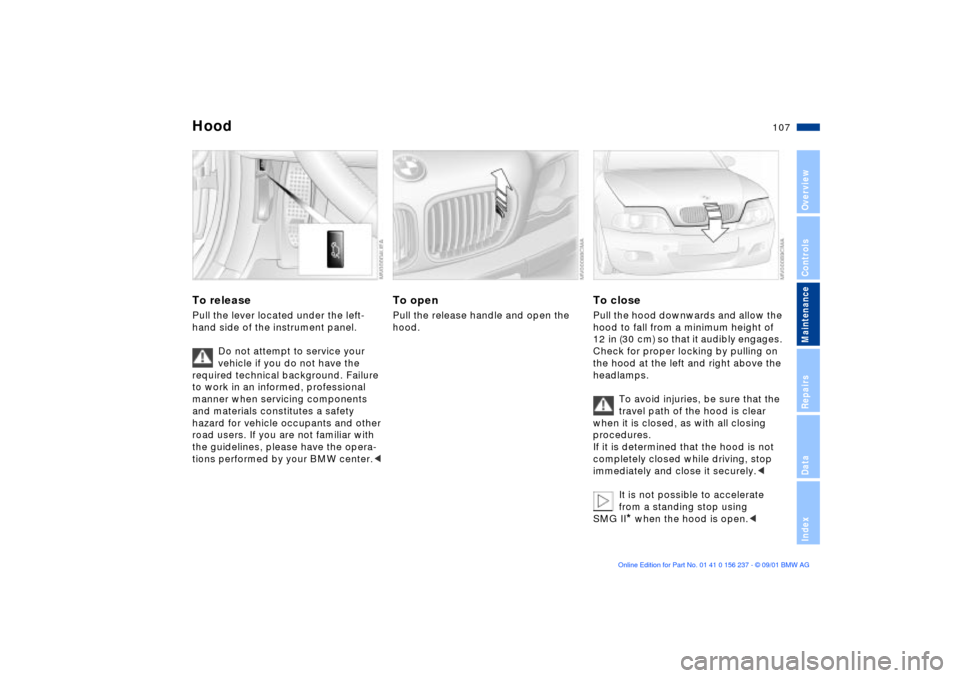
To releasePull the lever located under the left-
hand side of the instrument panel.
Do not attempt to service your
vehicle if you do not have the
required technical background. Failure
to work in an informed, professional
manner when servicing components
and materials constitutes a safety
hazard for vehicle occupants and other
road users. If you are not familiar with
the guidelines, please have the opera-
tions performed by your BMW center.<
To openPull the release handle and open the
hood.
To closePull the hood downwards and allow the
hood to fall from a minimum height of
12 in (30 cm) so that it audibly engages.
Check for proper locking by pulling on
the hood at the left and right above the
headlamps.
To avoid injuries, be sure that the
travel path of the hood is clear
when it is closed, as with all closing
procedures.
If it is determined that the hood is not
completely closed while driving, stop
immediately and close it securely.<
It is not possible to accelerate
from a standing stop using
SMG II
* when the hood is open.<
Hood
Page 113 of 151

113n
OverviewControlsMaintenanceRepairsDataIndex
Brake fluid
If the brake warning lamp
comes on and the parking brake
has been released: the brake
fluid level is too low.
For adding brake fluid or for
determining and correcting the
cause of brake fluid loss, consult your
BMW center. Your BMW center is
familiar with the specifications for
factory-approved brake fluids (DOT 4).
Due to loss in brake fluid, pedal travel
can lengthen and braking efficiency
may be reduced. Comply with the infor-
mation provided on page 102.
Brake fluid is hygroscopic, that is,
it absorbs moisture from the air
over time.
In order to ensure the safety and reli-
ability of the brake system, have the
brake fluid changed every two years by
a BMW center. Refer also to the Service
and Warranty Information Booklet (US
models) or the Warranty and Service
Guide Booklet (Canadian models).
Brake fluid is toxic and damages the
vehicle's paint. You should always store
it in its original container and in a loca-
tion inaccessible to children.
Do not spill brake fluid and fill the brake
fluid reservoir only as far as the "MAX"
mark. The brake fluid could ignite upon
contact with hot engine parts and
cause serious burns.<
Comply with the applicable envi-
ronmental laws regulating the
disposal of brake fluid.<
Page 114 of 151

114n
The BMW Maintenance System has
been designed as a reliable means of
providing maximum driving and oper-
ating safety Ð and as cost-effectively as
possible for you. Due to technical inno-
vations, maintenance costs were again
able to be markedly reduced with
respect to the previous model.
Please keep in mind that regular main-
tenance is not only necessary for the
safety of your vehicle, but also plays a
significant role in maintaining the resale
value of the vehicle.
Service Interval DisplayWhile conventional systems rely on
distance traveled alone to determine
when service is due, the BMW Mainte-
nance System has for years considered
the actual conditions under which the
vehicle operates, because miles can be
traveled in many different ways:
For example, 62,000 miles
(100,000 km) short-distance driving are
not equal to the same 62,000 miles
(100,000 km) of long-distance travel.
The BMW Maintenance System
includes the Engine Oil Service and
Inspections I and II.
Determining the maintenance intervals
according to the actual loads on the
vehicle covers every kind of operating
situation. Those who are outright
"Sunday drivers," driving fewer than
6,000 miles (10,000 km) per year Ð
should, nevertheless have their oil
changed every 2 years at the most, no
matter what the Service Interval Display
indicates, since engine oil breaks down
over time, regardless of use.
Service and Warranty Information
Booklet (US models)/Warranty
and Service Guide Booklet
(Canadian models)For additional information on required
maintenance intervals and procedures,
please refer to the Service and
Warranty Information Booklet (US
models), or the Warranty and Service
Guide Booklet (Canadian models).
As a precaution against corrosion, if
your vehicle is exposed to potential
damage from unimproved road
surfaces we suggest that you have the
body checked for damage from stone
chips and gravel at the same time.
Have your BMW center do the
maintenance and repair.
Be sure that all maintenance work is
confirmed in the Service and Warranty
Information Booklet (US models), or in
the Warranty and Service Guide
Booklet (Canadian models). These
entries are your proof that the vehicle
has received regular maintenance. They
are also a requirement for warranty
claims.<
The BMW Maintenance System
Page 116 of 151

116n
OBD interface socketThe Onboard Diagnostic (OBD) inter-
face socket is located on the left of the
driver's side at the bottom of the instru-
ment panel and under a cover. The
cover has the letters "OBD" on it.
The purpose of the OBD system is to
assure proper emission-control system
operation for the vehicle's lifetime by
monitoring emission-related compo-
nents and systems for deterioration and
malfunction.
An illuminated lamp informs you
of the need for service, not of
the need to stop the vehicle.
However, the systems should be
checked by your BMW center at the
earliest possible opportunity
If the indicator blinks or flashes, this
indicates a high level of engine misfire.
Reduce speed and contact your
nearest BMW center immediately.
Severe engine misfiring over even a
short period of time can seriously
damage emission-control system
components, especially the catalytic
converter.
Service Engine Soon warning
lamp for Canadian models
If the fuel filler cap is not on tight
enough, the OBD system can
detect leaking vapor and the indicator
will light up. If the fuel filler cap is then
tightened, the indicator will usually go
out after a short period of time.<
Page 119 of 151

119n
OverviewControlsMaintenanceRepairsDataIndex
Overview
Controls and features
Operation, maintenance
Owner service procedures
Index Technical data
Repairs
Page 120 of 151

120n
The onboard tool kit is located in the
luggage compartment lid.
Loosen the wingnut to open.
1. Rotate the wiper arm completely out
from the windshield
2. Position the wiper blade at an angle
and pull the release spring (arrow)
3. Fold the wiper blade down and
unhook it toward the windshield
4. Pull the wiper blade past the wiper
arm toward the top
5. Insert a new wiper blade and apply
pressure until you hear it engage.
Use only wiper blades approved
by BMW.<
The lamps and bulbs make essential
contributions to the safety of your
vehicle. Therefore, comply fully with the
following instructions during bulb
replacement. If you are not familiar with
any of the procedures, consult your
BMW center.
Do not touch the glass portion of a
new bulb with your bare hands
since even small amounts of impurities
burn into the surface and reduce the
service life of the bulb. Use a clean
cloth, paper napkin, or a similar mate-
rial, or hold the bulb by its metallic
base.<
A replacement bulb set is available from
your BMW center.
Whenever working on the elec-
trical system, switch off the elec-
trical accessory you are working on or
disconnect the cable from the negative
terminal of the battery. Failure to do this
could result in short circuits.
To prevent injuries and damage when
changing a bulb, be sure to comply with
any instructions provided by the bulb
manufacturer.<
Onboard tool kit Windshield wiper blades Lamps and bulbs