Page 28 of 151

28n
Keys Central locking systemThe key set1 The master keys with remote control
determine the functions of the Key
Memory, refer to page 55.
You can mark individual keys for
subsequent identification by applying
the colored decals that you received
when accepting delivery of your
vehicle
There is an extended-life battery
in every master key that is
charged automatically in the ignition
lock as you drive. For this reason, if you
have a master key that is otherwise not
used, use that key at least once every
year while driving for an extended
period to charge the battery, also refer
to page 30.<
2 Spare master key for storage in a
safe place, such as in your wallet.
This key is not intended for constant
use
3 Door and ignition key
The locks for the luggage compart-
ment lid and the glove compartment
cannot be operated with this key Ð
this is recommended for valet
parking, for instance
The conceptThe central locking system is ready for
operation whenever the driver's door is
closed. The system engages and
releases the locks on the
>doors
>luggage compartment lid
>fuel filler door.
The central locking system can be
operated
>from outside via the door lock and
using the remote control
>from inside by pressing a button.
If it is operated from inside, the fuel
filler door will not be locked, refer to
page 33.
When the system is actuated from
outside the vehicle, the anti-theft
system is simultaneously activated.
Both the door locks and release
handles remain locked. The alarm
system is also armed or disarmed.
Information for your safety: if locked
from inside, the central locking system
unlocks automatically in the event of an
accident. In addition, the hazard
warning flashers and interior lamps
come on.
Page 29 of 151
29n
OverviewControlsMaintenanceRepairsDataIndex
Opening and closing Ð via the door lockWith the keyTurning the key once in the driver's
door will unlock only the driver's door.
Turning the key a second time will
unlock the passenger's door, the
luggage compartment lid and the fuel
filler door.
You can have a signal set to
confirm that the vehicle's locks
have engaged securely.<
Convenience operating modeYou can also operate the windows and
the sliding/tilt sunroof via the door lock.
To open: with the door closed, hold the
key in the "Unlock" position.
To close: with the door closed, turn the
key to the "Lock" position and hold it.
Watch during the closing process
to be sure that no one is inadvert-
ently injured. Releasing the key stops
the operation.
Turn the key all the way to the extreme
left or right to unlock/lock the driver's
door.
Page 33 of 151

33n
OverviewControlsMaintenanceRepairsDataIndex
Opening and closing Ð from the inside With this button you operate the central
locking system whenever the doors are
closed. The doors and luggage
compartment lid are unlocked or locked
only. The anti-theft system is not acti-
vated.
If only the driver's door was
unlocked from the outside and
you press the button, then, with the
driver's door still open, the passenger's
door, the luggage compartment lid and
the fuel filler door will unlock, too.
If the driver's door is closed, it will be
locked.<
If you desire, the central locking
system will secure the locks as
soon as you start to drive. This can be
adjusted to be key-specific.<
To unlock and open the doors>Either unlock the doors together with
the button for the central locking
system and then pull each of the
release handles above the armrests
or
>pull the release handle for each door
twice: the first pull unlocks the door,
and the second one opens it.
To engage the locks>Either use the central locking button
to lock all doors at once
or
>press down the individual door lock
buttons. To prevent the driver from
being inadvertently locked out of the
vehicle, the driver's door lock button
will not engage as long as the door is
open.
Since passengers or animals
remaining in the vehicle might be
able to lock the doors from the inside,
take the vehicle's keys with you so that
the vehicle can be opened again from
the outside at any time.<
Page 70 of 151
70n
1 Odometer
2 Trip odometer
OdometerYou can activate the displays shown in
the illustration with the ignition key in
position 0 by pressing the button in the
instrument cluster (arrow).Trip odometerTo reset the trip odometer to zero,
press the button (arrow) with the igni-
tion key in position 1 or higher.
Variable pre-warning zoneThe yellow pre-warning zone displays
current permissible engine speed,
depending on the engine temperature.
As the engine temperature climbs,
some of the sectors for this pre-warning
zone will go out one after the other.
Avoid engine speeds in the pre-warning
zone if possible.
Absolutely avoid engine speeds in the
red warning zone.
To protect the engine, the fuel supply is
interrupted when you approach this
sector.
The general operating temperature is
between 175 7 (80 6) and 250 7
(120 6). During performance-oriented
driving, do not exceed the maximum
temperature of 300 7 (150 6).
Odometer Tachometer Temperature gauge
Page 71 of 151
71n
OverviewControlsMaintenanceRepairsDataIndex
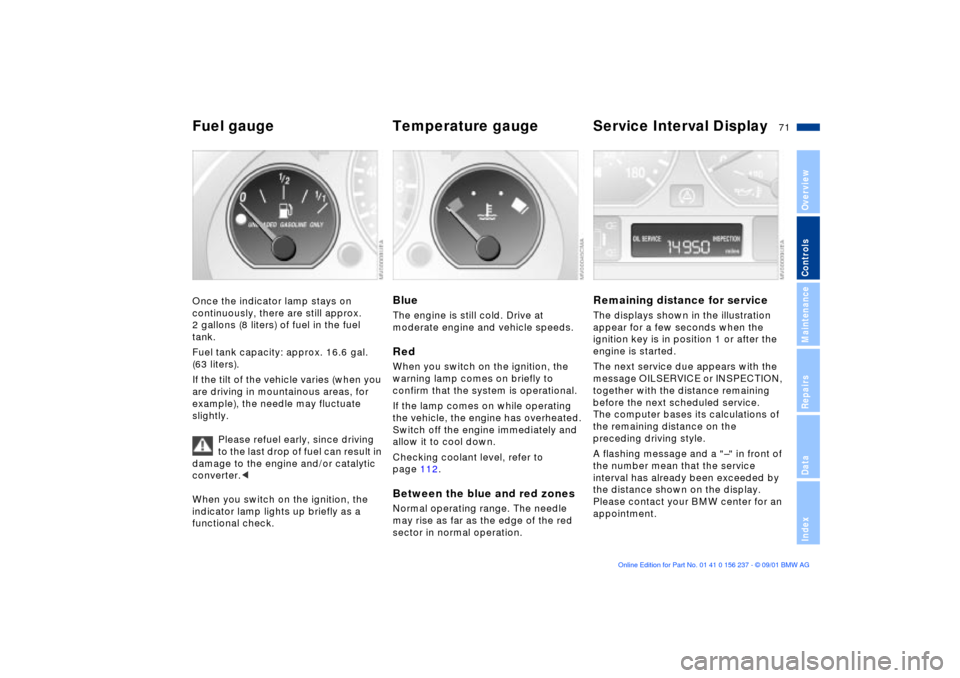
Fuel gauge Temperature gauge Service Interval Display Once the indicator lamp stays on
continuously, there are still approx.
2 gallons (8 liters) of fuel in the fuel
tank.
Fuel tank capacity: approx. 16.6 gal.
(63 liters).
If the tilt of the vehicle varies (when you
are driving in mountainous areas, for
example), the needle may fluctuate
slightly.
Please refuel early, since driving
to the last drop of fuel can result in
damage to the engine and/or catalytic
converter.<
When you switch on the ignition, the
indicator lamp lights up briefly as a
functional check.
BlueThe engine is still cold. Drive at
moderate engine and vehicle speeds. RedWhen you switch on the ignition, the
warning lamp comes on briefly to
confirm that the system is operational.
If the lamp comes on while operating
the vehicle, the engine has overheated.
Switch off the engine immediately and
allow it to cool down.
Checking coolant level, refer to
page 112.Between the blue and red zonesNormal operating range. The needle
may rise as far as the edge of the red
sector in normal operation.
Remaining distance for serviceThe displays shown in the illustration
appear for a few seconds when the
ignition key is in position 1 or after the
engine is started.
The next service due appears with the
message OILSERVICE or INSPECTION,
together with the distance remaining
before the next scheduled service.
The computer bases its calculations of
the remaining distance on the
preceding driving style.
A flashing message and a "Ð" in front of
the number mean that the service
interval has already been exceeded by
the distance shown on the display.
Please contact your BMW center for an
appointment.
Page 72 of 151

72n
DisplayThe following information or conditions
are displayed from ignition key posi-
tion 2 on, until the cause has been
corrected:
1 Inspect the low beams and the high
beams, as well as the parking lamps
2 Door open
3 Luggage compartment lid open
4 Check brake and tail lamps.
After completion of a trip and upon
opening the driver's door, an acoustic
signal will sound yet not be displayed,
as a reminder that the low beam head-
lamps have not been turned off.
Mode selectionWith the ignition key in position 1 and
higher, you can use the button in the
turn signal lever to retrieve information
from the computer for display in the
instrument cluster. By pressing the
button briefly in the direction of the
steering column, you can call up a new
function for display.
The displays appear in the following
order:
Time of day, outside temperature,
average fuel consumption, cruising
range, average vehicle speed.
From ignition key position 1, the last
active setting is displayed.
ClockIf you wish to have a permanent time
display, you can make this adjustment
in the car radio display (refer to the
Radio Owner's Manual).
You can set the time of day, and the
display for the car radio, as follows:
Check Control
Computer
Page 74 of 151
74n
Computer Average fuel consumption If you continue to hold the button on the
turn signal lever, the average fuel
consumption last displayed is recalcu-
lated from that point.
Range The computer bases its calculations of
the cruising range on the preceding
driving style.Average speed If you continue to hold the button on the
turn signal lever, the average fuel
consumption last displayed for that
speed is recalculated from that point in
time.
Any time spent when the vehicle is
stationary and the engine is shut off is
ignored for the calculation.
Page 105 of 151

105n
OverviewControlsMaintenanceRepairsDataIndex
Tire replacement Wheel and tire combinationsTire ageBMW recommends the replacement of
all tires after 6 years at the latest, even
if a tire life of 10 years is possible.
The date on which the tire was manu-
factured is indicated by the code on the
sidewall:
DOT ... 4 101 means that the tire was
produced in the 41st week of the year
2001. Following wheel/tire changesFollowing wheel and/or tire replace-
ment you will need to reinitialize both
the Flat Tire Monitor and the sequential
M gearbox
* SMG II, refer to pages 65,
78.
The right choice
Use only wheels and tires
approved by BMW for the corre-
sponding vehicle model, as otherwise
the tires may make contact with the
body as the result of tolerances despite
the same nominal size being used,
resulting in serious accidents. If non-
approved wheels and tires are used,
BMW cannot evaluate their suitability,
and therefore cannot be held liable for
driving safety.<
BMW tests certain tire brands for each
tire size, classifies them as road-safe
and approves them. Consult your BMW
center for more information. Observe
any country-specific regulations, e.g.
on making a corresponding entry in the
vehicle documents.
The correct wheel and tire combi-
nation affects different systems
such as ABS, DSC, Flat Tire Monitor.
The function of these systems is
impaired if improper wheel and tire
combinations are used.
For this reason, use only tires of the
same brand and tread pattern on the
vehicle and, for example, restore the
approved wheel and tire combination
following a flat tire as soon as possible.<
The use of rims and lug bolts that
do not meet the specifications of
the original factory-installed equipment
will affect the safe operation of your
vehicle and may cause an accident and
personal injury.
Never mix tires of different design, such
as steel-belted radials with radial bias-
belted or bias-ply tires, etc. Mixing tire
types will adversely affect roadholding
and can lead to loss of vehicle
control.<
Storage Store tires in a cool, dry place,
protecting them against light whenever
possible. Protect the tires against
contact with oil, grease and fuel.


