Page 118 of 159

118n
Coolant
Do not add coolant to the cooling
system when the engine is hot. If
you attempt to do so, escaping coolant
can cause burns.
To avoid the possibility of damage later
on, never use anything other than
factory-approved, nitrite and amino-
free extended-duty antifreeze with
corrosion inhibitor. Your BMW center is
familiar with the official specifications.
Antifreeze and anti-corrosion agents
are hazardous to health. You should
always store them in their original
containers and in a location inacces-
sible to children. Extended-duty anti-
freeze with corrosion inhibitor contains
ethylene glycol, a flammable
substance. For this reason, do not spill
extended-duty antifreeze with corrosion
inhibitor on hot engine parts. It could
catch fire and cause burns.<
Check the coolant level and
add coolant
Check the coolant level when the
engine is cold (approx. 68 7 or
+20 6).
1. Open the cap for the expansion tank
by turning it slightly counterclock-
wise to allow accumulated pressure
to escape. Then open
2. The coolant level is correct when the
upper end of the red float is at least
even with the upper edge of the filler
neck (refer to the arrow in the illustra-
tion), but no more than 0.8 in (2 cm)
above it Ð that is, up to the second
mark on the float (refer also to the
schematic diagram next to the filler
neck)
3. If necessary, add coolant. If the
coolant is low, slowly add
coolant until the correct level is
reached Ñ do not overfill.
Comply with the applicable envi-
ronmental laws regulating the
disposal of extended-duty antifreeze
with corrosion inhibitor.<
Page 121 of 159
121n
OverviewControlsMaintenanceRepairsDataIndex
Technical modifications California Proposition 65 WarningLight-emitting diodes (LEDs)Light-emitting diodes installed behind
translucent lenses serve as the light
source for many of the controls and
displays in your vehicle. The concept
behind their operation is related to that
employed for lasers, and they are offi-
cially designated as Class 1 light-emit-
ting diodes.
Do not remove the protective lens
and avoid staring directly at the
unfiltered beam for extended periods
(several hours), as inflammation of the
iris could result.<
California laws require us to state the
following warning:
Engine exhaust, some of its
constituents, and certain vehicle
components contain or emit chemicals
known to the State of California to
cause cancer and birth defects or other
reproductive harm.<
Page 122 of 159

122n
OBD interface socketThe Onboard Diagnostic (OBD) inter-
face socket is located on the left of the
driver's side at the bottom of the instru-
ment panel and under a cover. The
cover has the letters "OBD" on it.
The purpose of the OBD system is to
assure proper emission-control system
operation for the vehicle's lifetime by
monitoring emission-related compo-
nents and systems for deterioration and
malfunction.
An illuminated lamp informs you
of the need for service, not of
the need to stop the vehicle.
However, the systems should be
checked by your BMW center at the
earliest possible opportunity.
If the indicator blinks or flashes, this
indicates a high level of engine misfire.
Reduce speed and contact your
nearest BMW center immediately.
Severe engine misfiring over even a
short period of time can seriously
damage emission-control system
components, especially the catalytic
converter.
Service Engine Soon warning
lamp for Canadian models.
If the fuel filler cap is not on tight
enough, the OBD system can
detect leaking vapor and the indicator
will light up. If the fuel filler cap is then
tightened, the indicator will usually go
out after a short period of time.<
Page 127 of 159

127n
OverviewControlsMaintenanceRepairsDataIndex
Lamps and bulbsLow and high beams >Low beams: H7 bulb, 55 watts
>High beams: H7 bulb, 55 watts
The H7 bulb is pressurized. There-
fore, wear safety glasses and
protective gloves. Failure to comply
with this precaution could lead to injury
if the bulb is damaged during replace-
ment.<
Please contact a BMW center in case of
a malfunction.Parking lamps5 watt bulb
Please contact a BMW center in case of
a malfunction.
When caring for your headlamps please
observe the notes and instructions
contained in the "Care for your vehicle"
Manual.
Xenon lamps
*
The service life of these bulbs is very
long and the probability of a failure is
very low, provided that they are not
switched on and off an unusual number
of times. If one of these bulbs should
nevertheless fail, it is possible to
continue driving with great caution
using the fog lamps, provided traffic
laws in your area do not prohibit this.
Because of the extremely high
voltages involved, any work on the
lighting system should be carried out by
technically-qualified personnel only.
Otherwise, there is a risk of fatal
injury.<
Page 128 of 159
128n
Lamps and bulbsTurn signal indicator, front 21 watt bulb
1. Using a screwdriver, release the
inner hook through the upper
opening
2. Remove lamp by pulling it out toward
the front
3. Applying light pressure, turn the bulb
to the left. Remove and exchange the
bulb
4. Insert the 2 pins on the lamp into the
guides on the vehicle
5. Push the lamp in. Carefully apply
pressure until you hear it snap into
place.
Side turn signal indicators5 watt bulb
1. Use finger pressure against the rear
end of the lamp (arrow) to press it
forward for removal
2. Apply gentle pressure to the bulb
while turning it to the left to remove.
Page 130 of 159
130n
Lamps and bulbs2. Take out the bulb holder
3. Unplug the power supply receptacle.
Set the bulb holder aside (on the
luggage compartment floor, for
example)
4. Applying light pressure, turn the bulb
to the left. Remove and exchange the
bulb
5. Plug in the power supply receptacle
6. Reattach the bulb holder until you
hear it snap into place (Illustration).
Bulbs in the luggage
compartment lid1. Using a screwdriver, loosen the clip
2. Fold the trim panel down (arrow 1).
Disengage the bulb holder (arrow 2)
and remove it
3. Applying light pressure, turn the bulb
to the left. Remove and exchange the
bulb
4. Press the bulb holder into position
until you hear it engage
5. Reinstall the trim with the clip.
Page 133 of 159
133n
OverviewControlsMaintenanceRepairsDataIndex
Repairing a flat tire
Please note that the system's
sealant container must be
replaced every three years by your
BMW center if the device is not used.<
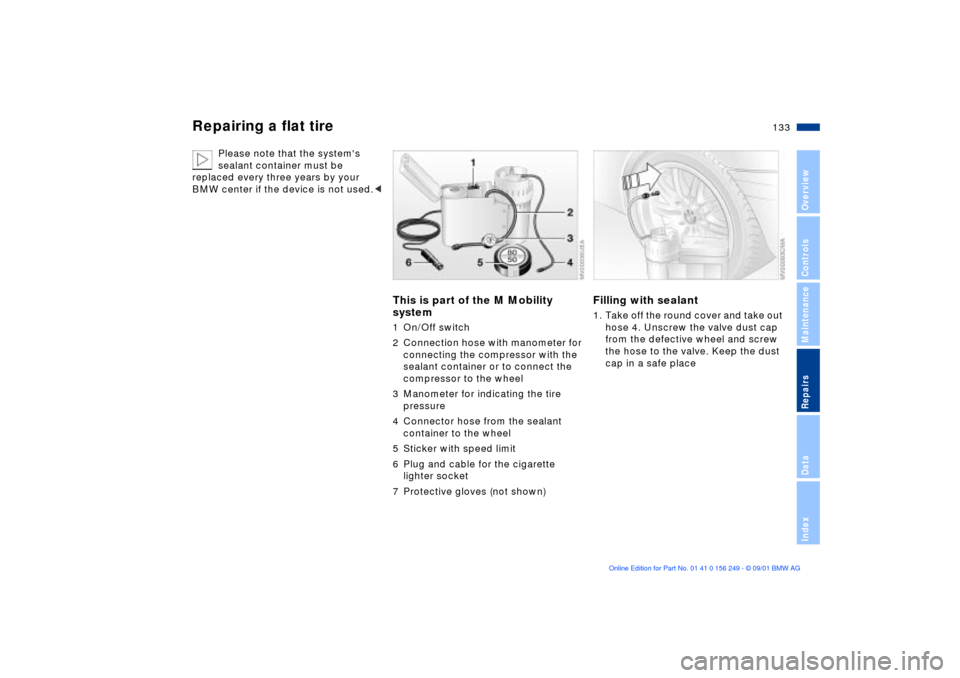
This is part of the M Mobility
system1 On/Off switch
2 Connection hose with manometer for
connecting the compressor with the
sealant container or to connect the
compressor to the wheel
3 Manometer for indicating the tire
pressure
4 Connector hose from the sealant
container to the wheel
5 Sticker with speed limit
6 Plug and cable for the cigarette
lighter socket
7 Protective gloves (not shown)
Filling with sealant1. Take off the round cover and take out
hose 4. Unscrew the valve dust cap
from the defective wheel and screw
the hose to the valve. Keep the dust
cap in a safe place
Page 134 of 159
134n
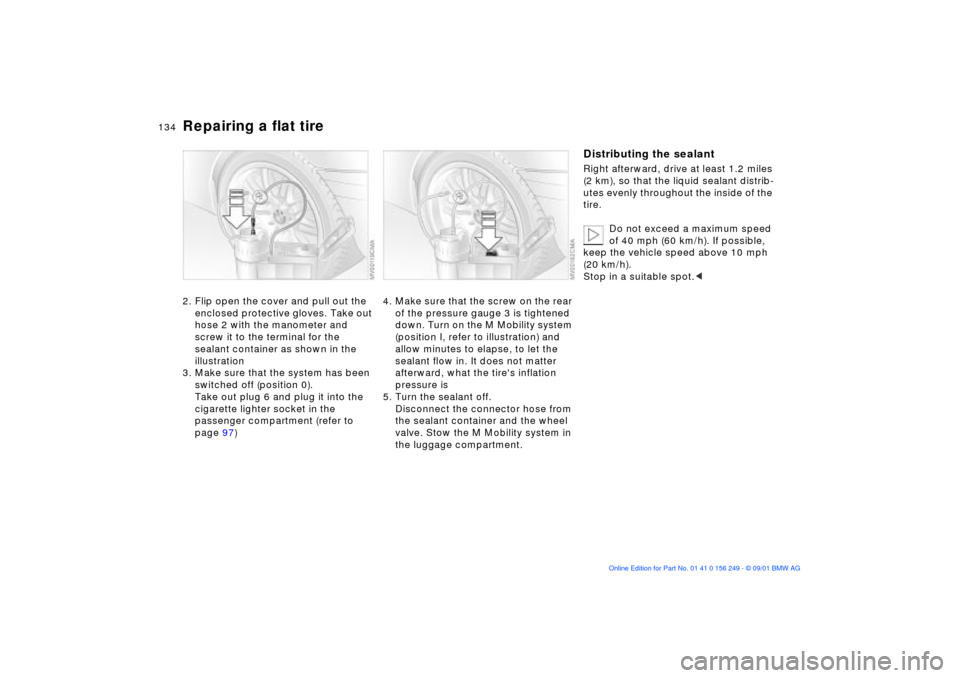
Repairing a flat tire2. Flip open the cover and pull out the
enclosed protective gloves. Take out
hose 2 with the manometer and
screw it to the terminal for the
sealant container as shown in the
illustration
3. Make sure that the system has been
switched off (position 0).
Take out plug 6 and plug it into the
cigarette lighter socket in the
passenger compartment (refer to
page 97)
4. Make sure that the screw on the rear
of the pressure gauge 3 is tightened
down. Turn on the M Mobility system
(position I, refer to illustration) and
allow minutes to elapse, to let the
sealant flow in. It does not matter
afterward, what the tire's inflation
pressure is
5. Turn the sealant off.
Disconnect the connector hose from
the sealant container and the wheel
valve. Stow the M Mobility system in
the luggage compartment.
Distributing the sealantRight afterward, drive at least 1.2 miles
(2 km), so that the liquid sealant distrib-
utes evenly throughout the inside of the
tire.
Do not exceed a maximum speed
of 40 mph (60 km/h). If possible,
keep the vehicle speed above 10 mph
(20 km/h).
Stop in a suitable spot.<