Page 114 of 159
114n
Engine compartment essentials1 Filler neck for windshield and
head-
lamp washer cleaning system115
2 Coolant expansion tank118
3 Positive terminal connection (for jump
starting) (positive terminal)137 4 Engine oil filler neck116
5 Expansion tank for SMG
* hydraulic
unit (checking and possible refilling
by your BMW center)646 Engine oil dipstick116
7 Filler neck for brake fluid119
Page 116 of 159
116n
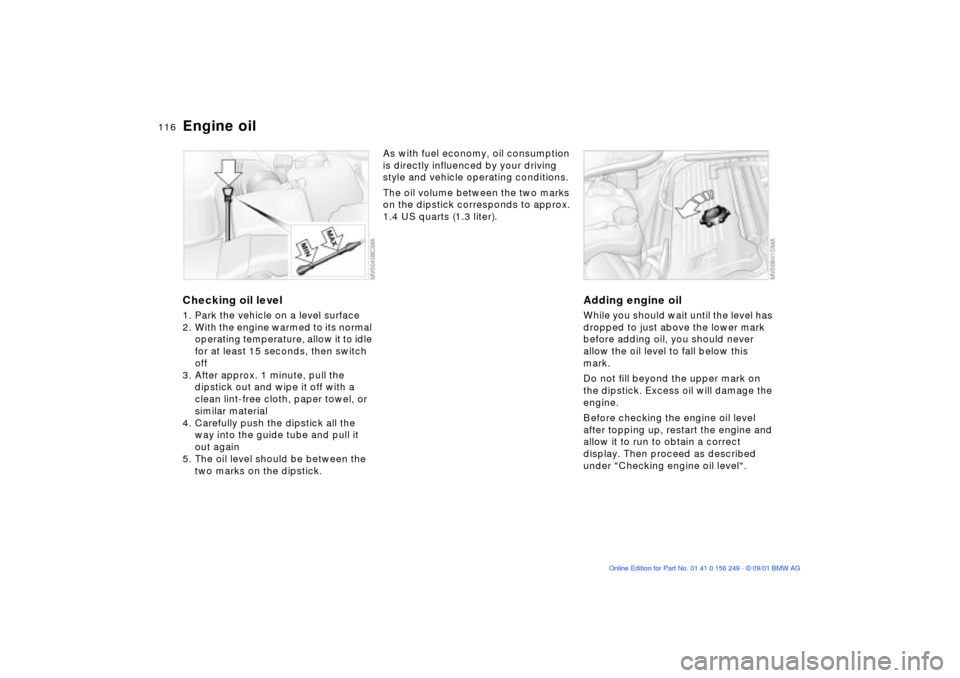
Engine oilChecking oil level 1. Park the vehicle on a level surface
2. With the engine warmed to its normal
operating temperature, allow it to idle
for at least 15 seconds, then switch
off
3. After approx. 1 minute, pull the
dipstick out and wipe it off with a
clean lint-free cloth, paper towel, or
similar material
4. Carefully push the dipstick all the
way into the guide tube and pull it
out again
5. The oil level should be between the
two marks on the dipstick.
As with fuel economy, oil consumption
is directly influenced by your driving
style and vehicle operating conditions.
The oil volume between the two marks
on the dipstick corresponds to approx.
1.4 US quarts (1.3 liter).
Adding engine oil While you should wait until the level has
dropped to just above the lower mark
before adding oil, you should never
allow the oil level to fall below this
mark.
Do not fill beyond the upper mark on
the dipstick. Excess oil will damage the
engine.
Before checking the engine oil level
after topping up, restart the engine and
allow it to run to obtain a correct
display. Then proceed as described
under "Checking engine oil level".
Page 117 of 159

117n
OverviewControlsMaintenanceRepairsDataIndex
Engine oil
BMW engines are designed to
operate without oil additives; the
use of additives could lead to damage
in some cases. This is also true for the
manual transmission, the differential,
and the power steering system.<
Recommendation: have the oil changed
by your BMW center only.
Continuous exposure to used oil
has caused cancer in laboratory
testing. For this reason, thoroughly
wash any areas of skin that come into
contact with oil using soap and water.
Always store oils, grease and similar
materials so that they are inaccessible
to children. Comply with warning labels
and information on containers.<
Comply with the applicable envi-
ronmental laws regulating the
disposal of used oil.<
Prescribed engine oilThe quality of the engine oil is
extremely important for the function
and life of an engine. Based on exten-
sive testing, BMW has approved only
certain types of engine oils.
Use only oils approved for your vehicle
model.
Ask your BMW center for details
concerning oils that have been
approved. You can also call BMW of
North America at 1-800-831-1117 or
visit this website: www.bmwusa.com
to obtain this information.< Alternative oil typesShould it not be possible to purchase
an oil approved by BMW, you can also
use other oils for adding smaller quanti-
ties between oil changes as an excep-
tion. The following information must be
specified on the package:
1. Viscosity
preferred: SAE 10W-60
or as an alternative: SAE 5W-40 or
SAE 10W-40
2. Specification
preferred: API SJ/CF
or as an alternative: API SJ (also SK,
SL, S etc.).
Low ambient temperaturesThe oils used by BMW at the factory for
your vehicle model can be used at virtu-
ally any ambient temperature.
However, if the vehicle is exposed to
temperatures below Ð4 7 (Ð20 6) for
extended periods, please have your
BMW center recommend a suitable oil.
Page 118 of 159

118n
Coolant
Do not add coolant to the cooling
system when the engine is hot. If
you attempt to do so, escaping coolant
can cause burns.
To avoid the possibility of damage later
on, never use anything other than
factory-approved, nitrite and amino-
free extended-duty antifreeze with
corrosion inhibitor. Your BMW center is
familiar with the official specifications.
Antifreeze and anti-corrosion agents
are hazardous to health. You should
always store them in their original
containers and in a location inacces-
sible to children. Extended-duty anti-
freeze with corrosion inhibitor contains
ethylene glycol, a flammable
substance. For this reason, do not spill
extended-duty antifreeze with corrosion
inhibitor on hot engine parts. It could
catch fire and cause burns.<
Check the coolant level and
add coolant
Check the coolant level when the
engine is cold (approx. 68 7 or
+20 6).
1. Open the cap for the expansion tank
by turning it slightly counterclock-
wise to allow accumulated pressure
to escape. Then open
2. The coolant level is correct when the
upper end of the red float is at least
even with the upper edge of the filler
neck (refer to the arrow in the illustra-
tion), but no more than 0.8 in (2 cm)
above it Ð that is, up to the second
mark on the float (refer also to the
schematic diagram next to the filler
neck)
3. If necessary, add coolant. If the
coolant is low, slowly add
coolant until the correct level is
reached Ñ do not overfill.
Comply with the applicable envi-
ronmental laws regulating the
disposal of extended-duty antifreeze
with corrosion inhibitor.<
Page 119 of 159

119n
OverviewControlsMaintenanceRepairsDataIndex
Brake fluid
If the brake warning lamp
comes on with the parking
brake released: the brake fluid
level is too low.
For adding brake fluid or for
determining and correcting the
cause of brake fluid loss, consult your
BMW center. Your BMW center is
familiar with the specifications for
factory-approved brake fluids (DOT 4).
Due to loss in brake fluid, pedal travel
can lengthen and braking efficiency
may be reduced. Comply with the infor-
mation provided on page 105.
Brake fluid is hygroscopic, that is,
it absorbs moisture from the air
over time.
In order to ensure the safety and reli-
ability of the brake system, have the
brake fluid changed every two years by
a BMW center. Refer also to the Service
and Warranty Information Booklet (US
models) or the Warranty and Service
Guide Booklet (Canadian models).
Brake fluid is toxic and damages the
vehicle's paint. You should always store
it in its original container and in a loca-
tion inaccessible to children.
Do not spill the fluid and do not fill the
brake fluid reservoir beyond the "MAX"
mark. The brake fluid could ignite upon
contact with hot engine parts and
cause serious burns.<
Comply with the applicable envi-
ronmental laws regulating the
disposal of brake fluid.<
Page 120 of 159

120n
The BMW Maintenance System has
been designed as a reliable means of
providing maximum driving and oper-
ating safety Ð and as cost-effectively as
possible for you.
Please keep in mind that regular main-
tenance is not only necessary for the
safety of your vehicle, but also plays a
significant role in maintaining the resale
value of the vehicle.
Service Interval DisplayWhile conventional systems rely on
distance traveled alone to determine
when service is due, the BMW Mainte-
nance System has for years considered
the actual conditions under which the
vehicle operates, because miles can be
traveled in many different ways:
For example, 62,000 miles
(100,000 km) short-distance driving are
not equal to the same 62,000 miles
(100,000 ) of long-distance travel.
The BMW Maintenance System
includes the Engine Oil Service and
Inspections I and II.
Determining the maintenance intervals
according to the actual loads on the
vehicle covers every kind of operating
situation. Those who are outright
"Sunday drivers," driving fewer than
6,000 miles (10,000 km) per year
should, nevertheless have their oil
changed every 2 years at the most, no
matter what the Service Interval Display
indicates, since engine oil breaks down
over time, regardless of use. Service and Warranty Information
Booklet (US models)/Warranty
and Service Guide Booklet
(Canadian models)For additional information on required
maintenance intervals and procedures,
please refer to the Service and
Warranty Information Booklet (US
models), or the Warranty and Service
Guide Booklet (Canadian models).As a precaution against corrosion, it is
advisable to have the body checked for
damage from rocks or gravel at the
same time, depending upon operating
conditions.
Have your vehicle's maintenance
and repairs performed at your
BMW center. Be sure that all mainte-
nance work is confirmed in the Service
and Warranty Information Booklet (US
models), or in the Warranty and Service
Guide Booklet (Canadian models).
These entries are your verification for
the regular maintenance of your vehicle
and are required for the performance of
warranty repairs.<
Storing the vehicleIf the vehicle is to be stored for longer
than three months, please follow the
instructions in the "Caring for your
vehicle" Manual.
The BMW Maintenance System
Page 121 of 159
121n
OverviewControlsMaintenanceRepairsDataIndex
Technical modifications California Proposition 65 WarningLight-emitting diodes (LEDs)Light-emitting diodes installed behind
translucent lenses serve as the light
source for many of the controls and
displays in your vehicle. The concept
behind their operation is related to that
employed for lasers, and they are offi-
cially designated as Class 1 light-emit-
ting diodes.
Do not remove the protective lens
and avoid staring directly at the
unfiltered beam for extended periods
(several hours), as inflammation of the
iris could result.<
California laws require us to state the
following warning:
Engine exhaust, some of its
constituents, and certain vehicle
components contain or emit chemicals
known to the State of California to
cause cancer and birth defects or other
reproductive harm.<
Page 122 of 159

122n
OBD interface socketThe Onboard Diagnostic (OBD) inter-
face socket is located on the left of the
driver's side at the bottom of the instru-
ment panel and under a cover. The
cover has the letters "OBD" on it.
The purpose of the OBD system is to
assure proper emission-control system
operation for the vehicle's lifetime by
monitoring emission-related compo-
nents and systems for deterioration and
malfunction.
An illuminated lamp informs you
of the need for service, not of
the need to stop the vehicle.
However, the systems should be
checked by your BMW center at the
earliest possible opportunity.
If the indicator blinks or flashes, this
indicates a high level of engine misfire.
Reduce speed and contact your
nearest BMW center immediately.
Severe engine misfiring over even a
short period of time can seriously
damage emission-control system
components, especially the catalytic
converter.
Service Engine Soon warning
lamp for Canadian models.
If the fuel filler cap is not on tight
enough, the OBD system can
detect leaking vapor and the indicator
will light up. If the fuel filler cap is then
tightened, the indicator will usually go
out after a short period of time.<

