Page 110 of 155
110n
Wheel and tire combinationsThe right choice
Never mount wheels and tires that
have not been specifically
approved by BMW for use on your
particular model. Although other wheels
and tires may theoretically have the
same dimensions, variations in factors
such as manufacturing tolerances can
result in contact between tire and body-
work, ultimately leading to serious acci-
dents. BMW can not evaluate all tires
and wheels on the market, and is thus
unable to guarantee that the vehicle will
continue to perform safely if unap-
proved tires and/or wheels are
mounted.
The correct wheel and tire combi-
nation affects various systems
that would otherwise be impaired, for
example ABS, ATC, ASC+T/DSC and
ADB/ADB-X/DBC.
For this reason, use only tires of the
same manufacture and tread configura-
tion. In the event of a flat tire, for
example, remount the approved wheel
and tire combination as soon as
possible.<
Page 118 of 155
118n
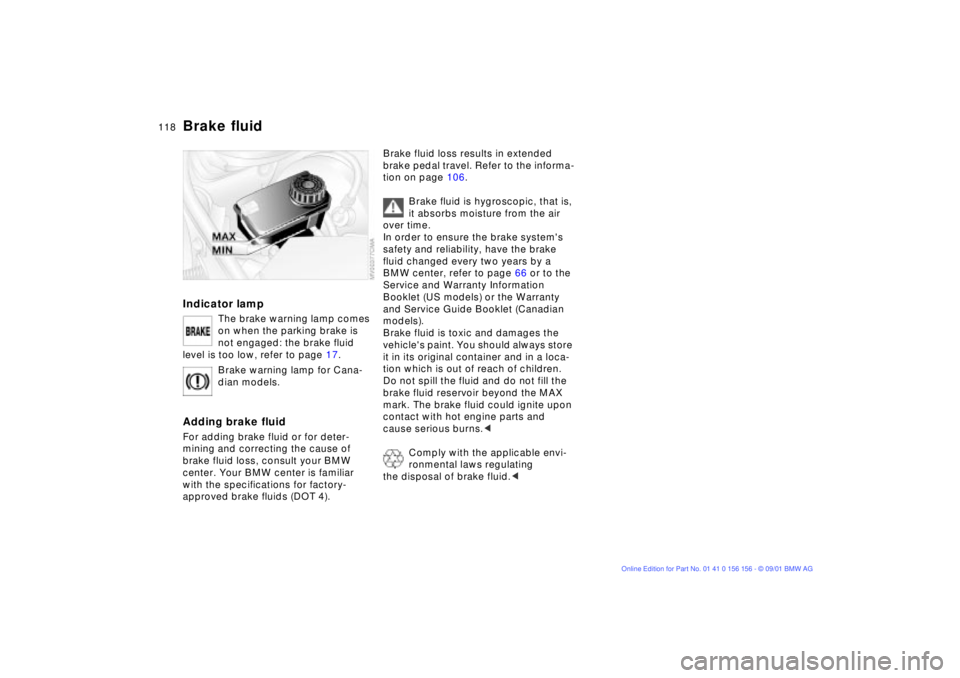
Brake fluidIndicator lamp
The brake warning lamp comes
on when the parking brake is
not engaged: the brake fluid
level is too low, refer to page 17.
Brake warning lamp for Cana-
dian models.
Adding brake fluidFor adding brake fluid or for deter-
mining and correcting the cause of
brake fluid loss, consult your BMW
center. Your BMW center is familiar
with the specifications for factory-
approved brake fluids (DOT 4).
Brake fluid loss results in extended
brake pedal travel. Refer to the informa-
tion on page 106.
Brake fluid is hygroscopic, that is,
it absorbs moisture from the air
over time.
In order to ensure the brake system's
safety and reliability, have the brake
fluid changed every two years by a
BMW center, refer to page 66 or to the
Service and Warranty Information
Booklet (US models) or the Warranty
and Service Guide Booklet (Canadian
models).
Brake fluid is toxic and damages the
vehicle's paint. You should always store
it in its original container and in a loca-
tion which is out of reach of children.
Do not spill the fluid and do not fill the
brake fluid reservoir beyond the MAX
mark. The brake fluid could ignite upon
contact with hot engine parts and
cause serious burns.<
Comply with the applicable envi-
ronmental laws regulating
the disposal of brake fluid.<
Page 133 of 155
133n
OverviewControlsMaintenanceRepairsDataIndex
Changing a wheel Battery Fuses
Safety tires are only possible in
conjunction with Tire Pressure
Monitor (RDC) or Flat Tire Monitor.<
If the defective wheel cannot be seen
as such immediately from the outside,
check the tire inflation pressure at all
four wheels.
Have the tires changed by your
BMW center. For safety reasons,
do not have a safety tire repaired. Your
BMW center has the information
needed for working with safety tires
and is equipped with the necessary
special tools.<
If appropriate, please consult your
BMW center to reequip your
vehicle from summer to winter tires Ð or
vice versa.<
Battery careThe battery is absolutely maintenance-
free, that is, the original electrolyte will
normally last for the service life of the
battery under moderate climatic condi-
tions.
Please consult your BMW center
whenever you have any questions
concerning the battery. Since the battery
is absolutely maintenance-free, the
following is for your information only.<
Never disconnect the battery
when the engine is running; the
ensuing voltage surge would seriously
damage the vehicle's onboard elec-
tronic systems.
vehicle, leave the engine off at all times.
Connect the charge cables to the termi-
nals in the engine compartment.
Terminal locations, refer to Jump-
starting on page 134.
Return used batteries to a recycling
point or your BMW center. Maintain
the battery in an upright position for
transport and storage. Secure the
battery against tilting during transport.<
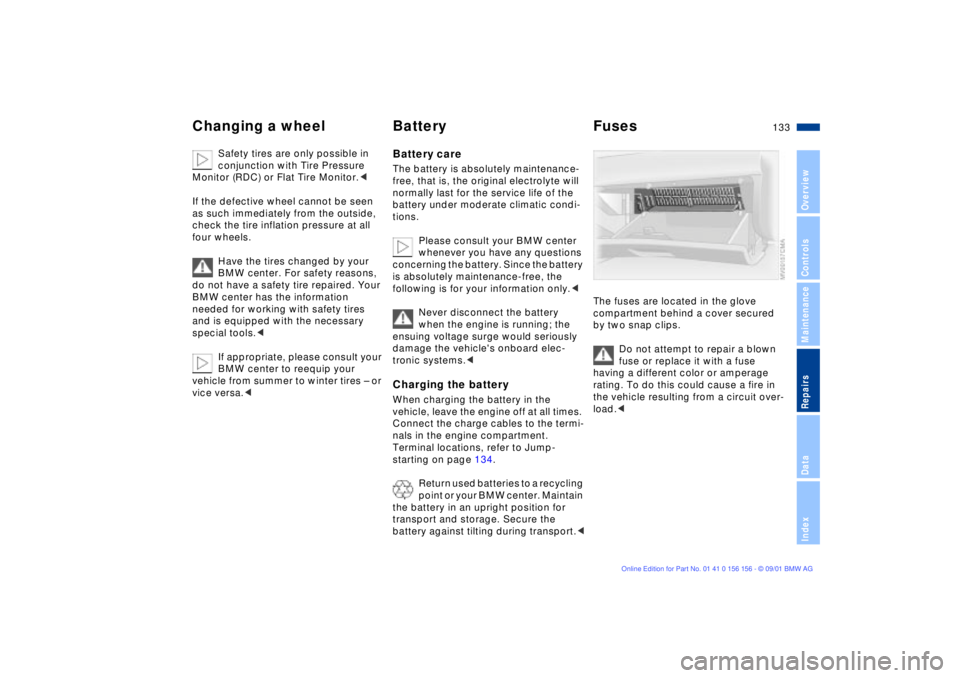
The fuses are located in the glove
compartment behind a cover secured
by two snap clips.
Do not attempt to repair a blown
fuse or replace it with a fuse
having a different color or amperage
rating. To do this could cause a fire in
the vehicle resulting from a circuit over-
load.<
Page 134 of 155
134n
Do not use spray starter fluids to start
the engine.
When your battery is discharged you can
used two jumper cables to start your
vehicle with power from the battery in a
second vehicle. You can also use the
same method to help start another
vehicle. Always use jumper cables with
fully insulated handles on the terminal
clamps.
Do not touch high-voltage wiring
and cables on a running engine.
Contact with components carrying high
voltage can be harmful or fatal. Care-
fully observe the following instructions
to avoid personal injury and/or damage
to one or both vehicles.<
1. Ensure that the battery in the support
vehicle is also rated at 12 volts. This
information is provided on the top of
the battery casing
2. Do not disconnect your battery from
your vehicle's electrical system.
Switch off all electrical accessories in
both vehicles
3. Make absolutely certain that there is
no contact between the bodywork of
the two vehicles Ð short circuit
hazard
4. Start the engine on the support
vehicle and allow it to run
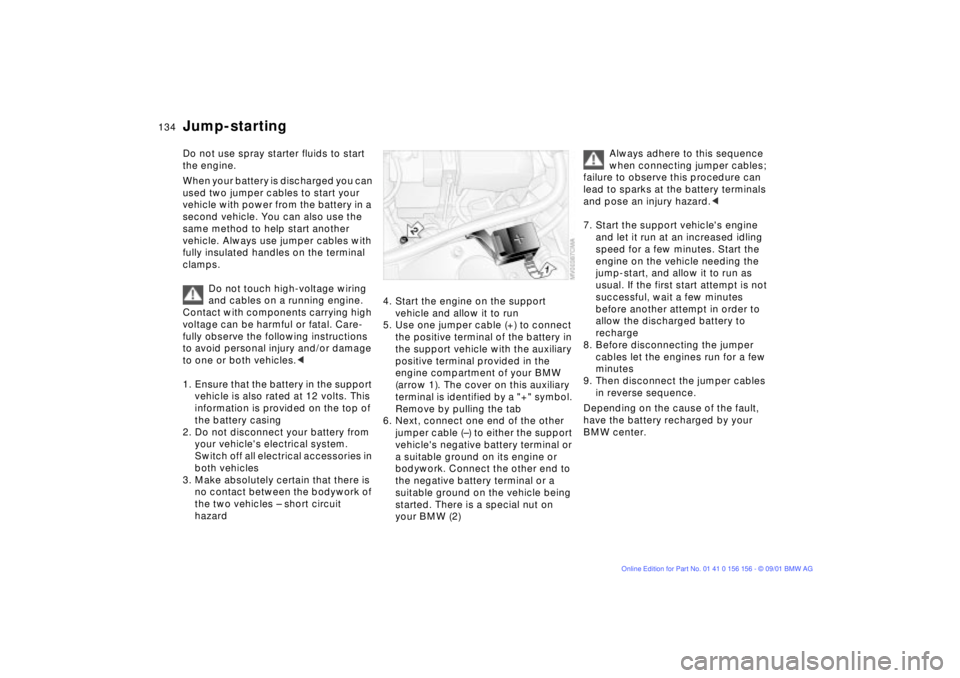
5. Use one jumper cable (+) to connect
the positive terminal of the battery in
the support vehicle with the auxiliary
positive terminal provided in the
engine compartment of your BMW
(arrow 1). The cover on this auxiliary
terminal is identified by a "+" symbol.
Remove by pulling the tab
6. Next, connect one end of the other
jumper cable (Ð) to either the support
vehicle's negative battery terminal or
a suitable ground on its engine or
bodywork. Connect the other end to
the negative battery terminal or a
suitable ground on the vehicle being
started. There is a special nut on
your BMW (2)
Always adhere to this sequence
when connecting jumper cables;
failure to observe this procedure can
lead to sparks at the battery terminals
and pose an injury hazard.<
7. Start the support vehicle's engine
and let it run at an increased idling
speed for a few minutes. Start the
engine on the vehicle needing the
jump-start, and allow it to run as
usual. If the first start attempt is not
successful, wait a few minutes
before another attempt in order to
allow the discharged battery to
recharge
8. Before disconnecting the jumper
cables let the engines run for a few
minutes
9. Then disconnect the jumper cables
in reverse sequence.
Depending on the cause of the fault,
have the battery recharged by your
BMW center.
Jump-starting
Page 146 of 155
Everything from A to ZA
ABS (Antilock Brake
System)19, 105
Accessories10
Activated-charcoal filter91
Adaptive Transmission
Control (ATC)59
ADB (Automatic Differential
Brake)73
Adding
brake fluid118
coolant117
engine oil115
washer fluid114
Adjusting
backrest41
manual seat41
mirrors47
power seat42
steering wheel46
thigh support41
Air conditioning85
Air distribution86, 89
Air outlets,
ventilation85, 88
Air supply86, 89 Airbags18, 48
sitting correctly40
Alarm system35
Antifreeze and anti-
corrosion agents117
disposal117
Antilock Brake System
(ABS)19, 105
Anti-theft system35
Approved gross vehicle
weight142
Aquaplaning105, 107
Armrest92
ASC+T (Automatic Stability
Control plus Traction)71
Ashtray
front94
rear95
ATC (Adaptive Transmission
Control)59
Attach vehicle vacuum
cleaner94
AUC (Automatic recircu-
lated-air control)90 Automatic climate
control88, 89
Automatic cruise control63
Automatic Differential Brake
(ADB)73
Automatic headlight
control82
Automatic recirculated-air
control (AUC)90
Automatic Stability Control
plus Traction (ASC+T)71
Automatic transmission58
Automatic transmission with
Steptronic18, 58
Average fuel
consumption69
Average speed69
Axle loads142
B
Backrest41
Backup lamps57
bulb replacement127
Battery133
care133
charging133
disposal133 Battery charge current
indicator17
Beverage holder93
Blower86, 89
BMW High Performance
Synthetic Oil116
BMW Maintenance
System119
BMW sports seat
manual adjustment41
power adjustment42
Bore140
Bottle holder, refer to
beverage holder93
Brake fluid118
disposal118
Brake lamps
bulb replacement127
Brake pads19
Brake system
brake fluid level106
brake pads106
brake rotors,
corrosion106
defect in hydraulic
circuits106
disc brakes106
A-Z