2001 YAMAHA YZF600 engine coolant
[x] Cancel search: engine coolantPage 20 of 114

INSTRUMENT AND CONTROL FUNCTIONS
3-5
3
EAU00109
Anti-theft alarm (optional) This motorcycle can be equipped with
an optional anti-theft alarm by a
Yamaha dealer. Contact a Yamaha
dealer for more information.
EAU01652
Coolant temperature gauge With the key in the “ON” position, the
coolant temperature gauge indicates
the temperature of the coolant. The
coolant temperature varies with chang-
es in the weather and engine load. If
the needle reaches or enters the red
zone, stop the motorcycle and let the
engine cool. (See page 6-45 for further
instructions.)
EC000002
CAUTION:_ Do not operate the engine if it is
overheated. _
EAU00118
Handlebar switches
EAU00120
Pass switch “PASS”
Press this switch to flash the headlight.
EAU00121
Dimmer switch
Set this switch to “ ” for the high
beam and to “ ” for the low beam.
1. Coolant temperature gauge
2. Coolant temperature gauge red zone
1. Pass switch “PASS”
2. Dimmer switch
3. Turn signal switch
4. Horn switch “ ”
E_4tv.book Page 5 Wednesday, October 4, 2000 2:15 PM
Page 38 of 114

4-1
4
EAU01114
4-PRE-OPERATION CHECKSThe condition of a vehicle is the owner’s responsibility. Vital components can start to deteriorate quickly and unexpectedly,
even if the vehicle remains unused (for example, as a result of exposure to the elements). Any damage, fluid leakage or loss
of tire air pressure could have serious consequences. Therefore, it is very important, in addition to a thorough visual inspec-
tion, to check the following points before each ride.
EAU03439
Pre-operation check list
CO-01E
ITEM CHECKS PAGE
Fuel• Check fuel level in fuel tank.
• Refuel if necessary.
• Check fuel line for leakage.3-9
Engine oil• Check oil level in engine.
• If necessary, add recommended oil to specified level.
• Check vehicle for oil leakage.6-10
Coolant• Check coolant level in reservoir.
• If necessary, add recommended coolant to specified level.
• Check cooling system for leakage.6-13–6-14
Front brake• Check operation.
• If soft or spongy, have Yamaha dealer bleed hydraulic system.
• Check fluid level in reservoir.
• If necessary, add recommended brake fluid to specified level.
• Check hydraulic system for leakage.6-27–6-28
Rear brake• Check operation.
• If soft or spongy, have Yamaha dealer bleed hydraulic system.
• Check fluid level in reservoir.
• If necessary, add recommended brake fluid to specified level.
• Check hydraulic system for leakage.6-25–6-28
Clutch• Check operation.
• Lubricate cable if necessary.
• Check lever free play.
• Adjust if necessary.6-25
E_4tv.book Page 1 Wednesday, October 4, 2000 2:15 PM
Page 49 of 114

6
PERIODIC MAINTENANCE AND MINOR REPAIR
Owner’s tool kit .................................................... 6-1
Periodic maintenance and lubrication chart ......... 6-2
Removing and installing cowlings ........................ 6-5
Checking the spark plugs .................................... 6-8
Engine oil and oil filter cartridge ........................ 6-10
Coolant .............................................................. 6-13
Cleaning the air filter element ............................ 6-17
Checking the air vent hose ................................ 6-18
Air intake duct .................................................... 6-19
Adjusting the carburetors ................................... 6-19
Adjusting the engine idling speed ...................... 6-19
Adjusting the throttle cable free play .................. 6-20
Adjusting the valve clearance ............................ 6-20
Tires ................................................................... 6-21
Cast wheels ....................................................... 6-24
Adjusting the clutch lever free play .................... 6-25
Adjusting the brake pedal position ..................... 6-25
Adjusting the rear brake light switch .................. 6-26
Checking the front and rear brake pads ............. 6-27
Checking the brake fluid level ............................ 6-27
Changing the brake fluid .................................... 6-28
Drive chain slack ................................................ 6-29
Lubricating the drive chain ................................. 6-30Checking and lubricating the cables ................. 6-31
Checking and lubricating the throttle grip and
cable ............................................................... 6-31
Checking and lubricating the brake and
shift pedals ...................................................... 6-32
Checking and lubricating the brake and
clutch levers .................................................... 6-32
Checking and lubricating the sidestand ............ 6-32
Lubricating the rear suspension ........................ 6-33
Checking the front fork ...................................... 6-33
Checking the steering ....................................... 6-34
Checking the wheel bearings ............................ 6-34
Battery ............................................................... 6-35
Replacing the fuses .......................................... 6-36
Replacing the headlight bulb ............................. 6-37
Replacing the tail/brake light bulb ..................... 6-38
Replacing a turn signal light bulb ...................... 6-39
Supporting the motorcycle ................................ 6-39
Front wheel ....................................................... 6-40
Rear wheel ........................................................ 6-41
Troubleshooting ................................................. 6-43
Troubleshooting charts ...................................... 6-44
E_4tv.book Page 1 Wednesday, October 4, 2000 2:15 PM
Page 53 of 114

PERIODIC MAINTENANCE AND MINOR REPAIR
6-4
6
EAU03541
NOTE:_l
The air filter needs more frequent service if you are riding in unusually wet or dusty areas.
l
Hydraulic brake service
• Regularly check and, if necessary, correct the brake fluid level.
• Every two years replace the internal components of the brake master cylinder and caliper, and change the brake fluid.
• Replace the brake hoses every four years and if cracked or damaged.
_22
*Carburetors• Check starter (choke) operation.
• Adjust engine idling speed and synchronization.ÖÖÖÖÖ Ö
23 Engine oil• Change.ÖÖÖÖÖ Ö
24 Engine oil filter cartridge• Replace.ÖÖÖ
25*Cooling system• Check coolant level and vehicle for coolant leakage.ÖÖÖÖ Ö
• Change. Every 3 years
26*Front and rear brake
switches• Check operation.ÖÖÖÖÖ Ö
27 Moving parts and cables• Lubricate.ÖÖÖÖ Ö
28*Lights, signals and
switches• Check operation.
• Adjust headlight beam.ÖÖÖÖÖ Ö NO. ITEM CHECK OR MAINTENANCE JOBODOMETER READING (´1,000 km)
ANNUAL
CHECK
1 10203040
E_4tv.book Page 4 Wednesday, October 4, 2000 2:15 PM
Page 62 of 114
PERIODIC MAINTENANCE AND MINOR REPAIR
6-13
6
EAU03495
Coolant The coolant level should be checked
before each ride. In addition, the cool-
ant must be changed at the intervals
specified in the periodic maintenance
and lubrication chart.
If the engine overheats, see page 6-45
for further instructions.
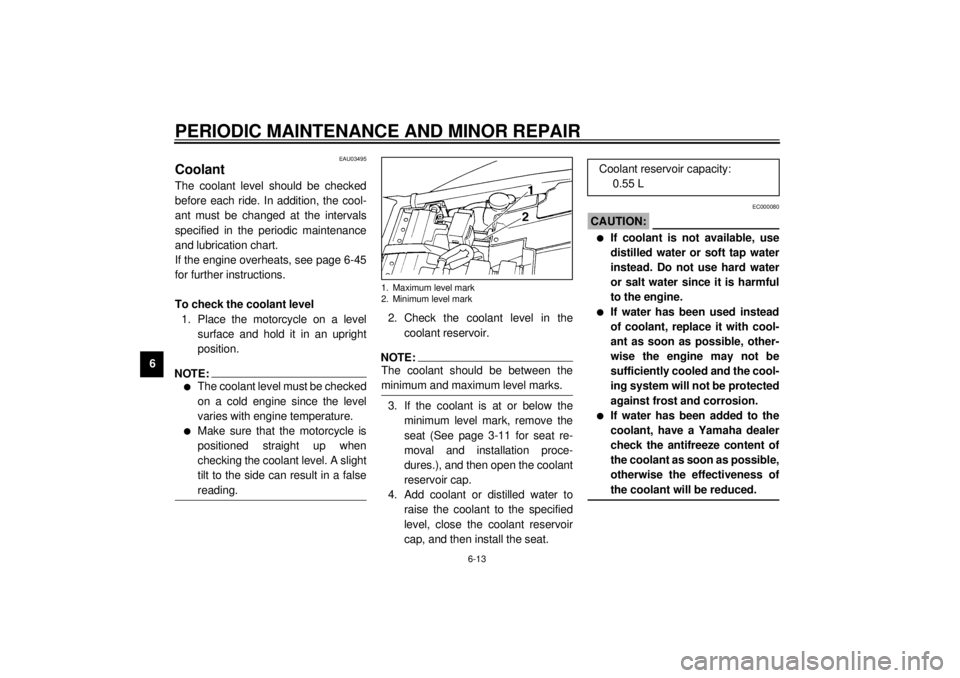
To check the coolant level
1. Place the motorcycle on a level
surface and hold it in an upright
position.NOTE:_ l
The coolant level must be checked
on a cold engine since the level
varies with engine temperature.
l
Make sure that the motorcycle is
positioned straight up when
checking the coolant level. A slight
tilt to the side can result in a false
reading.
_
2. Check the coolant level in the
coolant reservoir.NOTE:_ The coolant should be between the
minimum and maximum level marks. _3. If the coolant is at or below the
minimum level mark, remove the
seat (See page 3-11 for seat re-
moval and installation proce-
dures.), and then open the coolant
reservoir cap.
4. Add coolant or distilled water to
raise the coolant to the specified
level, close the coolant reservoir
cap, and then install the seat.
EC000080
CAUTION:_ l
If coolant is not available, use
distilled water or soft tap water
instead. Do not use hard water
or salt water since it is harmful
to the engine.
l
If water has been used instead
of coolant, replace it with cool-
ant as soon as possible, other-
wise the engine may not be
sufficiently cooled and the cool-
ing system will not be protected
against frost and corrosion.
l
If water has been added to the
coolant, have a Yamaha dealer
check the antifreeze content of
the coolant as soon as possible,
otherwise the effectiveness of
the coolant will be reduced.
_
1. Maximum level mark
2. Minimum level mark
Coolant reservoir capacity:
0.55 L
E_4tv.book Page 13 Wednesday, October 4, 2000 2:15 PM
Page 63 of 114
PERIODIC MAINTENANCE AND MINOR REPAIR
6-14
6
EW000067
WARNING
_ Never attempt to remove the radia-
tor cap when the engine is hot. _NOTE:_ l
The radiator fan is automatically
switched on or off according to the
coolant temperature in the radia-
tor.
l
If the engine overheats, see
page 6-45 for further instructions.
_
EAU03819
To change the coolant
1. Place the motorcycle on a level
surface and let the engine cool if
necessary.
2. Remove the seat. (See page 3-11
for seat removal and installation
procedures.)
3. Remove cowling D. (See page 6-7
for cowling removal and installa-
tion procedures.)
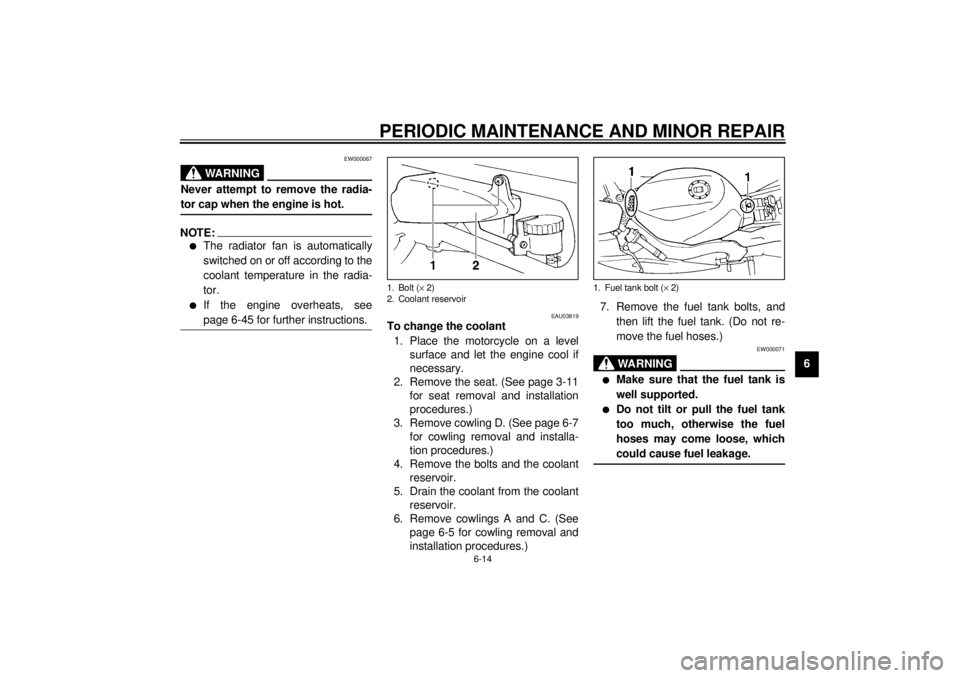
4. Remove the bolts and the coolant
reservoir.
5. Drain the coolant from the coolant
reservoir.
6. Remove cowlings A and C. (See
page 6-5 for cowling removal and
installation procedures.)7. Remove the fuel tank bolts, and
then lift the fuel tank. (Do not re-
move the fuel hoses.)
EW000071
WARNING
_ l
Make sure that the fuel tank is
well supported.
l
Do not tilt or pull the fuel tank
too much, otherwise the fuel
hoses may come loose, which
could cause fuel leakage.
_
1. Bolt (´ 2)
2. Coolant reservoir
1. Fuel tank bolt (´ 2)
E_4tv.book Page 14 Wednesday, October 4, 2000 2:15 PM
Page 64 of 114
PERIODIC MAINTENANCE AND MINOR REPAIR
6-15
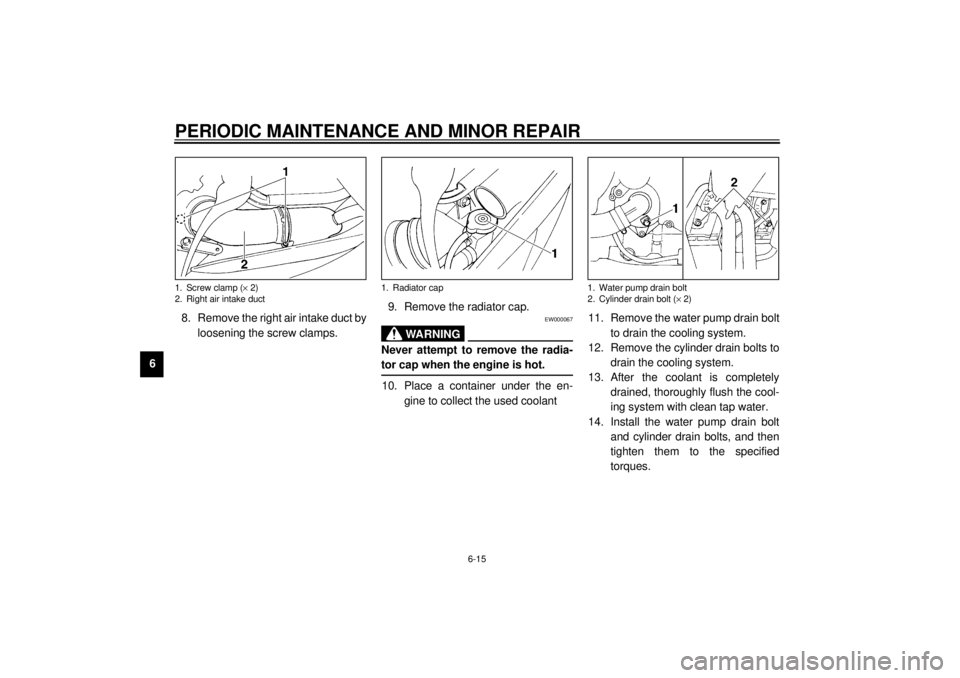
68. Remove the right air intake duct by
loosening the screw clamps.9. Remove the radiator cap.
EW000067
WARNING
_ Never attempt to remove the radia-
tor cap when the engine is hot. _10. Place a container under the en-
gine to collect the used coolant11. Remove the water pump drain bolt
to drain the cooling system.
12. Remove the cylinder drain bolts to
drain the cooling system.
13. After the coolant is completely
drained, thoroughly flush the cool-
ing system with clean tap water.
14. Install the water pump drain bolt
and cylinder drain bolts, and then
tighten them to the specified
torques.
1. Screw clamp (´ 2)
2. Right air intake duct
1. Radiator cap
1. Water pump drain bolt
2. Cylinder drain bolt (´ 2)
E_4tv.book Page 15 Wednesday, October 4, 2000 2:15 PM
Page 65 of 114
PERIODIC MAINTENANCE AND MINOR REPAIR
6-16
6 15. Pour the specified amount of rec-
ommended coolant into the radia-
tor and reservoir.
ECA00041
CAUTION:_ Hard water or salt water is harmful
to the engine. You may use soft wa-
ter if you can’t get distilled water. _16. Install the radiator cap, start the
engine, let it idle for several min-
utes, and then turn it off.
17. Remove the radiator cap to check
the coolant level in the radiator. If
necessary, add sufficient coolant
until it reaches the top of the radia-
tor, and then install the radiator
cap.
18. Check the coolant level in the res-
ervoir. If necessary, remove the
coolant reservoir cap, add coolant
to the maximum level mark, and
then install the cap.
19. Start the engine, and then check
the vehicle for coolant leakage. If
coolant is leaking, have a Yamaha
dealer check the cooling system.
20. Install the right air intake duct, then
tighten the screw clamps.21. Install the fuel tank and fuel tank
bolts.
22. Install the coolant reservoir and
bolts.
23. Fill the coolant reservoir with the
recommended coolant to the
specified level.
24. Install the cowlings.
25. Install the seat. Tightening torques:
Water pump drain bolt:
10 Nm (1.0 m·kg)
Cylinder drain bolt
7.0 Nm (0.7 m·kg)
Antifreeze/water mixture ratio:
1:1
Recommended anti-freeze:
High-quality ethylene glycol
antifreeze containing corrosion
inhibitors for aluminum engines
Coolant quantity:
Total amount:
1.95 L
Coolant reservoir capacity:
0.55 L
E_4tv.book Page 16 Wednesday, October 4, 2000 2:15 PM