Page 38 of 114

4-1
4
EAU01114
4-PRE-OPERATION CHECKSThe condition of a vehicle is the owner’s responsibility. Vital components can start to deteriorate quickly and unexpectedly,
even if the vehicle remains unused (for example, as a result of exposure to the elements). Any damage, fluid leakage or loss
of tire air pressure could have serious consequences. Therefore, it is very important, in addition to a thorough visual inspec-
tion, to check the following points before each ride.
EAU03439
Pre-operation check list
CO-01E
ITEM CHECKS PAGE
Fuel• Check fuel level in fuel tank.
• Refuel if necessary.
• Check fuel line for leakage.3-9
Engine oil• Check oil level in engine.
• If necessary, add recommended oil to specified level.
• Check vehicle for oil leakage.6-10
Coolant• Check coolant level in reservoir.
• If necessary, add recommended coolant to specified level.
• Check cooling system for leakage.6-13–6-14
Front brake• Check operation.
• If soft or spongy, have Yamaha dealer bleed hydraulic system.
• Check fluid level in reservoir.
• If necessary, add recommended brake fluid to specified level.
• Check hydraulic system for leakage.6-27–6-28
Rear brake• Check operation.
• If soft or spongy, have Yamaha dealer bleed hydraulic system.
• Check fluid level in reservoir.
• If necessary, add recommended brake fluid to specified level.
• Check hydraulic system for leakage.6-25–6-28
Clutch• Check operation.
• Lubricate cable if necessary.
• Check lever free play.
• Adjust if necessary.6-25
E_4tv.book Page 1 Wednesday, October 4, 2000 2:15 PM
Page 41 of 114
OPERATION AND IMPORTANT RIDING POINTS
5
Starting a cold engine ....................................................................... 5-1
Starting a warm engine ..................................................................... 5-3
Shifting .............................................................................................. 5-3
Recommended shift points (for Switzerland only) ............................. 5-4
Tips for reducing fuel consumption ................................................... 5-4
Engine break-in ................................................................................. 5-5
Parking .............................................................................................. 5-6
E_4tv.book Page 1 Wednesday, October 4, 2000 2:15 PM
Page 42 of 114
5-1
5
EAU00372
5-OPERATION AND IMPORTANT RIDING POINTS
EAU00373
WARNING
_ l
Become thoroughly familiar
with all operating controls and
their functions before riding.
Consult a Yamaha dealer re-
garding any control or function
that you do not thoroughly un-
derstand.
l
Never start the engine or oper-
ate it in a closed area for any
length of time. Exhaust fumes
are poisonous, and inhaling
them can cause loss of con-
sciousness and death within a
short time. Always make sure
that there is adequate ventila-
tion.
l
Before starting out, make sure
that the sidestand is up. If the
sidestand is not raised com-
pletely, it could contact the
ground and distract the opera-
tor, resulting in a possible loss
of control.
_
EAU03818*
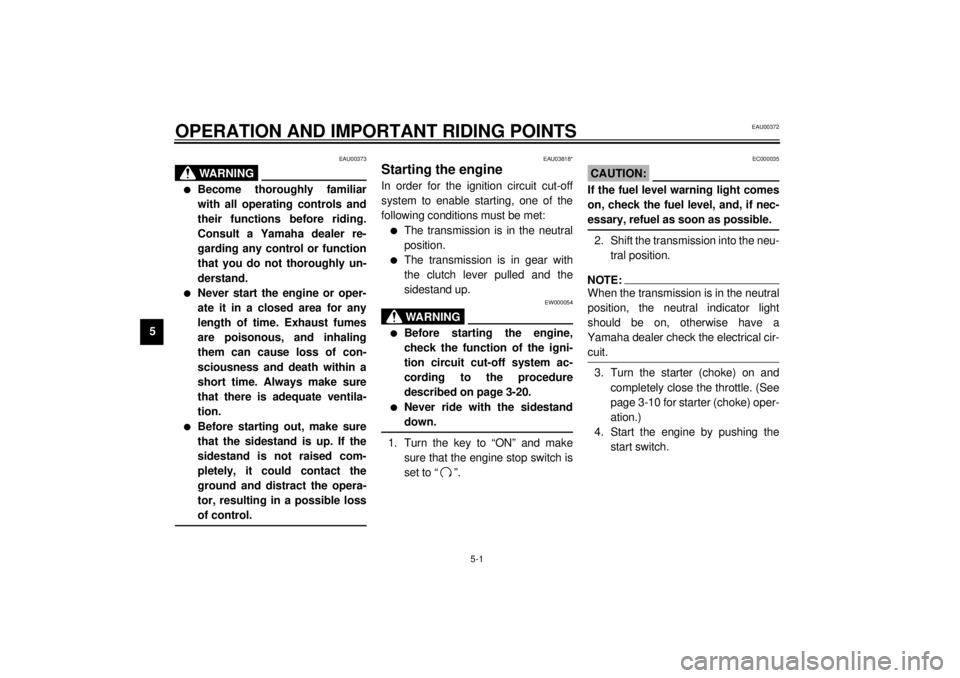
Starting the engine In order for the ignition circuit cut-off
system to enable starting, one of the
following conditions must be met:l
The transmission is in the neutral
position.
l
The transmission is in gear with
the clutch lever pulled and the
sidestand up.
EW000054
WARNING
_ l
Before starting the engine,
check the function of the igni-
tion circuit cut-off system ac-
cording to the procedure
described on page 3-20.
l
Never ride with the sidestand
down.
_1. Turn the key to “ON” and make
sure that the engine stop switch is
set to “ ”.
EC000035
CAUTION:_ If the fuel level warning light comes
on, check the fuel level, and, if nec-
essary, refuel as soon as possible. _2. Shift the transmission into the neu-
tral position.NOTE:_ When the transmission is in the neutral
position, the neutral indicator light
should be on, otherwise have a
Yamaha dealer check the electrical cir-
cuit. _3. Turn the starter (choke) on and
completely close the throttle. (See
page 3-10 for starter (choke) oper-
ation.)
4. Start the engine by pushing the
start switch.
E_4tv.book Page 1 Wednesday, October 4, 2000 2:15 PM
Page 43 of 114

OPERATION AND IMPORTANT RIDING POINTS
5-2
5
NOTE:_ If the engine fails to start, release the
start switch, wait a few seconds, and
then try again. Each starting attempt
should be as short as possible to pre-
serve the battery. Do not crank the en-
gine more than 10 seconds on any one
attempt. _
EC000038
CAUTION:_ l
The oil level warning light and
fuel level warning light should
come on when the start switch
is pushed, and they should go
off when the start switch is re-
leased.
l
If the oil level warning light flick-
ers or remains on after starting,
immediately stop the engine,
and then check the engine oil
level and the vehicle for oil leak-
age. If necessary, add engine
oil, and then check the warning
light again. If the warning light
does not come on when push-
ing the start switch, or if it doesnot go off after starting with suf-
ficient engine oil, have a
Yamaha dealer check the elec-
trical circuit.
l
If the fuel level warning light re-
mains on after starting, stop the
engine, and then check the fuel
level. If necessary, refuel as
soon as possible, and then
check the warning light again. If
the warning light does not come
on when pushing the start
switch, or if it does not go off af-
ter starting with sufficient fuel,
have a Yamaha dealer check the
electrical circuit.
_5. After starting the engine, move the
starter (choke) lever back halfway.
ECA00045
CAUTION:_ For maximum engine life, never ac-
celerate hard when the engine is
cold! _
6. When the engine is warm, turn the
starter (choke) off.NOTE:_ The engine is warm when it responds
normally to the throttle with the starter
(choke) turned off. _
E_4tv.book Page 2 Wednesday, October 4, 2000 2:15 PM
Page 45 of 114
OPERATION AND IMPORTANT RIDING POINTS
5-4
5
EAU02937
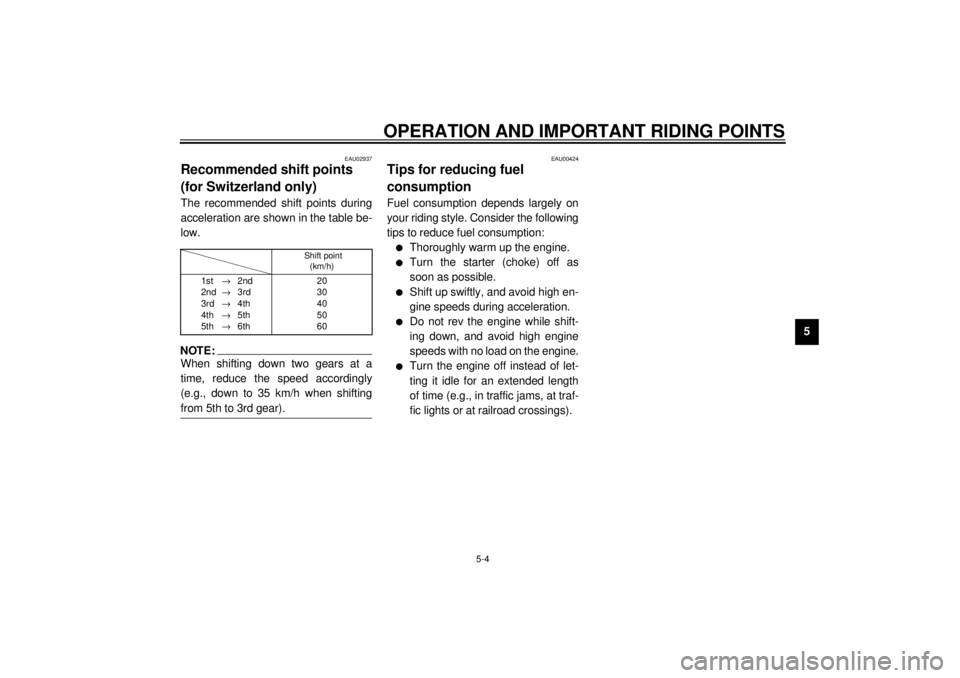
Recommended shift points
(for Switzerland only) The recommended shift points during
acceleration are shown in the table be-
low.CF-02ENOTE:_ When shifting down two gears at a
time, reduce the speed accordingly
(e.g., down to 35 km/h when shifting
from 5th to 3rd gear). _
EAU00424
Tips for reducing fuel
consumption Fuel consumption depends largely on
your riding style. Consider the following
tips to reduce fuel consumption:l
Thoroughly warm up the engine.
l
Turn the starter (choke) off as
soon as possible.
l
Shift up swiftly, and avoid high en-
gine speeds during acceleration.
l
Do not rev the engine while shift-
ing down, and avoid high engine
speeds with no load on the engine.
l
Turn the engine off instead of let-
ting it idle for an extended length
of time (e.g., in traffic jams, at traf-
fic lights or at railroad crossings).
Shift point
(km/h)
1st®2nd
2nd®3rd
3rd®4th
4th®5th
5th®6th20
30
40
50
60
E_4tv.book Page 4 Wednesday, October 4, 2000 2:15 PM
Page 51 of 114
PERIODIC MAINTENANCE AND MINOR REPAIR
6-2
6
EAU03685
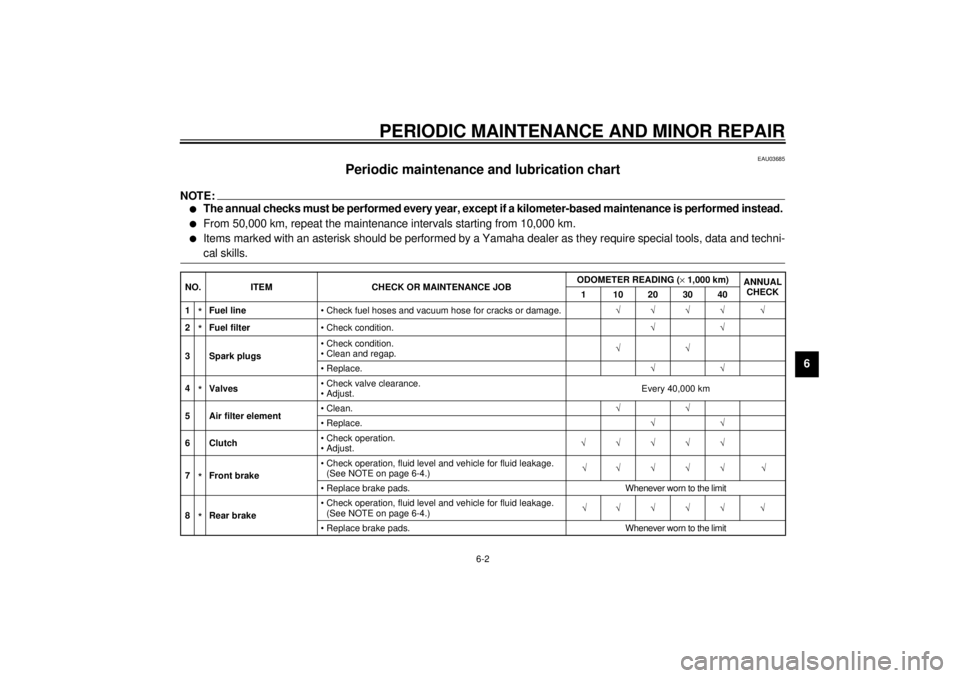
Periodic maintenance and lubrication chart
NOTE:_ l
The annual checks must be performed every year, except if a kilometer-based maintenance is performed instead.
l
From 50,000 km, repeat the maintenance intervals starting from 10,000 km.
l
Items marked with an asterisk should be performed by a Yamaha dealer as they require special tools, data and techni-
cal skills.
_
CP-03ENO. ITEM CHECK OR MAINTENANCE JOBODOMETER READING (´1,000 km)
ANNUAL
CHECK
1 10203040
1
*Fuel line• Check fuel hoses and vacuum hose for cracks or damage.ÖÖÖÖ Ö
2*Fuel filter• Check condition.ÖÖ
3 Spark plugs• Check condition.
• Clean and regap.ÖÖ
• Replace.ÖÖ
4*Valves• Check valve clearance.
•Adjust.Every 40,000 km
5 Air filter element•Clean.ÖÖ
• Replace.ÖÖ
6Clutch• Check operation.
•Adjust.ÖÖÖÖÖ
7*Front brake• Check operation, fluid level and vehicle for fluid leakage.
(See NOTE on page 6-4.)ÖÖÖÖÖ Ö
• Replace brake pads. Whenever worn to the limit
8*Rear brake• Check operation, fluid level and vehicle for fluid leakage.
(See NOTE on page 6-4.)ÖÖÖÖÖ Ö
• Replace brake pads. Whenever worn to the limit
E_4tv.book Page 2 Wednesday, October 4, 2000 2:15 PM
Page 63 of 114
PERIODIC MAINTENANCE AND MINOR REPAIR
6-14
6
EW000067
WARNING
_ Never attempt to remove the radia-
tor cap when the engine is hot. _NOTE:_ l
The radiator fan is automatically
switched on or off according to the
coolant temperature in the radia-
tor.
l
If the engine overheats, see
page 6-45 for further instructions.
_
EAU03819
To change the coolant
1. Place the motorcycle on a level
surface and let the engine cool if
necessary.
2. Remove the seat. (See page 3-11
for seat removal and installation
procedures.)
3. Remove cowling D. (See page 6-7
for cowling removal and installa-
tion procedures.)
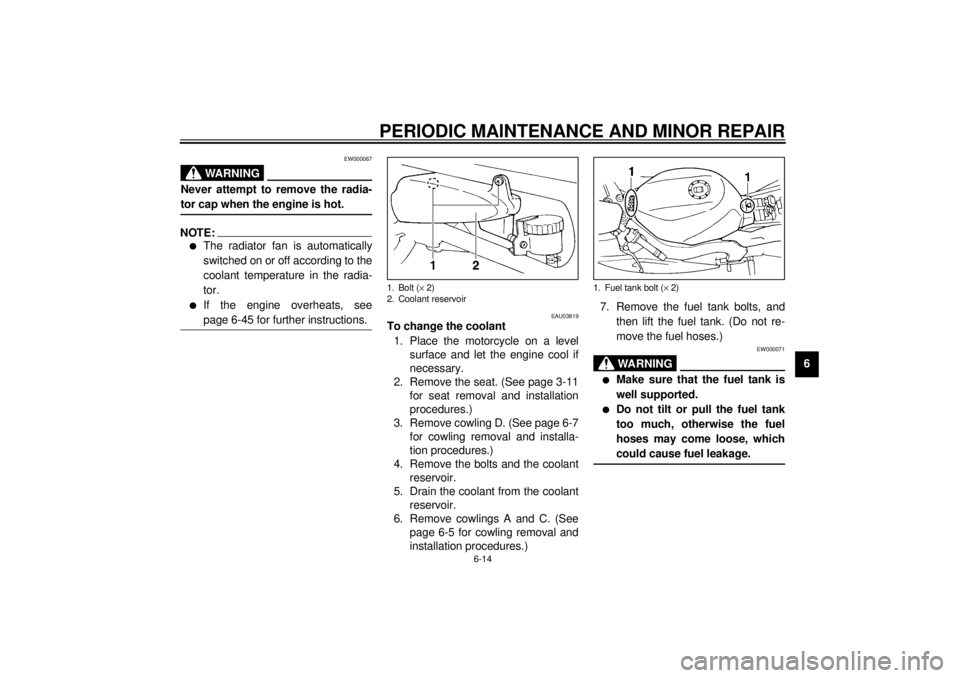
4. Remove the bolts and the coolant
reservoir.
5. Drain the coolant from the coolant
reservoir.
6. Remove cowlings A and C. (See
page 6-5 for cowling removal and
installation procedures.)7. Remove the fuel tank bolts, and
then lift the fuel tank. (Do not re-
move the fuel hoses.)
EW000071
WARNING
_ l
Make sure that the fuel tank is
well supported.
l
Do not tilt or pull the fuel tank
too much, otherwise the fuel
hoses may come loose, which
could cause fuel leakage.
_
1. Bolt (´ 2)
2. Coolant reservoir
1. Fuel tank bolt (´ 2)
E_4tv.book Page 14 Wednesday, October 4, 2000 2:15 PM
Page 65 of 114
PERIODIC MAINTENANCE AND MINOR REPAIR
6-16
6 15. Pour the specified amount of rec-
ommended coolant into the radia-
tor and reservoir.
ECA00041
CAUTION:_ Hard water or salt water is harmful
to the engine. You may use soft wa-
ter if you can’t get distilled water. _16. Install the radiator cap, start the
engine, let it idle for several min-
utes, and then turn it off.
17. Remove the radiator cap to check
the coolant level in the radiator. If
necessary, add sufficient coolant
until it reaches the top of the radia-
tor, and then install the radiator
cap.
18. Check the coolant level in the res-
ervoir. If necessary, remove the
coolant reservoir cap, add coolant
to the maximum level mark, and
then install the cap.
19. Start the engine, and then check
the vehicle for coolant leakage. If
coolant is leaking, have a Yamaha
dealer check the cooling system.
20. Install the right air intake duct, then
tighten the screw clamps.21. Install the fuel tank and fuel tank
bolts.
22. Install the coolant reservoir and
bolts.
23. Fill the coolant reservoir with the
recommended coolant to the
specified level.
24. Install the cowlings.
25. Install the seat. Tightening torques:
Water pump drain bolt:
10 Nm (1.0 m·kg)
Cylinder drain bolt
7.0 Nm (0.7 m·kg)
Antifreeze/water mixture ratio:
1:1
Recommended anti-freeze:
High-quality ethylene glycol
antifreeze containing corrosion
inhibitors for aluminum engines
Coolant quantity:
Total amount:
1.95 L
Coolant reservoir capacity:
0.55 L
E_4tv.book Page 16 Wednesday, October 4, 2000 2:15 PM