2001 YAMAHA YZF-R1 warning
[x] Cancel search: warningPage 47 of 116
OPERATION AND IMPORTANT RIDING POINTS
5-2
5
NOTE:@ If the engine fails to start, release the
start switch, wait a few seconds, and
then try again. Each starting attempt
should be as short as possible to pre-
serve the battery. Do not crank the en-
gine more than 10 seconds on any one
attempt. @
EC000038
CAUTION:@ l
The oil level warning light and
fuel level warning light should
come on when the start switch
is pushed, and they should go
off when the start switch is
released.
l
If the oil level warning light flick-
ers or remains on after starting,
immediately stop the engine,
and then check the engine oil
level and the vehicle for oil leak-
age. If necessary, add engine
oil, and then check the warning
light again. If the warning light
does not come on when push-
ing the start switch, or if it doesnot go off after starting with suf-
ficient engine oil, have a
Yamaha dealer check the elec-
trical circuit.
l
If the fuel level warning light re-
mains on after starting, stop the
engine, and then check the fuel
level. If necessary, refuel as
soon as possible, and then
check the warning light again. If
the warning light does not come
on when pushing the start
switch, or if it does not go off af-
ter starting with sufficient fuel,
have a Yamaha dealer check the
electrical circuit.
@5. After starting the engine, move the
starter (choke) lever back halfway.
ECA00045
CAUTION:@ For maximum engine life, never ac-
celerate hard when the engine is
cold! @
6. When the engine is warm, turn the
starter (choke) off.NOTE:@ l
The engine is warm when it re-
sponds normally to the throttle
with the starter (choke) turned off.
l
When the engine is idling with the
starter (choke) turned on, the radi-
ator fan will automatically be
switched on and off regardless of
the coolant temperature. As a re-
sult, the engine idling speed will
vary, but this does not indicate a
malfunction.
@
E_5jj.book Page 2 Friday, September 8, 2000 3:33 PM
Page 50 of 116

OPERATION AND IMPORTANT RIDING POINTS
5-5
5
EAU03172*
0–1,000 km
Avoid prolonged operation above
5,000 r/min.
1,000–1,600 km
Avoid prolonged operation above
6,000 r/min.
EC000052*
CAUTION:@ After 1,000 km of operation, the en-
gine oil must be changed and the oil
filter cartridge replaced. @1,600 km and beyond
The vehicle can now be operated
normally.
EC000053
CAUTION:@ l
Keep the engine speed out of
the tachometer red zone.
l
If any engine trouble should oc-
cur during the engine break-in
period, immediately have a
Yamaha dealer check the
vehicle.
@
NOTE:During and after the engine break-in
period, the exhaust heat may cause
discoloration of the exhaust pipe, but
this is normal.
EAU00460
ParkingWhen parking, stop the engine, and
then remove the key from the main
switch.
EW000058
WARNING
@ l
Since the engine and exhaust
system can become very hot,
park in a place where pedestri-
ans or children are not likely to
touch them.
l
Do not park on a slope or on
soft ground, otherwise the
motorcycle may overturn.
@
E_5jj.book Page 5 Friday, September 8, 2000 3:33 PM
Page 52 of 116

6-1
6
EAU00462
6-PERIODIC MAINTENANCE AND MINOR REPAIR
EAU00464
Safety is an obligation of the owner.
Periodic inspection, adjustment and lu-
brication will keep your vehicle in the
safest and most efficient condition pos-
sible. The most important points of in-
spection, adjustment, and lubrication
are explained on the following pages.
The intervals given in the periodic
maintenance and lubrication chart
should be simply considered as a gen-
eral guide under normal riding condi-
tions. However, DEPENDING ON THE
WEATHER, TERRAIN, GEOGRAPHI-
CAL LOCATION, AND INDIVIDUAL
USE, THE MAINTENANCE INTER-
VALS MAY NEED TO BE
SHORTENED.
EW000060
WARNING
@ If you are not familiar with motor-
cycle maintenance work, have a
Yamaha dealer do it for you. @
EAU01575
Owner’s tool kitThe tool kit is located inside the storage
compartment under the passenger
seat. (See page 3-14 for passenger
seat removal procedures.)
The service information included in this
manual and the tools provided in the
owner’s tool kit are intended to assist
you in the performance of preventive
maintenance and minor repairs. How-
ever, additional tools such as a torque
wrench may be necessary to perform
certain maintenance work correctly.
NOTE:@ If you do not have the tools or experi-
ence required for a particular job, have
a Yamaha dealer perform it for you. @
EW000063
WARNING
@ Modifications not approved by
Yamaha may cause loss of perfor-
mance and render the vehicle un-
safe for use. Consult a Yamaha
dealer before attempting any
changes. @
1. Owner’s tool kit
E_5jj.book Page 1 Friday, September 8, 2000 3:33 PM
Page 62 of 116
PERIODIC MAINTENANCE AND MINOR REPAIR
6-11
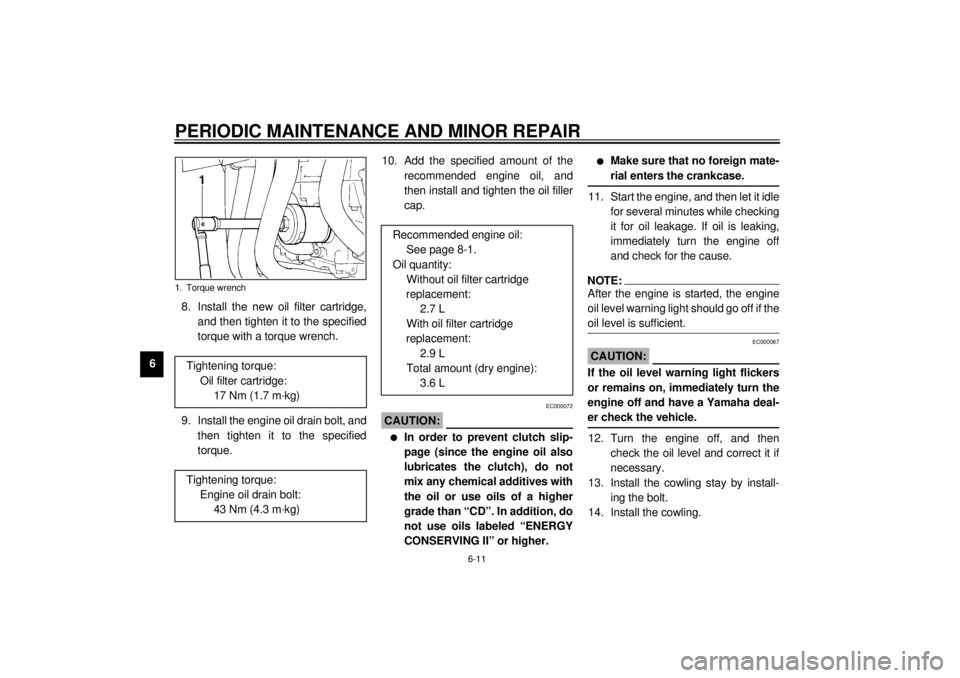
68. Install the new oil filter cartridge,
and then tighten it to the specified
torque with a torque wrench.
9. Install the engine oil drain bolt, and
then tighten it to the specified
torque.10. Add the specified amount of the
recommended engine oil, and
then install and tighten the oil filler
cap.
EC000072
CAUTION:@ l
In order to prevent clutch slip-
page (since the engine oil also
lubricates the clutch), do not
mix any chemical additives with
the oil or use oils of a higher
grade than “CD”. In addition, do
not use oils labeled “ENERGY
CONSERVING II” or higher.
l
Make sure that no foreign mate-
rial enters the crankcase.
@11. Start the engine, and then let it idle
for several minutes while checking
it for oil leakage. If oil is leaking,
immediately turn the engine off
and check for the cause.NOTE:@ After the engine is started, the engine
oil level warning light should go off if the
oil level is sufficient. @
EC000067
CAUTION:@ If the oil level warning light flickers
or remains on, immediately turn the
engine off and have a Yamaha deal-
er check the vehicle. @12. Turn the engine off, and then
check the oil level and correct it if
necessary.
13. Install the cowling stay by install-
ing the bolt.
14. Install the cowling.
1. Torque wrenchTightening torque:
Oil filter cartridge:
17 Nm (1.7 m·kg)
Tightening torque:
Engine oil drain bolt:
43 Nm (4.3 m·kg)
Recommended engine oil:
See page 8-1.
Oil quantity:
Without oil filter cartridge
replacement:
2.7 L
With oil filter cartridge
replacement:
2.9 L
Total amount (dry engine):
3.6 L
E_5jj.book Page 11 Friday, September 8, 2000 3:33 PM
Page 64 of 116

PERIODIC MAINTENANCE AND MINOR REPAIR
6-13
6
NOTE:@ l
The radiator fan is automatically
switched on or off according to the
coolant temperature in the
radiator.
l
When the engine is idling with the
starter (choke) turned on, the radi-
ator fan will automatically be
switched on and off regardless of
the coolant temperature, but this
does not indicate a malfunction.
l
If the engine overheats, see page
6-44 for further instructions.
@
EAU01577
To change the coolant
1. Place the motorcycle on a level
surface and let the engine cool if
necessary.
2. Remove cowlings A and B, and
panel A. (See pages 6-5 and 6-6
for cowling and panel removal and
installation procedures.)
3. Place a container under the en-
gine to collect the used coolant.4. Remove the radiator cap and cool-
ant reservoir cap.
EW000067
WARNING
@ Never attempt to remove the radia-
tor cap when the engine is hot. @5. Remove the coolant reservoir
bolts and the clutch cable holder
bolt, and then turn the coolant res-
ervoir upside-down to empty it.
6. Install the coolant reservoir and
the clutch cable holder by install-
ing the bolts.
1. Coolant reservoir cap
2. Radiator cap
1. Bolt (´ 3)
2. Coolant reservoir
3. Clutch cable holder
E_5jj.book Page 13 Friday, September 8, 2000 3:33 PM
Page 67 of 116

PERIODIC MAINTENANCE AND MINOR REPAIR
6-16
6 3. Lift the front of the fuel tank, and
then tilt it back and away from the
air filter case. (Do not disconnect
the fuel hoses!)
EW000071
WARNING
@ l
Make sure that the fuel tank is
well supported.
l
Do not tilt or pull the fuel tank
too much, otherwise the fuel
hoses may come loose, which
could cause fuel leakage.
@4. Remove the air filter case cover by
removing the screws and bolt.5. Pull the air filter element out.
6. Lightly tap the air filter element to
remove most of the dust and dirt,
and then blow the remaining dirt
out with compressed air as shown.
If the air filter element is damaged,
replace it.
7. Insert the air filter element into the
air filter case.1. Bolt
2. Screw (´ 8)
3. Air filter case cover
1. Air filter element
E_5jj.book Page 16 Friday, September 8, 2000 3:33 PM
Page 68 of 116

PERIODIC MAINTENANCE AND MINOR REPAIR
6-17
6
EC000082
CAUTION:@ l
Make sure that the air filter ele-
ment is properly seated in the
air filter case.
l
The engine should never be op-
erated without the air filter ele-
ment installed, otherwise the
piston(s) and/or cylinder(s) may
become excessively worn.
@8. Install the air filter case cover by
installing the screws and bolt.
9. Place the fuel tank in the original
position, and then install the bolt at
the front and tighten the bolt at the
rear.
EW000072
WARNING
@ l
Before installing the fuel tank,
make sure that the fuel hoses
are not damaged. If any fuel
hose is damaged, do not start
the engine but have a Yamaha
dealer replace the hose, other-
wise fuel may leak.
l
Make sure that the fuel hoses
are properly connected and
routed, and not pinched.
@
EAU00630
Adjusting the carburetors The carburetors are important parts of
the engine and require very sophisti-
cated adjustment. Therefore, most car-
buretor adjustments should be left to a
Yamaha dealer, who has the neces-
sary professional knowledge and expe-
rience. The adjustment described in
the following section, however, may be
serviced by the owner as part of routine
maintenance.
EC000095
CAUTION:@ The carburetors have been set and
extensively tested at the Yamaha
factory. Changing these settings
without sufficient technical knowl-
edge may result in poor perfor-
mance of or damage to the engine. @
E_5jj.book Page 17 Friday, September 8, 2000 3:33 PM
Page 70 of 116

PERIODIC MAINTENANCE AND MINOR REPAIR
6-19
6
EAU00637
Adjusting the valve clearance The valve clearance changes with use,
resulting in improper air-fuel mixture
and/or engine noise. To prevent this
from occurring, the valve clearance
must be adjusted by a Yamaha dealer
at the intervals specified in the periodic
maintenance and lubrication chart.
EAU00658
TiresTo maximize the performance, durabil-
ity, and safe operation of your motor-
cycle, note the following points
regarding the specified tires.
Tire air pressure
The tire air pressure should be
checked and, if necessary, adjusted
before each ride.
EW000082
WARNING
@ l
The tire air pressure must be
checked and adjusted on cold
tires (i.e., when the temperature
of the tires equals the ambient
temperature).
l
The tire air pressure must be
adjusted in accordance with the
riding speed and with the total
weight of rider, passenger, car-
go, and accessories approved
for this model.
@
CE-??E
CE-??E
EWA00012
WARNING
@ Because loading has an enormous
impact on the handling, braking,
performance and safety characteris-
tics of your motorcycle, you should
keep the following precautions in
mind. l
NEVER OVERLOAD THE
MOTORCYCLE! Operation of an
overloaded motorcycle may re-
sult in tire damage, loss of con-
trol, or severe injury. Make sure
Tire air pressure
(measured on cold tires)
Load* Front Rear
Up to 90 kg250 kPa
2.50 kg/cm
2
2.50 bar250 kPa
2.50 kg/cm
2
2.50 bar
90 kg–maximum250 kPa
2.50 kg/cm
2
2.50 bar290 kPa
2.90 kg/cm
2
2.90 bar
High-speed riding250 kPa
2.50 kg/cm
2
2.50 bar250 kPa
2.50 kg/cm
2
2.50 bar
Maximum load* 201 kg
* Total weight of rider, passenger, cargo and accesso-
ries
E_5jj.book Page 19 Friday, September 8, 2000 3:33 PM