Page 232 of 426

7-55
Yuki_Data:Yuki_data:Yuki:Yuki_1:ATV:HM00B061_YFM400FWA-61:YFM600-7.frame
EL
RIDING DOWNHILL
When riding your ATV downhill, shift your
weight as far to the rear and uphill side of the
ATV as possible. Move back on the seat and sit
with your arms straight. Engine compression
will do most of the braking for you. For maxi-
mum engine compression braking effect, se-
lect low range and change to 4WD before
beginning to descend the hill. Improper brak-
ing may cause a loss of traction.
Use caution while descending a hill with loose
or slippery surfaces. Braking ability and trac-
tion may be adversely affected by these surfac-
es. Improper braking may also cause a loss of
traction.
When this ATV is in 4WD, all wheels (front and
rear) are interconnected by the drive train. This
means that applying either the front brake or
the rear brake will brake all wheels. When de-
scending hills, using either brake lever or the
brake pedal will brake the wheels on the down-
hill side. Avoid sudden application of either the
front or rear brake because the wheels on the
uphill side could come off the ground. Apply
both the front and rear brakes gradually.
Page 386 of 426

8-129
Yuki_Data:Yuki_data:Yuki:Yuki_1:ATV:HM00B061_YFM400FWA-61:YFM600-8.frame
EL
EBU00413
Troubleshooting
Although Yamaha machines receive a rigid in-
spection before shipment from the factory,
trouble may occur during operation.
Any problem in the fuel, compression, or igni-
tion systems can cause poor starting and loss
of power. The troubleshooting chart describes
a quick, easy procedure for making checks. If
your machine requires any repair, take it to a
Yamaha dealer.
The skilled technicians at a Yamaha dealership
have the tools, experience, and know-how to
properly service your machine. Use only genu-
ine Yamaha parts on your machine. Imitation
parts may look like Yamaha parts, but they are
often inferior. Consequently, they have a short-
er service life and can lead to expensive repair
bills.
WARNING
Do not smoke when checking the fuel system.
Fuel can ignite or explode, causing severe inju-
ry or property damage. Make sure there are no
open flames or sparks in the area, including pi-lot lights from water heaters or furnaces.
Page 388 of 426

Yuki_Data:Yuki_data:Yuki:Yuki_1:ATV:HM00B061_YFM400FWA-61:YFM600-8.frame
EL
8-131
EBU00724Troubleshooting chart
Starting problems or poor engine performance1. Fuel
Check if there is fuel
in the fuel tank.There is fuel.Turn the fuel cock
lever to “OFF”.No fuel.Fuel cock is
clogged.
Clean the
fuel cock. Some fuel.Turn the fuel cock
lever to “RES”.Restart the engine.
No fuel.Supply fuel.
2. Compression
Use the electric
starter to see if
there is compression.There is compression.
Compression normal.
No compression.Ask a Yamaha dealer to
inspect.
3. Ignition
Remove the
spark plug and
check electrodes.WetWipe clean with dry cloth.
DryAttach spark plug cap and
ground to chassis.Use the
electric starter.Spark is good.Ignition system is
normal.
Spark is weak.
Adjust the spark plug gap
or replace the spark plug. No spark.
Ask a Yamaha dealer to
inspect. 4. Battery
Use the electric starter.Engine turns over
quickly.Battery is good.
Engine turns over
slowly.Check the connections.Check the
fuel flow.
Turn the fuel cock
lever to “ON”.
Remove the fuel hose
from the fuel cock.
Page 390 of 426
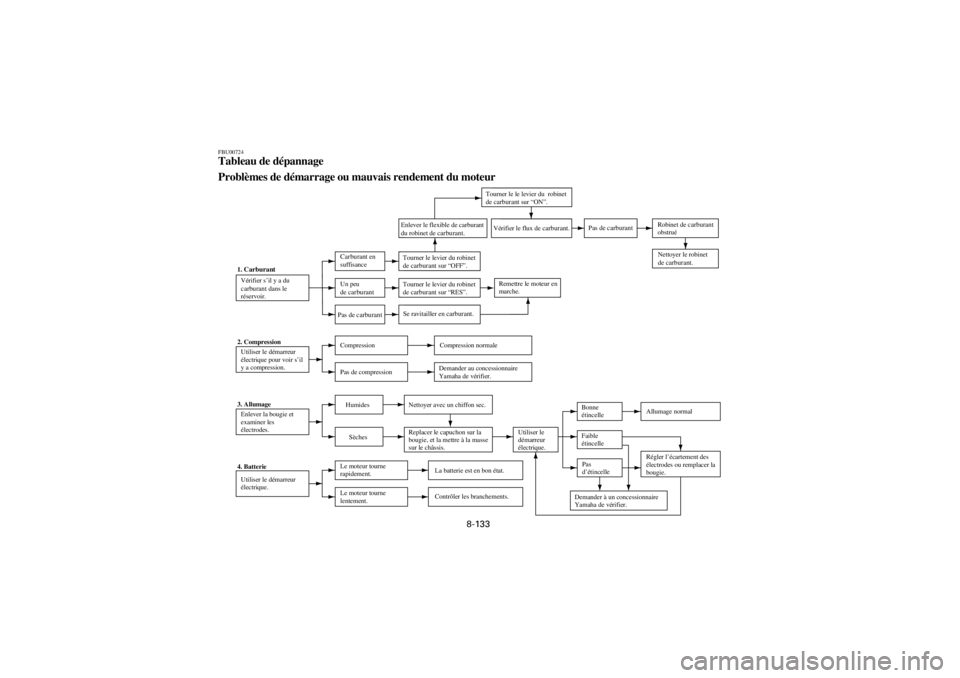
Yuki_Data:Yuki_data:Yuki:Yuki_1:ATV:HM00B061_YFM400FWA-61:YFM600-8.frame
EL
8-133
FBU00724Tableau de dépannage
Problèmes de démarrage ou mauvais rendement du moteur
1. CarburantVérifier s’il y a ducarburant
dans le
réservoir.
Carburant
en
suffisanceTourner le levier du robinet
de
carburant
sur “OFF”. Enlever le flexible de carburant
du robinet de carburant
.Vérifier le flux de
carburant
.Pas de
carburant
Robinet de
carburant
obstrué
Nettoyer le robinet
de carburant
.
Un peu
de
carburant
Tourner le levier du robinet
de carburant
sur “RES”.Remettre le moteur en
marche.
Pas de
carburant
Se ravitailler en
carburant
.
2. Compression
Utiliser le démarreur
électrique pour voir s’il
y a compression.Compression Compression normale
Pas de compressionDemander au concessionnaire
Yamaha de vérifier.
3. Allumage
Enlever la bougie et
examiner les
électrodes.Humides Nettoyer avec un chiffon sec.
SèchesReplacer le capuchon sur la
bougie, et la mettre à la masse
sur le châssis.Utiliser le
démarreur
électrique.Bonne
étincelleAllumage normal
Faible
étincelle
Régler l’écartement des
électrodes ou remplacer la
bougie. Pas
d’étincelle
Demander à un concessionnaire
Yamaha de vérifier. 4. Batterie
Utiliser le démarreur
électrique.Le moteur tourne
rapidement.La batterie est en bon état.
Le moteur tourne
lentement.Contrôler les branchements.
Tourner le le levier du robinet
de carburant
sur “ON”.
Page 404 of 426
Yuki_Data:Yuki_data:Yuki:Yuki_1:ATV:HM00B061_YFM400FWA-61:YFM600SPEC-
EL
10-1
EBU00428
SPECIFICATIONS
Model YFM400FA / YFM400FWAN
Dimensions:
Overall length 1,965 mm
Overall width 1,070 mm
Overall height 1,120 mm
Seat height 820 mm
Wheelbase 1,225 mm
Minimum ground clearance 245 mm
Minimum turning radius 3,000 mm
Basic weight:
With oil and full fuel tank 262 kg
Engine:
Engine type Liquid-cooled 4-stroke, SOHC
Cylinder arrangement Forward-inclined single cylinder
Displacement 401 cm
3
Bore
´
stroke 84.5
´
71.5 mm
Compression ratio 10.5 :1
Starting system Electric and recoil starter
Lubrication system Wet sump
Page 410 of 426
Yuki_Data:Yuki_data:Yuki:Yuki_1:ATV:HM00B061_YFM400FWA-61:YFM600SPEC-
EL
10-7
FBU00428
CARACTÉRISTIQUES TECHNIQUES
Modèle YFM400FA / YFM400FWAN
Dimensions:
Longueur hors tout 1.965 mm
Largeur hors tout 1.070 mm
Hauteur hors tout 1.120 mm
Hauteur de la selle 820 mm
Empattement 1.225 mm
Garde au sol minimale 245 mm
Rayon de braquage minimal 3.000 mm
Poids en ordre de marche:
Avec pleins d’huile et de carburant 262 kg
Moteur:
Type de moteur 4 temps, refroidissement par liquide, arbre à cames en tête
(SOHC)
Disposition des cylindres Monocylindre incliné vers l’avant
Cylindrée 401 cm
3
Alésage
´
course 84,5
´
71,5 mm
Taux de compression 10,5:1
Système de démarrage Électrique et à réenroulement
Système de graissage Carter humide

