2001 YAMAHA XL 1200 cooling
[x] Cancel search: coolingPage 93 of 131
E
4
EJU00515
MAINTENANCE AND
CARE
Storage....................................................... 4-1
Flushing the cooling system ................... 4-1
Lubrication............................................... 4-3
Fuel system............................................. 4-3
Battery ..................................................... 4-4
Cleaning the watercraft........................... 4-5
Maintenance and adjustments............... 4-6
Owner’s/Operator’s Manual and tool
kit ............................................................. 4-7
Periodic maintenance chart .................... 4-8
Inspecting the fuel system ...................... 4-9
Inspecting the oil injection system........ 4-11
Inspecting the steering cable................ 4-12
Inspecting the shift cable ...................... 4-12
Inspecting and adjusting the throttle
cable ...................................................... 4-12
Inspecting the QSTS mechanism ........ 4-13
Cleaning and adjusting the spark
plugs ...................................................... 4-14
Lubrication points .................................. 4-15
Adjusting the choke cable..................... 4-18
Inspecting the battery ........................... 4-19
Adjusting the carburetor ....................... 4-21
Replacing the fuse ................................ 4-22
Bleeding the oil injection pump............. 4-22
Specifications......................................... 4-23
Page 94 of 131
4-1
E
EJU00516a
Storage
WARNING
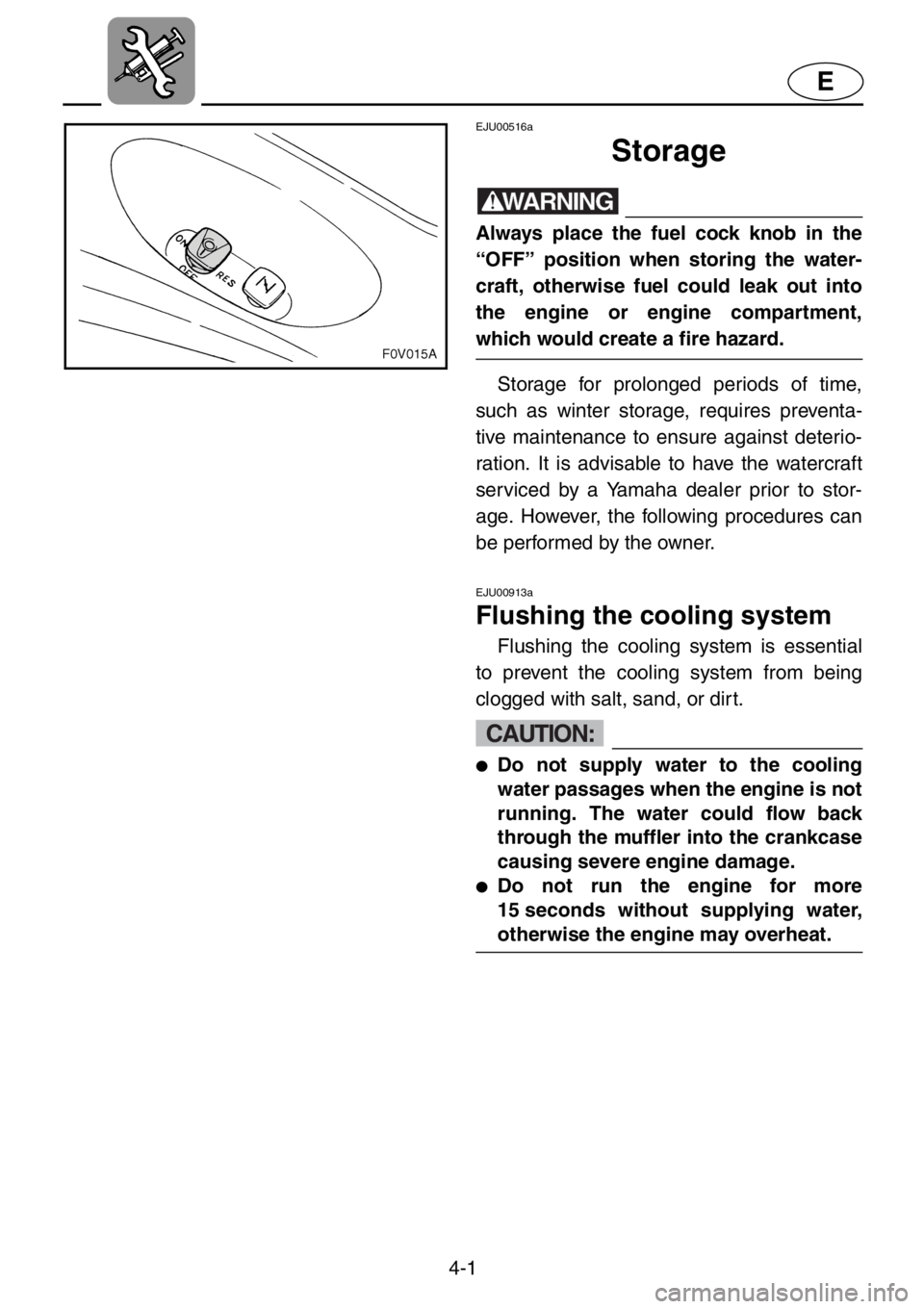
Always place the fuel cock knob in the
“OFF” position when storing the water-
craft, otherwise fuel could leak out into
the engine or engine compartment,
which would create a fire hazard.
Storage for prolonged periods of time,
such as winter storage, requires preventa-
tive maintenance to ensure against deterio-
ration. It is advisable to have the watercraft
serviced by a Yamaha dealer prior to stor-
age. However, the following procedures can
be performed by the owner.
EJU00913a
Flushing the cooling system
Flushing the cooling system is essential
to prevent the cooling system from being
clogged with salt, sand, or dirt.
CAUTION:
●Do not supply water to the cooling
water passages when the engine is not
running. The water could flow back
through the muffler into the crankcase
causing severe engine damage.
●Do not run the engine for more
15 seconds without supplying water,
otherwise the engine may overheat.
Page 95 of 131
4-2
E
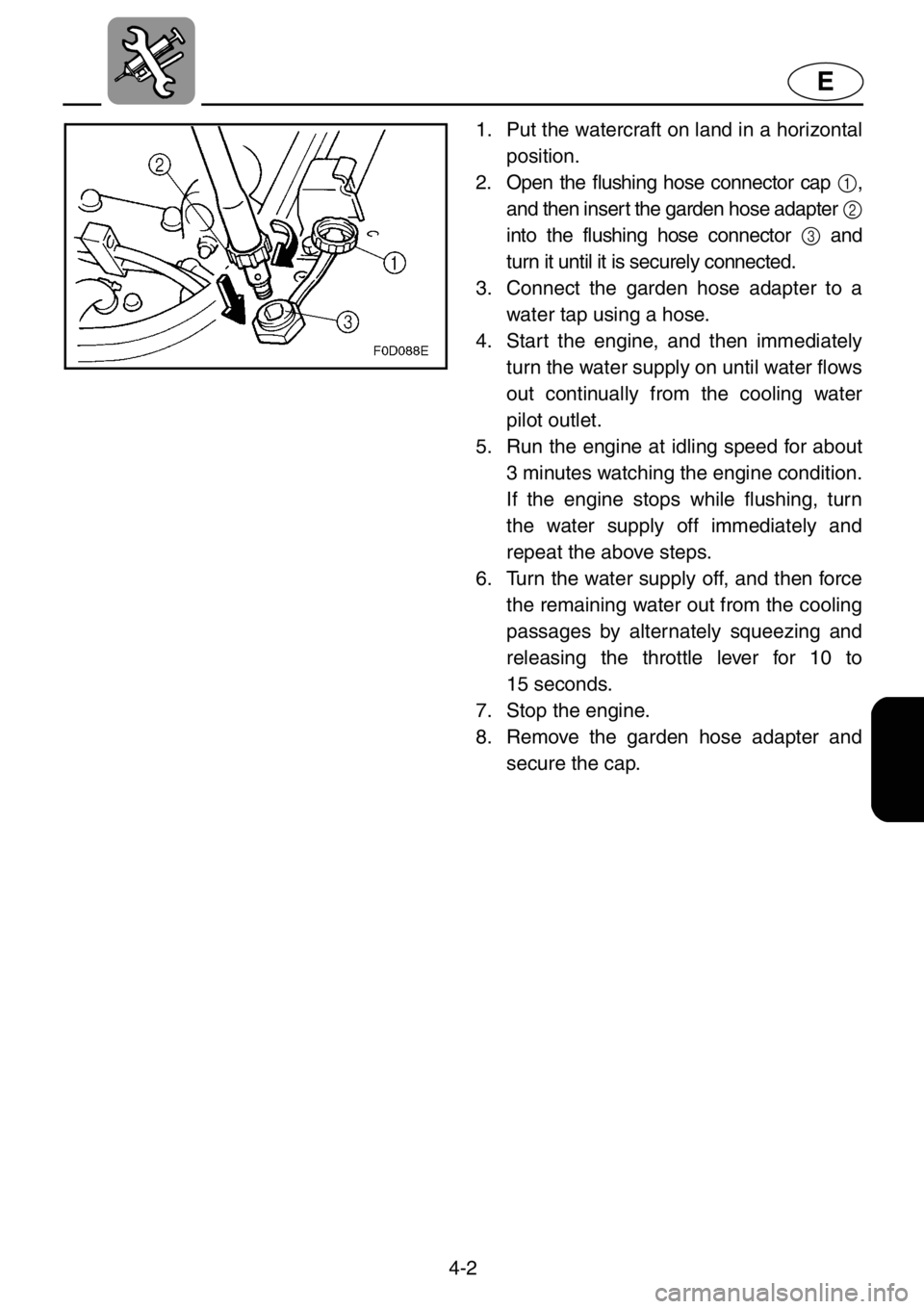
1. Put the watercraft on land in a horizontal
position.
2. Open the flushing hose connector cap 1,
and then inser t the garden hose adapter
2
into the flushing hose connector 3 and
turn it until it is securely connected.
3. Connect the garden hose adapter to a
water tap using a hose.
4. Start the engine, and then immediately
turn the water supply on until water flows
out continually from the cooling water
pilot outlet.
5. Run the engine at idling speed for about
3 minutes watching the engine condition.
If the engine stops while flushing, turn
the water supply off immediately and
repeat the above steps.
6. Turn the water supply off, and then force
the remaining water out from the cooling
passages by alternately squeezing and
releasing the throttle lever for 10 to
15 seconds.
7. Stop the engine.
8. Remove the garden hose adapter and
secure the cap.
Page 101 of 131

4-8
E
EJU00536
Periodic maintenance chart
The following chart gives general guidelines for periodic maintenance. However, depend-
ing on your operating conditions maintenance may need to be performed more frequently.
(
●) This mark indicates maintenance that you may do yourself.
(
❍) This mark indicates work to be done by a Yamaha dealer.
*1: Grease capacity: 33.0–35.0 cm3 (1.11–1.18 oz)
*2: Grease capacity: 6.0–8.0 cm3 (0.20–0.27 oz)
MAINTENANCE INTERVAL INITIALTHEREAFTER
EVERYPA G E
10
hours50
hours100
hours100
hours200
hours
ITEM
3
months6
months6
months12
months
Spark plug Inspect, clean, adjust●●●●
4-14
Lubrication points Lubricate●●
4-15
Intermediate housing Lubricate❍
*1●
*2●
*2 4-18
Fuel system Inspect❍❍
4-9
Fuel filter Check, replace❍❍
4-10
Fuel tank Clean❍
4-10
Oil injection system Inspect, clean❍❍
4-11
Trolling speed Adjust●●
4-21
Carburetor throttle shaft Inspect❍❍
—
Cooling water passages Flush
●
(after
ever y
use)4-1
Bilge strainer Clean●●●
—
Impeller Inspect●●●
—
Steering cable Inspect●●
4-12
Steering master Inspect❍❍❍
—
QSTS mechanism Inspect●●
4-13
Shift cable and mechanism Inspect, adjust●●
4-12
Throttle cable Inspect, adjust●●
4-12
Choke cable Inspect, adjust●●
4-18
Stern drain plugs Inspect, replace●
3-7
Battery Inspect
●(inspect
fluid level
before
ever y
use)
4-19
Rubber coupling Inspect❍
—
Nuts and bolts Retighten❍❍❍
—
Page 116 of 131

4-23
E
EJU00588
Specifications
MODEL
ITEMUnit XLT1200
WATERCRAFT CAPACITY
Maximum people on board Number of people 3
Maximum load capacity kg (lb) 240 (530)
DIMENSIONS
Length mm (in) 3,160 (125)
Width mm (in) 1,220 (48)
Height mm (in) 1,130 (45)
Dry weight kg (lb) 364 (803)
PERFORMANCE
Maximum output kW (PS) @ r/min 114 (155)@ 7,000
Maximum fuel consumption L/h (US gal/h, Imp gal/h) 64 (17, 14)
Cruising range at full throttle hr. 1.09
Trolling speed r/min 1,300–1,400
ENGINE
Engine type 2-stroke, L3
Engine displacement
cm
3 (cu in)1,176 (71.8)
Bore & stroke mm (in) 80.0 ×
78.0 (3.15 ×
3.07)
Compression ratio 5.9:1
Lubrication system Variable oil injection
Cooling system Water cooled
Starting system Electric starter
Ignition system Digital CDI
Spark plug BR8ES-11 (NGK)
Spark plug gap mm (in) 1.0–1.1 (0.039–0.043)
Battery capacity V-AH 12-19
Charging system Flywheel magneto
DRIVE UNIT
Propulsion system Jet pump
Jet pump type Axial flow, single stage
Impeller rotation Counterclockwise (viewed from rear)
Transmission Direct drive from engine
Jet thrust nozzle horizontal angle Degree 24 + 24
Jet thrust nozzle trim angle Degree -7, -2, 3, 8, 13
FUEL AND OIL
Recommended fuel Regular unleaded gasoline
Minimum octane rating PON
RON86
90
Recommended engine oil YAMALUBE 2-W, or an equivalent NMMA-
certified TC-W3 marine oil
Fuel tank capacity
Total L (US gal, Imp gal) 70 (18.5, 15.5)
Reserve L (US gal, Imp gal) 12 (3.2, 2.7)
Oil tank capacity L (US gal, Imp gal) 5.5 (1.5, 1.3)
Page 128 of 131

6-1
E
EJU00609
Index
2-stroke engine oil ................................... 3-3
A
Adjusting the carburetor ........................ 4-21
Adjusting the choke cable ..................... 4-18
Adjusting the trolling speed ................... 4-21
B
Battery .............................................. 3-8, 4-4
Battery warning indicator....................... 2-29
Beaching the watercraft ........................ 3-31
Bilge ........................................................ 3-7
Bleeding the oil injection pump ............. 4-22
Boarding alone ...................................... 3-24
Boarding and starting in deep water ..... 3-24
Boarding with passengers ..................... 3-25
Bow down.............................................. 2-16
Bow up .................................................. 2-16
C
Capsized watercraft .............................. 3-26
Caution labels ......................................... 1-6
Choke knob ........................................... 2-10
Cleaning and adjusting the spark
plugs...................................................... 4-14
Cleaning the jet intake and impeller ........ 5-4
Cleaning the watercraft ........................... 4-5
Clock ..................................................... 2-25
Connecting the jumper cables................. 5-6
Cooling water pilot outlet .............. 2-12, 3-13
Cruising limitations .................................. 1-9
D
Docking the watercraft .......................... 3-31
E
Emergency procedures ........................... 5-4
Engine break-in ..................................... 3-14
Engine compartment ............................... 3-6
Engine oil meter .................................... 2-25
Engine overheat warning indicator ........ 2-28
Engine overheat warning system .......... 2-17
Engine serial number .............................. 1-1
Engine shut-off cord (lanyard) ............... 3-12
Engine shut-off switch ........................... 2-10Engine stop switch ................................ 2-10
Enjoy your watercraft responsibly ......... 1-16
F
Filling the fuel tank .................................. 3-3
Filling the oil tank .................................... 3-4
Fire extinguisher ...................................... 3-9
Flushing the cooling system .................... 4-1
Front seat ................................................ 2-6
Front storage compartment ................... 2-30
Fuel and oil.............................................. 3-1
Fuel and oil systems ............................... 3-6
Fuel cock knob ........................................ 2-9
Fuel filter ............................................... 4-10
Fuel meter ............................................. 2-24
Fuel system ............................................. 4-3
Fuel tank ............................................... 4-10
Fuel tank filler cap ................................... 2-8
Fuel warning indicator ........................... 2-27
G
Gasohol ................................................... 3-2
Gasoline .................................................. 3-1
Getting to know your watercraft ............ 3-20
Glove compartment ............................... 2-31
H
Handgrip ................................................ 2-19
Hazard information ................................ 1-12
Hood........................................................ 2-7
Hour meter ............................................ 2-26
Hull Identification Number (HIN).............. 1-1
I
Identification numbers ............................. 1-1
Important labels ....................................... 1-2
Inspecting and adjusting the throttle
cable...................................................... 4-12
Inspecting the battery ............................ 4-19
Inspecting the fuel system ....................... 4-9
Inspecting the oil injection system ......... 4-11
Inspecting the QSTS mechanism .......... 4-13
Inspecting the shift cable ....................... 4-12
Inspecting the steering cable................ 4-12
J
Jet unit................................................... 3-12
Jumping the battery ................................. 5-5