2001 YAMAHA XJ900S check engine
[x] Cancel search: check enginePage 54 of 100
PERIODIC MAINTENANCE AND MINOR REPAIR
6-11
6
EC000067
CAUTION:@ If the oil level warning light flickers
or remains on, immediately turn the
engine off and have a Yamaha deal-
er check the vehicle. @10. Turn the engine off, and then
check the oil level and correct it if
necessary.
EAU03681
Final gear oil The final gear case must be checked
for oil leakage before each ride. If any
leakage is found, have a Yamaha deal-
er check and repair the motorcycle. In
addition, the final gear oil must be
changed as follows at the intervals
specified in the periodic maintenance
and lubrication chart.
EW000066
WARNING
_ l
Make sure that no foreign mate-
rial enters the final gear case.
l
Make sure that no oil gets on
the tire or wheel.
_To check the final gear oil level
1. Place the motorcycle on the cen-
terstand.
NOTE:_ l
The final gear oil level must be
checked on a cold engine.
l
Make sure that the motorcycle is
positioned straight up when
checking the oil level. A slight tilt to
the side can result in a false read-
ing.
_
E_4km.book Page 11 Thursday, September 7, 2000 9:32 AM
Page 58 of 100

PERIODIC MAINTENANCE AND MINOR REPAIR
6-15
6
EAU00630
Adjusting the carburetors The carburetors are important parts of
the engine and require very sophisti-
cated adjustment. Therefore, most car-
buretor adjustments should be left to a
Yamaha dealer, who has the neces-
sary professional knowledge and expe-
rience. The adjustment described in
the following section, however, may be
serviced by the owner as part of routine
maintenance.
EC000095
CAUTION:@ The carburetors have been set and
extensively tested at the Yamaha
factory. Changing these settings
without sufficient technical knowl-
edge may result in poor perfor-
mance of or damage to the engine. @
EAU00632
Adjusting the engine idling
speed The engine idling speed must be
checked and, if necessary, adjusted as
follows at the intervals specified in the
periodic maintenance and lubrication
chart.
1. Start the engine and warm it up
for several minutes at 1,000–
2,000 r/min while occasionally rev-
ving it to 4,000–5,000 r/min.NOTE:@ The engine is warm when it quickly re-
sponds to the throttle. @
2. Check the engine idling speed
and, if necessary, adjust it to spec-
ification by turning the throttle stop
screw. To increase the engine
idling speed, turn the screw in di-
rection
a. To decrease the engine
idling speed, turn the screw in
direction
b.NOTE:@ If the specified idling speed cannot be
obtained as described above, have a
Yamaha dealer make the adjustment. @ 1. Throttle stop screw
Engine idling speed:
950–1,050 r/min
E_4km.book Page 15 Thursday, September 7, 2000 9:32 AM
Page 60 of 100
PERIODIC MAINTENANCE AND MINOR REPAIR
6-17
6
EAU00637
Adjusting the valve clearance The valve clearance changes with use,
resulting in improper air-fuel mixture
and/or engine noise. To prevent this
from occurring, the valve clearance
must be adjusted by a Yamaha dealer
at the intervals specified in the periodic
maintenance and lubrication chart.
EAU00658
Tires To maximize the performance, durabil-
ity, and safe operation of your motor-
cycle, note the following points
regarding the specified tires.
Tire air pressure
The tire air pressure should be
checked and, if necessary, adjusted
before each ride.
EW000082
WARNING
@ l
The tire air pressure must be
checked and adjusted on cold
tires (i.e., when the temperature
of the tires equals the ambient
temperature).
l
The tire air pressure must be
adjusted in accordance with the
riding speed and with the total
weight of rider, passenger, car-
go, and accessories approved
for this model.
@
CE-01E
CE-07E
EWA00012
WARNING
@ Because loading has an enormous
impact on the handling, braking,
performance and safety characteris-
tics of your motorcycle, you should
keep the following precautions in
mind. l
NEVER OVERLOAD THE
MOTORCYCLE! Operation of an
overloaded motorcycle may re-
sult in tire damage, loss of con-
trol, or severe injury. Make sure
Tire air pressure
(measured on cold tires)
Load* Front Rear
Up to 90 kg225 kPa
2.25 kg/cm
2
2.25 bar250 kPa
2.50 kg/cm
2
2.50 bar
90 kg–maximum250 kPa
2.50 kg/cm
2
2.50 bar290 kPa
2.90 kg/cm
2
2.90 bar
High-speed riding250 kPa
2.50 kg/cm
2
2.50 bar290 kPa
2.90 kg/cm
2
2.90 bar
Maximum load* 205 kg
* Total weight of rider, passenger, cargo and
accessories
E_4km.book Page 17 Thursday, September 7, 2000 9:32 AM
Page 66 of 100
PERIODIC MAINTENANCE AND MINOR REPAIR
6-23
6
EAU03238
Changing the brake fluid Have a Yamaha dealer change the
brake fluid at the intervals specified in
the periodic maintenance and lubrica-
tion chart. In addition, have the oil seals
of the brake master cylinder and caliper
as well as the brake hose replaced at
the intervals listed below or whenever
they are damaged or leaking.l
Oil seals: Replace every two
years.
l
Brake hose: Replace every four
years.
EAU02962
Checking and lubricating the
cables The operation of all control cables and
the condition of the cables should be
checked before each ride, and the ca-
bles and cable ends should be lubricat-
ed if necessary. If a cable is damaged
or does not move smoothly, have a
Yamaha dealer check or replace it.
EW000112
WARNING
@ Damage to the outer sheath may in-
terfere with proper cable operation
and will cause the inner cable to
rust. Replace a damaged cable as
soon as possible to prevent unsafe
conditions. @
EAU03209
Checking and lubricating the
throttle grip and cable The operation of the throttle grip and
the condition of the throttle cable
should be checked before each ride,
and the cable should be lubricated or
replaced if necessary.NOTE:@ Since the throttle grip must be removed
to access the throttle cable end, the
throttle grip and the cable should al-
ways be lubricated at the same time. @1. Remove the throttle grip by remov-
ing the screws.
2. Disconnect the throttle cable, hold
it up, and then apply several drops
of oil to the cable end, allowing it to
trickle into the sheath.
3. Connect the throttle cable, and
then grease the inside of the throt-
tle grip housing.
4. Grease the metal-to-metal contact
surface of the throttle grip, and
then install the grip by installing
the screws. Recommended lubricant:
Engine oil
E_4km.book Page 23 Thursday, September 7, 2000 9:32 AM
Page 67 of 100
PERIODIC MAINTENANCE AND MINOR REPAIR
6-24
6
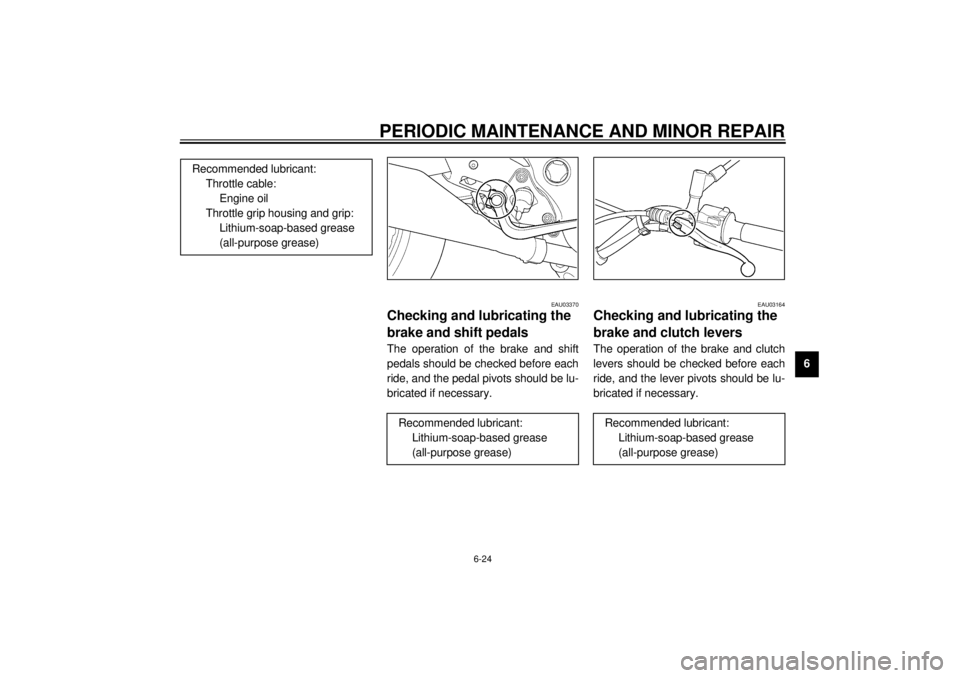
EAU03370
Checking and lubricating the
brake and shift pedals The operation of the brake and shift
pedals should be checked before each
ride, and the pedal pivots should be lu-
bricated if necessary.
EAU03164
Checking and lubricating the
brake and clutch levers The operation of the brake and clutch
levers should be checked before each
ride, and the lever pivots should be lu-
bricated if necessary. Recommended lubricant:
Throttle cable:
Engine oil
Throttle grip housing and grip:
Lithium-soap-based grease
(all-purpose grease)
Recommended lubricant:
Lithium-soap-based grease
(all-purpose grease)
Recommended lubricant:
Lithium-soap-based grease
(all-purpose grease)
E_4km.book Page 24 Thursday, September 7, 2000 9:32 AM
Page 69 of 100
PERIODIC MAINTENANCE AND MINOR REPAIR
6-26
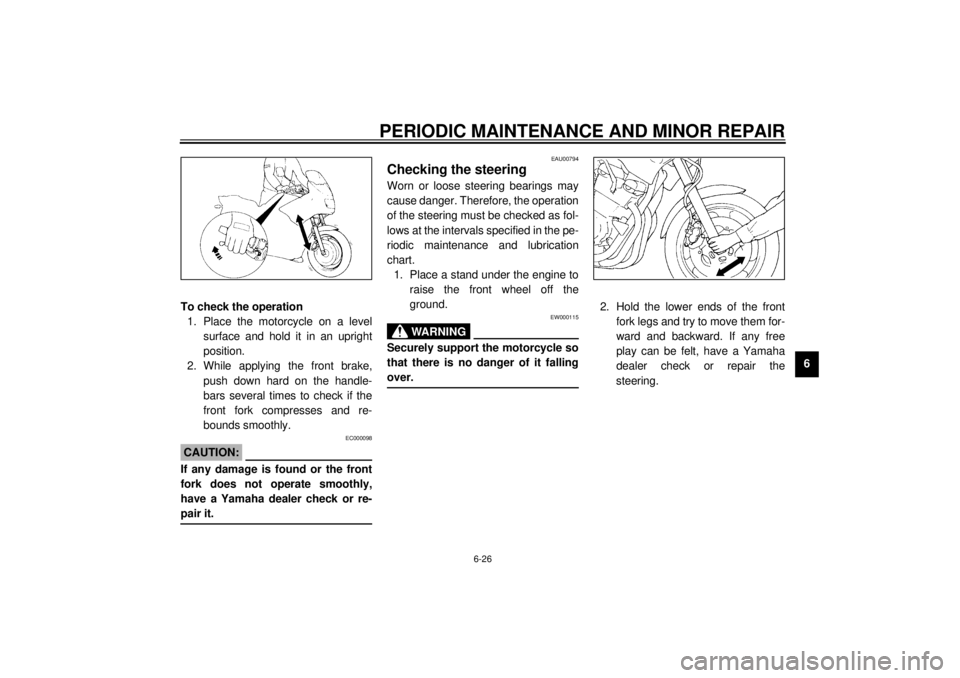
6 To check the operation
1. Place the motorcycle on a level
surface and hold it in an upright
position.
2. While applying the front brake,
push down hard on the handle-
bars several times to check if the
front fork compresses and re-
bounds smoothly.
EC000098
CAUTION:@ If any damage is found or the front
fork does not operate smoothly,
have a Yamaha dealer check or re-
pair it. @
EAU00794
Checking the steering Worn or loose steering bearings may
cause danger. Therefore, the operation
of the steering must be checked as fol-
lows at the intervals specified in the pe-
riodic maintenance and lubrication
chart.
1. Place a stand under the engine to
raise the front wheel off the
ground.
EW000115
WARNING
@ Securely support the motorcycle so
that there is no danger of it falling
over. @
2. Hold the lower ends of the front
fork legs and try to move them for-
ward and backward. If any free
play can be felt, have a Yamaha
dealer check or repair the
steering.
E_4km.book Page 26 Thursday, September 7, 2000 9:32 AM
Page 79 of 100

PERIODIC MAINTENANCE AND MINOR REPAIR
6-36
6
EAU01297
Troubleshooting chart
EW000125
WARNING
@ Keep away open flames and do not smoke while checking or working on the fuel system. @
Check the fuel level in
the fuel tank.1. Fuel
There is enough fuel.
There is no fuel.
Check the compression.
Supply fuel.
The engine does not start.
Check the compression.
Operate the electric starter.2. Compression
There is compression.
There is no compression.
Check the ignition.
Have a Yamaha dealer
check the vehicle.
Remove the spark plugs
and check the electrodes.3. Ignition
Wipe off with a dry cloth and correct the
spark plug gaps, or replace the spark plugs.
Have a Yamaha dealer check the vehicle.
The engine does not start.
Have a Yamaha dealer
check the vehicle.
The engine does not start.
Check the battery.
Operate the electric starter.4. Battery
The engine turns over
quickly.
The engine turns over
slowly.
The battery is good.Check the battery lead connections,
and charge the battery if necessary.
DryWet
Open the throttle halfway and operate
the electric starter.
E_4km.book Page 36 Thursday, September 7, 2000 9:32 AM
Page 96 of 100

10-INDEXAAir filter element, cleaning ...................... 6-13
Anti-theft alarm ........................................3-5BBattery ................................................... 6-27
Brake and clutch levers, checking and
lubricating ............................................ 6-24
Brake and shift pedals, checking and
lubricating ............................................ 6-24
Brake fluid, changing ............................. 6-23
Brake fluid level, checking...................... 6-22
Brake lever...............................................3-8
Brake light switch (rear), adjusting ......... 6-21
Brake pads, checking............................. 6-21
Brake pedal..............................................3-8CCables, checking and lubricating............ 6-23
Carburetors, adjusting............................ 6-15
Care.........................................................7-1
Centerstand and sidestand,
checking and lubricating ...................... 6-25
Clock .......................................................3-5
Clutch lever ..............................................3-7
Clutch lever free play, adjusting ............. 6-20
Conversion table ......................................8-5
Cowlings, removing and installing ............6-5DDimmer switch .........................................3-6
EEngine break-in ....................................... 5-4
Engine oil and oil filter cartridge ............... 6-8
Engine stop switch................................... 3-7FFinal gear oil .......................................... 6-11
Front fork, adjusting ............................... 3-13
Front fork, checking ............................... 6-25
Fuel ......................................................... 3-9
Fuel consumption, tips for reducing ......... 5-4
Fuel gauge .............................................. 3-5
Fuel level warning light ............................ 3-2
Fuel tank breather hose
(Germany only) ................................... 3-10
Fuel tank cap ........................................... 3-9
Fuses, replacing .................................... 6-29HHandlebar switches ................................. 3-6
Hazard switch .......................................... 3-6
Headlight bulb, replacing ....................... 6-30
Helmet holder ........................................ 3-11
High beam indicator light ......................... 3-3
Horn switch ............................................. 3-6IIdentification numbers ............................. 9-1
Idling speed, adjusting ........................... 6-15
Ignition circuit cut-off system.................. 3-15
Indicator and warning lights ..................... 3-2KKey identification number ........................ 9-1
LLight switch ..............................................3-7MMain switch/steering lock .........................3-1
Model label ..............................................9-2NNeutral indicator light ...............................3-3OOil level warning light ...............................3-3PParking.....................................................5-5
Part locations ...........................................2-1
Pass switch ..............................................3-6
Periodic maintenance and lubrication
chart ......................................................6-2
Pre-operation check list ............................4-1SSafety information ....................................1-1
Seat .......................................................3-11
Self-diagnosis device ...............................3-4
Shifting .....................................................5-3
Shift pedal ................................................3-8
Shift points (for Switzerland only) .............5-4
Shock absorber assembly, adjusting ......3-13
Sidestand ...............................................3-15
Spark plugs, checking ..............................6-7
Specifications ...........................................8-1
Speedometer unit.....................................3-3
Starter (choke) lever...............................3-10
Starting a cold engine ..............................5-1
E_4km.book Page 1 Thursday, September 7, 2000 9:32 AM