2001 YAMAHA XJ900S light
[x] Cancel search: lightPage 35 of 100

PRE-OPERATION CHECKS
4-2
4
NOTE:@ Pre-operation checks should be made each time the motorcycle is used. Such an inspection can be accomplished in a very
short time; and the added safety it assures is more than worth the time involved. @
EWA00033
WARNING
@ If any item in the Pre-operation check list is not working properly, have it inspected and repaired before operating
the motorcycle. @Wheels and tires• Check for damage.
• Check tire condition and tread depth.
• Check air pressure.
• Correct if necessary.6-17–6-20
Brake and shift pedals• Make sure that operation is smooth.
• Lubricate pedal pivoting points if necessary.6-24
Brake and clutch levers• Make sure that operation is smooth.
• Lubricate lever pivoting points if necessary.6-24
Centerstand, sidestand• Make sure that operation is smooth.
• Lubricate pivots if necessary.6-25
Chassis fasteners• Make sure that all nuts, bolts and screws are properly tightened.
• Tighten if necessary.—
Instruments, lights, signals
and switches• Check operation.
• Correct if necessary.—
Sidestand switch• Check operation of ignition circuit cut-off system.
• If system is defective, have Yamaha dealer check vehicle.3-15 ITEM CHECKS PAGE
E_4km.book Page 2 Thursday, September 7, 2000 9:32 AM
Page 38 of 100

5-1
5
EAU00372
5-OPERATION AND IMPORTANT RIDING POINTS
EAU00373
WARNING
@ l
Become thoroughly familiar
with all operating controls and
their functions before riding.
Consult a Yamaha dealer re-
garding any control or function
that you do not thoroughly
understand.
l
Never start the engine or oper-
ate it in a closed area for any
length of time. Exhaust fumes
are poisonous, and inhaling
them can cause loss of con-
sciousness and death within a
short time. Always make sure
that there is adequate
ventilation.
l
Before starting out, make sure
that the sidestand is up. If the
sidestand is not raised com-
pletely, it could contact the
ground and distract the opera-
tor, resulting in a possible loss
of control.
@
EAU01627*
Starting a cold engine In order for the ignition circuit cut-off
system to enable starting, one of the
following conditions must be met:l
The transmission is in the neutral
position.
l
The transmission is in gear with
the clutch lever pulled and the
sidestand up.
EW000054
WARNING
@ l
Before starting the engine,
check the function of the igni-
tion circuit cut-off system ac-
cording to the procedure
described on page 3-17.
l
Never ride with the sidestand
down.
@1. Turn the key to “ON” and make
sure that the engine stop switch is
set to “ ”.
EC000035
CAUTION:@ If the fuel level warning light comes
on, check the fuel level, and, if nec-
essary, refuel as soon as possible. @2. Shift the transmission into the neu-
tral position.NOTE:@ When the transmission is in the neutral
position, the neutral indicator light
should be on, otherwise have a
Yamaha dealer check the electrical
circuit. @3. Turn the starter (choke) on and
completely close the throttle. (See
page 3-10 for starter (choke) oper-
ation.)
4. Start the engine by pushing the
start switch.
E_4km.book Page 1 Thursday, September 7, 2000 9:32 AM
Page 39 of 100

OPERATION AND IMPORTANT RIDING POINTS
5-2
5
NOTE:@ If the engine fails to start, release the
start switch, wait a few seconds, and
then try again. Each starting attempt
should be as short as possible to pre-
serve the battery. Do not crank the en-
gine more than 10 seconds on any one
attempt. @
EC000038
CAUTION:@ l
The oil level warning light and
fuel level warning light should
come on when the start switch
is pushed, and they should go
off when the start switch is re-
leased.
l
If the oil level warning light flick-
ers or remains on after starting,
immediately stop the engine,
and then check the engine oil
level and the vehicle for oil leak-
age. If necessary, add engine
oil, and then check the warning
light again. If the warning light
does not come on when push-
ing the start switch, or if it doesnot go off after starting with suf-
ficient engine oil, have a
Yamaha dealer check the elec-
trical circuit.
l
If the fuel level warning light re-
mains on after starting, stop the
engine, and then check the fuel
level. If necessary, refuel as
soon as possible, and then
check the warning light again. If
the warning light does not come
on when pushing the start
switch, or if it does not go off af-
ter starting with sufficient fuel,
have a Yamaha dealer check the
electrical circuit.
@5. After starting the engine, move the
starter (choke) lever back halfway.
ECA00045
CAUTION:@ For maximum engine life, never ac-
celerate hard when the engine is
cold! @6. When the engine is warm, turn the
starter (choke) off.
NOTE:@ l
The engine is warm when it re-
sponds normally to the throttle
with the starter (choke) turned off.
l
When the engine is idling with the
starter (choke) on, the radiator fan
will automatically be switched on
and off regardless of the radiator
coolant temperature, and the en-
gine idling speed will vary at times,
but this is not a malfunction.
@
E_4km.book Page 2 Thursday, September 7, 2000 9:32 AM
Page 40 of 100
OPERATION AND IMPORTANT RIDING POINTS
5-3
5
EAU01258
Starting a warm engine Follow the same procedure as for start-
ing a cold engine with the exception
that the starter (choke) is not required
when the engine is warm.
EAU00423
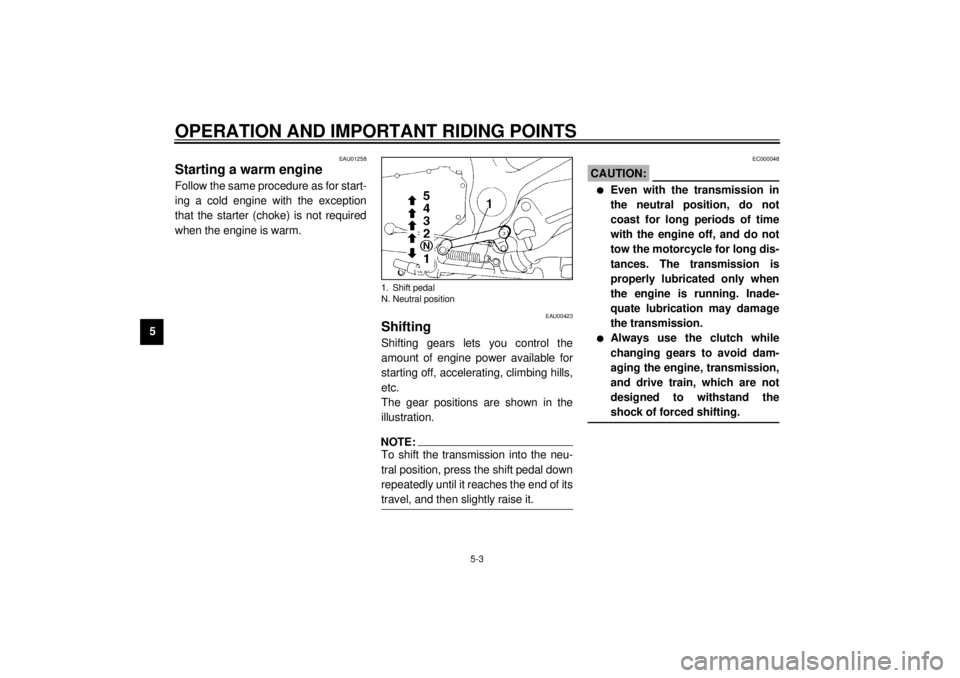
Shifting Shifting gears lets you control the
amount of engine power available for
starting off, accelerating, climbing hills,
etc.
The gear positions are shown in the
illustration.NOTE:@ To shift the transmission into the neu-
tral position, press the shift pedal down
repeatedly until it reaches the end of its
travel, and then slightly raise it. @
EC000048
CAUTION:@ l
Even with the transmission in
the neutral position, do not
coast for long periods of time
with the engine off, and do not
tow the motorcycle for long dis-
tances. The transmission is
properly lubricated only when
the engine is running. Inade-
quate lubrication may damage
the transmission.
l
Always use the clutch while
changing gears to avoid dam-
aging the engine, transmission,
and drive train, which are not
designed to withstand the
shock of forced shifting.
@
1. Shift pedal
N. Neutral position
E_4km.book Page 3 Thursday, September 7, 2000 9:32 AM
Page 41 of 100

OPERATION AND IMPORTANT RIDING POINTS
5-4
5
EAU02941
Recommended shift points
(for Switzerland only) The recommended shift points during
acceleration are shown in the table
below.CF-01ENOTE:@ When shifting down two gears at a
time, reduce the speed accordingly
(e.g., down to 35 km/h when shifting
from 4th to 2nd gear). @
EAU00424
Tips for reducing fuel
consumption Fuel consumption depends largely on
your riding style. Consider the following
tips to reduce fuel consumption:l
Thoroughly warm up the engine.
l
Turn the starter (choke) off as
soon as possible.
l
Shift up swiftly, and avoid high en-
gine speeds during acceleration.
l
Do not rev the engine while shift-
ing down, and avoid high engine
speeds with no load on the engine.
l
Turn the engine off instead of let-
ting it idle for an extended length
of time (e.g., in traffic jams, at traf-
fic lights or at railroad crossings).
EAU00436
Engine break-in There is never a more important period
in the life of your engine than the period
between 0 and 1,000 km. For this rea-
son, you should read the following ma-
terial carefully.
Since the engine is brand new, do not
put an excessive load on it for the first
1,000 km. The various parts in the en-
gine wear and polish themselves to the
correct operating clearances. During
this period, prolonged full-throttle oper-
ation or any condition that might result
in engine overheating must be avoided.
Shift point
(km/h)
1st®2nd
2nd®3rd
3rd®4th
4th®5th23
36
50
60
E_4km.book Page 4 Thursday, September 7, 2000 9:32 AM
Page 43 of 100
6
PERIODIC MAINTENANCE AND MINOR REPAIR
Owner’s tool kit .................................................... 6-1
Periodic maintenance and lubrication chart ......... 6-2
Removing and installing cowlings ........................ 6-5
Checking the spark plugs .................................... 6-7
Engine oil and oil filter cartridge .......................... 6-8
Final gear oil ...................................................... 6-11
Cleaning the air filter element ............................ 6-13
Adjusting the carburetors ................................... 6-15
Adjusting the engine idling speed ...................... 6-15
Adjusting the throttle cable free play .................. 6-16
Adjusting the valve clearance ............................ 6-17
Tires ................................................................... 6-17
Wheels ............................................................... 6-20
Adjusting the clutch lever free play .................... 6-20
Adjusting the rear brake light switch .................. 6-21
Checking the front and rear brake pads ............. 6-21
Checking the brake fluid level ............................ 6-22
Changing the brake fluid .................................... 6-23
Checking and lubricating the cables .................. 6-23Checking and lubricating the throttle grip and
cable ............................................................... 6-23
Checking and lubricating the brake and
shift pedals ...................................................... 6-24
Checking and lubricating the brake and
clutch levers .................................................... 6-24
Checking and lubricating the centerstand and
sidestand ......................................................... 6-25
Checking the front fork ...................................... 6-25
Checking the steering ....................................... 6-26
Checking the wheel bearings ............................ 6-27
Battery ............................................................... 6-27
Replacing the fuses .......................................... 6-29
Replacing a headlight bulb ................................ 6-30
Front wheel ....................................................... 6-31
Rear wheel ........................................................ 6-33
Troubleshooting ................................................. 6-35
Troubleshooting chart ........................................ 6-36
E_4km.book Page 1 Thursday, September 7, 2000 9:32 AM
Page 47 of 100

PERIODIC MAINTENANCE AND MINOR REPAIR
6-4
6
EAU03541
NOTE:@l
The air filter needs more frequent service if you are riding in unusually wet or dusty areas.
l
Hydraulic brake service
• Regularly check and, if necessary, correct the brake fluid level.
• Every two years replace the internal components of the brake master cylinder and caliper, and change the brake fluid.
• Replace the brake hoses every four years and if cracked or damaged.
@25
*Front and rear brake
switches• Check operation.ÖÖÖÖÖ Ö
26 Moving parts and cables• Lubricate.ÖÖÖÖ Ö
27*Lights, signals and
switches• Check operation.
• Adjust headlight beam.ÖÖÖÖÖ Ö NO. ITEM CHECK OR MAINTENANCE JOBODOMETER READING (´1,000 km)
ANNUAL
CHECK
1 10203040
E_4km.book Page 4 Thursday, September 7, 2000 9:32 AM
Page 50 of 100

PERIODIC MAINTENANCE AND MINOR REPAIR
6-7
6
EAU01880
Checking the spark plugs The spark plugs are important engine
components, which should be checked
periodically, preferably by a Yamaha
dealer. Since heat and deposits will
cause any spark plug to slowly erode,
they should be removed and checked
in accordance with the periodic mainte-
nance and lubrication chart. In addition,
the condition of the spark plugs can re-
veal the condition of the engine.
The porcelain insulator around the cen-
ter electrode of each spark plug should
be a medium-to-light tan (the ideal col-
or when the motorcycle is ridden nor-
mally), and all spark plugs installed in
the engine should have the same color.
If any spark plug shows a distinctly dif-
ferent color, the engine could be defec-
tive. Do not attempt to diagnose such
problems yourself. Instead, have a
Yamaha dealer check the motorcycle.If a spark plug shows signs of electrode
erosion and excessive carbon or other
deposits, it should be replaced.
Before installing a spark plug, the spark
plug gap should be measured with a
wire thickness gauge and, if necessary,
adjusted to specification.
Clean the surface of the spark plug
gasket and its mating surface, and then
wipe off any grime from the spark plug
threads. Specified spark plug:
DPR8EA-9 (NGK) or
X24EPR-U9 (DENSO)
a. Spark plug gap
Spark plug gap:
0.8–0.9 mm
Tightening torque:
Spark plug:
17.5 Nm (1.75 m·kg)
E_4km.book Page 7 Thursday, September 7, 2000 9:32 AM