Page 42 of 135
2-15
E
Bow down
Turn the grip to A or B and the bow will
go down while the watercraft is on plane.
Bow down puts more of the bow in the
water. This gives the watercraft more “hook,”
which enhances turning performance. This
position will also help the watercraft get up
on plane more quickly.
At higher speeds, however, the watercraft
will have greater tendency to “bow steer”
and follow waves and wakes in the water.
Fuel economy and maximum speed are also
reduced.
Bow up
Turn the grip to C or D and the bow will
go up while the watercraft is on plane.
Bow up puts less of the bow in the water.
There is less water resistance, so straight-
ahead acceleration when on plane and top
speed are enhanced.
In some conditions, however, the water-
craft may tend to “porpoise” (hop in the
water). If the watercraft is porpoising,
choose neutral or bow down.
E_GU5-71-2.fm Page 15 Thursday, July 13, 2000 7:48 PM
Page 45 of 135

2-18
E
EJU00698b
Multifunction meter
This meter contains following functions for
help and convenience in operating the
watercraft.
1
“MODE” button
2
“SET” button
3
“CODE” setting buttons
4
Tachometer
5
Speedometer
6
Fuel meter
7
Engine oil meter
8
Display for Clock, Hour meter, Trip meter and
Trip timer
9
Warning light
0
Display for PADLOC and direction of warning
indicator
A
Battery warning indicator
B
Overheat warning indicator
C
Fuel warning indicator
D
Oil warning indicator
CAUTION:
●Do not run the engine at full throttle or
more than 15 seconds to check the
meter for operation on land. The
engine could overheat.
●Use the specified resistor-type spark
plugs and caps, otherwise the meter
may function erratically.
NOTE:
The demonstration mode display starts
showing after the engine starts. Then all dis-
plays light up and the buzzer sounds twice.
The meter will operate normally after a few
seconds. The current display will continue to
operate for 30 seconds after the engine
stops.
E_GU5-71-2.fm Page 18 Thursday, July 13, 2000 7:48 PM
Page 49 of 135
2-22
E
EJU00384
Speedometer
This meter shows the watercraft speed in
kilometers per hour (km/h).
EJU00386a
Fuel meter
The fuel meter is provided for convenient
fuel level checking while operating the
watercraft.
The fuel meter has 4 segments which
show the amount of fuel remaining in the
fuel tank.
NOTE:
The indication of the segments differs
depending on your operating condition. Use
the meter as a reference.
E_GU5-71-2.fm Page 22 Thursday, July 13, 2000 7:48 PM
Page 52 of 135

2-25
E
EJU00712
Tr i p m e t e r
A tripmeter is provided for measuring the
approximate distance traveled.
To show the tripmeter, press the “MODE”
button until the display shows “TRIP” while
the engine is running. After showing “TRIP,”
the display turns to “.KM.”
1. When the display shows “.KM,” press the
“MODE” button for at least 2 seconds.
2. The buzzer will sound twice. The warn-
ing light and “.KM” blink for 2 seconds,
and “000” is displayed. Now the meter
will start to measure the distance you
travel.
3. When the tripmeter begins measuring
the distance traveled, the “.” to the left of
“KM” on the display will blink.
NOTE:
Measured distance may vary depending on
the water surface conditions, and wind direc-
tion. The measured distance should be used
for a reference.
EJU00716
Fuel warning indicator
If the fuel remaining in the tank drops to
about 17 L (4.5 US gal, 3.7 Imp gal), the
lowest fuel level segment, the fuel warning
indicator, “FUEL” and the warning light
begin to blink. The buzzer also starts sound-
ing intermittently.
E_GU5-71-2.fm Page 25 Thursday, July 13, 2000 7:48 PM
Page 55 of 135
2-28
E
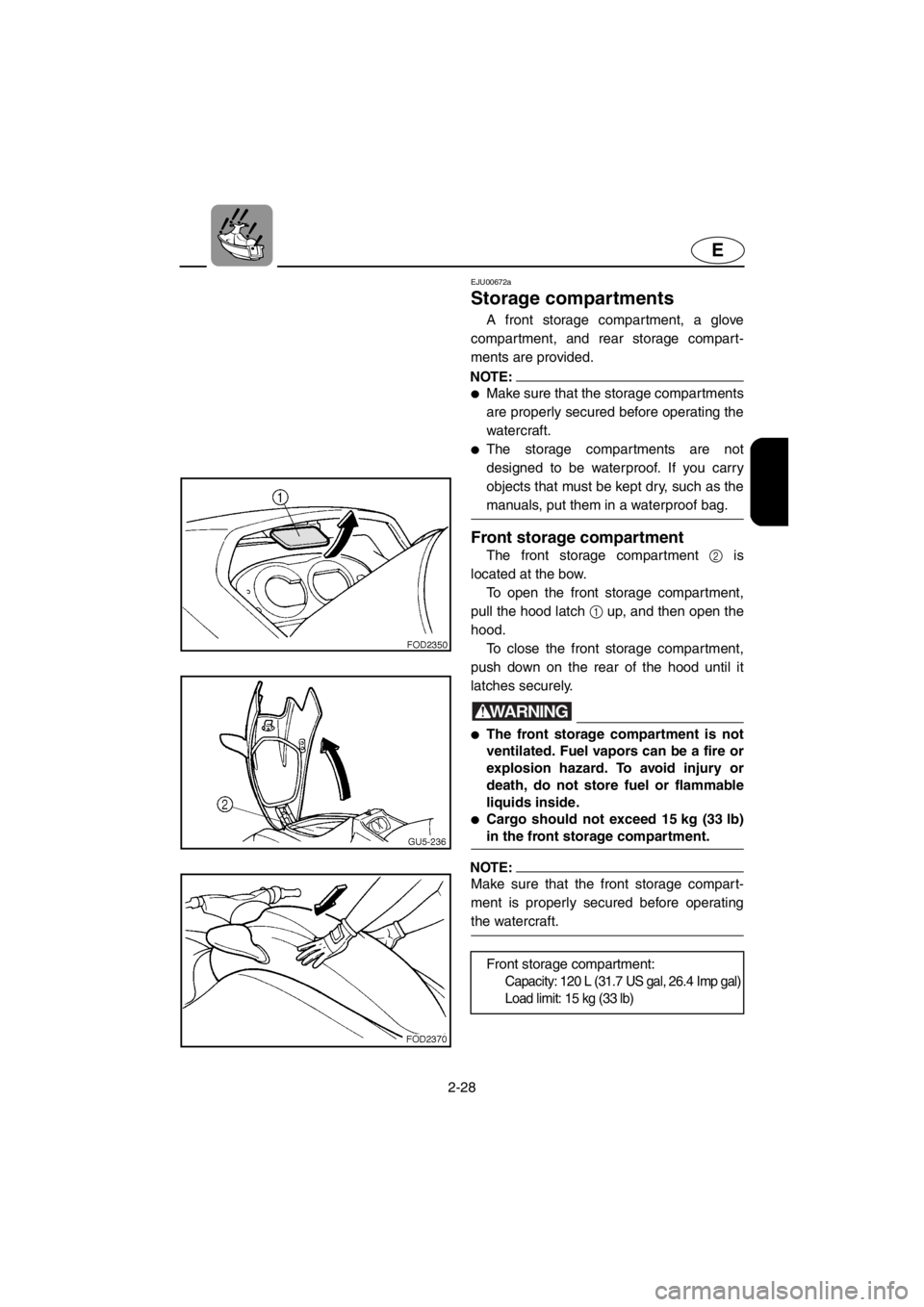
EJU00672a
Storage compartments
A front storage compartment, a glove
compartment, and rear storage compart-
ments are provided.
NOTE:
●Make sure that the storage compartments
are properly secured before operating the
watercraft.
●The storage compartments are not
designed to be waterproof. If you carry
objects that must be kept dry, such as the
manuals, put them in a waterproof bag.
Front storage compartment
The front storage compartment 2 is
located at the bow.
To open the front storage compartment,
pull the hood latch 1 up, and then open the
hood.
To close the front storage compartment,
push down on the rear of the hood until it
latches securely.
WARNING
●The front storage compartment is not
ventilated. Fuel vapors can be a fire or
explosion hazard. To avoid injury or
death, do not store fuel or flammable
liquids inside.
●Cargo should not exceed 15 kg (33 lb)
in the front storage compartment.
NOTE:
Make sure that the front storage compart-
ment is properly secured before operating
the watercraft.
Front storage compartment:
Capacity: 120 L (31.7 US gal, 26.4 Imp gal)
Load limit: 15 kg (33 lb)
E_GU5-71-2.fm Page 28 Thursday, July 13, 2000 7:48 PM
Page 57 of 135

2-30
E
Rear storage compartments
The rear storage compartments 6 are
located on both sides of the aft deck.
To open a rear storage compartment, pull
the latch 5 up, and then open the cover.
To close a rear storage compartment,
push down on the cover until it latches
securely.
NOTE:
Make sure that the rear storage compart-
ments are properly secured before operat-
ing the watercraft.
WARNING
●The rear storage compartments are
not ventilated. Fuel vapors can be a
fire or explosion hazard. To avoid
injury or death, do not store fuel or
flammable liquids here.
●Cargo should not exceed 22.5 kg
(50 lb) in either the port or starboard
storage compartment.
NOTE:
There is a drain plug 7 in each compart-
ment. To drain water in a rear storage com-
partment into the engine compartment,
remove the plug by turning it counterclock-
wise.
Rear storage compartments:
Capacity: 160 L (42.3 US gal, 35.2 Imp gal)
Load limit: 22.5 kg (50 lb)
E_GU5-71-2.fm Page 30 Thursday, July 13, 2000 7:48 PM
Page 59 of 135

E
3
EJU00410
OPERATION
Fuel and oil................................................ 3-1
Gasoline .................................................. 3-1
Filling the fuel tank .................................. 3-3
2-stroke engine oil................................... 3-3
Filling the oil tank .................................... 3-4
Pre-operation checks............................... 3-5
Pre-operation check list .......................... 3-5
Pre-operation check points..................... 3-6
Operation................................................. 3-14
Engine break-in ..................................... 3-14
Launching the watercraft ...................... 3-16
Starting the engine................................ 3-16
Stopping the engine.............................. 3-19
Leaving the watercraft .......................... 3-19
Operating your watercraft..................... 3-20
Getting to know your watercraft............ 3-20
Learning to operate your watercraft ..... 3-20
Riding watercraft with passengers ....... 3-21
Starting the watercraft........................... 3-22
Boarding and starting in deep water .... 3-24
Capsized watercraft .............................. 3-26
Turning the watercraft........................... 3-28
Stopping the watercraft......................... 3-30
Beaching the watercraft ........................ 3-31
Docking the watercraft .......................... 3-31
Reverse on waterways ......................... 3-32
Rough water operation ......................... 3-32
Post-operation checks.......................... 3-33
Transporting........................................... 3-35
E_GU5-71-3TOC.fm Page 1 Thursday, July 13, 2000 7:51 PM
Page 60 of 135

3-1
E
EJU00411a
Fuel and oil
This engine uses Yamaha’s oil injection
system, which provides superior lubrication
by ensuring the proper oil ratio for all operat-
ing conditions. No fuel premixing is neces-
sary except during the engine break-in
period. Simply pour gasoline into the fuel
tank and oil into the oil tank.
Gasoline
WARNING
GASOLINE AND ITS VAPORS ARE
HIGHLY FLAMMABLE AND EXPLOSIVE!
●Do not smoke when refueling, and
keep away from sparks, flames, or
other sources of ignition.
●Stop engine before refueling.
●Refuel in a well-ventilated area. Do not
stand or sit on the watercraft while
refueling in case of fire.
●Take care not to spill gasoline. If gaso-
line spills, wipe it up immediately with
dry rags. Always properly dispose of
gasoline-soaked rags.
●Avoid overfilling the fuel tank. Stop fill-
ing when the fuel level just reaches the
bottom of the filler tube. Do not fill up
the filler tube because fuel expands as
it warms up and could overflow.
●Tighten the filler cap securely after
refueling.
●If you should swallow some gasoline,
inhale a lot of gasoline vapor, or get
gasoline in your eyes, get immediate
medical attention.
●If any gasoline spills onto your skin,
immediately wash with soap and
water. Change clothing if gasoline
spills on it.
E_GU5-71-3.fm Page 1 Thursday, July 13, 2000 7:52 PM

