2001 VOLVO S80 automatic transmission
[x] Cancel search: automatic transmissionPage 55 of 106
N (Neutral)
Neutral - no gear engaged. Use the parking brake.
D (Drive)
D is the normal driving position and should be used as often as possible to help improve fuel economy. The car should
not be moving when shifting from R to the D position.
Kickdown
Automatic shift to a lower gear (kickdown) is achieved by depressing the accelerator pedal fully and briskly. An
upshift will occur when approaching the top speed for a particular gear or by releasing the accelerator pedal slightly.
Kickdown can be used for maximum acceleration or when passing at highway speeds. Kickdown does not function
when the transmission is in the manual shift (geartronic) mode (see next page).
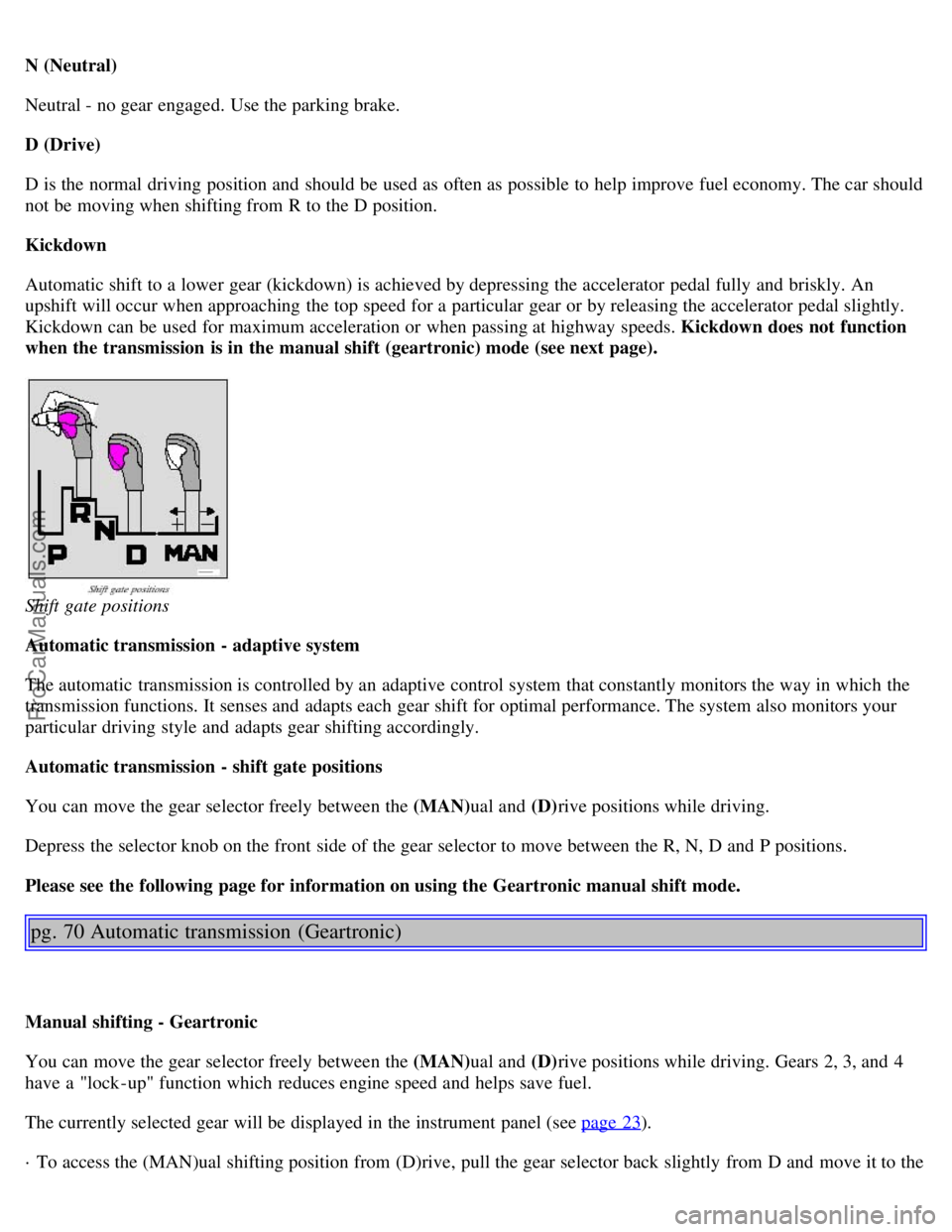
Shift gate positions
Automatic transmission - adaptive system
The automatic transmission is controlled by an adaptive control system that constantly monitors the way in which the
transmission functions. It senses and adapts each gear shift for optimal performance. The system also monitors your
particular driving style and adapts gear shifting accordingly.
Automatic transmission - shift gate positions
You can move the gear selector freely between the (MAN)ual and (D)rive positions while driving.
Depress the selector knob on the front side of the gear selector to move between the R, N, D and P positions.
Please see the following page for information on using the Geartronic manual shift mode.
pg. 70 Automatic transmission (Geartronic)
Manual shifting - Geartronic
You can move the gear selector freely between the (MAN) ual and (D)rive positions while driving. Gears 2, 3, and 4
have a "lock -up" function which reduces engine speed and helps save fuel.
The currently selected gear will be displayed in the instrument panel (see page 23
).
· To access the (MAN)ual shifting position from (D)rive, pull the gear selector back slightly from D and move it to the
ProCarManuals.com
Page 56 of 106

left to MAN.
· To return to the (D)rive position from MAN, move the gear selector to the right and push it forward to the (D)rive
position.
While driving
If you select the (MAN)ual position while driving, the gear that was being used in the (D)rive position will also
initially be selected in (MAN)ual position.
· Move the gear selector forward (toward "+") to shift to a higher gear or rearward (toward "-") to shift to a lower gear.
· If you hold the gear selector toward "-", the transmission will downshift, one gear at a time, and will utilize the
braking power of the engine. If the current speed is too high for using a lower gear, the downshift will not occur until
the speed has decreased enough to allow the lower gear to be used.
· If you slow down to a very low speed, the transmission will automatically shift down.
· When starting in the (MAN)ual position, 3rd gear is the highest gear that may be selected.
NOTE: Kickdown (see previous page) does not function when the transmission is in the manual shift (geartronic)
mode.
W Winter/Wet driving mode - enhanced vehicle traction
· Mode W will only function if the gear selector is in the (D)rive position.
· Press the button at the base of the gear selector to engage/disengage this driving mode (see illustration).
· An LED in the button will light up to indicate that W is engaged and this will also be displayed in the instrument
panel (see page 23
).
· This mode may be selected for starting/moving off on slippery roads.
pg. 71 Driving economy
Economical driving conserves natural resources
Better driving economy may be obtained by thinking ahead, avoiding rapid starts and stops and adjusting the speed of
your vehicle to immediate traffic conditions. Observe the following rules:
· Bring the engine to normal operating temperature as soon as possible by driving with a light foot on the accelerator
pedal for the first few minutes of operation. A cold engine uses more fuel and is subject to increased wear.
· Whenever possible, avoid using the car for driving short distances. This does not allow the engine to reach normal
operating temperature.
· Drive carefully and avoid rapid acceleration and hard braking.
· Do not exceed posted speed limits.
· Avoid carrying unnecessary items (extra load) in the car.
· Maintan correct tire pressure. Check tire pressure regularly (when tires are cold).
· Remove snow tires when threat of snow or ice has ended.
ProCarManuals.com
Page 57 of 106
· Note that roof racks, ski racks, etc., increase air resistance and also fuel consumption.
· Avoid using automatic transmission kickdown feature unless necessary.
· However, at higher driving speeds, fuel consumption will be lower with the air conditioning on and the windows
closed than with the air conditioning off and the windows open.
· Using the onboard trip computer's fuel consumption modes can help you learn how to drive more economically.
Other factors which decrease gas mileage are:
· Worn or dirty spark plugs
· Incorrect spark plug gap
· Dirty air cleaner
· Dirty engine oil and clogged oil filter
· Dragging brakes
· Incorrect front end alignment
Some of the above mentioned items and others are checked at the standard Maintenance Service intervals.
NOTE: Vehicles equipped with automatic transmissions should use (D)rive as often as possible and avoid using
"kickdown" to help improve fuel economy.
Cooling system
The risk for engine overheating is greatest, especially in hot weather, when:
· Towing a trailer up steep inclines for prolonged periods at wide open throttle and low engine rpm.
· Stopping the engine suddenly after high speed driving (so-called "after-boiling" can occur).
· To avoid overheating, the following rules should be followed: Do not drive for prolonged periods at engine speeds
above 4500 rpm if you are towing a trailer in hilly terrain.
· Reduce speed when towing a trailer up long, steep inclines. The risk of overheat -ing can be reduced by switching off
the air conditioning system for a short time.
· Do not let the engine idle unnecessarily for prolonged periods.
· Do not mount auxiliary lamps in front of the grill. When the risk of overheating is imminent, or in the event of
overheating (the temperature gauge goes repeatedly into, or stays continual-ly in, the red section), the following
precau-tions should be taken:
· Switch off the air conditioning system.
· Pull off the road, away from traffic, stop the car and put the gear selector into Park. Do not stop the engine!
· Switch the heater to full (maximum) position. Increase the engine speed to approx. 2000 rpm (twice idling speed)
until the temperature begins to drop.
· If the warning light in the center of the instrument panel is red, and the message "Coolant level lo stop engine" is
displayed, switch off the engine as soon as possible.
WARNING!
Do not remove coolant expansion tank cap. The coolant will be extremely hot.
If necessary, see See page 110
for information on checking and topping-up the coolant level.
Contents | Top of Page
ProCarManuals.com
Page 81 of 106
cool the compressed inlet air. The resulting increase in air flow raises pressure in the intake manifold and increases
engine power over that developed by the normallyaspirated engine. The charge air cooler (which resembles a radiator)
is located between the turbocompressor and inlet manifold.Designation: Volvo B 6294 S
Output 197 hp at 6000 rpm (147 KW/100 rps)
Max. torque 207 ft. lbs. at 4200 rpm (280 Nm at 70 rps)
Number of cylinders 6
Bore 3.27" (83 mm)
Stroke 3.54" (90 mm)
Displacement 2.92 liters
Compression ratio 10.5:1
Number of valves 24
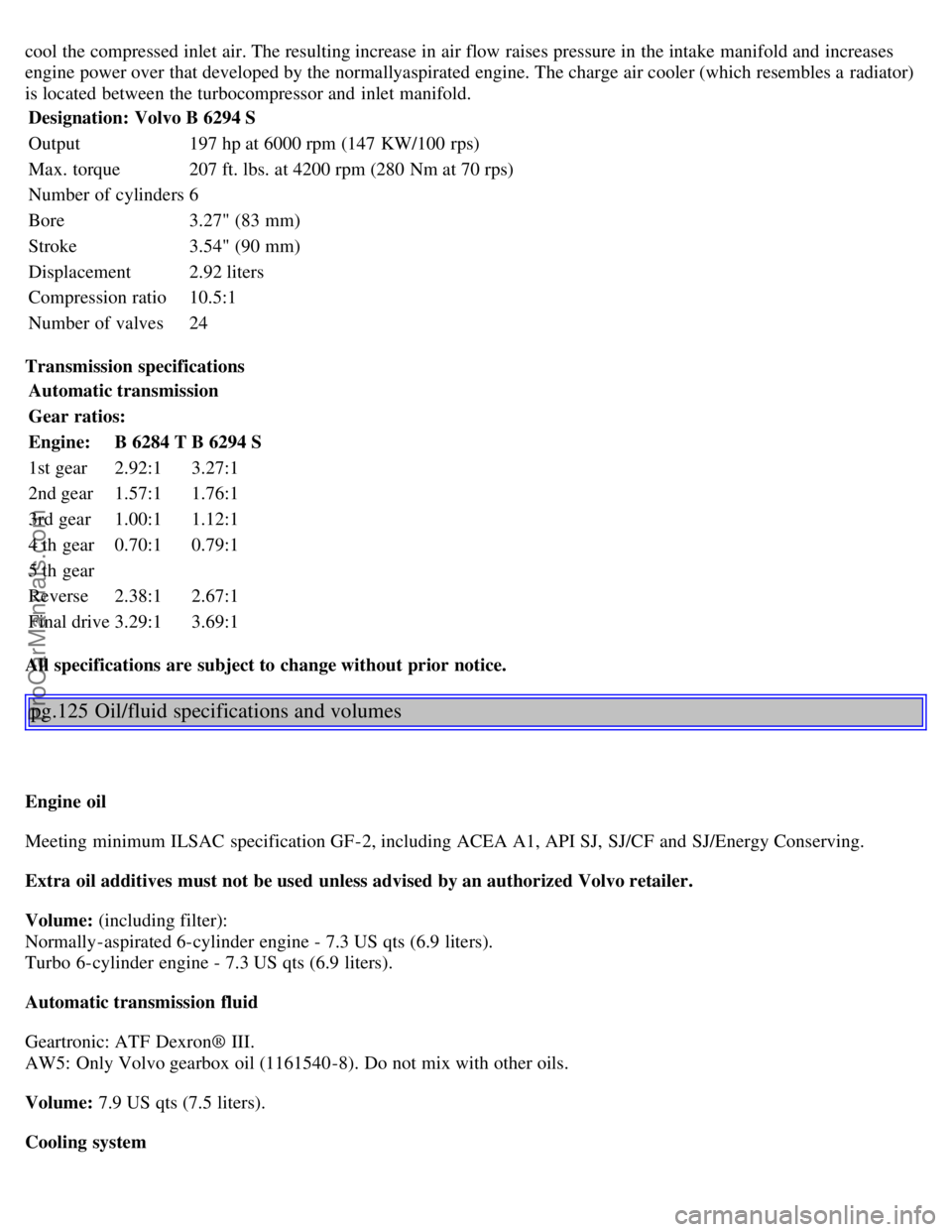
Transmission specifications Automatic transmission
Gear ratios:
Engine: B 6284 TB 6294 S
1st gear 2.92:13.27:1
2nd gear 1.57:11.76:1
3rd gear 1.00:11.12:1
4 th gear 0.70:10.79:1
5 th gear
Reverse 2.38:12.67:1
Final drive 3.29:13.69:1
All specifications are subject to change without prior notice.
pg.125 Oil/fluid specifications and volumes
Engine oil
Meeting minimum ILSAC specification GF-2, including ACEA A1, API SJ, SJ/CF and SJ/Energy Conserving.
Extra oil additives must not be used unless advised by an authorized Volvo retailer.
Volume: (including filter):
Normally-aspirated 6-cylinder engine - 7.3 US qts (6.9 liters).
Turbo 6-cylinder engine - 7.3 US qts (6.9 liters).
Automatic transmission fluid
Geartronic: ATF Dexron® III.
AW5: Only Volvo gearbox oil (1161540-8). Do not mix with other oils.
Volume: 7.9 US qts (7.5 liters).
Cooling system
ProCarManuals.com
Page 98 of 106
2 0 0 1
VOLVO S80
Index
pg.162 Index
A
ABS..........17
ABS - warning light..........25
Accessory lights..........27
Adjusting the steering wheel..........32
Advanced User Mode (AUM) - radio..........137
Air conditioning..........41, 42, 43, 45
Air pump system..........110
Air vents..........40
Airbag (SIPS)..........8
Airbag (SRS)..........4
Alarm..........60, 61
Alarm - "panic" function..........60
ALR/ELR..........14
Anti-lock Brake System (ABS)..........17
Anti-lock Brake System - warning light..........25
Antifreeze..........80, 110
Approach lighting..........56
Ashtrays..........34
Audio systems..........129
..cassette deck..........141
..CD player..........139
..HU -611 - overview..........130
..HU -801 - overview..........131
..radio..........134
..specifications..........144
AUM (Advanced User Mode) - radio..........137
Automatic car washing..........105
Automatic locking..........58
Automatic Locking Retractor (ALR)..........14
Automatic transmission
ProCarManuals.com
Page 101 of 106

Front fog lights..........30
Front fog lights - replacing ........99
Front reading lights..........50
Front seats - adjusting..........48
Front seats - heated..........33
Front suspension..........126
Fuel..........64, 125
Fuel filler cap..........65
Fuel filler door..........65
Fuel gauge..........23
Fuel requirements..........64
Fuel system..........109, 126
Fuel/emissions systems..........109
Fuses..........92, 93, 94
G
Gas cap..........65
Gasoline..........64
Gear indicator..........23
Gear ratios..........124
Geartronic (automatic transmission)..........69, 70
Generator..........127
Generator warning light..........24
H
Hand brake..........34
Handling..........72
Hazard warning flashers..........33
Head restraint - center rear..........3
Head restraints, rear - folding..........27
Headlight bulbs - replacing..........96
Headlight wiper blades - replacing..........119
Headlights..........30
Heated front seats..........33
Heated rear window..........33
Heated sideview mirrors..........33
Heating..........41, 42, 43, 45
Hoisting the car..........112
Home Safe System..........56
HomeLink¨ ........146-148
Hood - opening..........113
I
Ignition switch..........32
Immobilizer (start inhibitor)..........56,66
Indicator lights..........24, 25
Inflatable curtain (IC)..........9
ProCarManuals.com
Page 105 of 106
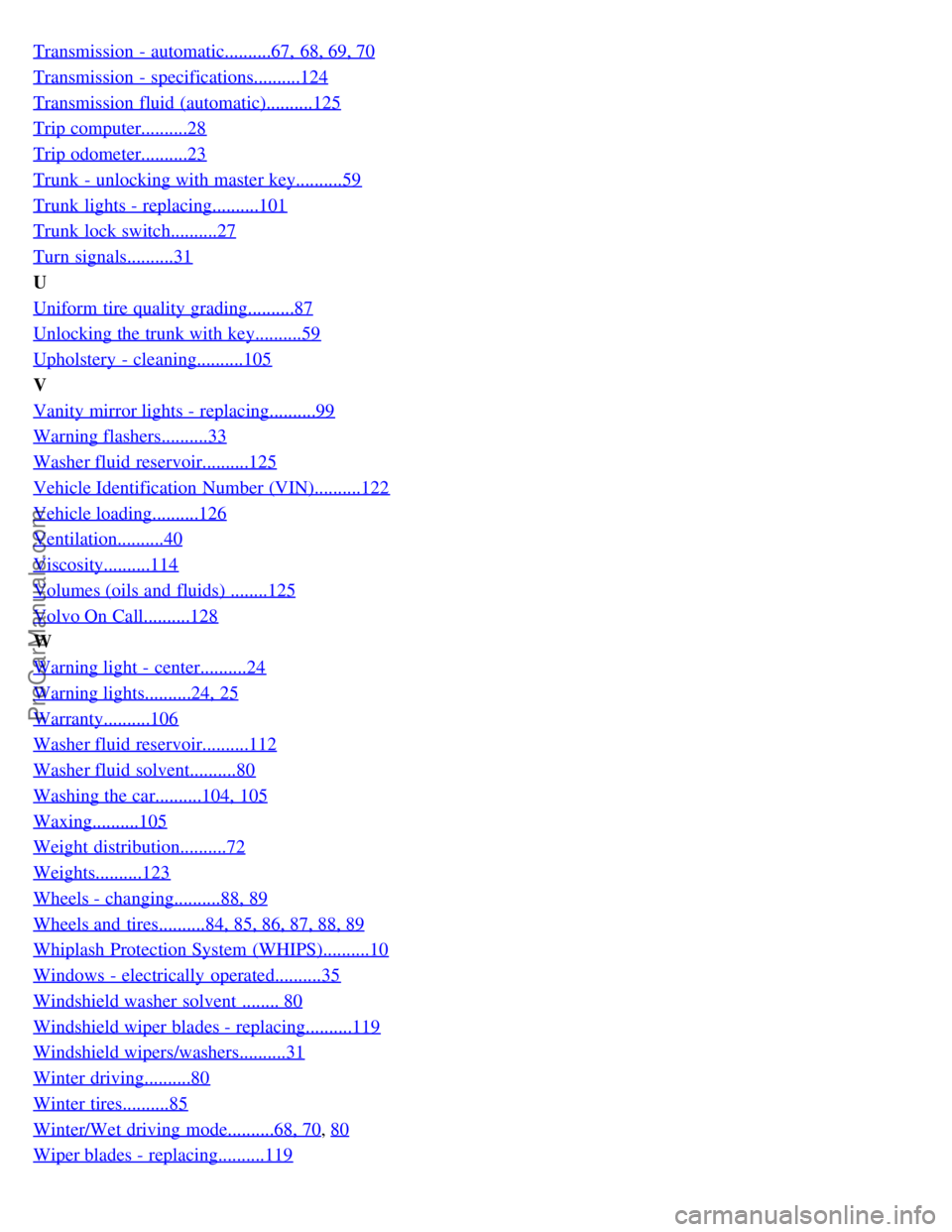
Transmission - automatic..........67, 68, 69, 70
Transmission - specifications..........124
Transmission fluid (automatic)..........125
Trip computer..........28
Trip odometer..........23
Trunk - unlocking with master key..........59
Trunk lights - replacing..........101
Trunk lock switch..........27
Turn signals..........31
U
Uniform tire quality grading..........87
Unlocking the trunk with key..........59
Upholstery - cleaning..........105
V
Vanity mirror lights - replacing..........99
Warning flashers..........33
Washer fluid reservoir..........125
Vehicle Identification Number (VIN)..........122
Vehicle loading..........126
Ventilation..........40
Viscosity..........114
Volumes (oils and fluids) ........125
Volvo On Call..........128
W
Warning light - center..........24
Warning lights..........24, 25
Warranty..........106
Washer fluid reservoir..........112
Washer fluid solvent..........80
Washing the car..........104, 105
Waxing..........105
Weight distribution..........72
Weights..........123
Wheels - changing..........88, 89
Wheels and tires..........84, 85, 86, 87, 88, 89
Whiplash Protection System (WHIPS)..........10
Windows - electrically operated..........35
Windshield washer solvent ........ 80
Windshield wiper blades - replacing..........119
Windshield wipers/washers..........31
Winter driving..........80
Winter tires..........85
Winter/Wet driving mode..........68, 70, 80
Wiper blades - replacing..........119
ProCarManuals.com