2001 VOLVO S60 lock
[x] Cancel search: lockPage 70 of 128
doors immediately if the key is left in the ignition switch, the car is locked using the lock button on the door and the
door is then closed. A sound from the lock will be audible at this time. Please note that this function will not unlock
the doors if the engine is running.
Immobilizer (start inhibitor)
Each of the keys supplied with your car contains a coded transmitter. The code in the key is transmitted to an antenna
in the ignition switch where it is compared to the code stored in the start inhibitor module. The car will start only with
a properly coded key.
If you misplace a key, take the other keys to an authorized Volvo retailer for reprogramming as an antitheft measure.
NOTE: This device complies with part 15 of the FCC rules. Operation is subject to the following condition: (1) This
device may not cause harmful interference, and (2) this device must accept any interference received, including
interference that may cause undesired operation.
WARNING!
If the doors are locked while driving, this may hinder rapid access to the occupants of the car in the event of an
accident. (Also see information on "Child safety locks"
pg. 117 Keys and remote controls
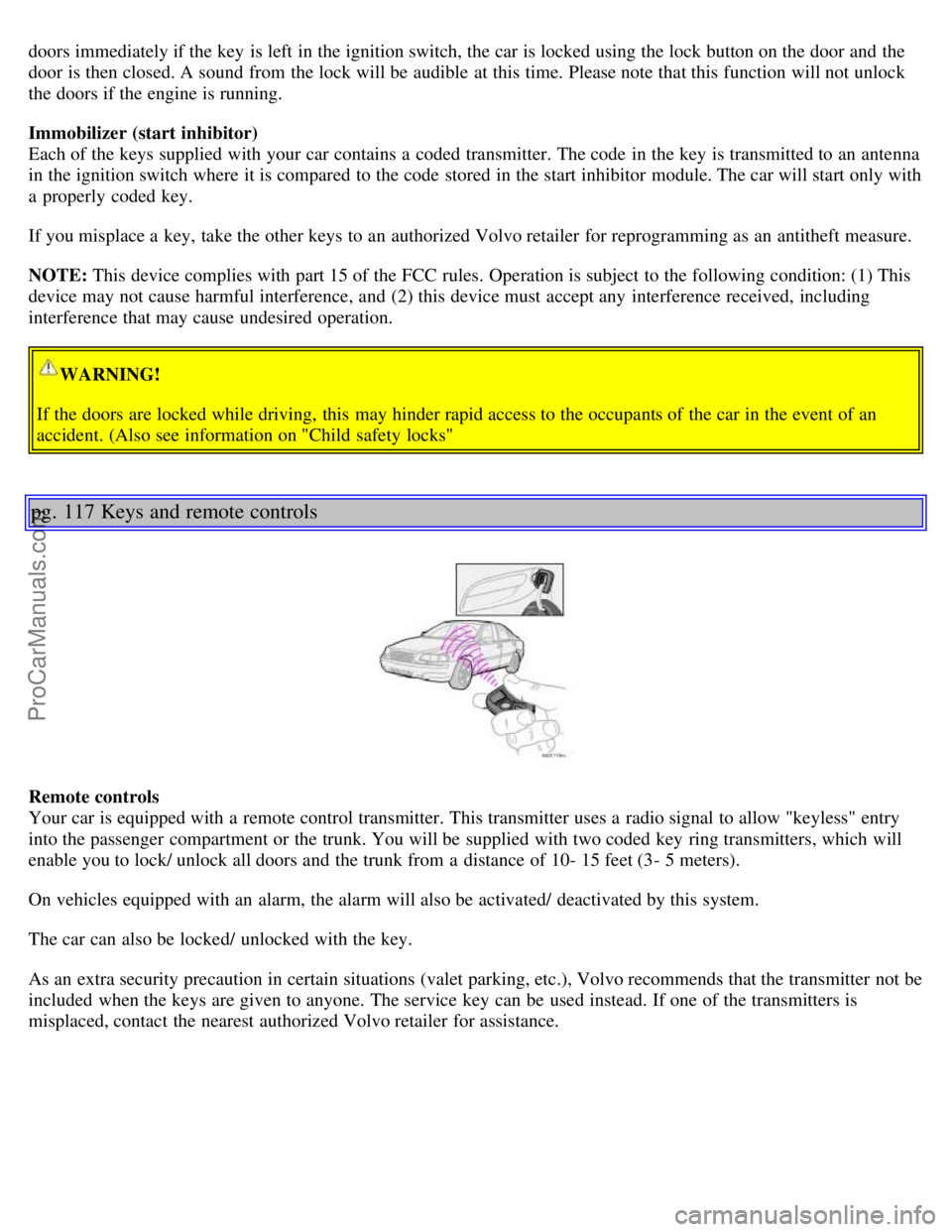
Remote controls
Your car is equipped with a remote control transmitter. This transmitter uses a radio signal to allow "keyless" entry
into the passenger compartment or the trunk. You will be supplied with two coded key ring transmitters, which will
enable you to lock/ unlock all doors and the trunk from a distance of 10- 15 feet (3- 5 meters).
On vehicles equipped with an alarm, the alarm will also be activated/ deactivated by this system.
The car can also be locked/ unlocked with the key.
As an extra security precaution in certain situations (valet parking, etc.), Volvo recommends that the transmitter not be
included when the keys are given to anyone. The service key can be used instead. If one of the transmitters is
misplaced, contact the nearest authorized Volvo retailer for assistance.
ProCarManuals.com
Page 71 of 128
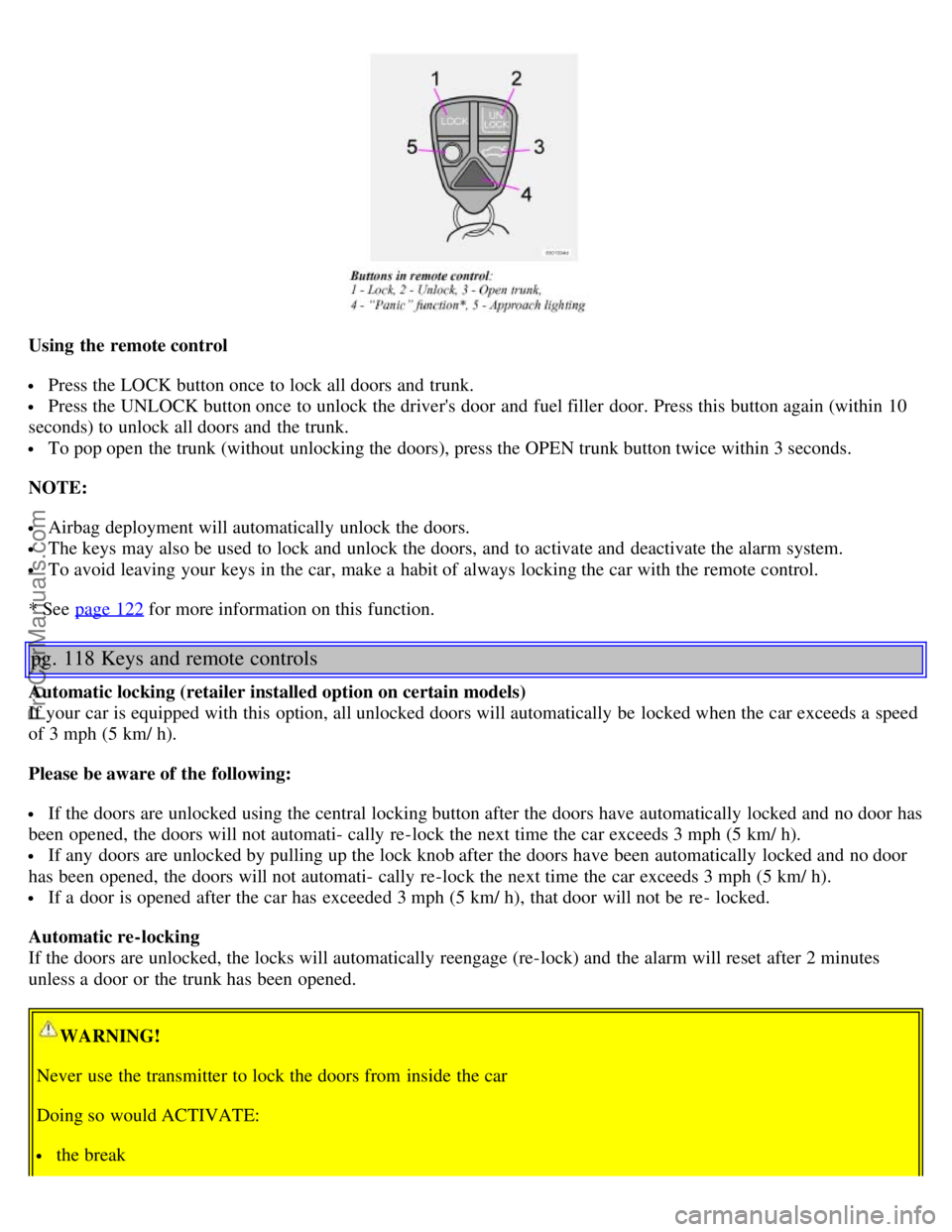
Using the remote control
Press the LOCK button once to lock all doors and trunk.
Press the UNLOCK button once to unlock the driver's door and fuel filler door. Press this button again (within 10
seconds) to unlock all doors and the trunk.
To pop open the trunk (without unlocking the doors), press the OPEN trunk button twice within 3 seconds.
NOTE:
Airbag deployment will automatically unlock the doors.
The keys may also be used to lock and unlock the doors, and to activate and deactivate the alarm system.
To avoid leaving your keys in the car, make a habit of always locking the car with the remote control.
* See page 122
for more information on this function.
pg. 118 Keys and remote controls
Automatic locking (retailer installed option on certain models)
If your car is equipped with this option, all unlocked doors will automatically be locked when the car exceeds a speed
of 3 mph (5 km/ h).
Please be aware of the following:
If the doors are unlocked using the central locking button after the doors have automatically locked and no door has
been opened, the doors will not automati- cally re-lock the next time the car exceeds 3 mph (5 km/ h).
If any doors are unlocked by pulling up the lock knob after the doors have been automatically locked and no door
has been opened, the doors will not automati- cally re-lock the next time the car exceeds 3 mph (5 km/ h).
If a door is opened after the car has exceeded 3 mph (5 km/ h), that door will not be re- locked.
Automatic re-locking
If the doors are unlocked, the locks will automatically reengage (re-lock) and the alarm will reset after 2 minutes
unless a door or the trunk has been opened.
WARNING!
Never use the transmitter to lock the doors from inside the car
Doing so would ACTIVATE:
the break
ProCarManuals.com
Page 72 of 128

in alarm, which would sound if one of the doors were opened
the optional interior motion and inclination alarm sensors.
Doing so would DEACTIVATE:
the sunroof and interior courtesy light controls.
the central locking buttons on the front door armrests, although the interior door handles would still function to
allow occupants to leave the car.
Disabled features would remain disabled until the remote were used again to unlock the car.
In addition, locking an occupied vehicle would hinder rapid access to the occupants in an accident or emergency.
Replacing the battery in the remote control
If the range of the transmitter is noticeably reduced, this indicates that the battery is weak and should be replaced.
To replace the battery
Remove the screw on the transmitter cover with a small screwdriver.
Remove the cover carefully pressing it rearward/ upward.
Replace the battery with a new 3- volt, CR 2032 battery. The battery should be inserted with the minus side
upward. Avoid touching the contact surfaces of the battery with your fingers.
Reinstall the cover and tighten the screw to help protect the transmitter.
pg. 119 Locking and unlocking
Locking and unlocking the car from the inside
The switch on the driver's door armrest can be used to lock or unlock all doors and the trunk, and to set the alarm.
ProCarManuals.com
Page 73 of 128
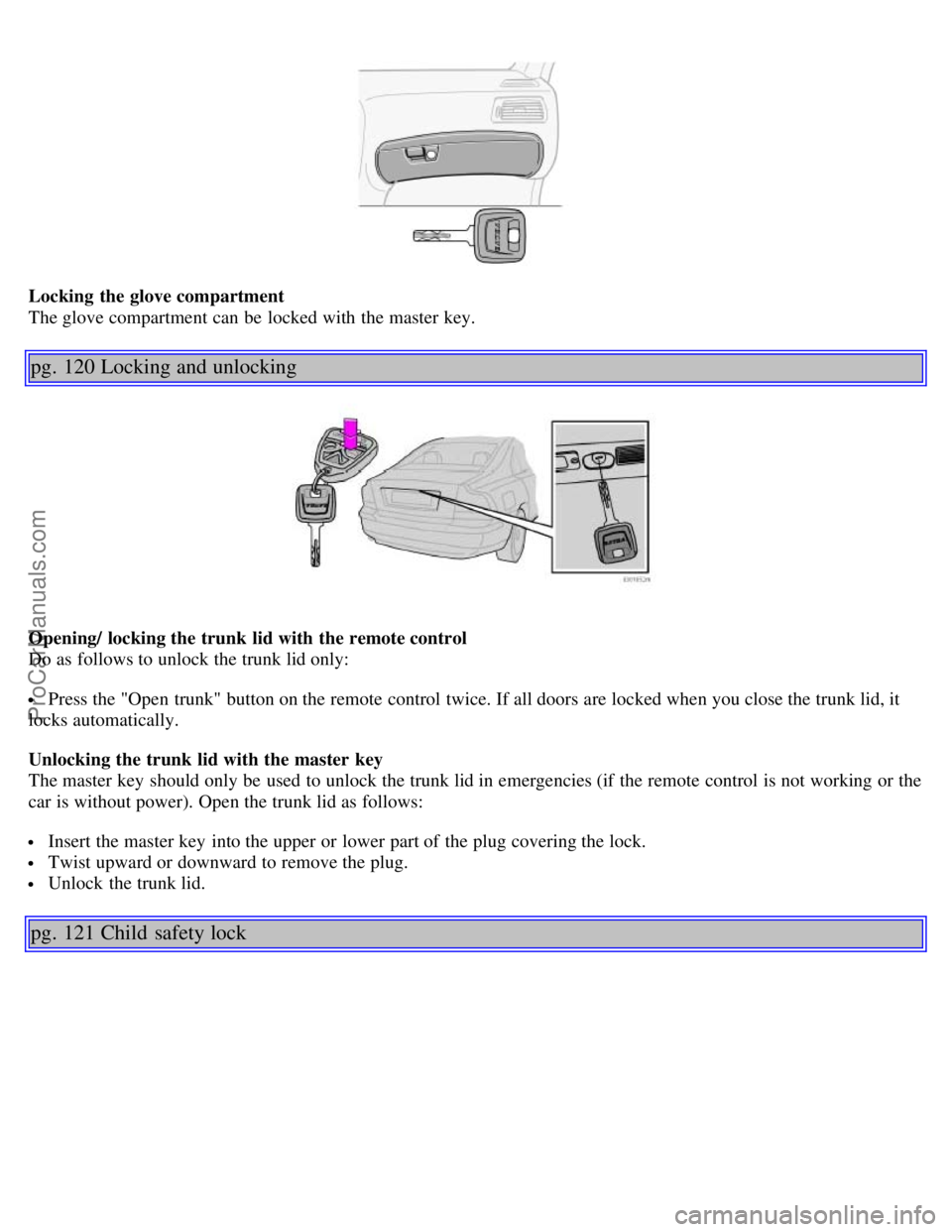
Locking the glove compartment
The glove compartment can be locked with the master key.
pg. 120 Locking and unlocking
Opening/ locking the trunk lid with the remote control
Do as follows to unlock the trunk lid only:
Press the "Open trunk" button on the remote control twice. If all doors are locked when you close the trunk lid, it
locks automatically.
Unlocking the trunk lid with the master key
The master key should only be used to unlock the trunk lid in emergencies (if the remote control is not working or the
car is without power). Open the trunk lid as follows:
Insert the master key into the upper or lower part of the plug covering the lock.
Twist upward or downward to remove the plug.
Unlock the trunk lid.
pg. 121 Child safety lock
ProCarManuals.com
Page 74 of 128

Manual child safety locks - rear doors
The controls are located on the rear door jambs. Use a screwdriver to adjust these controls.
A The door cannot be opened from the inside. Normal operation from the outside.
B The door lock functions normally.
WARNING!
Remember, in the event of an accident, the rear seat passengers cannot open the doors from the inside with the
buttons in position A
pg. 122 Alarm
Alarm The alarm is automatically armed whenever you lock your car.
When armed, the alarm continuously monitors a number of points on the car. The following conditions will set off the
alarm:
The hood is forced open.
The trunk is forced open.
A door is forced open.
The ignition switch is tampered with.
If there is movement in the passenger compartment (if the car is equipped with the optional movement sensor).
The car is lifted or towed (if the car is equipped with the optional inclination sensor).
The battery is disconnected (while the alarm is armed).
The siren is disconnected when the alarm is disarmed.
ProCarManuals.com
Page 75 of 128

Arming the alarm
Press the LOCK button on the remote control, lock the car using the key in the driver's door or press the central lock
button on one of the front doors with the door open. One long flash of the turn signals will confirm that the alarm is
armed.
Disarming the alarm
Press the UNLOCK button on the remote control or unlock the doors with the key.
Turning off (stopping) the alarm
If the alarm is sounding, it can be stopped by pressing the UNLOCK button on the remote control or by unlocking the
driver's door with the key.
Visual alarm signal
The visual alarm signal is given by flashing all turn signals and turning on the interior lighting for approximately 5
minutes.
Audible alarm signal
An audible alarm signal is given by a battery powered siren. One alarm cycle lasts for 25 seconds.
"Panic" button
In an emergency situation, this feature can be used to attract attention.
Activate the "panic" button by pressing the red button on the remote control (see illustration on page 117
) for at least
3 seconds or by pressing this button twice within 3 seconds. The turn signals will flash, the interior lights will go on
and the car's horn will sound.
The function can be turned off by pressing any of the buttons on the remote control or will stop automatically after 25
seconds. When a button is pressed, there is a 5 second delay before the panic alarm is deactivated.
NOTE: This button will NOT unlock the car.
pg. 123 Alarm
Temporarily turning off the alarm sensor( s) - option
This button will only be found in cars equipped with the optional inclination and/ or movement sensors.
In certain situations it may be desirable to turn off the optional inclination and movement alarm sensors if, for
example, you drive your car onto a ferry where the rocking of the boat could trigger the alarm or if a pet is left in the
car with the doors locked.
To temporarily turn off the inclination and movement alarm sensors from the alarm system: B From the time the
ignition key is turned from the Drive position (position II) until you lock the car, you can press the button in the
ProCarManuals.com
Page 76 of 128

center console*. The LED in the switch will light up and a message will be displayed in the text window to indicate
that the sensors are disconnected.
The car can then be locked in the usual way to set the alarm.
NOTE: The optional sensors are automatically reconnected to the alarm system the next time the car is unlocked and
then locked again.
LED alarm status signals The status of the alarm system is indicated by the red LED at the top of the dash:
LED off - the alarm is not armed
LED flashes once per second - the alarm is armed
LED flashes rapidly before the ignition is switched on - the alarm has been triggered
Fault in the alarm system: If a fault has been detected in the alarm system, a message will be displayed in the text
window. Contact your Volvo retailer.
Automatic re-lock/ re-arm system
If the car is unlocked with the remote, the car will re- lock and the alarm will re- arm after 2 minutes unless a door or
the trunk has been opened.
* The position of this button may vary, depending on the specifications of your car.
Contents | Top of Page
ProCarManuals.com
Page 78 of 128

pumps deliv- ering unleaded gasoline be labelled "UNLEADED". Only these pumps have nozzles which fit your car's
filler inlet. It is unlawful to dispense leaded fuel into a vehicle labelled "unleaded gasoline only". Leaded gasoline
damages the three- way catalytic converter and the heated oxygen sensor system. Repeated use of leaded gasoline will
lessen the effectiveness of the emission control system and could result in loss of emission warranty coverage. State
and local vehicle inspection programs will make detection of misfueling easier, possibly resulting in emission test
failure for misfueled vehicles.
NOTE: Some U. S. and Canadian gasolines contain an octane enhancing additive called methyl- cyclopentadienyl
manganese tricar- bonyl (MMT). If such fuels are used, your Emission Control System performance may be affected,
and the Check Engine Light (malfunction indicator lamp) located on your instrument panel may light. If this occurs,
please return your vehicle to an authorized Volvo retailer for service.
Gasoline containing alcohol and ethers
"Oxygenated fuels"
Some fuel suppliers sell gasoline containing "oxygenates" which are usually alcohols or ethers. In some areas, state or
local laws require that the service pump be marked indicating use of alcohols or ethers. However, there are areas in
which the pumps are unmarked. If you are not sure whether there is alcohol or ethers in the gasoline you buy, check
with the service station operator. To meet seasonal air quality standards, some areas require the use of "oxygenated"
fuel.
Volvo allows the use of the following "oxygenated" fuels; however, the octane ratings listed on this page must still be
met.
Alcohol - Ethanol: Fuels containing up to 10% ethanol by volume may be used. Ethanol may also be referred to as
Ethyl alcohol, or "Gasohol".
Ethers - MTBE: Fuels containing up to 15% MTBE may be used.
pg. 127 Refueling
Fuel filler door
The fuel filler door, located on the right rear fender, is connected to your car's central locking system. The driver's
door must be unlocked before the fuel filler door can be opened.
Be sure the fuel filler door is not obstructed and is completely closed after refueling. Open the fuel filler cap slowly
during hot weather.
NOTE: During a transitional period, a small number of service stations may still have fuel nozzles that are not
compatible with the fuel filler neck on cars equipped with the evaporative control system.
Refueling
The fuel tank is designed to hold approximately 18.5 US gals (70 liters) or 21.1 US gals (80 liters) on turbo models,
ProCarManuals.com