2001 VOLVO S60 maintenance
[x] Cancel search: maintenancePage 81 of 128

Steering wheel lock
The steering wheel lock might be under tension when the car is parked.
Turn the steering wheel slightly to free the ignition key.
In order to help reduce car theft, make sure the steering wheel lock is engaged before leaving the car.
pg. 130 General information
Economical driving conserves natural resources
Better driving economy may be obtained by thinking ahead, avoiding rapid starts and stops and adjusting the speed of
your vehicle to immediate traffic conditions. Observe the following rules:
Bring the engine to normal operating temperature as soon as possible by driving with a light foot on the accel-
erator pedal for the first few minutes of operation. A cold engine uses more fuel and is subject to increased wear.
Whenever possible, avoid using the car for driving short distances. This does not allow the engine to reach normal
operating temperature.
Drive carefully and avoid rapid acceler- ation and hard braking.
Do not exceed posted speed limits.
Avoid carrying unnecessary items (extra load) in the car.
Maintain correct tire pressure. Check tire pressure regularly (when tires are cold).
Remove snow tires when threat of snow or ice has ended.
Note that roof racks, ski racks, etc, increase air resistance and also fuel consumption.
Avoid using automatic transmission kickdown feature unless necessary.
However, at higher driving speeds, fuel consumption will be lower with the air conditioning on and the windows
closed than with the air conditioning off and the windows open.
Using the onboard trip computer's fuel consumption modes can help you learn how to drive more economically.
Other factors that decrease gas mileage are:
Worn or dirty spark plugs
Incorrect spark plug gap
Dirty air cleaner
Dirty engine oil and clogged oil filter
Dragging brakes
Incorrect front end alignment Some of the above mentioned items and others are checked at the standard
Maintenance Service intervals.
NOTE: Vehicles equipped with automatic transmissions should use (D) rive as often as possible and avoid using
"kickdown" to help improve fuel economy.
WARNING!
Driving with the trunk open: Driving with the trunk open could lead to poisonous exhaust gases entering the
passenger compartment. If the trunk must be kept open for any reason, proceed as follows
- Close the windows
- Set the ventilation system control to air flow to floor, windshield and side windows and blower control to its
highest setting.
ProCarManuals.com
Page 101 of 128

2 0 0 1
VOLVO S60
Maintenance and service
pg. 163 Maintenance and service
Volvo service 164
Maintenance Schedule165
Working on your car168
Hood and engine compartment170
Oils and fluids171
Wiper blades175
Battery176
Bulbs179
Fuses186
pg. 164 Volvo service
Maintenance service
Volvo advises you to follow the service program outlined in the Warranty and Service Records Information booklet.
This maintenance program contains inspections and services necessary for the proper function of your car. The
maintenance services contain several checks which require special instruments and tools and therefore must be
performed by a qualified technician. To keep your Volvo in top condition, specify time- tested and proven Genuine
Volvo Parts and Accessories.
The Federal Clean Air Act - U. S.
The Clean Air Act requires vehicle manufacturers to furnish written instructions to the ultimate purchaser to assure
the proper functioning of those components that control emissions. The maintenance instructions listed in this manual
represent the minimum maintenance required. These services are not covered by the warranty. You will be required to
pay for labor and material used. Refer to your Warranty and Service Records Information booklet for further details.
Maintenance services
Your Volvo has passed several major inspec- tions before being delivered to you, according to Volvo specifications.
The maintenance services outlined in this book should be performed as indicated. The extended maintenance service
intervals make it even more advisable to follow this program. Inspection and service should also be performed any
time a malfunction is observed or suspected. It is recommended that receipts for vehicle emission services be retained
in the event that questions arise concerning maintenance. See your Warranty and Service Records Information
booklet. Applicable warranties - U. S. In accordance with U. S. Federal Regulations, the following list of applicable
U. S. warranties is provided. For Canadian specification vehicles, see your separate warranty booklet.
New Car Limited Warranty
Parts and Accessories Limited Warranty
Corrosion Protection Limited Warranty
Seat Belt and Supplemental Restraint Systems Limited Warranty
Emission Design and Defect Warranty
Emission Performance Warranty
ProCarManuals.com
Page 102 of 128

These are the Federal warranties; other warranties are provided as required by state law. Refer to your separate
Warranty and Service Records Information booklet for detailed information concerning each of the warranties.
pg. 165 Maintenance Schedule2001
MAINTENANCE SCHEDULE S60
For complete maintenance information, please refer to your
Warranty and Service Records Information Booklet.
R = Replace
I = Inspect (Correct or Replace if necessary)
L = Lubricate
Maintenance Operationthousand miles 7.51522.5 3037.5 4552.5 6067.5 7582.5
90 2
(thousand km)(12)(24)(36) (48)(60)(72)(84)(96) (108) (120)(132)(144)
EMISSION SYSTEM MAINTENANCE
Engine oil and filter
1R RR RRRRR R RRR
Engine drive belt (accessory belt) I
Air cleaner filter R R R
Spark plugs R R R
Automatic transmission fluid I I I I I I
Timing belt - all engines
3
1) See section "Engine oil" for detailed information.
NOTE: The oil should be changed at these intervals, after 750 hours of driving or after 12 months, whichever
occurs first.
2) For services beyond 90,000 miles (144,000 km), please refer to the Warranty and Service Records
Information Booklet".
3) For proper functioning of the vehicle and its emission control systems, the timing belt and tensioner must be
replaced every 105,000 miles (168,000 km).
pg. 166 Maintenance Schedule
2001
MAINTENANCE SCHEDULE S60
R = Replace
I = Inspect (Correct or Replace if necessary)
L = Lubricate
Maintenance Operationthousand miles 7.51522.5 3037.5 4552.5 6067.5 7582.5 90
ProCarManuals.com
Page 103 of 128

(thousand km)(12)(24)(36) (48)(60) (72)(84) (96)(108) (120)(132)(144)
EMISSION SYSTEM MAINTENANCE
Engine
Fuel line filter
1
PCV nipple (orifice)/hoses, clean I I
Battery (check charge and electrolyte level) II II II II I III
Brakes
Inspect brake pads, replace components as necessary I II II II I III
Brake fluid level
2 - check
I I I I I I
Steering/suspension
Tires
3, check pressure, wear and condition I
I II II II I III
Check power steering fluid level I I I I I I
Body
Power antenna (clean) L L L L L L
Trunk/hood, hinges and latches L L L L
Cabin air filter (see page 167
) R R R R R R
1) Replace at 105,000 miles (168,000 km)
2) Brake fluid should be changed at owner request every second year or 30,000 miles (48,000 km). The fluid
should be replaced once a year or every 15,000 miles (24,000 km) when driving under extremely hard
conditions (mountain driving, etc.).
3) Rotate tires at owner request.
The following items should be checked weekly by the driver (it takes only a few minutes):
Engine oil level, brake fluid level, radiator coolant level, operation of all lights, horns, windshield wipers, tire
pressure (all five tires), windshield washer fluid level
The following should also be carried out at regular intervals:
Washing (check all drain holes), polishing, cleaning
pg. 167 Maintenance Schedule
Air cleaner
Replace the air cleaner cartridge with a new one every 30,000 miles (48,000 km). The cartridge should be replaced
more often when driving under dirty and dusty conditions. The filter cannot be cleaned and therefore should always
be replaced with a new one.
Timing belt
For proper functioning of the vehicle and its emission control systems, the timing belt must be replaced every 105,000
miles (168,000 km). Engine damage will occur if the belt fails.
Fuel filler cap, tank and lines and
connections The effectiveness of the fuel system to contain hydrocarbons is dependent largely on a leak- free system.
Check for proper sealing of the fuel filler cap which contains "O" ring type seals. NOTE: If the fuel filler cap is not
closed tightly or if the engine is running when the car is refueled, the Malfunction Indicator Lamp (" Check Engine")
may indicate a fault. However, your vehicle's performance will not be affected. Use only Volvo original or approved
fuel filler caps.
ProCarManuals.com
Page 107 of 128
pg. 171 Oils and fluids
Oil quality
Meeting minimum ILSAC specification GF- 2, including ACEA A1, API SJ, SJ/ CF and SJ/ Energy Conserving.
Your Volvo has been certified using ILSAC oil specification GF- 2 5W/ 30.
Depending on your driving habits, premium or synthetic oils may provide superior fuel economy and engine
protection. Consult your Volvo retailer for recommendations on premium or synthetic oils. Volvo does not
recommend the use of oil additives.
Volvo recommends use of oil with a quality rating equal to or higher than ILSAC GF- 2. Equivalent and better oils
include ACEA A1, API SJ, SJ/ CF, and SJ/ Energy conserving. Lower quality oils may not offer the same fuel
economy, engine performance, or engine protection.
Operation in hot climates
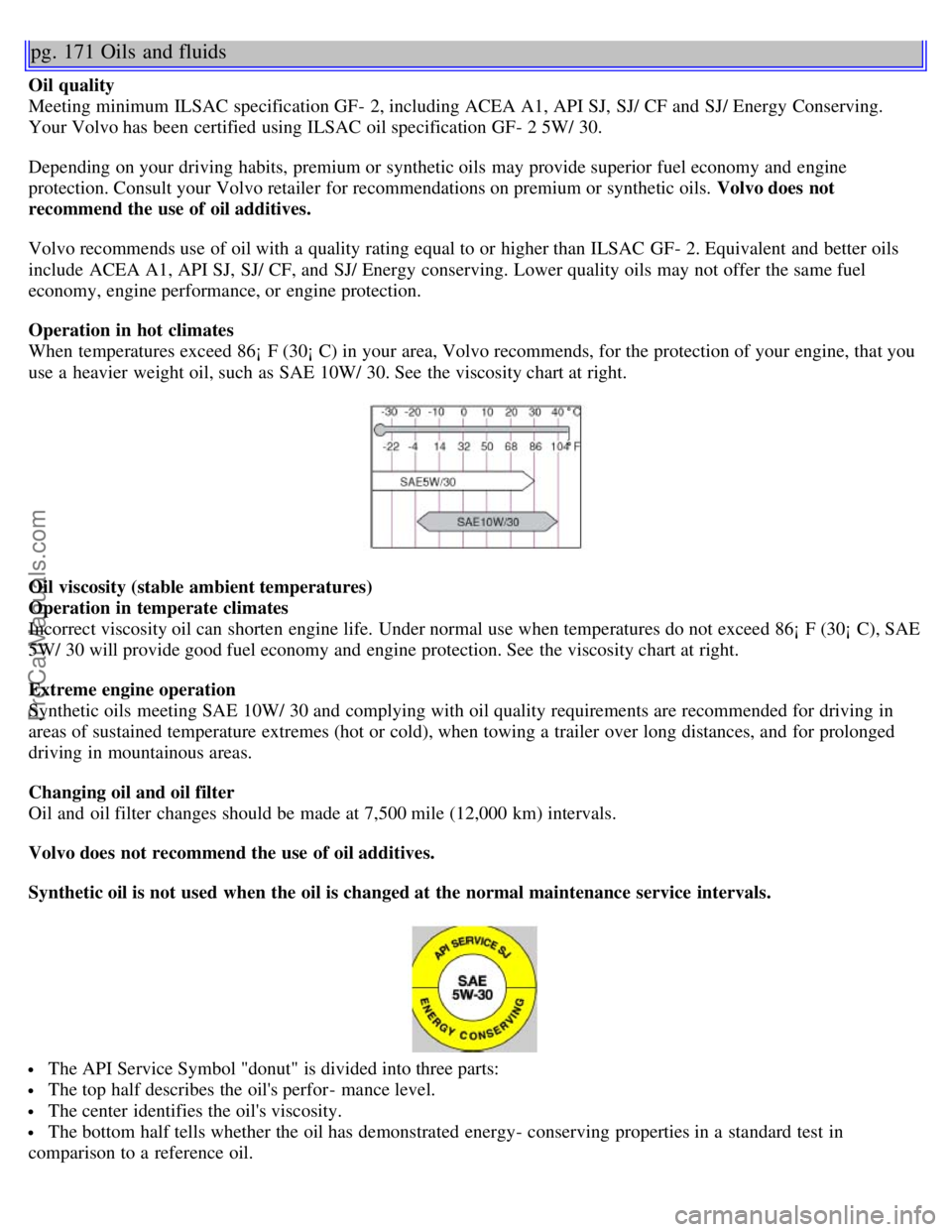
When temperatures exceed 86¡ F (30¡ C) in your area, Volvo recommends, for the protection of your engine, that you
use a heavier weight oil, such as SAE 10W/ 30. See the viscosity chart at right.
Oil viscosity (stable ambient temperatures)
Operation in temperate climates
Incorrect viscosity oil can shorten engine life. Under normal use when temperatures do not exceed 86¡ F (30¡ C), SAE
5W/ 30 will provide good fuel economy and engine protection. See the viscosity chart at right.
Extreme engine operation
Synthetic oils meeting SAE 10W/ 30 and complying with oil quality requirements are recommended for driving in
areas of sustained temperature extremes (hot or cold), when towing a trailer over long distances, and for prolonged
driving in mountainous areas.
Changing oil and oil filter
Oil and oil filter changes should be made at 7,500 mile (12,000 km) intervals.
Volvo does not recommend the use of oil additives.
Synthetic oil is not used when the oil is changed at the normal maintenance service intervals.
The API Service Symbol "donut" is divided into three parts:
The top half describes the oil's perfor - mance level.
The center identifies the oil's viscosity.
The bottom half tells whether the oil has demonstrated energy- conserving properties in a standard test in
comparison to a reference oil.
ProCarManuals.com
Page 123 of 128

LED illumination40
Lighting panel39
Load carriers148
Locking119
Locking steering wheel129
Locks115
Long distance trips150
Long loads - carrying112
Low beam bulb180
Lubricants195
M
Maintenance Schedule165
Maintenance services164
Malfunction indicator light33
Manual climate control with air conditioning58
Manual transmission132
Messages in the display35
Multifilter with air quality sensor57
N
Normal turns (direction indicators)40
O
Occupant safety28
Octane rating126
Odometer30
Oil pressure33
Oil quality171
Oil viscosity171
Opening/ locking the trunk120
P
P Park133
, 135
Paint162
Paint - color code162
Paintwork damage162
Parking brake33 , 45
Parking lights39
Pen holder108
Polishing161
Power seat102
Power steering fluid174
Power sun roof49
Prem- Air3
Programme type PT70
PROPOSITION 65 WARNING143
R
ProCarManuals.com
Page 124 of 128

Radiator170
Radio65
Rain sensor41
Reading lamps104
Rear fog lights39
Rear seat111
Rear suspension197
Rear window defroster42 , 59
Rearview mirror/ door mirrors48
Recirculation56 , 60
REDUCE SPEED35
Refrigerant (A/ C system)52
Refueling126 , 127
Remote control - central locking system117
Replacing the battery177
Reporting safety defects28
Reverse gear inhibitor132
Roadholding131
Roof racks (load carriers)148
S
Safety9
Safety defects - reporting28
Seat belt10
Seat belt maintenance28
Seat belt reminder48
Seat belts (keeping child seats in place)27
SEE MANUAL35
Service164
Service reminder33
SERVICE REQUIRED35
SERVICE URGENT35
Shiftlock2 , 128
Side airbags18
Side marker lamp183
SIPS airbags18
Ski hatch112
Snow chains153
Snow tires153
Spare tires154
Spare wheel113
Spark plugs199
Specifications191
Speedometer30
Spoiler lamps39
ProCarManuals.com
Page 126 of 128
Vehicle Identification Number (VIN)192
Vehicle loading154
VIN (Vehicle Identification Number)192
Volvo and the environment3
Volvo On Call202
W
W - Winter134
, 136
Warning symbol in center of dashboard31
Warranties164
Washer fluid reservoir170 , 173
Washing the car160
Waste bin110
Waxing161
Weight distribution130
Weights193
Wheels152
WHIPS22
Windshield washer41
Windshield washer fluid reservoir173
Windshield wipers41
Winter tires152
Winter/ Wet driving mode149
Wiper blades175
WARNING!
Detergents and solvents
Do not use gasoline containing lead or benzene as a detergent or solvent Both lead and benzene are toxic and may be
hazardous to your health
Installation of optional equipment/ use of mobile telephones
Incorrectly installed optional equipment, alarm systems or the use of mobile telephones which are not connected to a
suitable antenna can cause faults in the car's electronic control systems
Your car is equipped with a sophisticated electronics system Any repairs, maintenance or fault tracing on this system
should be done by an authorized Volvo retailer only
Please consult your Volvo retailer if you have any questions before connecting accessory or optional equipment to the
vehicle's electrical system
Carbon monoxide
Carbon monoxide is a poisonous, colorless and odorless gas which is present in all exhaust gases If you ever smell
exhaust fumes inside the vehicle, make sure the passenger compartment is venti- lated and immediately return the
vehicle to your retailer for correction
ProCarManuals.com