2001 VOLVO C70 service
[x] Cancel search: servicePage 29 of 88

Better driving economy may be obtained by thinking ahead, avoiding rapid starts and stops and adjusting the speed of
your vehicle to immediate traffic conditions. Observe the following rules:
· Bring the engine to normal operating temperature as soon as possible by driving with a light foot on the accelerator
pedal for the first few minutes of operation. A cold engine uses more fuel and is subject to increased wear.
· Whenever possible, avoid using the car for driving short distances. This does not allow the engine to reach normal
operating temperature.
· Drive carefully and avoid rapid acceleration and hard braking.
· Do not exceed speed limit.
· Avoid carrying unnecessary items (extra load) in the car.
· Maintain correct tire pressure. Check tire pressure regularly (check when tires are cold).
· Remove snow tires when threat of snow or ice has ended.
· Note that roof racks, ski racks, etc., increase air resistance and thereby fuel consumption.
· Avoid using automatic transmission kickdown feature unless necessary.
· Avoid using the air conditioning when it is not required. When engaged, the air conditioner's compressor places an
additional load on the engine. However, please note that fuel consumption is lower with the air conditioning on than it
is when driving with the air conditioning switched off and the windows down.
· If your car is equipped with the optional Trip Computer, utilizing the fuel consumption modes can help you "learn"
how to drive more economically.
Other factors which decrease gas mileage are:
· Worn or dirty spark plugs
· Incorrect spark plug gap
· Dirty air cleaner
· Dirty engine oil and clogged oil filter
· Dragging brakes
· Incorrect front end alignment
Some of the above mentioned items and others are checked at the standard Maintenance Service intervals.
NOTE: (D)rive or 5th gear (manual transmissions) should be used as often as possible to help improve fuel economy.
pg. 59 Starting the engine
Starting and stopping
ProCarManuals.com
Page 39 of 88
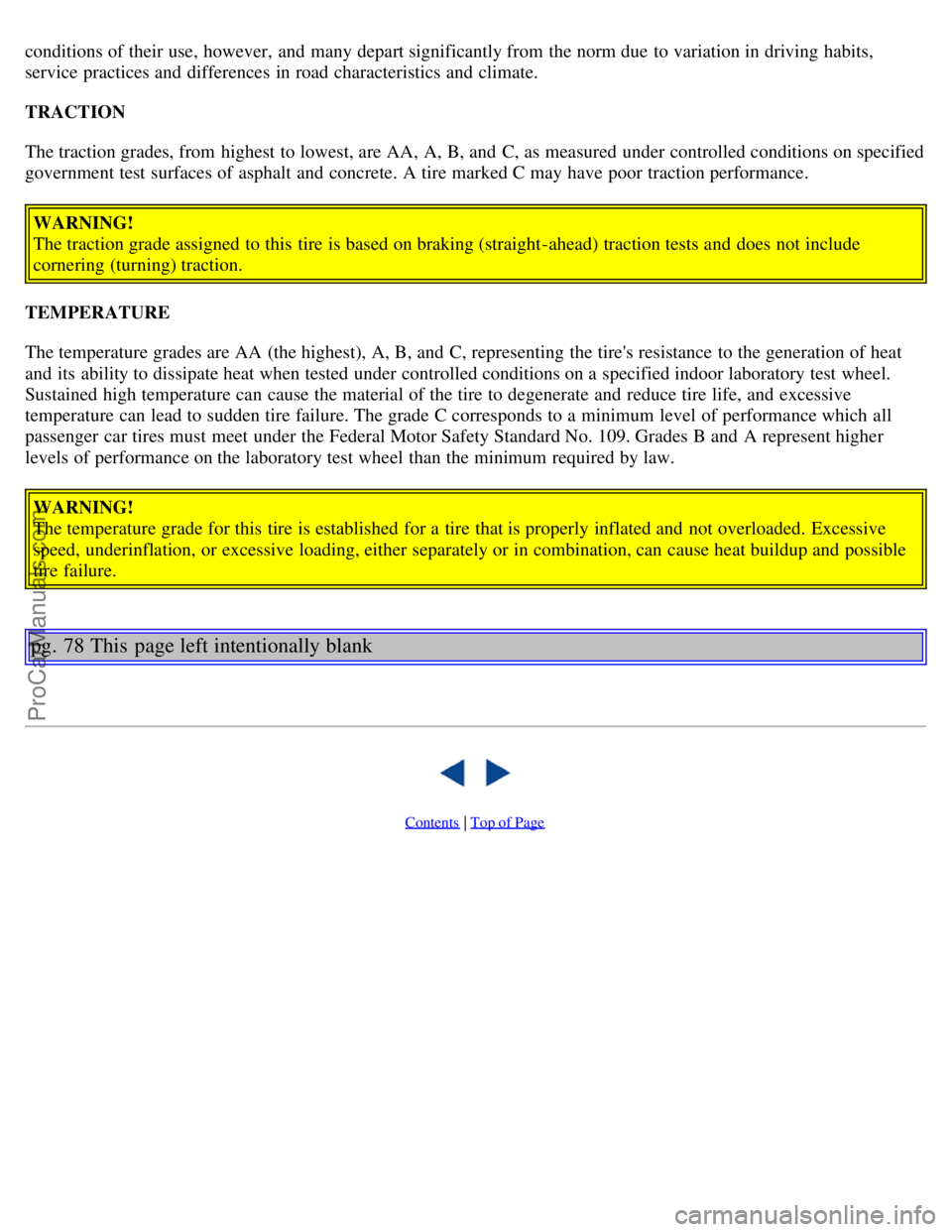
conditions of their use, however, and many depart significantly from the norm due to variation in driving habits,
service practices and differences in road characteristics and climate.
TRACTION
The traction grades, from highest to lowest, are AA, A, B, and C, as measured under controlled conditions on specified
government test surfaces of asphalt and concrete. A tire marked C may have poor traction performance. WARNING!
The traction grade assigned to this tire is based on braking (straight-ahead) traction tests and does not include
cornering (turning) traction.
TEMPERATURE
The temperature grades are AA (the highest), A, B, and C, representing the tire's resistance to the generation of heat
and its ability to dissipate heat when tested under controlled conditions on a specified indoor laboratory test wheel.
Sustained high temperature can cause the material of the tire to degenerate and reduce tire life, and excessive
temperature can lead to sudden tire failure. The grade C corresponds to a minimum level of performance which all
passenger car tires must meet under the Federal Motor Safety Standard No. 109. Grades B and A represent higher
levels of performance on the laboratory test wheel than the minimum required by law.
WARNING!
The temperature grade for this tire is established for a tire that is properly inflated and not overloaded. Excessive
speed, underinflation, or excessive loading, either separately or in combination, can cause heat buildup and possible
tire failure.
pg. 78 This page left intentionally blank
Contents | Top of Page
ProCarManuals.com
Page 51 of 88

2 0 0 1
VOLVO C70
Chapter 8 - Volvo Service
pg. 103 Volvo Service
Service an investment
An investment which will pay dividends in the form of improved reliability, durability and resale value. Label information
104
Maintenance service, Warranty105
Maintenance schedule106-107
Servicing108-109
Fuel/emissions systems110
Lubrication111
Engine oil112-113
Power steering fluid, Brake/clutch system fluid reservoir114
Windshield washer nozzle, Washer fluid reservoir115
Coolant116
Engine compartment117
Battery maintenance118
PROPOSITION 65 WARNING118
pg. 104 Label information
1 Vehicle Emission Control Information
Your Volvo is designed to meet all applicable emission standards, as evidenced by the certification label on the
underside of the hood. For further information regarding these regulations, please consult your Volvo retailer.
2 Vacuum hose routing
ProCarManuals.com
Page 52 of 88

(underside of hood)
3 Loads and Tire Pressures
(on rear edge of passenger's door)
4 Model plate
Vehicle Identification Number (VIN). Codes for color and upholstery, etc. This plate is located in the engine
compartment, on the inside of the left front fender.
5 Vehicle Identification Number (VIN) *
The VIN plate is located on the top left surface of the dashboard. The VIN is also stamped on the right hand door
pillar.
6 Federal Motor Vehicle Safety Standards (FMVSS) specifications (USA) and Ministry of Transport (CMVSS)
standards (Canada)
Your Volvo is designed to meet all applicable safety standards, as evidenced by the certification label on the rear edge
of the driver's door. For further information regarding these regulations, please consult your Volvo retailer.
* The Vehicle Identification Number (VIN) should always be quoted in all correspondence concerning your vehicle
with the retailer and when ordering parts.
** These decals are located on the underside of the hood.
All specifications are subject to change without notice.
pg. 105 Maintenance service, Warranty
Maintenance service
ProCarManuals.com
Page 53 of 88
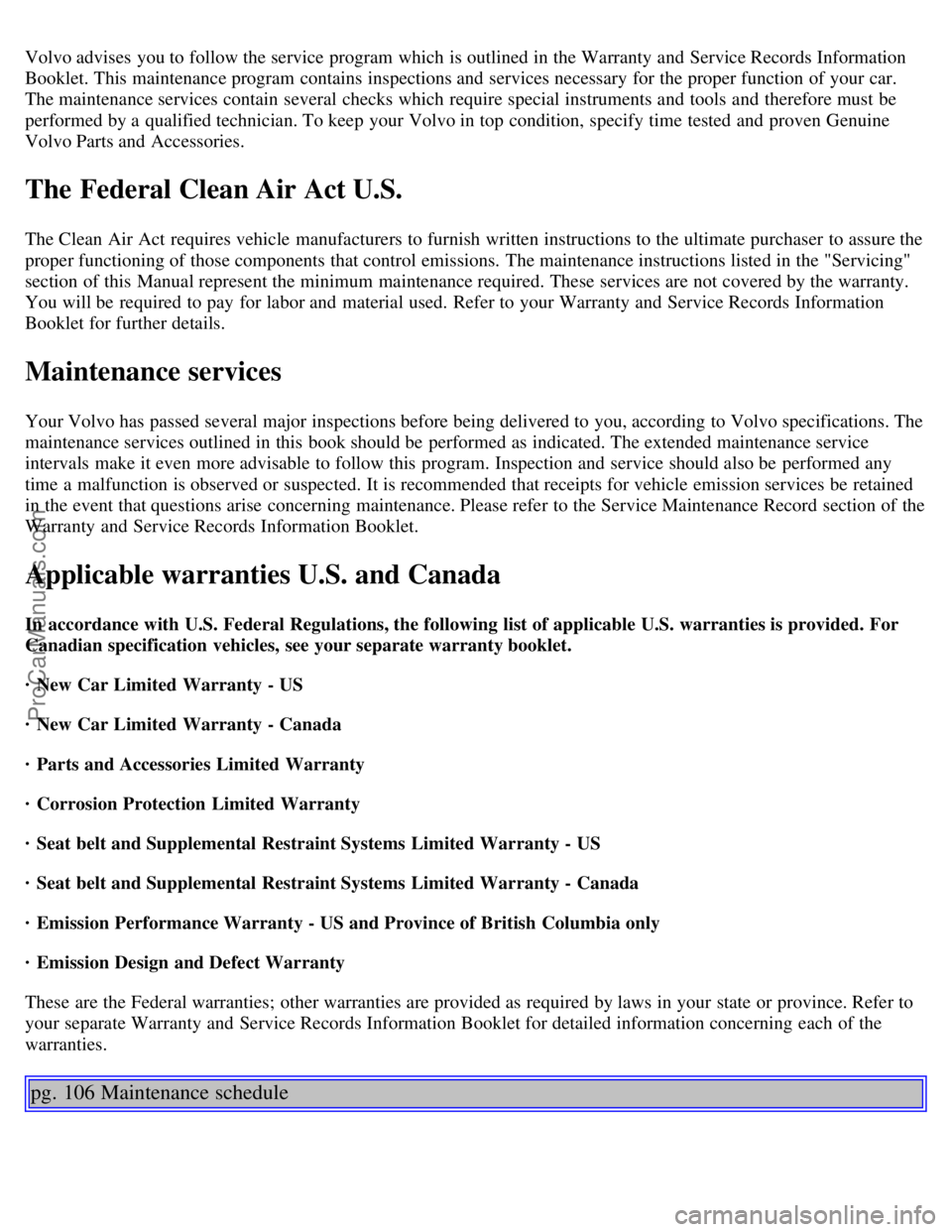
Volvo advises you to follow the service program which is outlined in the Warranty and Service Records Information
Booklet. This maintenance program contains inspections and services necessary for the proper function of your car.
The maintenance services contain several checks which require special instruments and tools and therefore must be
performed by a qualified technician. To keep your Volvo in top condition, specify time tested and proven Genuine
Volvo Parts and Accessories.
The Federal Clean Air Act U.S.
The Clean Air Act requires vehicle manufacturers to furnish written instructions to the ultimate purchaser to assure the
proper functioning of those components that control emissions. The maintenance instructions listed in the "Servicing"
section of this Manual represent the minimum maintenance required. These services are not covered by the warranty.
You will be required to pay for labor and material used. Refer to your Warranty and Service Records Information
Booklet for further details.
Maintenance services
Your Volvo has passed several major inspections before being delivered to you, according to Volvo specifications. The
maintenance services outlined in this book should be performed as indicated. The extended maintenance service
intervals make it even more advisable to follow this program. Inspection and service should also be performed any
time a malfunction is observed or suspected. It is recommended that receipts for vehicle emission services be retained
in the event that questions arise concerning maintenance. Please refer to the Service Maintenance Record section of the
Warranty and Service Records Information Booklet.
Applicable warranties U.S. and Canada
In accordance with U.S. Federal Regulations, the following list of applicable U.S. warranties is provided. For
Canadian specification vehicles, see your separate warranty booklet.
· New Car Limited Warranty - US
· New Car Limited Warranty - Canada
· Parts and Accessories Limited Warranty
· Corrosion Protection Limited Warranty
· Seat belt and Supplemental Restraint Systems Limited Warranty - US
· Seat belt and Supplemental Restraint Systems Limited Warranty - Canada
· Emission Performance Warranty - US and Province of British Columbia only
· Emission Design and Defect Warranty
These are the Federal warranties; other warranties are provided as required by laws in your state or province. Refer to
your separate Warranty and Service Records Information Booklet for detailed information concerning each of the
warranties.
pg. 106 Maintenance schedule
ProCarManuals.com
Page 54 of 88
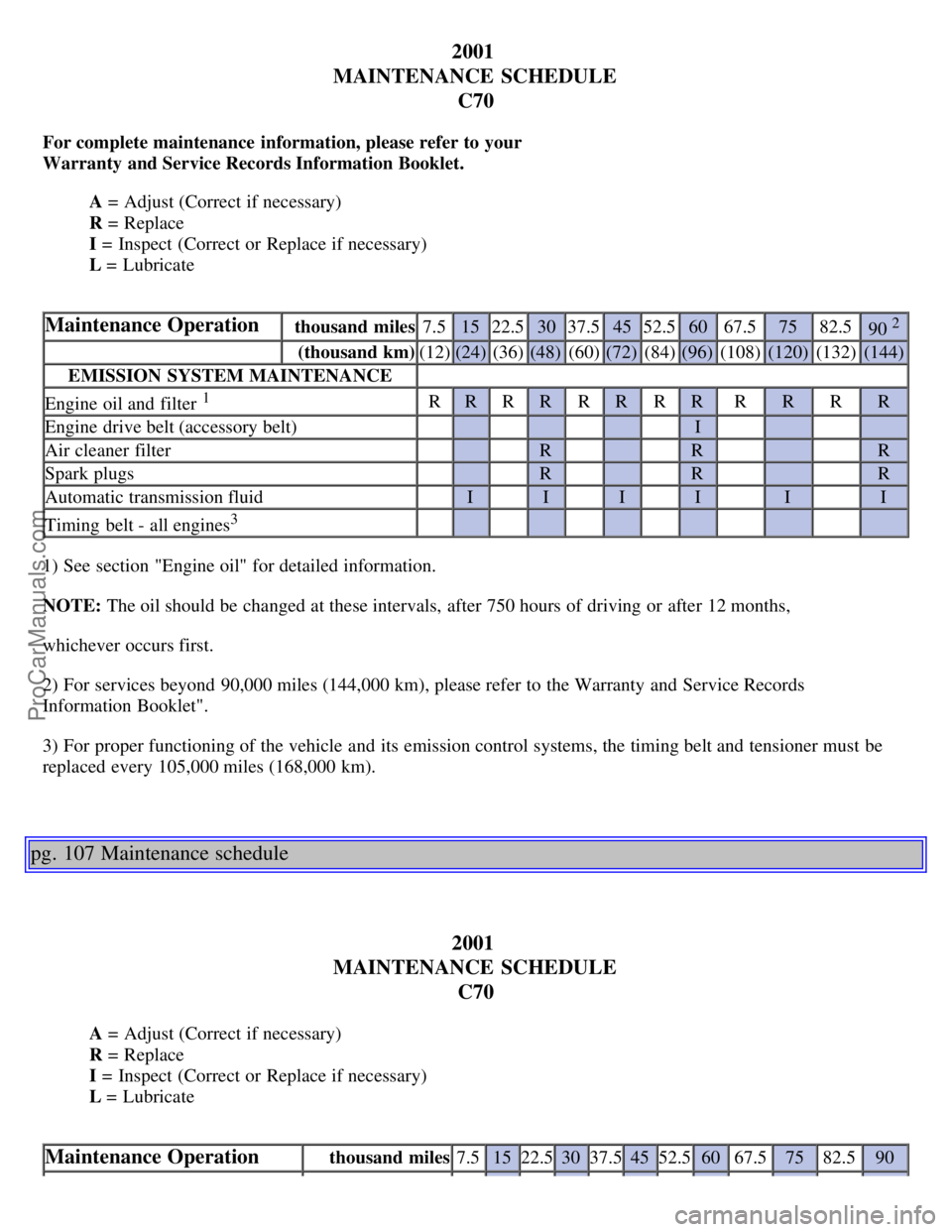
2001
MAINTENANCE SCHEDULEC70
For complete maintenance information, please refer to your
Warranty and Service Records Information Booklet.
A = Adjust (Correct if necessary)
R = Replace
I = Inspect (Correct or Replace if necessary)
L = Lubricate
Maintenance Operationthousand miles 7.51522.5 3037.5 4552.5 6067.5 7582.5
90 2
(thousand km)(12)(24) (36)(48) (60)(72) (84)(96) (108) (120)(132)(144)
EMISSION SYSTEM MAINTENANCE
Engine oil and filter
1R R RR RR RR R RRR
Engine drive belt (accessory belt) I
Air cleaner filter R R R
Spark plugs R R R
Automatic transmission fluid I I I I I I
Timing belt - all engines
3
1) See section "Engine oil" for detailed information.
NOTE: The oil should be changed at these intervals, after 750 hours of driving or after 12 months,
whichever occurs first.
2) For services beyond 90,000 miles (144,000 km), please refer to the Warranty and Service Records
Information Booklet".
3) For proper functioning of the vehicle and its emission control systems, the timing belt and tensioner must be
replaced every 105,000 miles (168,000 km).
pg. 107 Maintenance schedule
2001
MAINTENANCE SCHEDULE C70
A = Adjust (Correct if necessary)
R = Replace
I = Inspect (Correct or Replace if necessary)
L = Lubricate
Maintenance Operationthousand miles 7.51522.5 3037.5 4552.5 6067.5 7582.5 90
ProCarManuals.com
Page 58 of 88

canister, where it is stored. When the engine is started, the gasoline vapor is drawn from the charcoal canister to the
engine's air intake system and into the combustion process.
NOTE:
· If the fuel filler cap is not closed tightly or if the engine is running when the car is refueled, the Malfunction Indicator
Lamp may indicate a fault.
· During a transitional period, a small number of service stations may still have fuel nozzles that are not compatible
with the fuel filler neck on cars equipped with the evaporative control system (ORVR) mandated by the U.S.
Environmental Protection Agency and the California Air Resources Board. If you experience difficulties in refueling
your vehicle, please ask the gas station attendant for assistance.
CAUTION:
Fuel must not be siphoned from the fuel tank. This will damage the Evaporative control system.
pg. 111 Lubrication
No.Lubrication point lubricant
1 Hood lock and latch Oil
2 Door stop and hinges Oil
3 Sun roof wind deflector (visible when sun roof is open) Oil, low temperature grease
4 Door lock catch plate Oil
5 Power antenna WD 40 or similar
6 Locks Volvo teflon lock spray
7 Trunk lock catch plate Low temperature grease
8 Front seat side rail and latch Oil
To avoid rattles and unnecessary wear, the body should be lubricated at regular service intervals. This should be done
by an authorized Volvo retailer.
ProCarManuals.com
Page 60 of 88

2 0 0 1
VOLVO C70
Chapter 9 - Specifications
pg. 119 Specifications
Specifications
This chapter contains facts and figures pertaining to the technical specifications of your car. Oil/fluids specifications
120
Engine specifications121
Cooling/fuel/distributor ignition systems122
Front/rear suspensions122
Transmission, Capacities, Vehicle loading123
Electrical system/bulbs124
Dimensions and weights125
Service manuals, Road assistance126
pg. 120 Oil/fluid specifications
Oil quality
Engine Oil
Meeting or exceeding ILSAC specification GF-2, including ACEA A1, API SJ, SJ/CF, and SJ/Energy Conserving.
Oil additives must not be used unless advised by an authorized Volvo retailer.
Engine oil Quality:
Meeting or exceeding ILSAC specification GF-2, including
ACEA A1, API SJ, SJ/CF, and SJ/Energy Conserving. Capacity (incl. filter)
: 6.1
US qts. (5.8 liters)*
Automatic
transmission
fluid Quality:
AW5: Only Volvo gearbox oil (1161540-8). Do not mix with
other oils. Capacity:
8 US qts. (7.6
liters)
Manual
ProCarManuals.com