2001 VOLVO C70 lock
[x] Cancel search: lockPage 24 of 88

Doors and locks
Your car is equipped with a central locking system. The key, used on the driver's door, the remote control or central
locking button, will lock/unlock both doors and the trunk.
· Turn the key once to unlock the driver's door only.
· Turn the key again (within 10 seconds) to unlock both doors and the trunk.
One turn with the key towards lock in the drivers door locks both doors and the trunk.
· Use the switch on the front door armrests to lock/unlock the car from the inside.
Check the action of the button on the other door to verify its function (lock/ unlock).
WARNING!
If the doors are locked while driving, this may hinder rapid access to the occupants of the car in the event of an
accident. (Also see information on "Child safety locks").
NOTE :
· If a door is not closed completely, the courtesy lights will stay on and a chime will sound until the door is closed.
· As an added anti-theft measure, new keys have been developed which may take slightly longer to copy or replace if
the original keys are misplaced. Duplicate keys may be ordered from your Volvo retailer.
Immobilizer (start inhibitor)
Each of the keys supplied with your car contains a coded transmitter and receiver (transponder). The code in the key is
transmitted to an antenna in the ignition switch where it is compared to the code stored in the start inhibitor module.
The car can only be started if a properly coded key is used.
If you misplace a key, take the other keys to an authorized Volvo retailer. The existing code in the start inhibitor
module and all the keys will be erased as an antitheft measure and a new code will be programmed in.
NOTE:
Not more than one of the keys for your car should be kept on the same key ring. This could cause conflicting signals to
be transmitted to the ignition switch, making it impossible to start the car.
ProCarManuals.com
Page 25 of 88
This device complies with part 15 of the FCC rules. Operation is subject to the following condition: (1) This device
may not cause harmful interference, and (2) this device must accept any interference received, including interference
that may cause undesired operation.
This key operates the driver's door and the ignition switch/steering wheel lock.
The key number codes are stamped on a separate tag supplied with the keys. This tag should be separated from the key
ring and kept in a safe place.
Contents | Top of Page
ProCarManuals.com
Page 28 of 88

Fuels containing up to 10% ethanol by volume may be used.
Ethanol may also be referred to as Ethyl alcohol, or "Gasohol".
Ethers — MTBE
Fuels containing up to 15% MTBE may be used.
Refueling
The fuel tank holds approximately 17.9 US gal. (68 liters) with sufficient volume left over to accommodate possible
expansion of the fuel in hot weather. Be aware that the "usable" tank capacity will be somewhat less than the specified
maximum. When the fuel level is low, such factors as ambient temperature, the fuel's "Reid vapor pressure"
characteristics, and terrain can affect the fuel pumps' ability to supply the engine with an adequate supply of fuel.
Therefore, it is advisable to refuel as soon as possible when the needle nears the red zone, or when the fuel warning
light comes on.
Fuel tank cover
The fuel tank cover (on the right rear fender) is locked and must be popped open using the control on the driver's door.
Open fuel filler cap slowly during hot weather conditions.
CAUTION:
· Do not refuel with the engine running. Turn the ignition off or to position I. If the ignition is on, an incorrect reading
could occur in the fuel gauge.
· After refueling, close the fuel filler cap by turning it clockwise until it clicks into place *.
· Allow for fuel expansion by not overfilling the tank. Overfilling could also cause damage to the emission control
systems.
· Avoid spilling gasoline during refueling. Gasolines containing alcohol can cause damage to painted surfaces, which
may not be covered under the New Vehicle Limited Warranty.
· Do not use gasolines containing methanol (methyl alcohol, wood alcohol). This practice can result in vehicle
performance deterioration and can damage critical parts in the fuel system. Such damage may not be covered under the
New Vehicle Limited Warranty.
* If the fuel filler cap is not closed tightly or if the engine is running when the car is refueled, the Malfunction
Indicator Lamp may indicate a fault. However, your vehicle's performance will not be affected. Use only Volvo
original or approved fuel filler caps.
pg. 58 Driving economy
Economical driving conserves natural resources
ProCarManuals.com
Page 30 of 88

1. Fasten the seat belt.
WARNING!
Before starting, check that the seat, steering wheel and mirrors are adjusted properly. Make sure the brake pedal can
be depressed completely. Move the seat closer if necessary. Refer to section "front seats".
2. Apply the parking brake, if not already set. The gear selector (automatic transmission) is locked in the (P)ark
position (SHIFT LOCK).
Manual transmission: the clutch must be fully depressed.
3. Without touching the accelerator pedal, turn the ignition key to the starting position*. Allow the starter to operate
for up to 10 seconds. Release the key as soon as the engine starts. If the engine fails to start, repeat step 3.
For cold starts at altitudes above 6000 ft (1800 meters), depress the accelerator pedal halfway and turn the key to the
starting position. Release the pedal slowly when the engine starts.
* If the key is left in the Drive position (position II) for more than 30 seconds, it must be turned to position 0 and then
turned to the Start position (position III) again in order to start the car. See page 21
for ignition key positions.
4. To release the gear selector from the (P)ark position (automatic transmission), the ignition key must be in position II
and the brake pedal must be depressed. See page 95
for instructions on manually releasing the SHIFTLOCK
system.
Do not race a cold engine immediately after starting. Oil flow may not reach some lubrication points fast enough to
prevent engine damage.
NOTE: (Automatic transmission only)
Your car is equipped with a KEYLOCK system. When the engine is switched off, the gear selector must be in the
( P )ark position before the starting key can be removed from the ignition switch.
5. Select the desired gear. The gear engages after a slight delay (automatic transmission) which is especially noticeable
when selecting R.
CAUTION : (Automatic transmission only)
The engine should be idling; never accelerate until after you feel the gear engage! Toorapid acceleration immediately
after selecting a gear will cause harsh engagement and premature transmission wear.
NOTE : Selecting P or N (automatic transmission) when idling at a standstill for prolonged periods of time will help
prevent overheating of transmission oil.
WARNING!
Always place the gear selector (automatic transmission) in Park and apply the parking brake before leaving the
vehicle. Never leave the car unattended with the engine running.
Always open the garage doors fully before starting the engine inside a garage to ensure adequate ventilation. The
exhaust gases contain carbon monoxide, which is invisible and odorless but very poisonous.
ProCarManuals.com
Page 32 of 88
CAUTION: Be careful that you do not inadvertently engage reverse while moving forward.
* Clutch interlock (manual transmission only)
The clutch must be fully depressed before you can start your car. If the clutch is not depressed, it will not be possible
to start the engine.
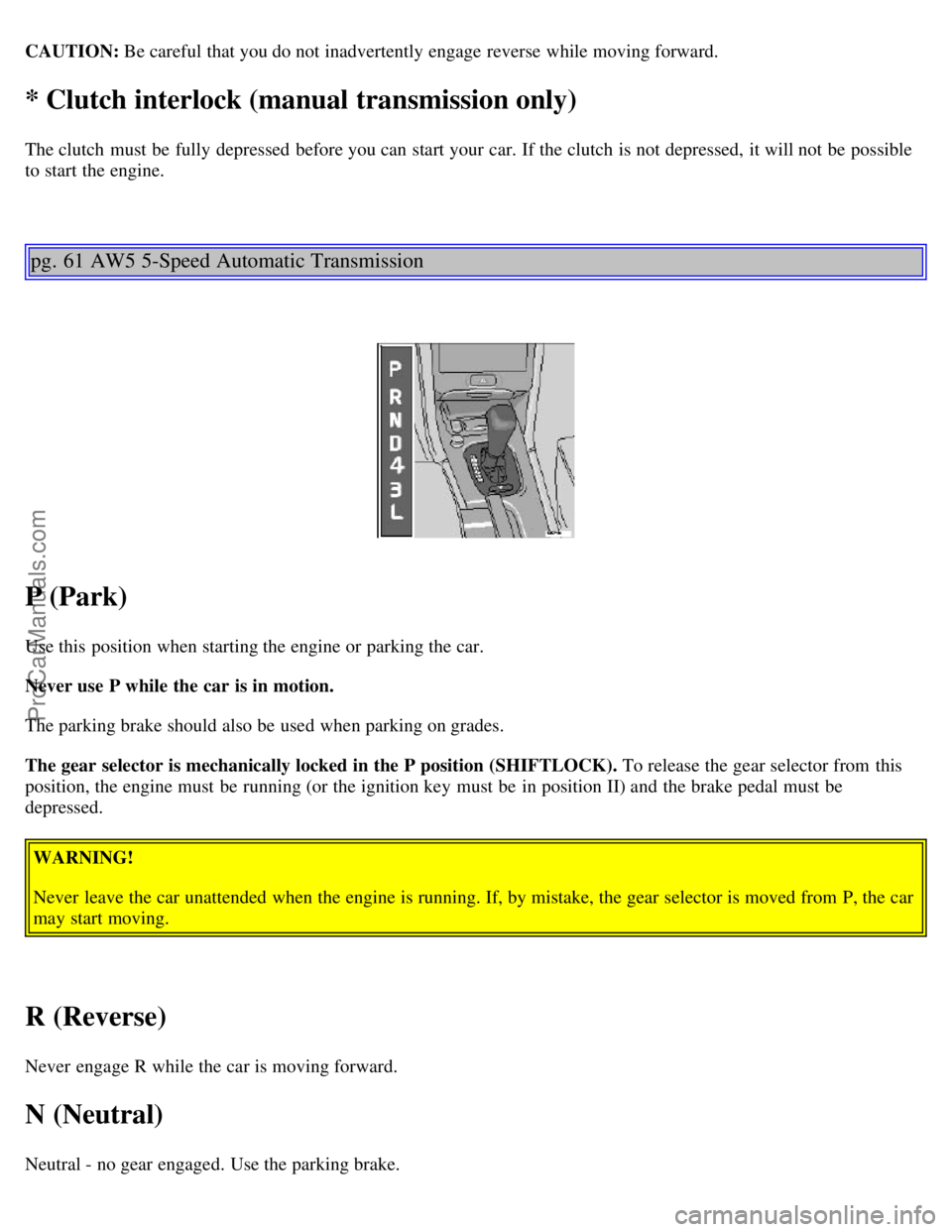
pg. 61 AW5 5-Speed Automatic Transmission
P (Park)
Use this position when starting the engine or parking the car.
Never use P while the car is in motion.
The parking brake should also be used when parking on grades.
The gear selector is mechanically locked in the P position (SHIFTLOCK). To release the gear selector from this
position, the engine must be running (or the ignition key must be in position II) and the brake pedal must be
depressed.
WARNING!
Never leave the car unattended when the engine is running. If, by mistake, the gear selector is moved from P, the car
may start moving.
R (Reverse)
Never engage R while the car is moving forward.
N (Neutral)
Neutral - no gear engaged. Use the parking brake.
ProCarManuals.com
Page 33 of 88
D (Drive)
D is the normal driving position and should be used as often as possible to help improve fuel economy. The car should
not be moving when shifting from R to the D position.
Neutral control
When the engine is idling, the gear selector is in the Drive position and the brake pedal is depressed, the
transmission will automatically switch to neutral.
The transmission will automatically return to Drive when the brake pedal is released.
This function has been added to help reduce emissions.
4 (Intermediate gear)
The transmission will shift automatically between gears 4, 3, 2 or 1 from this position.
The transmission cannot shift up to (D)rive from fourth gear.
3 (Intermediate gear)
The transmission will shift automatically between gears 3, 2 and 1 from this position.
The transmission cannot shift up to fourth gear or (D)rive from third gear.
L (Low gears)
The transmission is locked in gears 1 and 2 when the selector is in this position.
NOTE:
· Gears 4, 3, or L can be used if you are driving in a mountainous area, towing a trailer or to increase engine braking
effect.
· The transmission has a built-in limiter designed to help prevent excessive engine speeds (high rpm) when gears 4, 3
or L are selected.
Automatic transmission - adaptive system
The automatic transmission is controlled by an adaptive guidance system that constantly monitors the way in which the
transmission functions. It senses and adapts each gear shift for optimal performance. The system also monitors your
particular driving style and adapts gear shifting accordingly.
ProCarManuals.com
Page 37 of 88

· Snow chains should be installed on front wheels only. Use only Volvo approved snow chains.
· Snow chains may be mounted on tire dimension 195/65R15. Tire dimension 205/55R16 requires a special type of
snow chain. Consult your Volvo retailer.
If accessory, aftermarket or "custom" tires and wheels are installed and are of a size different than the original tires
and wheels, chains in some cases CANNOT be used. Snow chains cannot be used on those models fitted with all-
season tires 225/50 R16 or 225/45 R17 or 225/40R18. Sufficient clearances between chains and brakes, suspension
and body components must be maintained.
· Some strapon type chains will interfere with brake components and therefore CANNOT be used.
Consult your Volvo retailer for additional snow chain information.
CAUTION:
· Check local regulations regarding the use of snow chains before installing.
· Always follow the chain manufacturer's installation instructions carefully. Install chains as tightly as possible and
retighten periodically.
· Never exceed the chain manufacturer's specified maximum speed limit. (Under no circumstances should that limit be
higher than 30 mph (45 km/h).
· Avoid bumps, holes or sharp turns when driving with snow chains.
· The handling of the vehicle can be adversely affected when driving with chains. Avoid fast or sharp turns as well as
locked wheel braking.
Snow tires, studded tires *
Tires for winter use:
Owners who live in or regularly commute through areas with sustained periods of snow or icy driving
conditions are strongly advised to fit suitable winter tires to help retain the highest degree of traction.
It is important to install winter tires on all four wheels to help retain traction during cornering, braking, and
accelerating. Failure to do so could reduce traction to an unsafe level or adversely affect handling. Do not mix tires of
different design as this could also negatively affect overall tire road grip. Volvo recommends 195/65 R15 winter tires
on 15" steel wheels on all C70 models including those equipped with 16", 17" or 18" wheels .
Winter tires wear more quickly on dry roads in warm weather. They should be removed when the winter driving
season has ended.
Studded tires should be runin 300-600 miles (500-1000 km) during which the car should be driven as smoothly as
possible to give the studs the opportunity to seat properly in the tires. The car tires should have the same rotational
direction throughout their entire lifetime. In other words, if you wish to rotate the wheels, make sure that the same
wheels are always on the same side of the car.
NOTE: Please consult state or provincial regulations restricting the use of studded winter tires before installing such
tires.
* Where permitted.
ProCarManuals.com
Page 41 of 88

The spare wheel is located under the carpet on the trunk floor. The jack and crank are secured in the wheel recess.
· Engage the parking brake.
· Put the gear selector in (P)ark (automatic) or in Reverse (manual).
· With the car still on the ground, use the lug wrench to loosen the wheel bolts 1/2 -1 turn. Turn the bolts
counterclockwise to loosen.
· Fold out the crank handle on the jack by pressing the knob on the handle downward. To attach the jack, refer to the
illustration on the following page.
CAUTION: The car must not be driven with wheels of different dimensions or with a spare tire other than the one that
came with the car. The use of different size wheels can seriously damage your car's transmission.
NOTE: To avoid excessive wear and the necessity of rebalancing, mark and reinstall wheels in the same location and
position as before removal. To lessen the chance of imbalance, each wheel hub is equipped with a guide stud to ensure
that a removed wheel can be reinstalled in its original position (as when changing over to winter tires/wheels).
pg. 81 Wheel changing
There is a jack attachment located in the center on each side of the car. Position the jack on the bar in the attachment
as shown in illustration above and crank while simultaneously guiding the base of the jack to the ground. The base of
the jack must be flat on a level, firm, non-slippery surface. Before raising the car, check that the jack is still
correctly positioned in the attachment. Raise the vehicle until both wheels on the side of the car where the jack is
attached are lifted off the ground. Unscrew the wheel bolts completely and carefully remove the wheel so as not to
damage the thread on the studs.
Installing the wheel
Clean the contact surfaces on the wheel and hub. Lift the wheel and place it on the hub. Make sure that you align the
wheel with the guide stud on the wheel hub prior to installation. Install the wheel bolts crosswise (see illustration) and
tighten by turning lightly clockwise. Lower the vehicle to the ground and alternately tighten the bolts to 100 ft. lbs.
(136 Nm). Install the wheel cap (where applicable).
ProCarManuals.com