Page 156 of 330
01 SIENNA_U (L/O0008)
1522001 MY SIENNA (OM45406U)
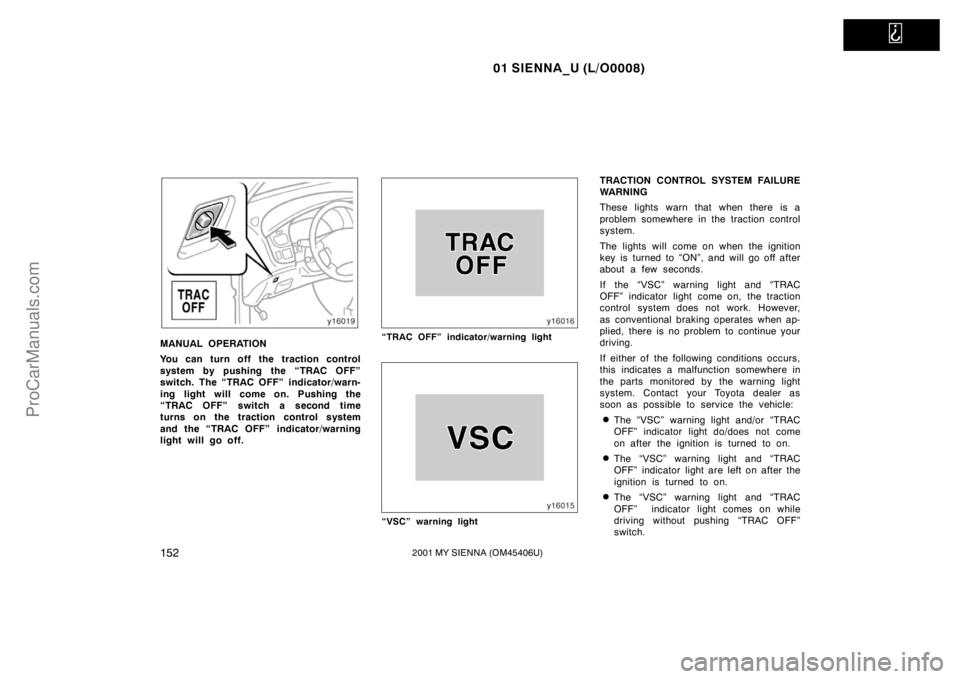
MANUAL OPERATION
You can turn off the traction control
system by pushing the “TRAC OFF”
switch. The “TRAC OFF” indicator/warn-
ing light will come on. Pushing the
“TRAC OFF” switch a second time
turns on the traction control system
and the “TRAC OFF” indicator/warning
light will go off.“TRAC OFF” indicator/warning light
“VSC” warning light
TRACTION CONTROL SYSTEM FAILURE
WA R N I N G
These lights warn that when there is a
problem somewhere in the traction control
system.
The lights will come on when the ignition
key is turned to “ON”, and will go off after
about a few seconds.
If the “VSC” warning light and “TRAC
OFF” indicator light come on, the traction
control system does not work. However,
as conventional braking operates when ap-
plied, there is no problem to continue your
driving.
If either of the following conditions occurs,
this indicates a malfunction somewhere in
the parts monitored by the warning light
system. Contact your Toyota dealer as
soon as possible to service the vehicle:
�The “VSC” warning light and/or “TRAC
OFF” indicator light do/does not come
on after the ignition is turned to on.
�The “VSC” warning light and “TRAC
OFF” indicator light are left on after the
ignition is turned to on.
�The “VSC” warning light and “TRAC
OFF” indicator light comes on while
driving without pushing “TRAC OFF”
switch.
ProCarManuals.com
Page 157 of 330

01 SIENNA_U (L/O0008)
1532001 MY SIENNA (OM45406U)
CAUTION
Under certain slippery road condi-
tions, full traction of the vehicle and
power to the front wheels may not be
maintained, even though the traction
control system is in operation. Do not
drive the vehicle at any speed or con-
duct any during maneuver which will
cause the vehicle to lose traction. In
situations where the road surface is
covered with ice or snow, your ve-
hicle should be fitted with snow tires
or tire chains. Always drive at an ap-
propriate and cautious speed for the
road conditions present.
Vehicle skid control system
Slip indicator light
“VSC” warning light
“TRAC OFF” indicator/warning light
The vehicle skid control system helps
provide comprehensive control of the
systems such as an anti−lock brake
system, brake assist system, traction
control system, engine control system,
etc. This system automatically controls
the output of the brakes or engine to
help prevent the vehicle from skidding
when cornering on a slippery road sur-
face or abrupt steering wheel operation
occurs.
If the vehicles is going to skid during
driving, the slip indicator light flashes and
an alarm sounds intermittently.
ProCarManuals.com
Page 234 of 330
01 SIENNA_U (L/O0008)
2302001 MY SIENNA (OM45406U)
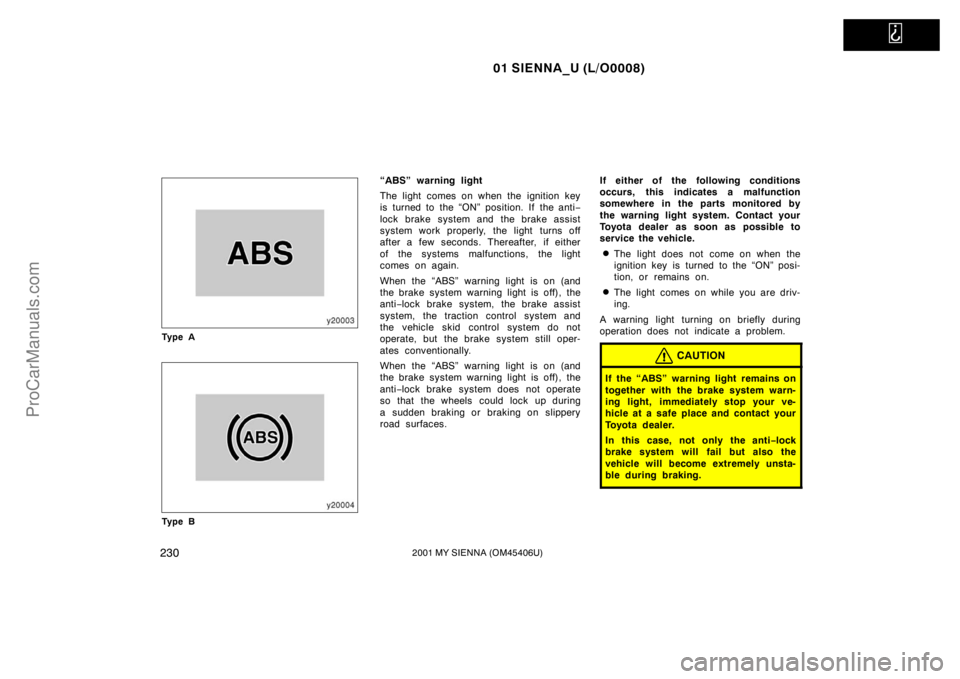
Ty p e A
Ty p e B
“ABS” warning light
The light comes on when the ignition key
is turned to the “ON” position. If the anti−
lock brake system and the brake assist
system work properly, the light turns off
after a few seconds. Thereafter, if either
of the systems malfunctions, the light
comes on again.
When the “ABS” warning light is on (and
the brake system warning light is off), the
anti−lock brake system, the brake assist
system, the traction control system and
the vehicle skid control system do not
operate, but the brake system still oper-
ates conventionally.
When the “ABS” warning light is on (and
the brake system warning light is off), the
anti−lock brake system does not operate
so that the wheels could lock up during
a sudden braking or braking on slippery
road surfaces.If either of the following conditions
occurs, this indicates a malfunction
somewhere in the parts monitored by
the warning light system. Contact your
Toyota dealer as soon as possible to
service the vehicle.
�The light does not come on when the
ignition key is turned to the “ON” posi-
tion, or remains on.
�The light comes on while you are driv-
ing.
A warning light turning on briefly during
operation does not indicate a problem.
CAUTION
If the “ABS” warning light remains on
together with the brake system warn-
ing light, immediately stop your ve-
hicle at a safe place and contact your
Toyota dealer.
In this case, not only the anti−lock
brake system will fail but also the
vehicle will become extremely unsta-
ble during braking.
ProCarManuals.com
Page 302 of 330

01 SIENNA_U (L/O0008)
2972001 MY SIENNA (OM45406U)
WHEN TO USE SNOW TIRES OR
CHAINS
Snow tires or chains are recommended
when driving on snow or ice.
On wet or dry roads, conventional tires
provide better traction than snow tires.
SNOW TIRE SELECTION
If you need snow tires, select the same
size, construction and load capacity as
the original tires on your Toyota.
Do not use tires other than those men-
tioned above. Do not install studded tires
without first checking local regulations for
possible restrictions.
SNOW TIRE INSTALLATION
Snow tires should be installed on all
wheels.
Installing snow tires on the front wheels
only can lead to an excessive difference
in road grip capability between the front
and rear tires which could cause loss of
vehicle control.
When storing removed tires, you should
store them in a cool dry place. Mark the
direction of rotation and be sure to install
them in the same direction when replac-
ing.CAUTION
�Do not drive with the snow tires
incorrectly inflated.
�Never drive over 120 km/h (75 mph)
with any type of snow tires.
TIRE CHAIN SELECTION
Use the tire chains of correct size and
type.
Use SAE Class “S” type radial tire chains
except radial cable chains or V−bar type
chains.
Regulations regarding the use of tire
chains vary according to location or
type of road, so always check them
before installing chains.
CHAIN INSTALLATION
Install the chains on the front tires as
tightly as possible. Do not use tire
chains on the rear tires. Retighten
chains after driving 0.5—1.0 km
(1/4—1/2 mile).
When installing chains on your tires, care-
fully follow the instructions of the chain
manufacturer.If wheel covers are used, they will be
scratched by the chain band, so remove
the covers before putting on the chains.
CAUTION
�Do not exceed 50 km/h (30 mph) or
the chain manufacturer ’s recom-
mended speed limit, whichever is
lower.
�Drive carefully avoiding bumps,
holes, and sharp turns, which may
cause the vehicle to bounce.
�Avoid sharp turns or locked−wheel
braking, as use of chains may ad-
versely affect vehicle handling.
�When driving with chains installed,
be sure to drive carefully. Slow
down before entering the curves to
avoid losing control of the vehicle.
Otherwise an accident may occur.
NOTICE
Do not attempt to use a tire chain on
the compact spare tire, as it may re-
sult in damage to the vehicle as well
as the tire.
Installing snow tires and
chains
ProCarManuals.com
Page 326 of 330

01 SIENNA_U (L/O0008)
3212001 MY SIENNA (OM45406U)
Treadwear—The treadwear grade is a
comparative rating based on the wear rate
of the tire when tested under controlled
conditions on a specified government test
course. For example, a tire graded 150
would wear one and a half (1−1/2) times
as well on the government course as a
tire graded 100. The relative performance
of tires depends upon the actual condi-
tions of their use, however, and may de-
part significantly from the norm due to
variations in driving habits, service prac-
tices and differences in road characteris-
tics and climate.
Traction AA, A, B, C—The traction
grades, from highest to lowest, are AA, A,
B, and C, and they represent the tire’s
ability to stop on wet pavement as mea-
sured under controlled conditions on spe-
cified government test surfaces of asphalt
and concrete. A tire marked C may have
poor traction performance.
Warning: The traction grade assigned to
this tire is based on braking (straight
ahead) traction tests and does not include
cornering (turning) traction.Temperature A, B, C—The temperature
grades are A (the highest), B, and C,
representing the tire’s resistance to the
generation of heat and its ability to dissi-
pate heat when tested under controlled
conditions on a specified indoor laboratory
test wheel. Sustained high temperature
can cause the material of the tire to de-
generate and reduce tire life, and exces-
sive temperature can lead to sudden tire
failure. The grade C corresponds to a lev-
el of performance which all passenger car
tires must meet under the Federal Motor
Vehicle Safety Standard No.109. Grades B
and A represent higher levels of perfor-
mance on the laboratory test wheel than
the minimum required by law.
Warning: The temperature grades for this
tire are established for a tire that is prop-
erly inflated and not overloaded. Exces-
sive speed, underinflation, or excessive
loading, either separately or in combina-
tion, can cause heat buildup and possible
tire failure.
ProCarManuals.com