Page 178 of 268

’01Camry_U (L/O 0009)
1702001 MY CAMRY (OM33528U)
Suspension and chassis
CAUTION
Do not modify the suspension/chassis
with lift kits, spacers, springs, etc. It
can cause dangerous vehicle handling
characteristics, resulting in loss of
control.
Types of tires
Determine what kind of tires your ve-
hicle is originally equipped with.
1. Summer tires
Summer tires are high−speed capability
tires best suited to highway driving under
dry conditions.
Since summer tires do not have the same
traction performance as snow tires, sum-
mer tires are inadequate for driving on
snow−covered or icy roads. For driving on
snow−covered or icy roads, we recom-
mend using snow tires. If installing snow
tires, be sure to replace all four tires.
2. All season tires
All season tires are designed to provide
better traction in snow and to be adequate
for driving in most winter conditions, as
well as for use all year round.
All season tires, however, do not have
adequate traction performance compared
with snow tires in heavy or loose snow.
Also, all season tires fall short in accel-
eration and handling performance
compared with summer tires in highway
driving.CAUTION
�Do not mix summer and all season
tires on your vehicle as this can
cause dangerous handling charac-
teristics, resulting in loss of con-
trol.
�Do not use tires other than the
manufacturer ’s designated tires, and
never mix tires or wheels of the
sizes different from the originally
equipped tires and wheels.
ProCarManuals.com
Page 238 of 268
’01Camry_U (L/O 0009)
2302001 MY CAMRY (OM33528U)
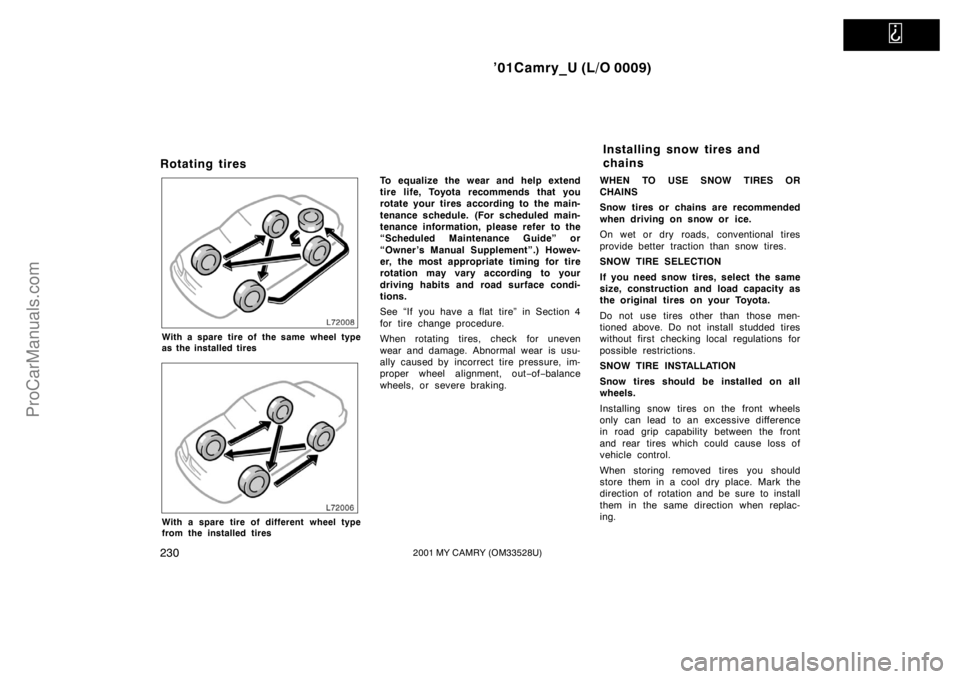
Rotating tires
With a spare tire of the same wheel type
as the installed tires
With a spare tire of different wheel type
from the installed tires
To equalize the wear and help extend
tire life, Toyota recommends that you
rotate your tires according to the main-
tenance schedule. (For scheduled main-
tenance information, please refer to the
“Scheduled Maintenance Guide” or
“Owner ’s Manual Supplement”.) Howev-
er, the most appropriate timing for tire
rotation may vary according to your
driving habits and road surface condi-
tions.
See “If you have a flat tire” in Section 4
for tire change procedure.
When rotating tires, check for uneven
wear and damage. Abnormal wear is usu-
ally caused by incorrect tire pressure, im-
proper wheel alignment, out−of−balance
wheels, or severe braking.WHEN TO USE SNOW TIRES OR
CHAINS
Snow tires or chains are recommended
when driving on snow or ice.
On wet or dry roads, conventional tires
provide better traction than snow tires.
SNOW TIRE SELECTION
If you need snow tires, select the same
size, construction and load capacity as
the original tires on your Toyota.
Do not use tires other than those men-
tioned above. Do not install studded tires
without first checking local regulations for
possible restrictions.
SNOW TIRE INSTALLATION
Snow tires should be installed on all
wheels.
Installing snow tires on the front wheels
only can lead to an excessive difference
in road grip capability between the front
and rear tires which could cause loss of
vehicle control.
When storing removed tires you should
store them in a cool dry place. Mark the
direction of rotation and be sure to install
them in the same direction when replac-
ing.
Installing snow tires and
chains
ProCarManuals.com
Page 262 of 268

’01Camry_U (L/O 0009)
2542001 MY CAMRY (OM33528U)
Instrument panel
14. DOME 7.5 A: Theft deterrent system,
daytime running light system, clock,
locking with wireless remote control
system, ignition switch light, personal
light, trunk light, electric moon roof,
interior light, vanity mirror light, door
courtesy light, power door lock system
15. ECU−B 10 A: Cruise control system,
anti−lock brake system, SRS airbag
system, seat belt pretensioners
16. DRL NO.2 5 A: Daytime running light
system
17. H−LP LH(LWR) 10 A: Left−hand head-
light18. H−LP RH(LWR) 10 A: Right−hand
headlight
19. A/F HTR 25 A: A/F sensor
20. SEAT−HEATER 20 A: Seat heater
21. HEATER 10 A: Air conditioning system,
rear window defogger, starting system
22. GAUGE 10 A: Gauges and meters,
back−up lights, cruise control system,
charging system, traction control sys-
tem, daytime running light system,
power windows, service reminder indi-
cators and warning buzzers
23. WIPER 25 A: Windshield wipers and
washer
24. MIRROR−HEATER 10 A: Outside rear
view mirror defogger
25. ECU−IG 15 A: Cruise control system,
anti−lock brake system, power antenna,
SRS airbag system, seat belt preten-
sioners, theft deterrent system, shift
lock control system, traction control
system, daytime running light system,
locking with wireless remote control
system, multiport fuel injection system/
sequential multiport fuel injection sys-
tem26. IGN 5 A: Gauges and meters, charging
system, SRS airbag system, seat belt
pretensioners, multiport fuel injection
system/sequential multiport fuel injec-
tion system
27. STOP 15 A: Stop lights, cruise control
system, high−mounted stoplight, anti−
lock brake system, shift lock control
system, multiport fuel injection system/
sequential multiport fuel injection sys-
tem
28. TAIL 10 A: Parking lights, license plate
lights, tail lights, front side marker
lights, daytime running light system,
multiport fuel injection system/sequen-
tial multiport fuel injection system
29. POWER−
OUTLET 15 A: Power outlet
30. OBD 7.5 A: On−board diagnosis sys-
tem
31. FOG 15 A: No circuit
32. STARTER 5 A: Gauges and meters,
multiport fuel injection system/sequen-
tial multiport fuel injection system
33. DOOR 25 A: Power door lock system,
theft deterrent system
ProCarManuals.com
Page 267 of 268

’01Camry_U (L/O 0009)
2592001 MY CAMRY (OM33528U)
Treadwear—The treadwear grade is a
comparative rating based on the wear rate
of the tire when tested under controlled
conditions on a specified government test
course. For example, a tire graded 150
would wear one and a half (1−1/2) times
as well on the government course as a
tire graded 100. The relative performance
of tires depends upon the actual condi-
tions of their use, however, and may de-
part significantly from the norm due to
variations in driving habits, service prac-
tices and differences in road characteris-
tics and climate.
Traction AA, A, B, C—The traction
grades, from highest to lowest, are AA, A,
B, and C, and they represent the tire’s
ability to stop on wet pavement as mea-
sured under controlled conditions on spe-
cified government test surfaces of asphalt
and concrete. A tire marked C may have
poor traction performance.
Warning: The traction grade assigned to
this tire is based on braking (straight
ahead) traction tests and does not include
cornering (turning) traction.Temperature A, B, C—The temperature
grades are A (the highest), B, and C,
representing the tire’s resistance to the
generation of heat and its ability to dissi-
pate heat when tested under controlled
conditions on a specified indoor laboratory
test wheel. Sustained high temperature
can cause the material of the tire to de-
generate and reduce tire life, and exces-
sive temperature can lead to sudden tire
failure. The grade C corresponds to a lev-
el of performance which all passenger car
tires must meet under the Federal Motor
Vehicle Safety Standard No.109. Grades B
and A represent higher levels of perfor-
mance on the laboratory test wheel than
the minimum required by law.
Warning: The temperature grades for this
tire are established for a tire that is prop-
erly inflated and not overloaded. Exces-
sive speed, underinflation, or excessive
loading, either separately or in combina-
tion, can cause heat buildup and possible
tire failure.
ProCarManuals.com