Page 260 of 656

ENGINE GENERAL INFORMATION AND DIAGNOSIS (H27 ENGINE) 6-1-99
1) Connect scan tool to DLC with ignition switch OFF.
2) Turn ON ignition switch and clear DTC, pending DTC and freeze frame data by using scan tool.
3) Start engine and warm up it completely.
4) Increase vehicle speed to 55 km/h (35 mph) or more.
5) Keep driving above vehicle speed for 20 min or more (Change of vehicle speed is permitted in this step).
6) Release accelerator pedal, stop vehicle and run engine at speed for 2 min.
7) Check DTC and pending DTC by using scan tool.
TROUBLESHOOTING
Step Action Yes No
1 Was “ENGINE DIAG. FLOW TABLE” per-
formed?Go to Step 2. Go to “ENGINE DIAG.
FLOW TABLE” in this
section.
2 Check EVAP canister purge system for opera-
tion referring to “EVAP CANISTER PURGE
SYSTEM INSPECTION” in this section.
Is check result satisfactory?Intermittent trouble or
faulty ECM (PCM).
Check for intermittent
referring to “INTERMIT-
TENT AND POOR CON-
NECTION” in Section 0A.Go to Step 3.
3 Check EVAP canister purge valve for resistance
referring to “EVAP CANISTER PURGE VALVE
INSPECTION” in this section.
Is resistance as specified?“GRN/BLK” or “BLU/BLK”
circuit open or short.
If wire and connections
are OK, substitute a
known-good ECM (PCM)
and recheck.Replace EVAP canister
purge valve.
Page 261 of 656

6-1-100 ENGINE GENERAL INFORMATION AND DIAGNOSIS (H27 ENGINE)
Evap canister purge system inspection
1) Warm up engine to normal operating temperature.
2) Hoist vehicle so that all wheels rotate freely.
3) Set M/T in “Neutral” or A/T in “P” position and parking brake.
4) Disconnect purge hose (1) from EVAP canister.
5) Place finger against the end of disconnected hose (1) and
check that vacuum is not felt there when engine is running at
idle speed.
6) Release parking brake lever, set transfer in “2H” and M/T in
“1st” or A/T in “L”.
7) Also check that vacuum is felt when engine speed is
increased to higher than about 1,500 r/min. and keep it for 3
min. or more. If check result is not described in steps 5) and
7), check EVAP canister purge valve, wire harness and vac-
uum passage.
Vacuum passage inspection
Start engine and run it at idle speed. With finger placed against
vacuum nozzle (1), check that vacuum is applied.
If it is not applied, clean vacuum passage by blowing compressed
air.
WARNING:
Make sure that transfer is set to “2H” range position for
this check. If it is set to “4H” or “4L” position, front and
rear wheels turn at high speed and a very dangerous sit-
uation may occur.
1
Page 266 of 656
ENGINE GENERAL INFORMATION AND DIAGNOSIS (H27 ENGINE) 6-1-105
DTC P0500 (DTC No.24) Vehicle Speed Sensor Malfunction
WIRING DIAGRAM
DTC DETECTING CONDITION AND TROUBLE AREA
1. Speedometer
2. Vehicle speed sensor
3. Cruise control module (if equipped)
4. ECM (PCM)
DTC DETECTING CONDITION TROUBLE AREA
Vehicle speed signal not inputted although fuel is kept
cut for longer than 5 seconds
(2 driving cycle detection logic)•Vehicle speed sensor circuit open or short
•Vehicle speed sensor
•Vehicle speed sensor drive gear or driven gear
•Speedometer malfunction
•Cruise control module malfunction (if equipped)
•ECM (PCM)
Page 267 of 656
6-1-106 ENGINE GENERAL INFORMATION AND DIAGNOSIS (H27 ENGINE)
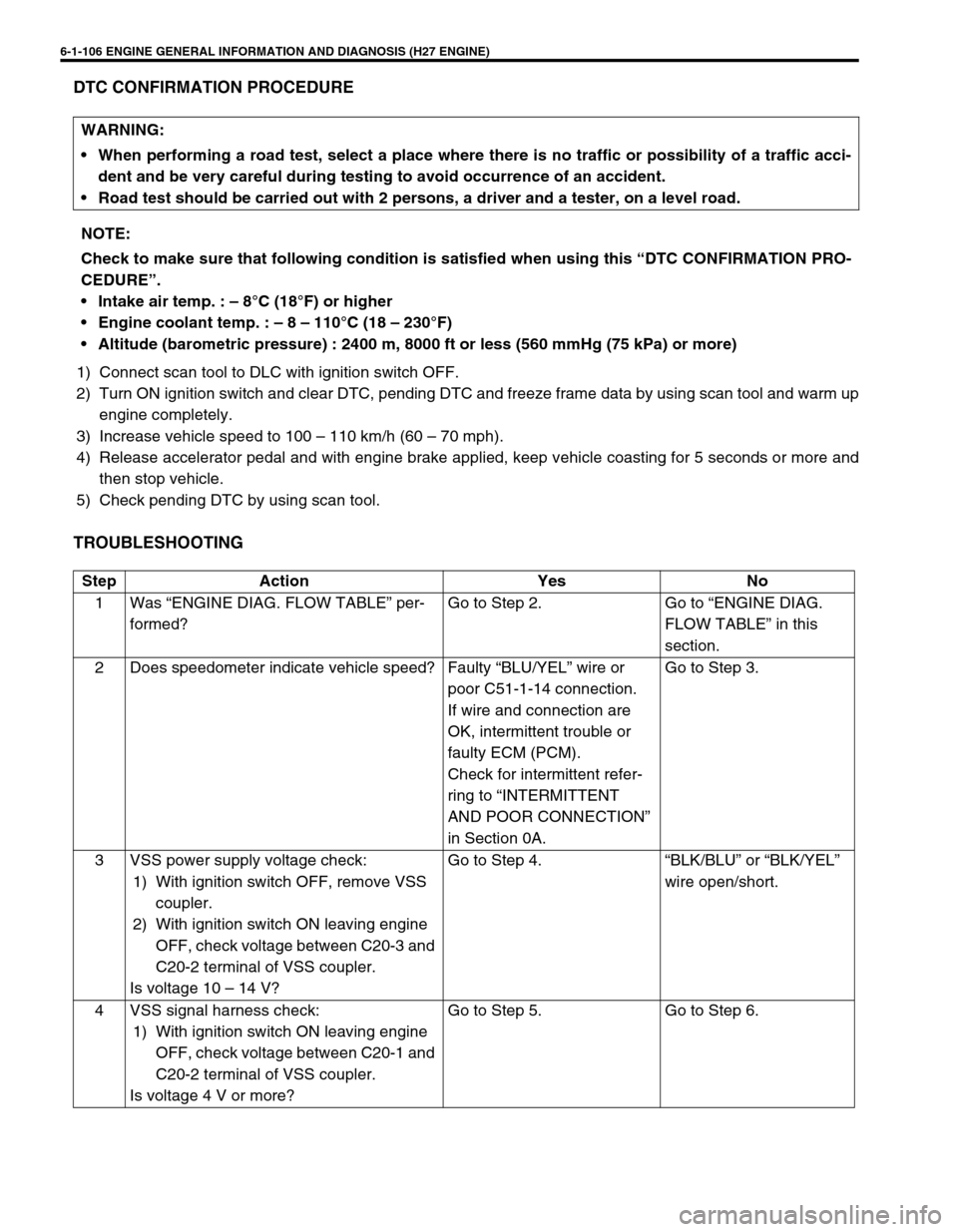
DTC CONFIRMATION PROCEDURE
1) Connect scan tool to DLC with ignition switch OFF.
2) Turn ON ignition switch and clear DTC, pending DTC and freeze frame data by using scan tool and warm up
engine completely.
3) Increase vehicle speed to 100 – 110 km/h (60 – 70 mph).
4) Release accelerator pedal and with engine brake applied, keep vehicle coasting for 5 seconds or more and
then stop vehicle.
5) Check pending DTC by using scan tool.
TROUBLESHOOTING
WARNING:
When performing a road test, select a place where there is no traffic or possibility of a traffic acci-
dent and be very careful during testing to avoid occurrence of an accident.
Road test should be carried out with 2 persons, a driver and a tester, on a level road.
NOTE:
Check to make sure that following condition is satisfied when using this “DTC CONFIRMATION PRO-
CEDURE”.
Intake air temp. : – 8°C (18°F) or higher
Engine coolant temp. : – 8 – 110°C (18 – 230°F)
Altitude (barometric pressure) : 2400 m, 8000 ft or less (560 mmHg (75 kPa) or more)
Step Action Yes No
1Was “ENGINE DIAG. FLOW TABLE” per-
formed?Go to Step 2. Go to “ENGINE DIAG.
FLOW TABLE” in this
section.
2 Does speedometer indicate vehicle speed? Faulty “BLU/YEL” wire or
poor C51-1-14 connection.
If wire and connection are
OK, intermittent trouble or
faulty ECM (PCM).
Check for intermittent refer-
ring to “INTERMITTENT
AND POOR CONNECTION”
in Section 0A.Go to Step 3.
3 VSS power supply voltage check:
1) With ignition switch OFF, remove VSS
coupler.
2) With ignition switch ON leaving engine
OFF, check voltage between C20-3 and
C20-2 terminal of VSS coupler.
Is voltage 10 – 14 V?Go to Step 4.“BLK/BLU” or “BLK/YEL”
wire open/short.
4 VSS signal harness check:
1) With ignition switch ON leaving engine
OFF, check voltage between C20-1 and
C20-2 terminal of VSS coupler.
Is voltage 4 V or more?Go to Step 5. Go to Step 6.
Page 268 of 656
![SUZUKI GRAND VITARA 2001 2.G Owners Manual ENGINE GENERAL INFORMATION AND DIAGNOSIS (H27 ENGINE) 6-1-107
[A] Fig. for Step 3 / [B] Fig. for Step 4, 6, 7
Fig. for Step 55 VSS visual inspection:
1) Remove VSS referring to “TRANSFER”
section](/manual-img/20/7584/w960_7584-267.png "SUZUKI GRAND VITARA 2001 2.G Owners Manual ENGINE GENERAL INFORMATION AND DIAGNOSIS (H27 ENGINE) 6-1-107
[A] Fig. for Step 3 / [B] Fig. for Step 4, 6, 7
Fig. for Step 55 VSS visual inspection:
1) Remove VSS referring to “TRANSFER”
section")
ENGINE GENERAL INFORMATION AND DIAGNOSIS (H27 ENGINE) 6-1-107
[A] Fig. for Step 3 / [B] Fig. for Step 4, 6, 7
Fig. for Step 55 VSS visual inspection:
1) Remove VSS referring to “TRANSFER”
section.
2) Check VSS drive and driven gears for
damage and excessive wear.
Are they in good condition?Poor VSS connection or VSS
malfunction.
If connection is OK, substi-
tute a known-good VSS and
recheck.Replace VSS.
6 Speedometer circuit check:
1) With ignition switch OFF, disconnect
G11 coupler from combination meter.
2) With ignition switch ON leaving engine
OFF, check voltage between C20-1 and
C20-2 terminal of VSS coupler.
Is voltage 4 V or more?Substitute a known-good
combination meter and
recheck.Go to Step 7.
7 Cruise control module circuit check (if
equipped):
1) With ignition switch OFF, disconnect
E132 coupler from cruise control mod-
ule.
2) With ignition switch ON leaving engine
OFF, check voltage between C20-1 and
C20-2 terminal of VSS coupler.
Is voltage 4 V or more?Substitute a known-good
cruise control module and
recheck.“BLU/YEL” wire open/
short or faulty ECM
(PCM).
If wire and connection are
OK, substitute a known-
good ECM (PCM) and
recheck.
1. VSS coupler
2.“BLU/YEL” (C20-1) terminal
3.“BLK/YEL” (C20-2) terminal
4.“BLU/BLK” (C20-3) terminal
Step Action Yes No
1. VSS coupler
2. VSS driven gear
3. VSS drive gear
Page 269 of 656
6-1-108 ENGINE GENERAL INFORMATION AND DIAGNOSIS (H27 ENGINE)
DTC P0505 Idle Air Control System Malfunction
SYSTEM/WIRING DIAGRAM
DTC DETECTING CONDITION AND TROUBLE AREA
1. Throttle body 3. ECM (PCM) 5. FIA valve 7. Main relay
2. Idle air control valve 4. Sensed information 6. Main fuse
DTC DETECTING CONDITION TROUBLE AREA
•Engine idle speed is 100 r/min. or more lower than target idle
speed for longer than 20 sec. continuously.
or
•Engine idle speed is 200 r/min or more higher than target
idle speed for longer than 20 sec. continuously.
(2 driving cycle detection logic)•IAC valve or its circuit
•Abnormal air drawn in air intake system
•FIA (fast idle air) valve
Page 270 of 656

ENGINE GENERAL INFORMATION AND DIAGNOSIS (H27 ENGINE) 6-1-109
DTC CONFIRMATION PROCEDURE
1) Connect scan tool to DLC with ignition switch OFF.
2) Turn ON ignition switch and clear DTC, pending DTC and freeze frame data by using scan tool and warm up
engine completely.
3) Run engine at idle speed for 1 min.
4) Check pending DTC by using scan tool.
TROUBLESHOOTING
NOTE:
Check to make sure that following condition is satisfied when using this “DTC CONFIRMATION PRO-
CEDURE”.
Intake air temp. : – 8°C (18°F) or higher
Engine coolant temp. : – 8 – 110°C (18 – 230°F)
Altitude (barometric pressure) : 2400 m, 8000 ft or less (560 mmHg (75 kPa) or more)
Step Action Yes No
1Was “ENGINE DIAG. FLOW TABLE” per-
formed?Go to Step 2. Go to “ENGINE DIAG.
FLOW TABLE” in this
section.
2 Idle speed check:
1) Check engine idle speed referring to “IDLE
SPEED/IDLE AIR CONTROL DUTY
INSPECTION” in Section 6E2.
Is engine idle speed within specification?Intermittent trouble or
faulty ECM (PCM).
Check for intermittent
referring to “INTERMIT-
TENT AND POOR CON-
NECTION” in Section 0A.Go to Step 3.
3 IAC valve check:
1) Check IAC valve referring to “IAC VALVE
INSPECTION” in Section 6E2.
Is check result as specified?Go to Step 6. Go to Step 4.
4 IAC valve circuit check:
1) With ignition switch OFF, disconnect ECM
(PCM) couplers.
2) Check for proper connection to IAC valve at
C51-1-4, C51-1-5, C51-1-16 and C51-1-17
terminals.
3) If OK, check resistance between C51-1-4
and C51-1-5, C51-1-16 and C51-1-17.
Is each resistance 51 – 67 Ω?Go to Step 5.“LT GRN/BLK”, “PPL/
BLK”, “GRY/BLU” or
“PPL/YEL” wire open or
short.
If wire and connections
are OK, replace IAC
valve.
5 IAC valve power supply voltage check:
1) Connect ECM (PCM) couplers.
2) With ignition switch OFF, disconnect C29
coupler of IAC valve.
3) With ignition switch ON, check voltage
between C29-2 and ground, C29-5 and
ground.
Is each voltage 10 – 14 V?IAC valve or ECM (PCM)
malfunction.Open “BLU/BLK” wire.
Page 271 of 656

6-1-110 ENGINE GENERAL INFORMATION AND DIAGNOSIS (H27 ENGINE)
DTC P0601 (DTC No.71) Internal Control Module Memory Check Sum Error
SYSTEM DESCRIPTION
Internal control module is installed in ECM (PCM).
DTC DETECTING CONDITION AND TROUBLE AREA
DTC CONFIRMATION PROCEDURE
1) Connect scan tool to DLC with ignition switch OFF.
2) Turn ON ignition switch and clear DTC, pending DTC and freeze frame data by using scan tool.
3) Start engine and run it at idle if possible.
4) Check DTC by using scan tool.
TROUBLESHOOTING
Substitute a known-good ECM (PCM) and recheck.6 Was idle speed higher than specification in
Step 2?Check FIA valve for mal-
function.
Check abnormal air inhal-
ing from intake manifold,
throttle body, PCV valve
and EVAP canister purge
control system.Check parts or system
which can cause engine
low idle.
Check FIA valve for stuck.
Air inhaling from between
throttle body and MAF
sensor, EGR valve mal-
function (leakage from
valve seat), accessory
engine load, clog of idle
air passage, engine
mechanical, engine over-
heat and etc. Step Action Yes No
DTC DETECTING CONDITION TROUBLE AREA
Data write error or check sum error ECM (PCM)

