Page 350 of 656

ENGINE AND EMISSION CONTROL SYSTEM (SEQUENTIAL MULTIPORT FUEL INJECTION FOR H27 ENGINE) 6E2-17
Idle mixture inspection/adjustment (vehicle without
heated oxygen sensor)
All vehicles not equipped with heated oxygen sensor are shipped
with their CO % factory adjusted as follows.
Engine idle mixture (CO %)
0.8 – 1.3 % at specified idle speed
Idle mixture adjustment should never be changed from the origi-
nal factory setting. However, if during diagnosis, the check indi-
cates idle mixture to be the cause of a driver performance
complaint or emission failure, the idle mixture can be adjusted
using the following procedures.
1) Check idle speed according to “Idle Speed/Idle Air Control
Duty Inspection” in this section.
2) Using exhaust gas tester, check that idle mixture CO % is
within above specification. If it is out of specification, adjust it
to specification by turning resistor knob (1).
3) If idle mixture has been adjusted, confirm that idle speed is
within specification. NOTE:
For this inspection and adjustment, exhaust gas tester
(CO meter) and engine tachometer are necessary.
Page 370 of 656

ENGINE AND EMISSION CONTROL SYSTEM (SEQUENTIAL MULTIPORT FUEL INJECTION FOR H27 ENGINE) 6E2-37
Heated oxygen sensor (sensor 1)
REMOVAL
1) Disconnect negative (–) cable from battery.
2) Disconnect coupler of oxygen sensor (s).
3) Remove oxygen sensor (s) from exhaust manifold (s).
INSTALLATION
Reverse removal procedure noting the followings.
•Tighten oxygen sensor (s) to specified torque.
Tightening torque
Heated oxygen sensor 1
(a) : 45 N·m (4.5 kg-m, 32.5 lb-ft)
•Connect connector of oxygen sensor (s) and clamp wire har-
ness securely.
•After installing oxygen sensor (s), start engine and check
that no exhaust gas leakage exists.
INSPECTION
Inspect HO2S-1 and its circuit referring to “DTC P0130 or P0150
Diag. Flow Table” in Section 6-1. If malfunction is found, replace. WARNING:
To avoid danger of being burned, do not touch exhaust
system when system is hot. Oxygen sensor removal
should be performed when system is cool.
NOTE:
Be careful not to expose it to excessive shock.
1. Left (No.1) bank oxygen sensor (sensor 1)
Page 371 of 656

6E2-38 ENGINE AND EMISSION CONTROL SYSTEM (SEQUENTIAL MULTIPORT FUEL INJECTION FOR H27 ENGINE)
HEATER INSPECTION
1) Disconnect HO2S-1 or -2 coupler.
2) Using ohmmeter, measure resistance between terminals
“VB” and “GND” of HO2S coupler (1).
If found faulty, replace HO2S.
Resistance of HO2S heater:
11.7 – 14.3 Ω
ΩΩ Ω (at 20 °C (68 °F)) for HO2S-2
5.0 – 6.4 Ω
ΩΩ Ω (at 20 °C (68 °F)) for HO2S-1
3) Connect HO2S coupler securely.
Heated oxygen sensor (sensor 2)
REMOVAL
1) Disconnect negative (–) cable from battery.
2) Disconnect coupler (3) of oxygen sensor(s).
3) Remove oxygen sensor(s) (2) from exhaust manifold(s) (1).
INSTALLATION
Reverse removal procedure noting the followings.
•Tighten oxygen sensor(s) to specified torque.
Tightening torque
Heated oxygen sensor 2 (a) : 45 N·m (4.5 kg-m, 32.5 lb-ft)
•Connect connector of oxygen sensor(s) and clamp wire har-
ness securely.
•After installing oxygen sensor(s), start engine and check that
no exhaust gas leakage exists. NOTE:
Temperature of HO2S affects resistance value largely.
Make sure that HO2S heater is at correct temperature.
WARNING:
To avoid danger of being burned, do not touch exhaust
system when system is hot. Oxygen sensor removal
should be performed when system is cool.
NOTE:
Be careful not to expose it to excessive shock.
Page 404 of 656
EXHAUST SYSTEM 6K-1
6K
SECTION 6K
EXHAUST SYSTEM
CONTENTS
On-Vehicle Service..........................................6K-2Components.................................................. 6K-2
CAUTION:
Be sure to use UNLEADED FUEL for the catalytic converter equipped vehicle. Use of LEADED FUEL
will affect performance of the catalytic converter adversely to a great extent.
NOTE:
For the descriptions (items) not found in this section, refer to the same section of service manual
mentioned in the FOREWORD of this manual.
Page 405 of 656
6K-2 EXHAUST SYSTEM
On-Vehicle Service
Components
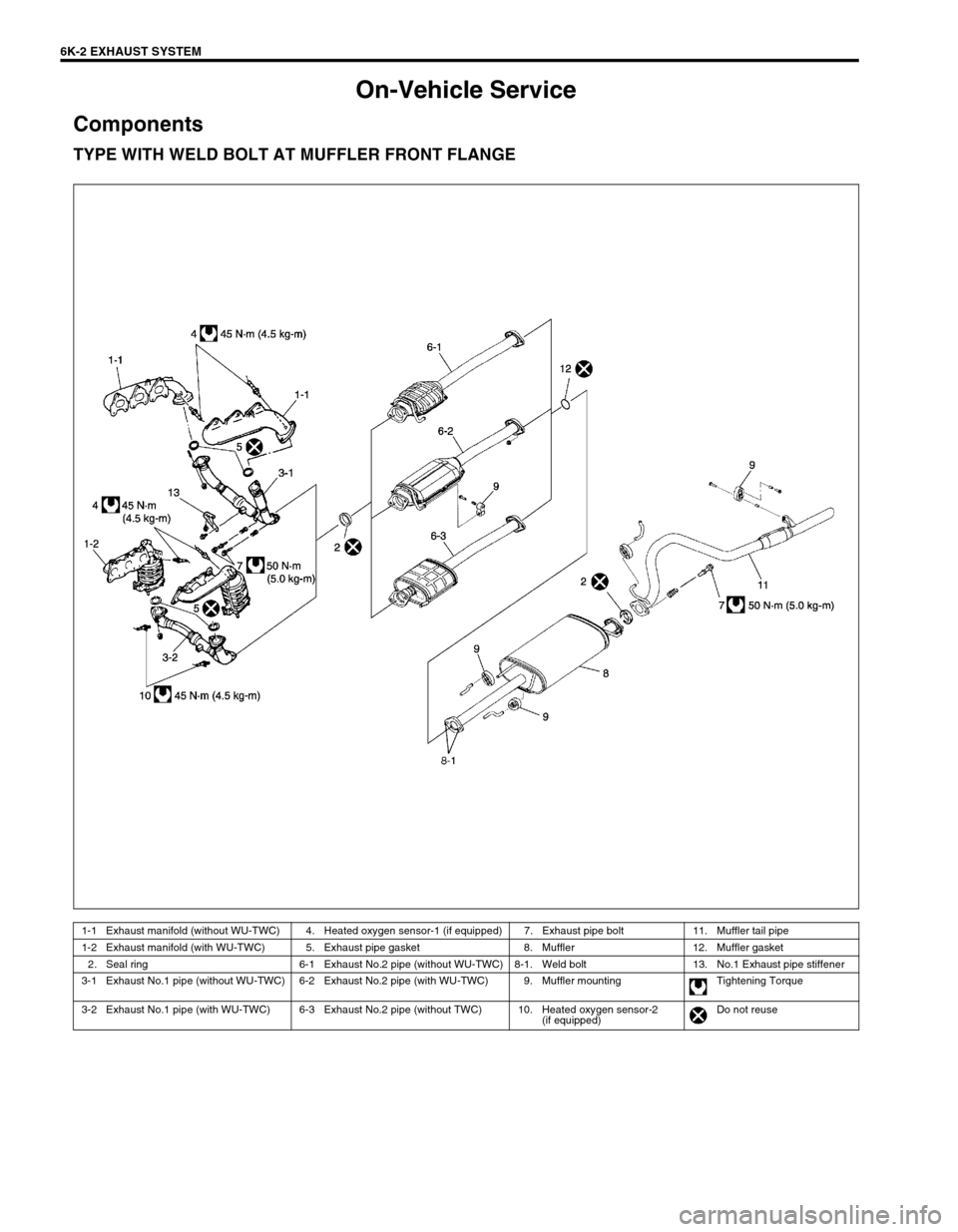
TYPE WITH WELD BOLT AT MUFFLER FRONT FLANGE
1-1 Exhaust manifold (without WU-TWC) 4. Heated oxygen sensor-1 (if equipped) 7. Exhaust pipe bolt 11. Muffler tail pipe
1-2 Exhaust manifold (with WU-TWC) 5. Exhaust pipe gasket 8. Muffler 12. Muffler gasket
2. Seal ring 6-1 Exhaust No.2 pipe (without WU-TWC) 8-1. Weld bolt 13. No.1 Exhaust pipe stiffener
3-1 Exhaust No.1 pipe (without WU-TWC) 6-2 Exhaust No.2 pipe (with WU-TWC) 9. Muffler mounting Tightening Torque
3-2 Exhaust No.1 pipe (with WU-TWC) 6-3 Exhaust No.2 pipe (without TWC) 10. Heated oxygen sensor-2
(if equipped)Do not reuse
Page 406 of 656
EXHAUST SYSTEM 6K-3
TYPE WITHOUT WELD BOLT AT MUFFLER FRONT FLANGE
1-1 Exhaust manifold (without WU-TWC) 4. Heated oxygen sensor-1 (if equipped) 7. Exhaust pipe bolt 12. Muffler gasket
1-2 Exhaust manifold (with WU-TWC) 5. Exhaust pipe gasket 8. Muffler 13. No.1 Exhaust pipe stiffener
2. Seal ring 6-1 Exhaust No.2 pipe (without WU-TWC) 9. Muffler mounting Tightening Torque
3-1 Exhaust No.1 pipe (without WU-TWC) 6-2 Exhaust No.2 pipe (with WU-TWC) 10. Heated oxygen sensor-2
(if equipped)Do not reuse
3-2 Exhaust No.1 pipe (with WU-TWC) 6-3 Exhaust No.2 pipe (without TWC) 11. Muffler tail pipe
Page 407 of 656
Page 416 of 656

AUTOMATIC TRANSMISSION (4 A/T) 7B1-7
Diagnosis
This vehicle is equipped with an electronic transmission control system, which control the automatic shift up and
shift down timing, TCC operation, etc. suitably to vehicle driving conditions.
PCM (ECM) has an On-Board Diagnosis system which detects a malfunction in this system and abnormality of
those parts that influence the engine exhaust emission.
When diagnosing a trouble in the transmission including this system, be sure to have full understanding of the
outline of “ON-BOARD DIAGNOSTIC SYSTEM” and each item in “PRECAUTION IN DIAGNOSING TROUBLE”
and execute diagnosis according to “AUTOMATIC TRANSMISSION DIAGNOSTIC FLOW TABLE” to obtain
correct result smoothly.
On-Board Diagnostic System (Vehicle without
monitor connector)
For automatic transmission control system, PCM (ECM) has fol-
lowing functions. Refer to Section 6-1 for details.
•When the ignition switch is turned ON with the engine at a
stop, malfunction indicator lamp (MIL) (1) turns ON to check
the bulb of the MIL.
•When PCM detects a malfunction in A/T control system
(and/or a malfunction which gives an adverse effect to vehi-
cle emission) while the engine is running, it makes the mal-
function indicator lamp in the meter cluster of the instrument
panel turn ON and stores the malfunction area.
(If it detects that continuously 3 driving cycles are normal
after detecting a malfunction, however, it makes MIL (1) turn
OFF although DTC stored in its memory will remain.)
•It is possible to communicate through DLC (3) by using not
only SUZUKI scan tool (2). (Diagnostic information can be
accessed by using a scan tool (2).)
2 DRIVING CYCLE DETECTION LOGIC
Refer to Section 6-1 for details.
PENDING DTC
Refer to Section 6-1 for details.
FREEZE FRAME DATA
Refer to Section 6-1 for details.