2001 SUZUKI GRAND VITARA air flow meter
[x] Cancel search: air flow meterPage 234 of 656
ENGINE GENERAL INFORMATION AND DIAGNOSIS (H27 ENGINE) 6-1-73
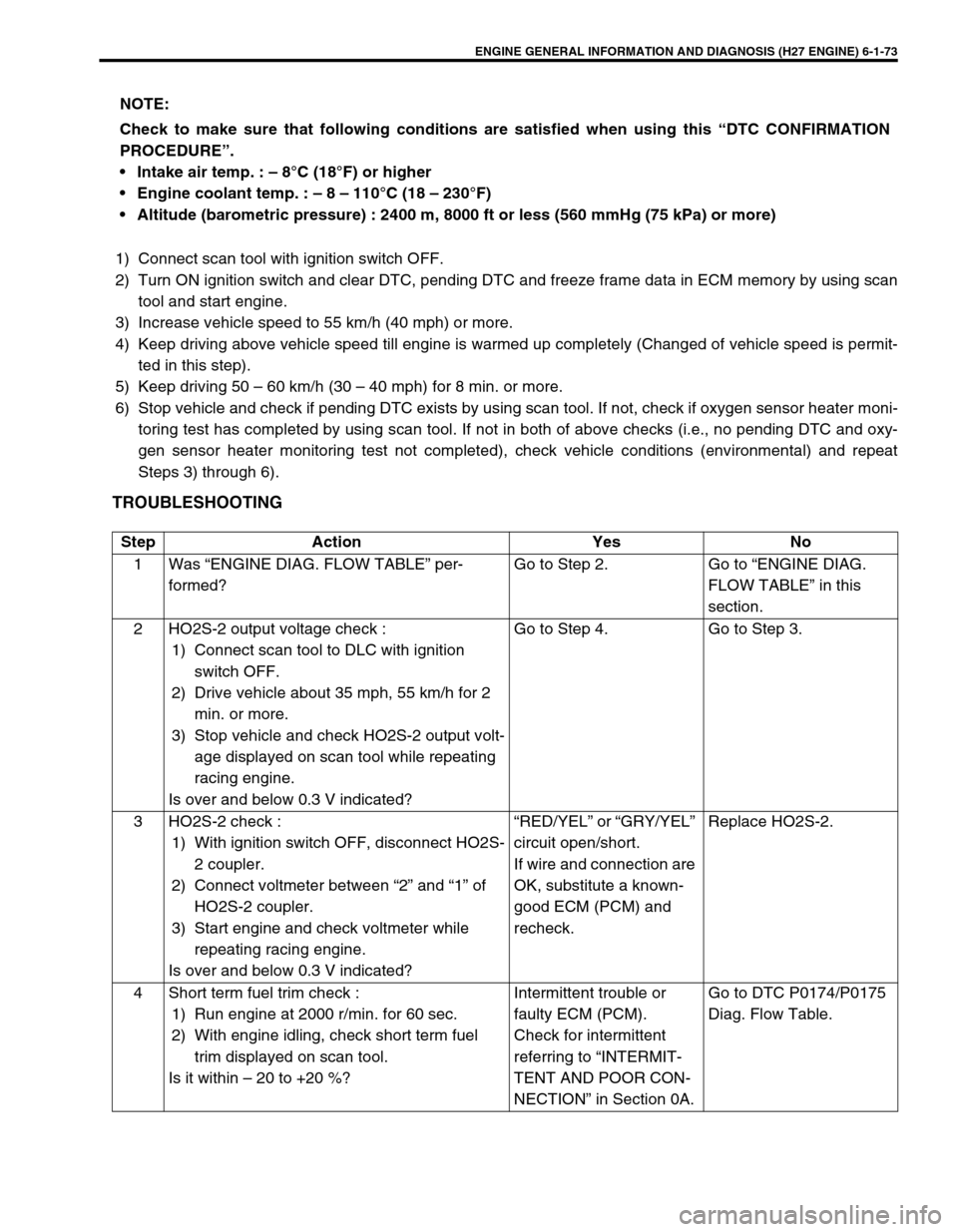
1) Connect scan tool with ignition switch OFF.
2) Turn ON ignition switch and clear DTC, pending DTC and freeze frame data in ECM memory by using scan
tool and start engine.
3) Increase vehicle speed to 55 km/h (40 mph) or more.
4) Keep driving above vehicle speed till engine is warmed up completely (Changed of vehicle speed is permit-
ted in this step).
5) Keep driving 50 – 60 km/h (30 – 40 mph) for 8 min. or more.
6) Stop vehicle and check if pending DTC exists by using scan tool. If not, check if oxygen sensor heater moni-
toring test has completed by using scan tool. If not in both of above checks (i.e., no pending DTC and oxy-
gen sensor heater monitoring test not completed), check vehicle conditions (environmental) and repeat
Steps 3) through 6).
TROUBLESHOOTING
NOTE:
Check to make sure that following conditions are satisfied when using this “DTC CONFIRMATION
PROCEDURE”.
Intake air temp. : – 8°C (18°F) or higher
Engine coolant temp. : – 8 – 110°C (18 – 230°F)
Altitude (barometric pressure) : 2400 m, 8000 ft or less (560 mmHg (75 kPa) or more)
Step Action Yes No
1 Was “ENGINE DIAG. FLOW TABLE” per-
formed?Go to Step 2. Go to “ENGINE DIAG.
FLOW TABLE” in this
section.
2 HO2S-2 output voltage check :
1) Connect scan tool to DLC with ignition
switch OFF.
2) Drive vehicle about 35 mph, 55 km/h for 2
min. or more.
3) Stop vehicle and check HO2S-2 output volt-
age displayed on scan tool while repeating
racing engine.
Is over and below 0.3 V indicated?Go to Step 4. Go to Step 3.
3 HO2S-2 check :
1) With ignition switch OFF, disconnect HO2S-
2 coupler.
2) Connect voltmeter between “2” and “1” of
HO2S-2 coupler.
3) Start engine and check voltmeter while
repeating racing engine.
Is over and below 0.3 V indicated?“RED/YEL” or “GRY/YEL”
circuit open/short.
If wire and connection are
OK, substitute a known-
good ECM (PCM) and
recheck.Replace HO2S-2.
4 Short term fuel trim check :
1) Run engine at 2000 r/min. for 60 sec.
2) With engine idling, check short term fuel
trim displayed on scan tool.
Is it within – 20 to +20 %?Intermittent trouble or
faulty ECM (PCM).
Check for intermittent
referring to “INTERMIT-
TENT AND POOR CON-
NECTION” in Section 0A.Go to DTC P0174/P0175
Diag. Flow Table.
Page 267 of 656
6-1-106 ENGINE GENERAL INFORMATION AND DIAGNOSIS (H27 ENGINE)
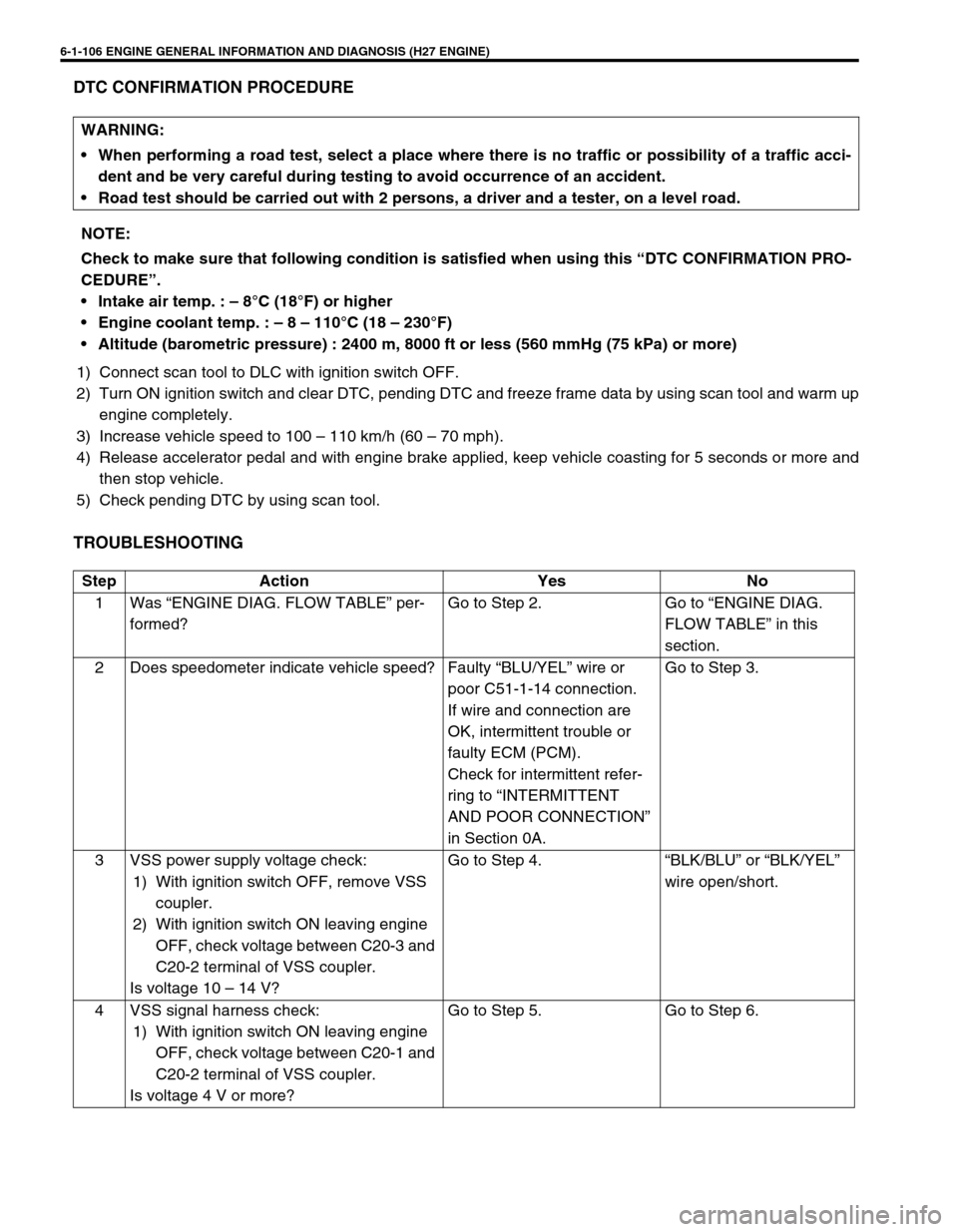
DTC CONFIRMATION PROCEDURE
1) Connect scan tool to DLC with ignition switch OFF.
2) Turn ON ignition switch and clear DTC, pending DTC and freeze frame data by using scan tool and warm up
engine completely.
3) Increase vehicle speed to 100 – 110 km/h (60 – 70 mph).
4) Release accelerator pedal and with engine brake applied, keep vehicle coasting for 5 seconds or more and
then stop vehicle.
5) Check pending DTC by using scan tool.
TROUBLESHOOTING
WARNING:
When performing a road test, select a place where there is no traffic or possibility of a traffic acci-
dent and be very careful during testing to avoid occurrence of an accident.
Road test should be carried out with 2 persons, a driver and a tester, on a level road.
NOTE:
Check to make sure that following condition is satisfied when using this “DTC CONFIRMATION PRO-
CEDURE”.
Intake air temp. : – 8°C (18°F) or higher
Engine coolant temp. : – 8 – 110°C (18 – 230°F)
Altitude (barometric pressure) : 2400 m, 8000 ft or less (560 mmHg (75 kPa) or more)
Step Action Yes No
1Was “ENGINE DIAG. FLOW TABLE” per-
formed?Go to Step 2. Go to “ENGINE DIAG.
FLOW TABLE” in this
section.
2 Does speedometer indicate vehicle speed? Faulty “BLU/YEL” wire or
poor C51-1-14 connection.
If wire and connection are
OK, intermittent trouble or
faulty ECM (PCM).
Check for intermittent refer-
ring to “INTERMITTENT
AND POOR CONNECTION”
in Section 0A.Go to Step 3.
3 VSS power supply voltage check:
1) With ignition switch OFF, remove VSS
coupler.
2) With ignition switch ON leaving engine
OFF, check voltage between C20-3 and
C20-2 terminal of VSS coupler.
Is voltage 10 – 14 V?Go to Step 4.“BLK/BLU” or “BLK/YEL”
wire open/short.
4 VSS signal harness check:
1) With ignition switch ON leaving engine
OFF, check voltage between C20-1 and
C20-2 terminal of VSS coupler.
Is voltage 4 V or more?Go to Step 5. Go to Step 6.
Page 338 of 656

ENGINE AND EMISSION CONTROL SYSTEM (SEQUENTIAL MULTIPORT FUEL INJECTION FOR H27 ENGINE) 6E2-5
1. Air cleaner 22. Fuel level sensor 39. A/C controller (if equipped)
2. Intake air temp. sensor 23. Monitor connector (if equipped) 40. Data link connector/Immobilizer control mod-
ule (if equipped)
3. Mass air flow sensor 23-1. Diag. switch terminal 41. ABS control module
4. EVAP canister purge valve 23-2. Test switch terminal 42. Main relay
5. Throttle position sensor 23-3. Output duty select switch terminal 43. Ignition switch
6. Idle air control valve 23-4. Duty output terminal 44. Park/Neutral position switch in TR switch (A/T)
7. Camshaft position sensor 24. Fuel filter 45. Battery
8. EGR valve 25. Fuel pressure regulator 46. Starter magnetic switch
9. Manifold absolute pressure sensor
(if equipped)26. Immobilizer indicator lamp (if equipped) 47.“O/D OFF” lamp (A/T)
10. Fuel injector 27. Tank pressure control valve 48.“POWER” lamp (A/T)
11. PCV valve 28. EVAP canister 49. Lighting switch (A/T)
12. Ignition coil assembly 29. Knock sensor 50. Stop lamp switch (A/T)
13. Engine coolant temperature sensor 30. ECM/PCM (Engine control module/Powertrain con-
trol module)51. O/D cut switch (A/T)
14. Heated oxygen sensor
(bank 1 sensor 1) (if equipped)31. Malfunction indicator lamp 52. POWER/NORMAL change switch (A/T)
15. Heated oxygen sensor
(bank 2 sensor 1) (if equipped)32. Electric loads (rear defogger (if equipped), lighting) 53. 4WD low switch (A/T)
16. Heated oxygen sensor
(bank 1 sensor 2) (if equipped)33. Power steering pressure switch 54. Transmission range switch (A/T)
17. Heated oxygen sensor
(bank 2 sensor 2) (if equipped)34. Heater blower fan switch 55. Solenoid valve A (A/T)
18. Warm-up three way catalytic converter
(if equipped)35. Cruise control module 56. Solenoid valve B (A/T)
19. Three way catalytic converter
(if equipped)36. Vehicle speed sensor 57. TCC solenoid valve (A/T)
20. Crankshaft position sensor
(if equipped)37. Combination meter 58. A/T input speed sensor (A/T)
21. Fuel pump 38. A/C condenser fan relay (if equipped) 59. A/T vehicle (output) speed sensor (A/T)
Page 343 of 656

6E2-10 ENGINE AND EMISSION CONTROL SYSTEM (SEQUENTIAL MULTIPORT FUEL INJECTION FOR H27 ENGINE)
TERMINAL ARRANGEMENT OF ECM (PCM) CONNECTOR (VIEWED FROM HARNESS SIDE)
1. Fuel injector No.1 17.“O/D OFF” lamp (A/T) 34. Power steering pressure switch
2. Fuel injector No.2 18.“POWER” lamp (A/T) 35. Stop lamp switch (Brake pedal switch)
3. Fuel injector No.3 18-1.“4WD” lamp (4WD) 36. Lighting switch
4. Fuel injector No.4 18-2. 4WD air pump assembly (4WD) 37. Rear defogger switch (if equipped)
4-1. Fuel injector No.5 19. 4WD switch (4WD) 38. Heater blower motor (if equipped)
4-2. Fuel injector No.6 20. Power/Normal change switch (A/T) 39. A/C control module (amplifier)
5. EGR valve (if equipped) 21. O/D cut switch (A/T) 40. ABS control module
6. Idle air control 21-1. 4WD low switch (4WD) 41. Heated oxygen sensor-1 (Bank1) (if equipped)
7. EVAP canister purge valve 22. Main relay 41-1. Heated oxygen sensor-1 (Bank2) (if equipped)
8. Ignition coil for No.1 23. Transmission range switch (Park/Neutral
Position Switch) or clutch pedal position switch42. Heater oxygen sensor-2 (Bank1) (if equipped)
8-1. Ignition coil for No.2 24. Starter magnetic switch 42-1. Heater oxygen sensor-2 (Bank2) (if equipped)
9. Ignition coil for No.3 24-1. Cruise control module (if equipped) 43. Intake air temp. sensor
9-1. Ignition coil for No.4 25. Vehicle speed sensor 44. Engine coolant temp. sensor
10. Ignition coil for No.5 26. Combination meter 45. Throttle position sensor
10-1. Ignition coil for No.6 27. Data link connector 46. CO adjusting resistor (if equipped)
11. Fuel pump relay 28. TCC solenoid (A/T) 47. Manifold absolute pressure sensor (if
equipped)
12. Fuel pump 29. Shift solenoid-B (A/T) 48. Mass air flow sensor
13. A/C condenser fan relay (if equipped) 30. Shift solenoid-A (A/T) 49. Camshaft position sensor
14. A/C condenser fan motor (if equipped) 31. Transmission range switch (sensor) (A/T) 50. Crankshaft position sensor (if equipped)
15. Knock sensor 32. A/T input speed sensor (A/T) 51. Monitor connector (if equipped)
16. Malfunction indicator lamp 33. A/T vehicle (output) speed sensor (A/T) 52. Engine control module
(Powertrain control module)
TERMINAL CIRCUIT TERMINAL CIRCUIT TERMINAL CIRCUIT
E61-1 Power source for CO adjusting resistor
(if equipped)E61-13 Data link connector E61-25—
E61-2 Power source for back up E61-14 Test switch terminal (if equipped) E61-26—
E61-3—E61-15 Rear defogger switch (if equipped) E61-27—
E61-4 Cruise control module
(Throttle opening signal)E61-16 Heater blower switch E61-28—
E61-5 Duty output terminal (if equipped) E61-17 A/C signal (if equipped) E61-29 Diag. switch terminal (if equipped)
E61-6 Tachometer E61-18—E61-30 ABS control module (if equipped)
E61-7 MIL (“SERVICE INGINE SOON” lamp) E61-19“4WD” lamp E61-31 Power/Normal change switch (A/T)
E61-8 A/C cut signal (if equipped) E61-20“O/D OFF” lamp (A/T) E61-32 Lighting switch
E61-9 Main relay E61-21“POWER” lamp (A/T) E61-33 O/D cut switch (A/T)
E61-10 CO adjusting resistor (if equipped) E61-22 A/C fan motor relay (if equipped) E61-34 Stop lamp switch (Brake pedal switch)
E61-11—E61-23 Fuel pump relay E61-35 Cruise control module (if equipped)
E61-12—E61-24 Ground for CO adjusting resistor (if
equipped)
Page 349 of 656
![SUZUKI GRAND VITARA 2001 2.G Owners Manual 6E2-16 ENGINE AND EMISSION CONTROL SYSTEM (SEQUENTIAL MULTIPORT FUEL INJECTION FOR H27 ENGINE)
[Not using SUZUKI scan tool] (vehicle with monitor
connector)
1) Disconnect scan tool from DLC if connec](/manual-img/20/7584/w960_7584-348.png "SUZUKI GRAND VITARA 2001 2.G Owners Manual 6E2-16 ENGINE AND EMISSION CONTROL SYSTEM (SEQUENTIAL MULTIPORT FUEL INJECTION FOR H27 ENGINE)
[Not using SUZUKI scan tool] (vehicle with monitor
connector)
1) Disconnect scan tool from DLC if connec")
6E2-16 ENGINE AND EMISSION CONTROL SYSTEM (SEQUENTIAL MULTIPORT FUEL INJECTION FOR H27 ENGINE)
[Not using SUZUKI scan tool] (vehicle with monitor
connector)
1) Disconnect scan tool from DLC if connected.
2) Warm up engine to normal operating temperature.
3) Stop engine and connect duty meter (3) between duty output
terminal and ground terminal of monitor connector (1).
4) Using service wire (2), ground diagnosis switch terminal in
monitor connector.
5) Set tachometer.
6) Start engine and warm it up completely.
7) Check IAC duty and idle air control system referring to Diag-
nostic Flow Table B-4 “IDLE AIR CONTROL SYSTEM
CHECK” in this section.
•“OFF DUTY METER” is such duty meter that indicates
approx. 100% when terminal voltage is approx. “0 V”.
•“V
B” represents battery voltage while engine of vehicle being
checked is running.
8) Remove service wire from monitor connector.
9) Install cap to monitor connector.
10) Check that specified engine idle speed is obtained with A/C
ON if vehicle is equipped with A/C.
If not, check A/C ON signal circuit and idle air control sys-
tem.
A: Output duty select switch terminal
B: Diagnosis switch terminal
C: Blank
D: Ground terminal
E: Test switch terminal
F: Duty output terminal
A/C OFF A/C ON
Engine idle speed: 700 ± 50 r/min. 750 ± 50 r/min.
IAC duty at specified
idle speed:5 – 40 % (0.7 – 5.6 V
when battery voltage
is 14 V)–
NOTE:
IAC duty can be checked roughly by using voltmeter. I
AC duty to voltage relation is as follows.
ON DUTY METER
INDICATION
(%)OFF DUTY
INDICATION
(%)VOLT METER
INDICATION
(V)
0
50
10010
50
00
0.5 x V
B
VB
Page 365 of 656

6E2-32 ENGINE AND EMISSION CONTROL SYSTEM (SEQUENTIAL MULTIPORT FUEL INJECTION FOR H27 ENGINE)
Mass air flow sensor (MAF sensor)
INSPECTION
1) Connect voltmeter (1) to “B+” terminal of MAF sensor (2)
coupler disconnected and ground (3).
2) Turn ignition switch ON and check that voltage is battery volt-
age.If not, check if wire harness is open or connection is
poor.
3) Turn ignition switch OFF and remove ECM/PCM cover (1)
from bracket.
4) Connect MAF sensor coupler to MAF sensor.
5) Turn ignition switch ON and check voltage at MAF sensor
output terminal of ECM/PCM connector (1).
MAF sensor output voltage
Voltage: 1.0 - 1.6 V
6) Start engine and check that voltage is lower than 5 V and it
rises as engine speed increases.
(Reference data: 1.7 – 2.0 V at specified idle speed)
If check result is not as specified above, cause may lie in
wire harness, coupler connection, MAF sensor or ECM/
PCM. NOTE:
Use voltmeter with high-impedance (10 kΩ
ΩΩ Ω/V minimum)
or digital type voltmeter.
Page 423 of 656

7B1-14 AUTOMATIC TRANSMISSION (4 A/T)
Diagnostic Trouble Code Table
Refer to the same item in Section 6-1.
Fail Safe Table
Refer to the same item in Section 6-1.
Visual Inspection
Visually check following parts and systems.
A/T Basic Check
This inspection is important for troubleshooting when PCM (ECM) has detected no DTC and no abnormality has
been noted in visual inspection. Follow flow table carefully.INSPECTION ITEM REFERRING SECTION
•A/T fluid - - - - - level, leakage, color SECTION 0B
•A/T fluid hoses - - - - - disconnection, looseness, deterioration SECTION 7B1
•Throttle (accelerator) cable - - - - - play, installation SECTION 6E2
•A/T throttle cable - - - - - play, installation SECTION 7B1
•A/T select cable - - - - - installation, operation SECTION 7B1
•Engine oil - - - - - level, leakage SECTION 0B
•Engine coolant - - - - - level, leakage SECTION 0B
•Battery - - - - - fluid level, corrosion of terminal
•Connectors of electric wire harness - - - - - disconnection, friction Section 6-1 or 7B1
•Fuses - - - - - burning SECTION 8
•Parts - - - - - installation, damage
•bolt - - - - - looseness
•Other parts that can be checked visually
•Also check following items at engine start, if possible.
–“O/D OFF” lamp - - - - - Operation SECTION 7B1
–“POWER” lamp - - - - - Operation SECTION 7B1
–Malfunction indicator lamp (“SERVICE ENGINE SOON” lamp) - -
- - - OperationSection 6-1
–Charge warning lamp - - - - - Operation SECTION 6H
–Engine oil pressure warning lamp - - - - - Operation SECTION 8C (SECTION 6A2 for pres-
sure check)
–Engine coolant temp. meter - - - - - Operation
–Other parts that can be checked visually
Step Action Yes No
1Was “AUTOMATIC TRANSMISSION DIAGNOSTIC
FLOW TABLE” performed?Go to Step 2. Go to “AUTOMATIC
TRANSMISSION DIAG-
NOSTIC FLOW TABLE”.
2Perform “MANUAL ROAD TEST” in this section.
Is it OK?Go to Step 3. Go to Step 4.
3Proceed to “TROUBLE DIAGNOSIS TABLE 1” in this
section.
Is trouble identified?Repair or replace
defective parts.Go to Step 5.
Page 477 of 656

7E-4 DIFFERENTIAL (FRONT)
Flow table
Step Action Yes No
1 Turn ON ignition switch (but engine at stop) and
check malfunction indicator lamp.
Does lamp light up?Go to step 2. A trouble has occurred
at some place. Repair
it referring to
MALFUNCTION INDI-
CATOR LAMP
(“CHECK ENGINE”
LAMP) CHECK in
DIAGNOSIS of Sec-
tion 6.
2 Check 4WD switch circuit.
Turn ignition switch ON and check that voltage
between terminal C51-3-7 and terminal C51-3-17
(ground) is as follows.
When transfer shift lever is in N or 2H : 10 – 14 V
When transfer shift lever is in 4L or 4H : 0 – 1 V
Is the check result satisfactory?Go to step 3. Check 4WD switch
(refer to Section 7A),
“BLK/ORN” and “BLK”
circuits of 4WD switch.
If OK, substitute a
known-good ECM
(PCM) and recheck.
3 Check power supply.
1) Turn ignition switch ON.
2) Check voltage between C51-1-9 and C51-3-17
(ground). The check results should be as follows.
When transfer shift lever is in N or 2H : 0 – 1 V
When transfer shift lever is in 4L or 4H : 10 – 14 V
Is the check result satisfactory?Go to step 4. Check “RED” circuit. If
it is OK, substitute a
known-good ECM
(PCM) and recheck.
4 Check air pump assembly circuit.
1) Check for proper connection to air pump assem-
bly at all terminals.
2) Turn ignition switch ON.
3) Check voltage between C51-3-18 and C51-3-17
(ground). The check result should be as follows.
When transfer shift lever is in 2H or N : 0 – 1 V
When transfer shift lever is in 4L or 4H (more than
4 seconds after shifted to 4L or 4H) : 10 – 14 V
Is the check result satisfactory?Go to step 5. Check air pump
assembly referring to
“ON-VEHICLE SER-
VICE”, and then
“PNK” circuit.
If OK, substitute a
known-good ECM
(PCM) and recheck.
5 Check 4WD indicator lamp circuit.
1) Turn ignition switch ON.
2) Check voltage between E61-19 and C51-3-17
(ground). The check result should be as follows.
When transfer shift lever is in 2H or N : 10 – 14 V
When transfer shift lever is in 4L or 4H : 0 – 1 V
Is the check result satisfactory?4WD control system is
in good condition.Check “ORN/BLK” cir-
cuit (including indica-
tor lamp and
combination meter).
If OK, substitute a
known-good ECM
(PCM) and recheck.