2001 SAAB 9-3 roof rack
[x] Cancel search: roof rackPage 4 of 260

4Exterior Sunroof _______________ 138
Convertible _____________ 48
Washing the car ________ 226
Waxing and polishing ____ 227
Touching-up of paintwork _ 227
Anticorrosion treatment ___ 228
Service program ________ 239Taillights ______________ 208
Stop lights _____________ 208
Light switches ___________ 75
Changing bulbs _________ 206Towing ________________ 185
Towrope attachment eyes _ 185
Towing a trailer _________ 179Trunk lid lock ___________ 144
Lowering the rear seat ____ 144
Trunk _________________ 147
Spare wheel ___________ 149
Tools _________________ 149
Lighting _______________ 208
Driving with a roof rack load ____ 182
Mounting of roof rack __________ 182
Maximum loads ______________ 244
Hood release handle __________ 192
Engine compartment: washing __ 226
Central locking __________ 36
Interior locking buttons ____ 37
Trunk lock ______________ 40
Child safety lock catch ____ 39
Car alarm (Anti-theft system) 41Headlight switches _______ 75
High/low beam control stalk 75
Turn signal & lane change
indicators ______________ 76
Headlamp wipers _______ 204
Changing bulbs ________ 206Fuel filler door __________ 157
Refuelling _____________ 157
Fuel grade ____________ 249
Fuel gauge _____________ 68
Fuel economy __________ 176
Tires & Rims _____________ 217 / 252
Tire pressure ___________ back cover
Driving in cold weather ________ 177
Brakes and braking ___________ 170
Compact spare wheel _________ 220
Changing a wheel ____________ 221
ProCarManuals.com
Page 48 of 260

48 ConvertibleConvertibleGeneral safety instructions• Never touch the hinges and struts of the
soft top nor the upper beam of the wind-
shield while operating the soft top.
After raising the soft top, always check
that it is properly secured to the top beam
of the windshield with the soft top locking
device before driving the car away.
After folding it down you should check that
the tonneau cover latches have engaged
properly. Otherwise it may come loose
while you are driving and cause injury.
Do not operate the soft top with passen-
gers in the rear seat or bystanders right
next to the car. There is a risk of head inju-
ries while the soft top is in motion.
Remove child car seats and children
before operating the soft top.
Don’t operate the soft top in temperatures
below 23°F (-5°C). Note that certain automatic carwashes
can do damage to fabric soft tops. This
applies to carwashes that use mechanical
feelers bearing against the body. We
advise against washing a Saab 9-3 Con-
vertible in automatic carwashes.
Note that certain automatic car washes
can cause water to leak in places that nor-
mally would not leak. Do not direct high
pressure streams of water at the seals for
the conver tible top.
Roof racks and ski holders must not be
mounted on the soft top.
Under no circumstances should anything
be put into the storage space for the soft
top (under the tonneau cover) since this
could cause obstruction when the soft top
is being folded away.
See that no luggage is resting against the
soft top stowage space since this could
interfere with the rasing and folding of the
soft top. When the soft top is being operated, low-
ering or raising should be completed. Do
not leave the soft top partially raised or
lowered: after 20 seconds it will quickly
"settle down" when the hydraulic pres-
sure is automatically released.
It is important that the telescopic locking
handle is completely pushed in when the
soft top is closed.
Fold down any auxilliary mounted
antenna before raising the top to avoid
possible antenna or top damage (e.g.,
OnStar cellular antenna on windshield of
Conver tible).
ProCarManuals.com
Page 151 of 260

151 Starting and driving
IB943
Starting and driving
Ignition switch ................. 152
Starting the engine .......... 153
Important considerations
for driving....................... 154
Refueling .......................... 157
Engine Break-in Period... 161
Manual transmission ...... 161
Automatic transmission . 162
Cruise Control ................. 169
Braking ............................. 170
Parking ............................. 174
Economical motoring ..... 176 Driving in cold weather ... 177
Driving in hot weather ..... 179
Towing a trailer ................ 179
Driving with a roof rack
load .................................. 182
Driving with the trunk lid
open ................................ 185
Driving in deep water....... 185
Towing the car.................. 185
Jump starting ................... 187
Driving considerations
with compact spare
wheel/tire fitted............... 190
For long trips .................... 190
ProCarManuals.com
Page 176 of 260
176 Starting and drivingEconomical motoringFactors affecting fuel consumption Fuel consumption is greatly affected by the
general driving conditions, the way in which
the car is driven and at what speeds, the
weather, the state of the road, the condition
of the car, etc. Breaking-in Fuel consumption may be somewhat higher
during the break-in period (the first 3,000–
4,000 miles (5,000–7,000 km). Weather conditionsFuel consumption can be as much as 10 %
lower in summer than in winter. The higher
consumption in cold weather is explained by
the longer time it takes for the engine to
reach normal operating temperature, and
for the transmission and wheel bearings to
warm up. Fuel economy is also affected by
the distance driven: short journeys of
3-5 miles (5-8 km) do not give the engine
enough time to reach normal temperature.
Strong winds can also affect fuel consump-
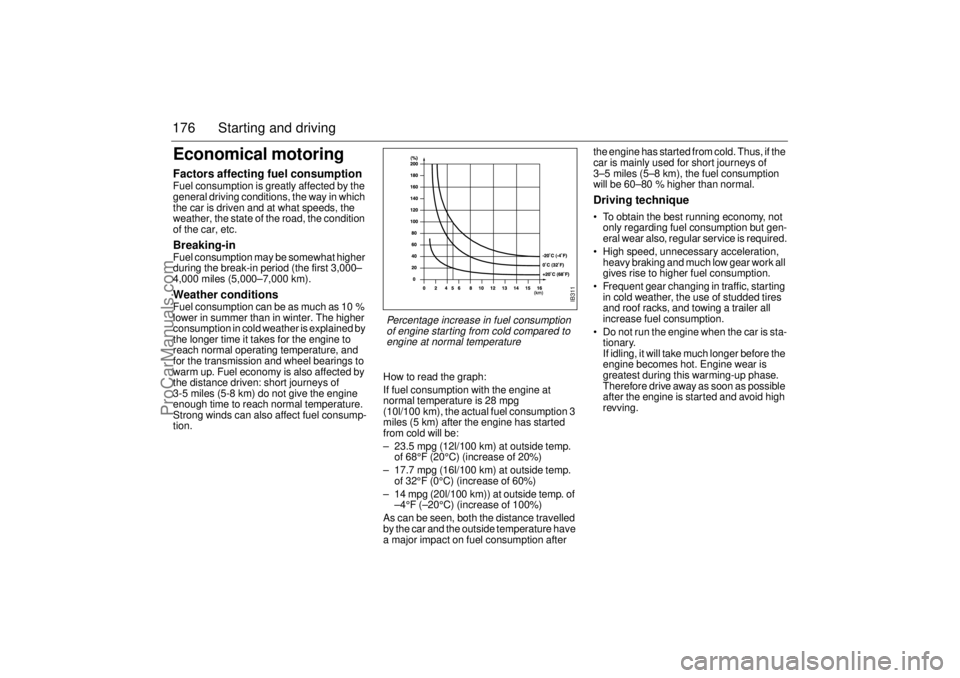
tion. How to read the graph:
If fuel consumption with the engine at
normal temperature is 28 mpg
(10l/100 km), the actual fuel consumption 3
miles (5 km) after the engine has started
from cold will be:
– 23.5 mpg (12l/100 km) at outside temp.
of 68°F (20°C) (increase of 20%)
– 17.7 mpg (16l/100 km) at outside temp.
of 32°F (0°C) (increase of 60%)
– 14 mpg (20l/100 km)) at outside temp. of
–4°F (–20°C) (increase of 100%)
As can be seen, both the distance travelled
by the car and the outside temperature have
a major impact on fuel consumption after the engine has started from cold. Thus, if the
car is mainly used for short journeys of
3–5 miles (5–8 km), the fuel consumption
will be 60–80 % higher than normal.
Driving technique To obtain the best running economy, not
only regarding fuel consumption but gen-
eral wear also, regular service is required.
High speed, unnecessary acceleration,
heavy braking and much low gear work all
gives rise to higher fuel consumption.
Frequent gear changing in traffic, starting
in cold weather, the use of studded tires
and roof racks, and towing a trailer all
increase fuel consumption.
Do not run the engine when the car is sta-
tionary.
If idling, it will take much longer before the
engine becomes hot. Engine wear is
greatest during this warming-up phase.
Therefore drive away as soon as possible
after the engine is started and avoid high
revving.
IB311
Percentage increase in fuel consumption
of engine starting from cold compared to
engine at normal temperature
ProCarManuals.com
Page 182 of 260

182 Starting and drivingTrailer hitch loadThe weight distribution on the trailer makes
a lot of difference to the handling properties
of the car and trailer combination.With sin-
gle-axle trailers, whenever possible, con-
centrate the load over the axle and keep it
as low as possible.
The trailer should be loaded so that the
maximum load on the towbar ball is 5% to
7% of the trailer weight with a maximum per-
missible tongue weight of 165 lbs (75 kg).
Note that this load must be added to the total
load for the car. If this now exceeds the
specified load capacity, the load in the trunk
will have to be reduced by a corresponding
amount.
Driving with a roof rack
loadThe maximum permissible roof load is
220 lbs (100 kg). Note that the roof load is
included in the car’s maximum permissible
load (see page 245).
Strong, sturdy roof carriers designed spe-
cially for the car are available from your
Saab dealer. Always secure the roof load
safely.
WARNING
A roof load will affect the car’s center
of gravity and aerodynamics. Be
aware of this when cornering and driv-
ing in crosswinds.
Adjust your speed to the prevailing
conditions.
Due to higher aerodynamic drag, fuel
economy may suffer when driving with
a roof rack.
IB880
Distribution of load in trailer aLight
b Moderate
cHeavy
ProCarManuals.com
Page 259 of 260

259 Index
Leather upholstery, care of
________ 225
Load eyes
_____________________ 148
Locks
__________________________ 36
Lowering rear seat
______________ 144
Luggage compartment ___________ 144
Luggage compartment, Convertible
__ 56
Luggage-compartment lighting
_____ 148
MMain beam
_____________________ 75
Main instrument panel
_____________ 60
Maintenance schedule ___________ 236
Manual climate-control system
______ 80
Manual raising of the soft top,
Convertible
____________________ 52
Manual transmission
_____________ 161
Manually opening the fuel filler door,
Convertible
____________________ 58
Manually opening the fuel filler door,
Coupé and 5-door
______________ 150
Maxi fuses
_____________________ 213
Memory, driver’s seat
____________ 134
Motoring abroad
________________ 190
NNight Panel
_____________________ 73
OORVR
________________________ 195
Odometer ______________________ 66
Oil specification
_________________ 247
OnStar
________________________ 117
Opening handle
__________________ 36
Owner assistance _______________ 237
PPaint touch-up
__________________ 227
Parcel shelf
____________________ 147
Park Brake Shift Lock
____________ 164
Parking brake
__________________ 174
Parking lights ____________________ 75
Plates and labels
________________ 253
Power steering fluid, check
________ 201
Power steering oil, grade
_________ 251
Pressure gauge
__________________ 67
Programmable driver’s seat
_______ 134
Programming, ACC
_______________ 90
RRadio
__________________________ 98
Raising the soft top, Convertible
_____ 51
Rear fog light
____________________ 77
Rear seat
______________________ 144
Rear seat, tipping
_______________ 144Rearview mirrors
________________ 143
Rear-window wiper _______________ 79
Recirculation
____________________ 82
Recycling
______________________ 230
Refuelling _____________________ 157
Relay table ____________________ 215
Release handle, hood
____________ 192
Remote control
__________________ 36
Remote control battery, changing
____ 39
Removing the key
_______________ 152
Reporting safety defects
__________ 238
Rev counter
_____________________ 66
Reversing lights
__________________ 77
Roof rack
______________________ 182
Rotating the tires
________________ 218
Running-in
_____________________ 161
SSAHR, head restraint
_____________ 18
SID (Side Instrument Display)
_______ 69
SRS (airbag)
____________________ 28
Saab Audio System
_______________ 93
Saab Trionic engine
management system ____________ 195
Safety belts
_____________________ 12
Safety belts, care of
______________ 224
Seat belts
______________________ 12
Seat-belt pretensioners
____________ 13
Seats
_________________________ 130
Service costs
___________________ 237
ProCarManuals.com