Page 4 of 373
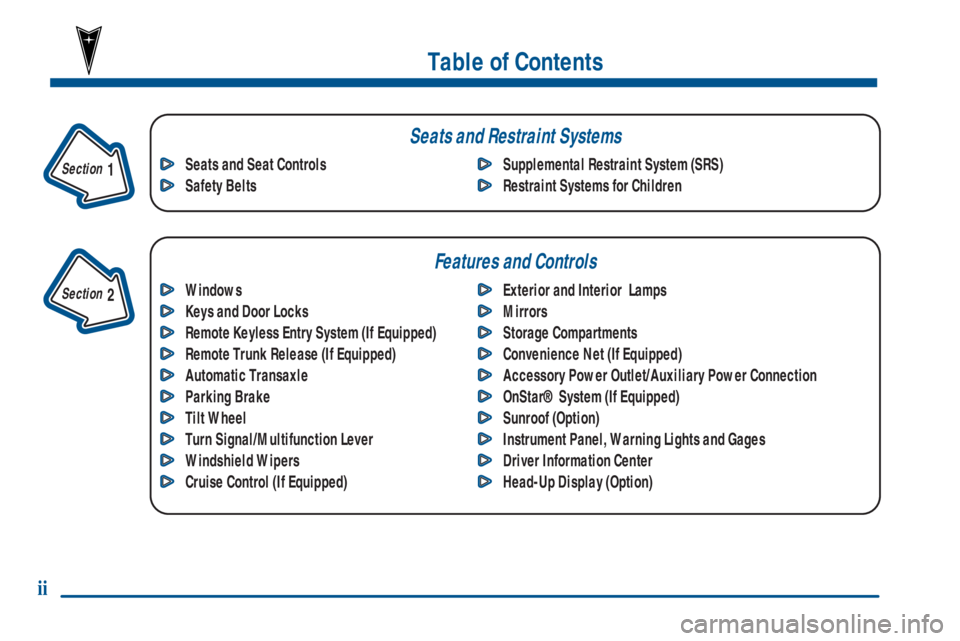
Table of Contents
Windows
Keys and Door Locks
Remote Keyless Entry System (If Equipped)
Remote Trunk Release (If Equipped)
Automatic Transaxle
Parking Brake
Tilt Wheel
Turn Signal/Multifunction Lever
Windshield Wipers
Cruise Control (If Equipped)
Exterior and Interior Lamps
Mirrors
Storage Compartments
Convenience Net (If Equipped)
Accessory Power Outlet/Auxiliary Power Connection
OnStar® System (If Equipped)
Sunroof (Option)
Instrument Panel, Warning Lights and Gages
Driver Information Center
Head-Up Display (Option) Seats and Seat Controls
Safety BeltsSupplemental Restraint System (SRS)
Restraint Systems for Children
Section
1
Section
2
Seats and Restraint Systems
Features and Controls
ii
Page 33 of 373
1-21
The best way to protect the fetus is to protect the
mother. When a safety belt is worn properly, it's more
likely that the fetus won't be hurt in a crash. For
pregnant women, as for anyone, the key to making
safety belts effective is wearing them properly.
Right Front Passenger Position
To learn how to wear the right front passenger's
safety belt properly, see ªDriver Positionº earlier in
this section.
The right front passenger's safety belt works the same
way as the driver's safety belt
-- except for two things.
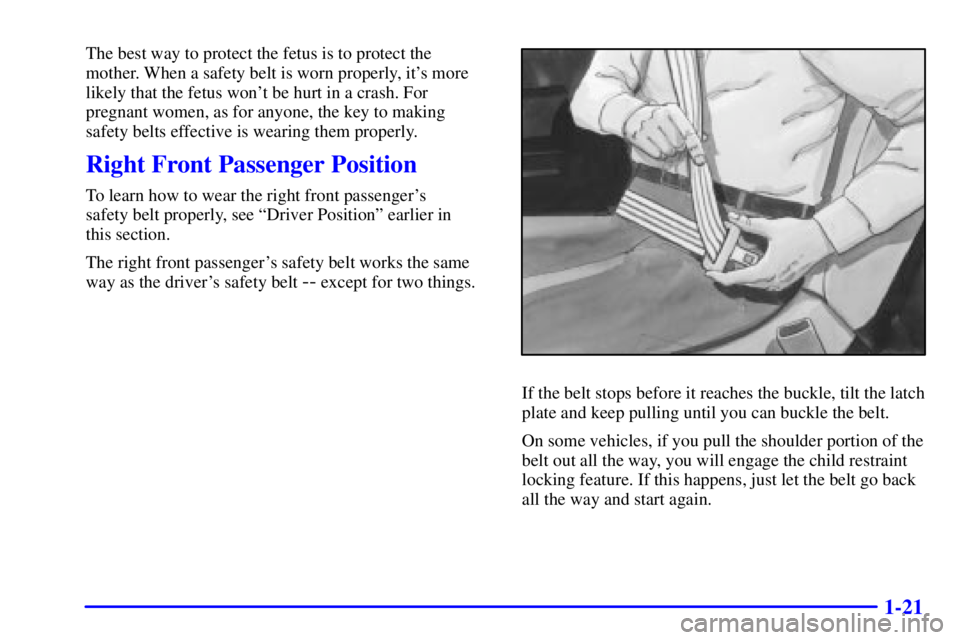
If the belt stops before it reaches the buckle, tilt the latch
plate and keep pulling until you can buckle the belt.
On some vehicles, if you pull the shoulder portion of the
belt out all the way, you will engage the child restraint
locking feature. If this happens, just let the belt go back
all the way and start again.
Page 39 of 373

1-27
�Your vehicle is equipped with a crash sensing and
diagnostic module, which records information about
the air bag system. The module records information
about the readiness of the system, when the system
commands air bag inflation and driver's safety belt
usage at deployment.
�Let only qualified technicians work on your air bag
system. Improper service can mean that your air bag
system won't work properly. See your dealer for service.
NOTICE:
If you damage the covering for the driver's or the
right front passenger's air bag, the bag may not
work properly. You may have to replace the air
bag module in the steering wheel or both the air
bag module and the instrument panel for the
right front passenger's air bag. Do not open or
break the air bag coverings.
Servicing Your Air Bag-Equipped Vehicle
Air bags affect how your vehicle should be serviced.
There are parts of the air bag system in several places
around your vehicle. You don't want the system to
inflate while someone is working on your vehicle. Your
dealer and the service manual have information about
servicing your vehicle and the air bag system. To
purchase a service manual, see ªService and Owner
Publicationsº in the Index.
CAUTION:
For up to 10 seconds after the ignition key is
turned off and the battery is disconnected, an air
bag can still inflate during improper service. You
can be injured if you are close to an air bag when
it inflates. Avoid yellow connectors. They are
probably part of the air bag system. Be sure to
follow proper service procedures, and make sure
the person performing work for you is qualified
to do so.
The air bag system does not need regular maintenance.
Page 70 of 373

2-
2-1
Section 2 Features and Controls
Here you can learn about the many standard and optional features on your vehicle, and information on starting,
shifting and braking. Also explained are the instrument panel and the warning systems that tell you if everything
is working properly
-- and what to do if you have a problem.
2
-2 Windows
2
-4 Keys
2
-6 Door Locks
2
-9 Remote Keyless Entry System (If Equipped)
2
-13 Multifunction Alarm Locks and
Lighting Choices
2
-24 Trunk
2
-26 Theft
2
-27 Content Theft-Deterrent (If Equipped)
2
-28 PASS-Key� III
2
-30 New Vehicle ªBreak-Inº
2
-31 Ignition Positions
2
-32 Starting Your Engine
2
-35 Engine Coolant Heater (Option)
2
-37 Automatic Transaxle Operation
2
-41 Parking Brake
2
-42 Shifting Into PARK (P)2
-44 Shifting Out of PARK (P)
2
-44 Parking Over Things That Burn
2
-45 Engine Exhaust
2
-45 Running Your Engine While You're Parked
2
-47 Turn Signal/Multifunction Lever
2
-52 Exterior Lamps
2
-54 Interior Lamps
2
-56 Mirrors
2
-61 Storage Compartments
2
-66 OnStar� System (If Equipped)
2
-69 Sunroof (Option)
2
-70 The Instrument Panel -- Your
Information System
2
-74 Warning Lights, Gages and Indicators
2
-87 Driver Information Center (DIC)
2
-89 Trip Computer (If Equipped)
2
-92 Head-Up Display (Option)
Page 73 of 373
2-4
Keys
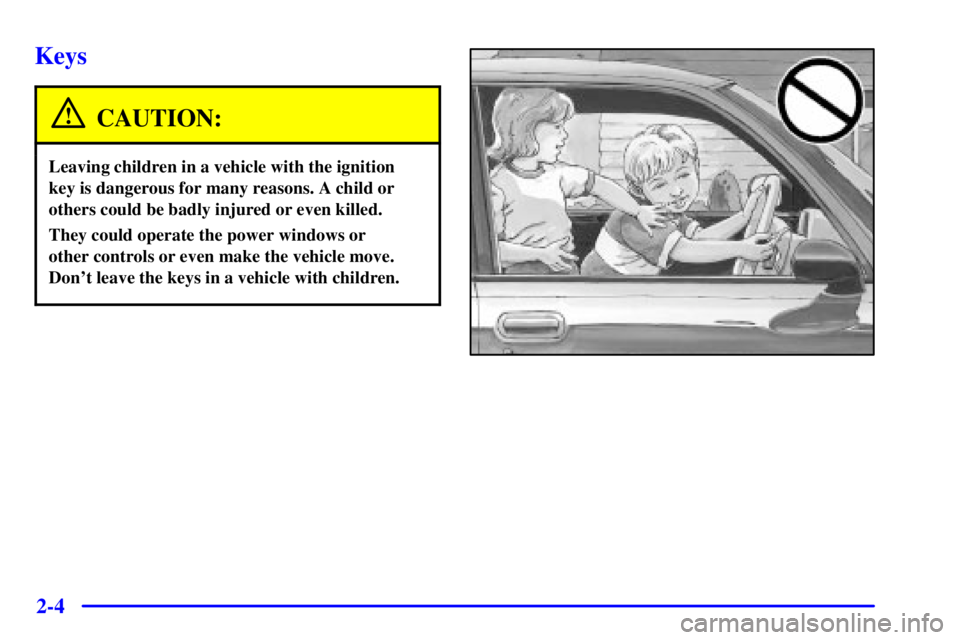
CAUTION:
Leaving children in a vehicle with the ignition
key is dangerous for many reasons. A child or
others could be badly injured or even killed.
They could operate the power windows or
other controls or even make the vehicle move.
Don't leave the keys in a vehicle with children.
Page 74 of 373
2-5
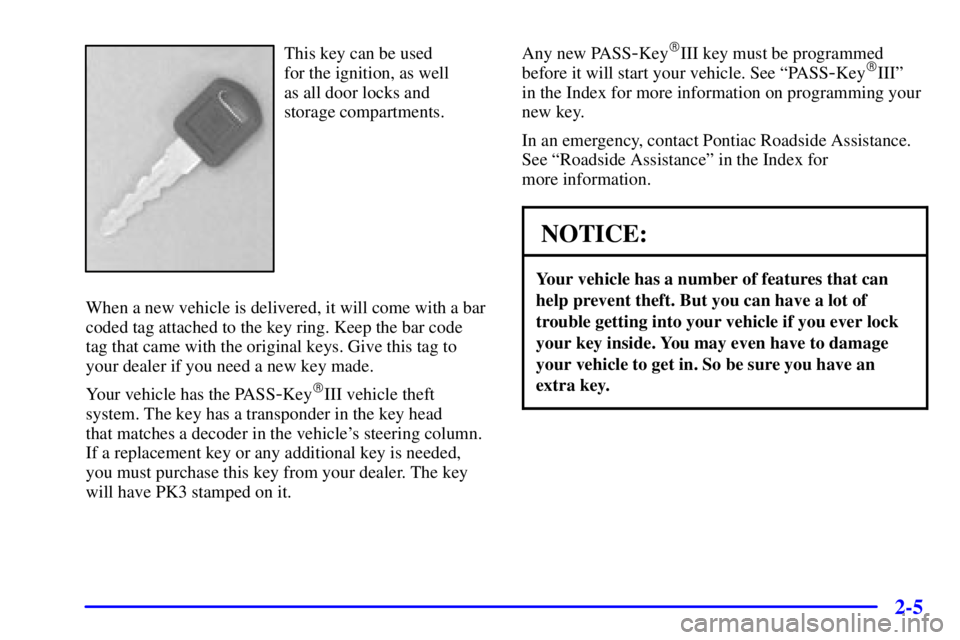
This key can be used
for the ignition, as well
as all door locks and
storage compartments.
When a new vehicle is delivered, it will come with a bar
coded tag attached to the key ring. Keep the bar code
tag that came with the original keys. Give this tag to
your dealer if you need a new key made.
Your vehicle has the PASS
-Key�III vehicle theft
system. The key has a transponder in the key head
that matches a decoder in the vehicle's steering column.
If a replacement key or any additional key is needed,
you must purchase this key from your dealer. The key
will have PK3 stamped on it.Any new PASS
-Key�III key must be programmed
before it will start your vehicle. See ªPASS
-Key�IIIº
in the Index for more information on programming your
new key.
In an emergency, contact Pontiac Roadside Assistance.
See ªRoadside Assistanceº in the Index for
more information.
NOTICE:
Your vehicle has a number of features that can
help prevent theft. But you can have a lot of
trouble getting into your vehicle if you ever lock
your key inside. You may even have to damage
your vehicle to get in. So be sure you have an
extra key.
Page 75 of 373
2-6
Door Locks
CAUTION:
Unlocked doors can be dangerous.
�Passengers -- especially children -- can
easily open the doors and fall out of a
moving vehicle. When a door is locked, the
handle won't open it. You increase the
chance of being thrown out of the vehicle in
a crash if the doors aren't locked. So, wear
safety belts properly and lock the doors
whenever you drive.
�Young children who get into unlocked
vehicles may be unable to get out. A child
can be overcome by extreme heat and can
suffer permanent injuries or even death
from heat stroke. Always lock your vehicle
whenever you leave it.
�Outsiders can easily enter through an
unlocked door when you slow down or stop
your vehicle. Locking your doors can help
prevent this from happening.
There are several ways to lock and unlock your vehicle.
To unlock either front door from outside the vehicle
with your key, insert it fully into the door key cylinder
and turn it counterclockwise.
You can lock either front door from outside the vehicle
with your key by inserting it fully into the door key
cylinder and turning it clockwise.
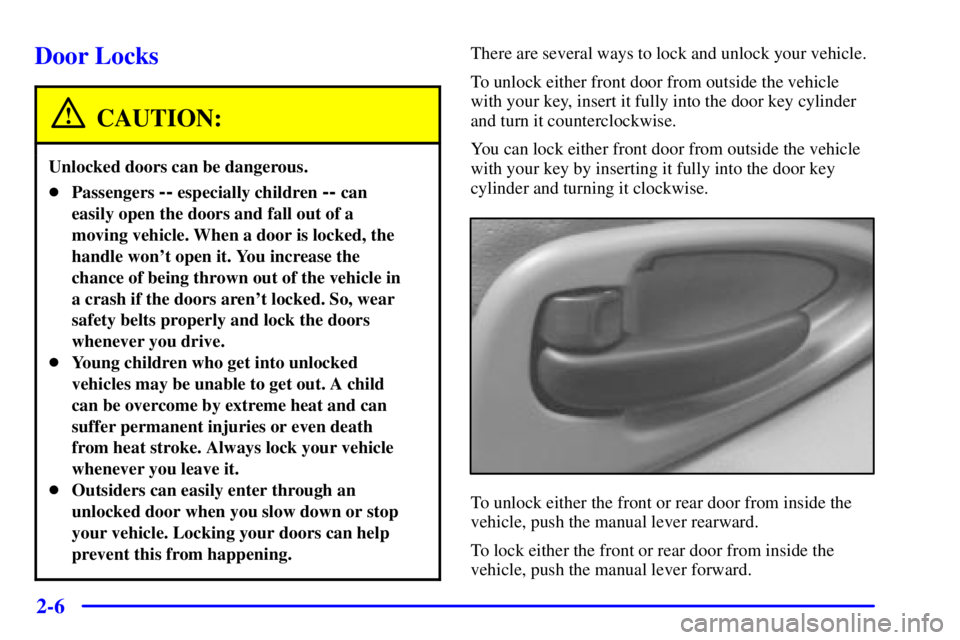
To unlock either the front or rear door from inside the
vehicle, push the manual lever rearward.
To lock either the front or rear door from inside the
vehicle, push the manual lever forward.
Page 76 of 373
2-7 Power Door Locks
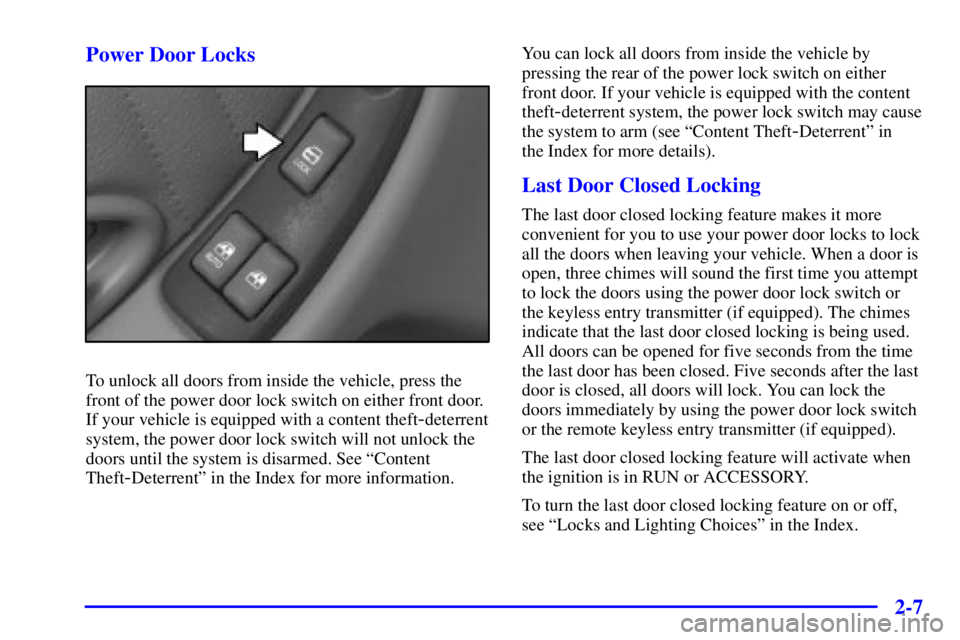
To unlock all doors from inside the vehicle, press the
front of the power door lock switch on either front door.
If your vehicle is equipped with a content theft
-deterrent
system, the power door lock switch will not unlock the
doors until the system is disarmed. See ªContent
Theft
-Deterrentº in the Index for more information.You can lock all doors from inside the vehicle by
pressing the rear of the power lock switch on either
front door. If your vehicle is equipped with the content
theft
-deterrent system, the power lock switch may cause
the system to arm (see ªContent Theft
-Deterrentº in
the Index for more details).
Last Door Closed Locking
The last door closed locking feature makes it more
convenient for you to use your power door locks to lock
all the doors when leaving your vehicle. When a door is
open, three chimes will sound the first time you attempt
to lock the doors using the power door lock switch or
the keyless entry transmitter (if equipped). The chimes
indicate that the last door closed locking is being used.
All doors can be opened for five seconds from the time
the last door has been closed. Five seconds after the last
door is closed, all doors will lock. You can lock the
doors immediately by using the power door lock switch
or the remote keyless entry transmitter (if equipped).
The last door closed locking feature will activate when
the ignition is in RUN or ACCESSORY.
To turn the last door closed locking feature on or off,
see ªLocks and Lighting Choicesº in the Index.