Page 251 of 341
6-10 Engine Compartment Overview
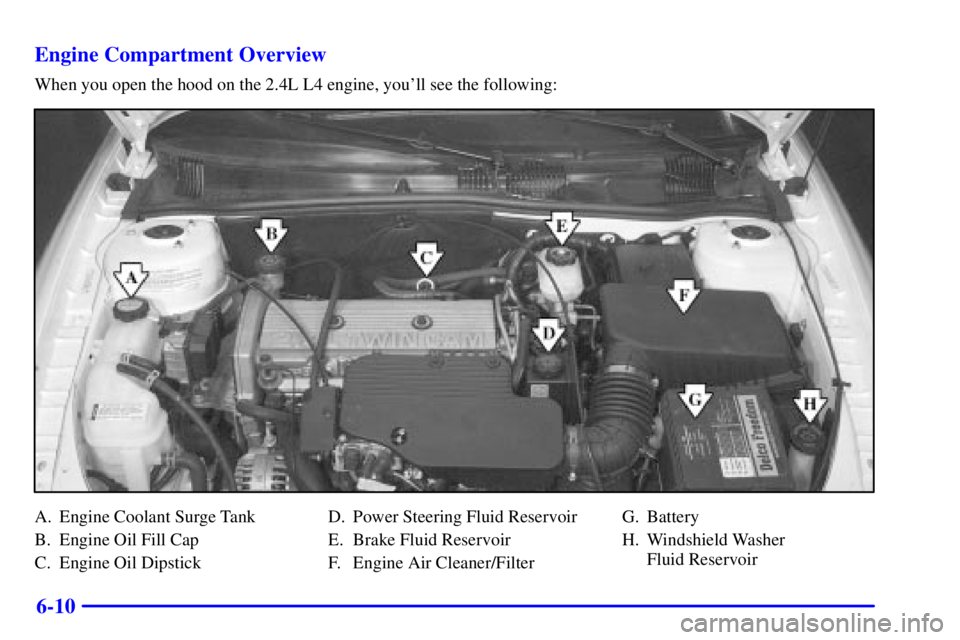
When you open the hood on the 2.4L L4 engine, you'll see the following:
A. Engine Coolant Surge Tank
B. Engine Oil Fill Cap
C. Engine Oil DipstickD. Power Steering Fluid Reservoir
E. Brake Fluid Reservoir
F. Engine Air Cleaner/FilterG. Battery
H. Windshield Washer
Fluid Reservoir
Page 254 of 341
6-13
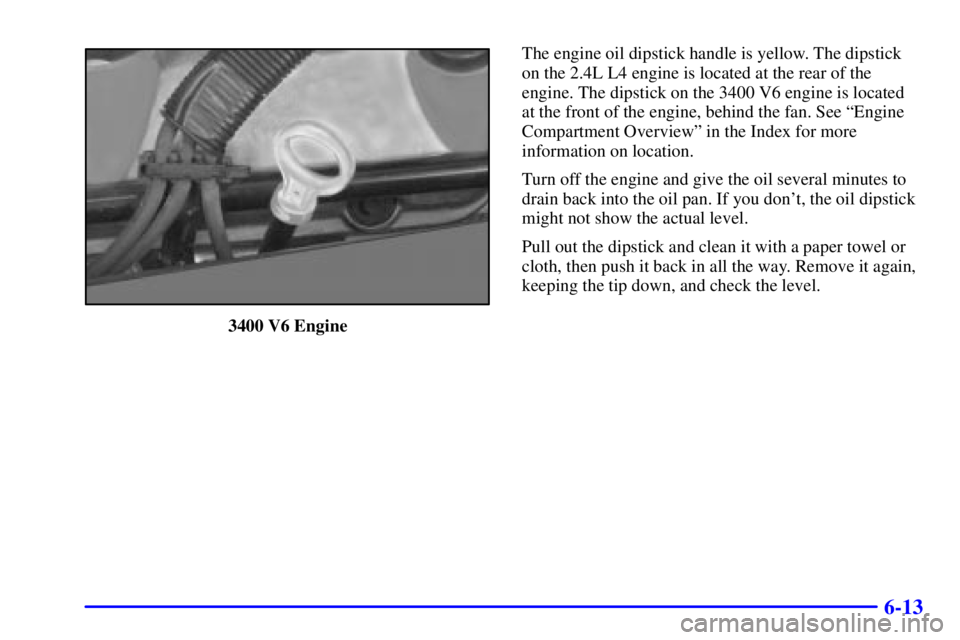
3400 V6 EngineThe engine oil dipstick handle is yellow. The dipstick
on the 2.4L L4 engine is located at the rear of the
engine. The dipstick on the 3400 V6 engine is located
at the front of the engine, behind the fan. See ªEngine
Compartment Overviewº in the Index for more
information on location.
Turn off the engine and give the oil several minutes to
drain back into the oil pan. If you don't, the oil dipstick
might not show the actual level.
Pull out the dipstick and clean it with a paper towel or
cloth, then push it back in all the way. Remove it again,
keeping the tip down, and check the level.
Page 256 of 341
6-15
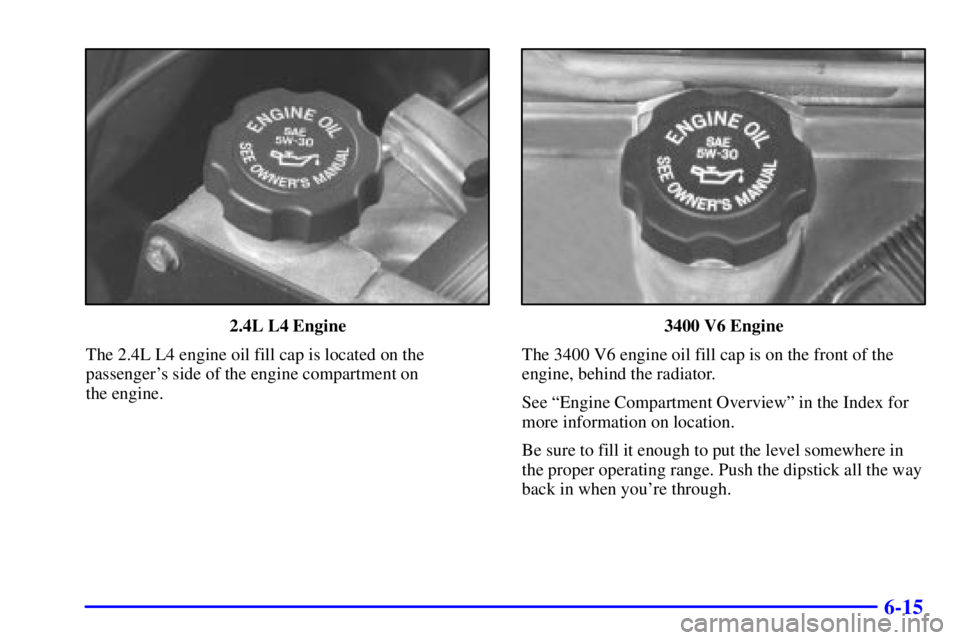
2.4L L4 Engine
The 2.4L L4 engine oil fill cap is located on the
passenger's side of the engine compartment on
the engine.3400 V6 Engine
The 3400 V6 engine oil fill cap is on the front of the
engine, behind the radiator.
See ªEngine Compartment Overviewº in the Index for
more information on location.
Be sure to fill it enough to put the level somewhere in
the proper operating range. Push the dipstick all the way
back in when you're through.
Page 259 of 341
6-18
How to Reset the Change Oil Light
After changing the engine oil, the system must be reset.
With the ignition key to ON (engine not running), push
the RESET button located in the driver's side instrument
panel fuse block. The CHANGE OIL light will start to
flash, press and hold the RESET button again. The reset
is complete when you hear the chimes and the
CHANGE OIL light goes out.
What to Do with Used Oil
Did you know that used engine oil contains certain
elements that may be unhealthy for your skin and could
even cause cancer? Don't let used oil stay on your skin
for very long. Clean your skin and nails with soap and
water, or a good hand cleaner. Wash or properly throw
away clothing or rags containing used engine oil. See
the manufacturer's warnings about the use and disposal
of oil products.
Used oil can be a real threat to the environment. If you
change your own oil, be sure to drain all free
-flowing oil
from the filter before disposal. Don't ever dispose of oil
by putting it in the trash, pouring it on the ground, into
sewers, or into streams or bodies of water. Instead,
recycle it by taking it to a place that collects used oil. If
you have a problem properly disposing of your used oil,
ask your dealer, a service station or a local recycling
center for help.
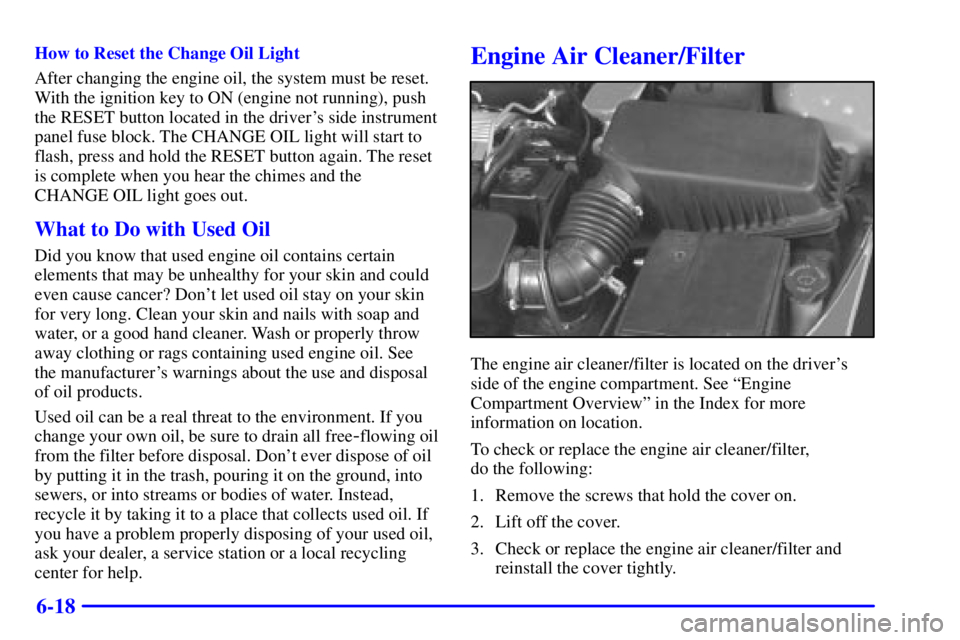
Engine Air Cleaner/Filter
The engine air cleaner/filter is located on the driver's
side of the engine compartment. See ªEngine
Compartment Overviewº in the Index for more
information on location.
To check or replace the engine air cleaner/filter,
do the following:
1. Remove the screws that hold the cover on.
2. Lift off the cover.
3. Check or replace the engine air cleaner/filter and
reinstall the cover tightly.
Page 264 of 341
6-23 Checking Coolant
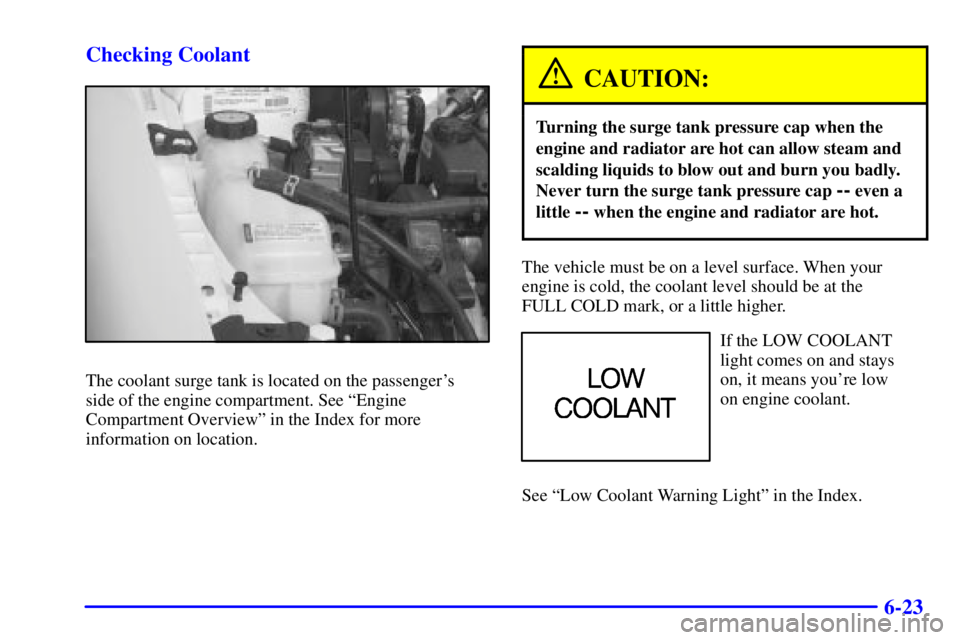
The coolant surge tank is located on the passenger's
side of the engine compartment. See ªEngine
Compartment Overviewº in the Index for more
information on location.
CAUTION:
Turning the surge tank pressure cap when the
engine and radiator are hot can allow steam and
scalding liquids to blow out and burn you badly.
Never turn the surge tank pressure cap
-- even a
little
-- when the engine and radiator are hot.
The vehicle must be on a level surface. When your
engine is cold, the coolant level should be at the
FULL COLD mark, or a little higher.
If the LOW COOLANT
light comes on and stays
on, it means you're low
on engine coolant.
See ªLow Coolant Warning Lightº in the Index.
Page 266 of 341
6-25 When to Check Power Steering Fluid
It is not necessary to regularly check power steering
fluid unless you suspect there is a leak in the system or
you hear an unusual noise. A fluid loss in this system
could indicate a problem. Have the system inspected
and repaired.
On the 2.4L L4 engine, the power steering fluid
reservoir is located on the driver's side of the engine
compartment. On the 3400 V6 engine, the power
steering fluid reservoir is located on the passenger's
side of the engine compartment. See ªEngine
Compartment Overviewº in the Index for more
information on location.
How to Check Power Steering Fluid
Turn the key off, let the engine compartment cool down,
wipe the cap and the top of the reservoir clean, then
unscrew the cap and wipe the dipstick with a clean rag.
Replace the cap and completely tighten it. Then remove
the cap again and look at the fluid level on the dipstick.
The level should be at the FULL COLD mark. If
necessary, add only enough fluid to bring the level up
to the mark.
What to Use
To determine what kind of fluid to use, see
ªRecommended Fluids and Lubricantsº in the Index.
Always use the proper fluid. Failure to use the proper
fluid can cause leaks and damage hoses and seals.
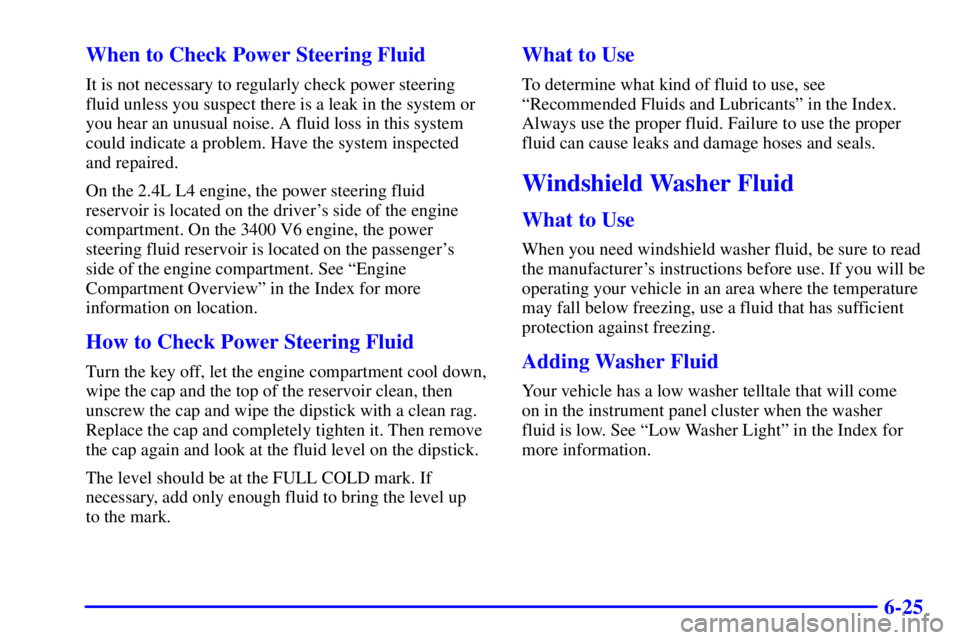
Windshield Washer Fluid
What to Use
When you need windshield washer fluid, be sure to read
the manufacturer's instructions before use. If you will be
operating your vehicle in an area where the temperature
may fall below freezing, use a fluid that has sufficient
protection against freezing.
Adding Washer Fluid
Your vehicle has a low washer telltale that will come
on in the instrument panel cluster when the washer
fluid is low. See ªLow Washer Lightº in the Index for
more information.
Page 267 of 341
6-26
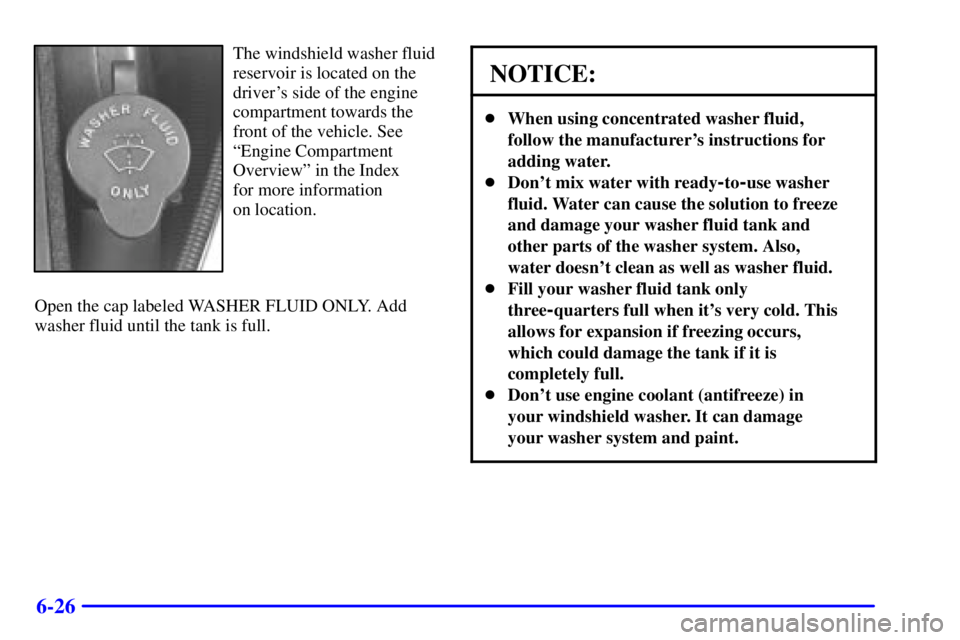
The windshield washer fluid
reservoir is located on the
driver's side of the engine
compartment towards the
front of the vehicle. See
ªEngine Compartment
Overviewº in the Index
for more information
on location.
Open the cap labeled WASHER FLUID ONLY. Add
washer fluid until the tank is full.
NOTICE:
�When using concentrated washer fluid,
follow the manufacturer's instructions for
adding water.
�Don't mix water with ready
-to-use washer
fluid. Water can cause the solution to freeze
and damage your washer fluid tank and
other parts of the washer system. Also,
water doesn't clean as well as washer fluid.
�Fill your washer fluid tank only
three
-quarters full when it's very cold. This
allows for expansion if freezing occurs,
which could damage the tank if it is
completely full.
�Don't use engine coolant (antifreeze) in
your windshield washer. It can damage
your washer system and paint.
Page 268 of 341
6-27
Brakes
Brake Fluid
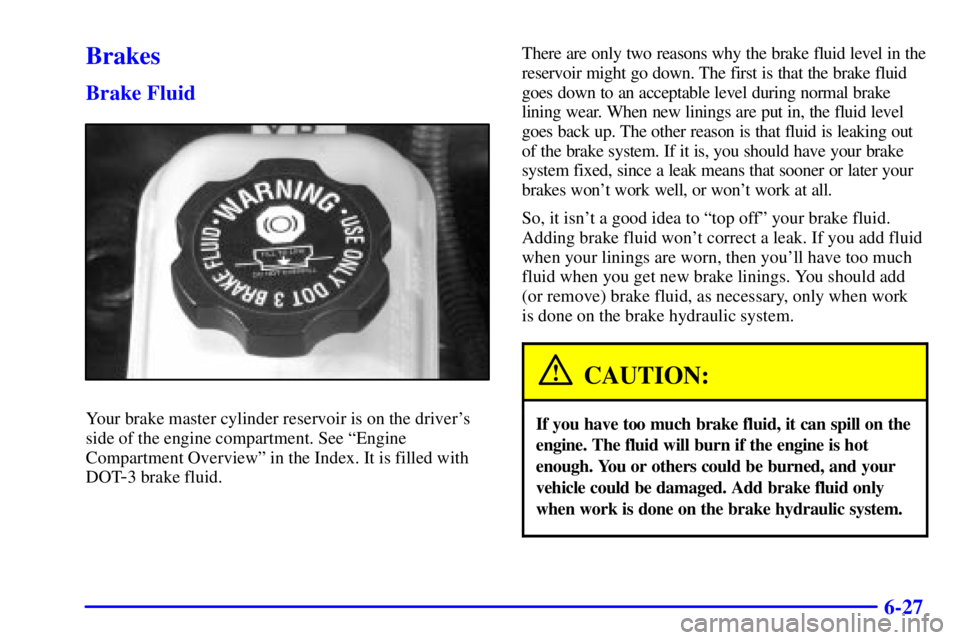
Your brake master cylinder reservoir is on the driver's
side of the engine compartment. See ªEngine
Compartment Overviewº in the Index. It is filled with
DOT
-3 brake fluid.There are only two reasons why the brake fluid level in the
reservoir might go down. The first is that the brake fluid
goes down to an acceptable level during normal brake
lining wear. When new linings are put in, the fluid level
goes back up. The other reason is that fluid is leaking out
of the brake system. If it is, you should have your brake
system fixed, since a leak means that sooner or later your
brakes won't work well, or won't work at all.
So, it isn't a good idea to ªtop offº your brake fluid.
Adding brake fluid won't correct a leak. If you add fluid
when your linings are worn, then you'll have too much
fluid when you get new brake linings. You should add
(or remove) brake fluid, as necessary, only when work
is done on the brake hydraulic system.
CAUTION:
If you have too much brake fluid, it can spill on the
engine. The fluid will burn if the engine is hot
enough. You or others could be burned, and your
vehicle could be damaged. Add brake fluid only
when work is done on the brake hydraulic system.