Page 5 of 366
Table of Contents (cont'd)
Defensive Driving
Drunken Driving
Control of a Vehicle
Braking
SteeringDriving Tips for Various Road Conditions
Recreational Vehicle Towing
Loading Your Vehicle
Towing a Trailer Heating and Air Conditioning
Setting the Radio Clock
Radio/Cassette Player/CD PlayerRadio Theft-Deterrent Feature
Steering Wheel Controls (If Equipped)
Hazard Warning Flashers
Jump Starting
Towing Your VehicleEngine Overheating
Changing a Flat Tire
If You're Stuck
Problems on the Road
iii
Section
5
Section
4
Section
3
Your Driving and the Road Comfort Controls and Audio Systems
Page 73 of 366

2-13 Resynchronization
Resynchronization may be necessary due to the security
method used by the remote keyless entry system.
The transmitter does not send the same signal twice
to the receiver. The receiver will not respond to a signal
that has been sent previously. This prevents anyone
from recording and playing back the signal from
the transmitter.
To resynchronize the transmitter with the receiver,
do the following:
1. Stand close to the vehicle.
2. Press and hold the LOCK and UNLOCK buttons
on the transmitter at the same time for about
eight seconds.
The door locks should cycle and the interior lamps
should flash to confirm resynchronization.
If this does not happen, you may need to replace the
battery in your transmitter or match the transmitter
to your vehicle. See ªMatching Transmitter(s) to
Your Vehicleº in the Index.
Hatch
CAUTION:
It can be dangerous to drive with the hatch open
because carbon monoxide (CO) gas can come into
your vehicle. You can't see or smell CO. It can
cause unconsciousness and even death.
If you must drive with the hatch open or if
electrical wiring or other cable connections
must pass through the seal between the body
and the hatch:
�Make sure all other windows are shut.
�Turn the fan on your heating or cooling
system to its highest speed with the setting
on VENT. That will force outside air into
your vehicle. See ªComfort Controlsº in
the Index.
�If you have air outlets on or under the
instrument panel, open them all the way.
See ªEngine Exhaustº in the Index.
Page 124 of 366
2-64
Ashtray and Cigarette Lighter
Lift up the cover to open the ashtray. To remove it, lift
up on either side of the ashtray. If you have an automatic
transmission, the ashtray is near the front of the console.
If you have a manual transmission, the ashtray is in front
of the cupholder.
NOTICE:
Don't put papers and other things that burn
into your ashtray. If you do, cigarettes or other
smoking materials could set them on fire,
causing damage.
To use the lighter, push it in all the way and let go.
When it's ready, it will pop back out by itself.
NOTICE:
Don't hold a cigarette lighter in with your hand
while it is heating. If you do, it won't be able to
back away from the heating element when it's
ready. That can make it overheat, damaging the
lighter and the heating element.
If you plug accessories into your cigarette lighter, such
as heating devices or air compressors, these accessories
should have a rated current of less than 15 amps.
Exceeding this limit will result in a blown fuse.
Sun Visors
To block out glare, you can swing down the visors.
You can also swing them to the side.
Visor Vanity Mirror
Pull down the sun visor and lift the cover to expose the
vanity mirror.
Page 149 of 366

2-89
If the traction control system warning light comes on
and stays on for an extended period of time when the
system is turned on, your vehicle needs service.
Low Traction Light
When your anti-lock system
is adjusting brake pressure
to help avoid a braking skid,
this light will come on.
If you have the traction control system, this light will
also come on when the system is limiting wheel spin.
You may feel or hear the system working, but this is
normal. Slippery road conditions may exist if the
low traction light comes on, so adjust your driving
accordingly. The light will stay on for a few seconds
after the traction control system stops limiting
wheel spin.
The low traction light also comes on briefly when you
turn the ignition key to RUN. If the light doesn't come
on then, have it fixed so it will be there to tell you when
the anti
-lock brake system or traction control system
is active.
Engine Coolant Temperature Gage
This gage shows the engine
coolant temperature. If the
gage pointer moves into
the red area, your engine
is approaching an
overheating condition.
If you have been operating your vehicle under normal
driving conditions, you should pull off the road, stop
your vehicle and turn off the engine as soon as possible.
See ªEngine Overheatingº in the Index.
Page 157 of 366
3-
3-1
Section 3 Comfort Controls and Audio Systems
In this section, you'll find out how to operate the comfort control and audio systems offered with your vehicle.
Be sure to read about the particular systems supplied with your vehicle.
3
-2 Comfort Controls
3
-3 Cooling
3
-3 Heating
3
-4 Defogging and Defrosting
3
-4 Rear Window Defogger
3
-5 Ventilation System
3
-6 Audio Systems
3
-6 Setting the Clock
3
-6 Monsoon� AM-FM Stereo with Cassette Tape
Player and Equalizer
3
-10 AM-FM Stereo with Compact Disc Player and
Equalizer (If Equipped)3
-13 Trunk Mounted CD Changer (Option)
3
-18 Theft-Deterrent Feature
3
-20 Audio Steering Wheel Controls (If Equipped)
3
-21 Understanding Radio Reception
3
-21 Tips About Your Audio System
3
-22 Care of Your Cassette Tape Player
3
-23 Care of Your Compact Discs
3
-23 Care of Your Compact Disc Player
3
-23 Fixed Mast Antenna
3
-24 Power Antenna Mast Care
Page 158 of 366

3-2
Comfort Controls
With this system, you can control the heating, air
conditioning and ventilation in your vehicle.
Your vehicle also has the flow
-through ventilation
system described later in this section.
Fan Control Knob
Turn the fan knob to select the force of air
you want.Temperature Control Knob
Turn the center knob to change the temperature
of the air flowing from the system. Turn it toward the
red (clockwise) for warmer air and toward the
blue (counterclockwise) for cooler air.
Air Control Knob
OFF: In this setting the system is off.
MAX: This setting provides maximum cooling or quick
cool
-down on very hot days. This setting recirculates
most of the air inside your vehicle. If it is used for long
periods of time the air may become dry. This setting
directs air through the upper air vents.
A/C: Use A/C for normal cooling on hot days. This
setting cools outside air and directs it through the upper
air vents.
The air conditioner compressor operates in MAX, A/C,
BI
-LEVEL, BLEND and DEFROST when the outside
temperature is above freezing. When the air conditioner
is on, you may sometimes notice slight changes in your
vehicle's engine speed and power due to the operation of
the compressor.
Page 159 of 366

3-3
BI-LEVEL: This setting directs air through the
upper air vents and the heater ducts.
VENT: This setting directs air through the upper
air vents.
HEATER: This setting directs most of the air
through the heater ducts and some of the air through the
windshield defroster vents.
BLEND: This setting directs air through the
windshield defroster vents and the heater ducts.
DEFROST: This setting directs most of the air
through the windshield defroster vents and some of the
air through the heater ducts.
Cooling
The air conditioner works best if you keep your
windows closed. On very hot days, open the windows
just long enough for the hot air to escape.
1. Turn the air control knob to A/C for normal cooling.
For faster cooling, turn the knob to MAX.
2. Turn the temperature control knob to a
comfortable setting.
3. Turn the fan control knob to the desired speed.
Heating
The heater works best if you keep your windows closed
while using it.
1. Turn the air control knob to HEATER.
2. Turn the fan control knob to the desired speed.
3. Turn the temperature control knob to a
comfortable setting.
During initial start
-up only, if your vehicle is equipped
with an optional engine coolant heater, you can use it in
cold weather (around +20�F/
-8�C or lower) to improve
heater performance on initial start up. See ªEngine
Coolant Heaterº in the Index.
Bi
-Level
You may want to use bi
-level on cool, but sunny days.
This setting directs cool air toward your body and
warmer air toward your feet.
1. Turn the air control knob to BI
-LEVEL.
2. Turn the temperature control knob to a
comfortable setting.
3. Turn the fan control knob to the desired speed.
Page 161 of 366
3-5 Ventilation System
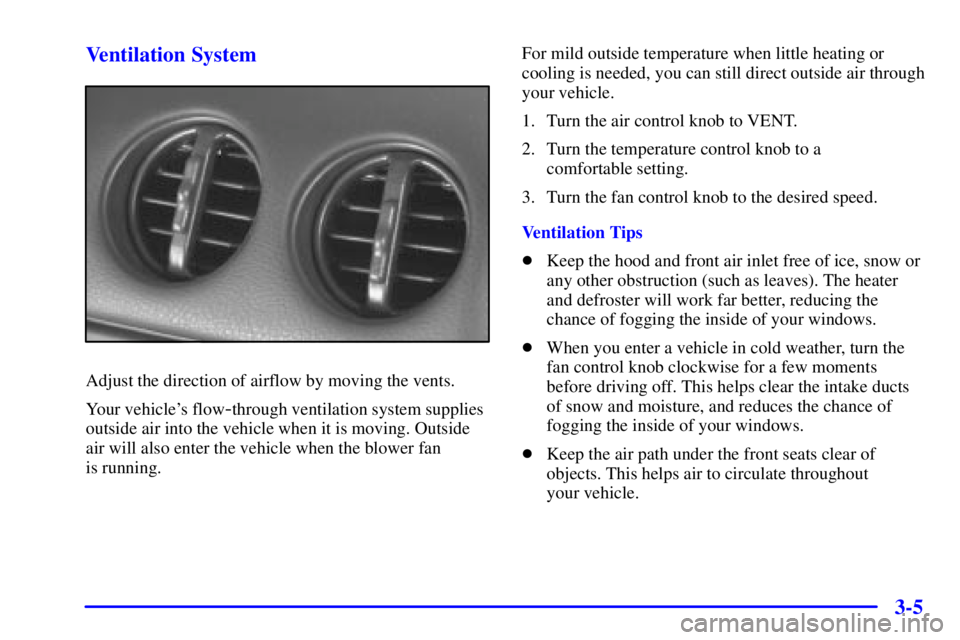
Adjust the direction of airflow by moving the vents.
Your vehicle's flow
-through ventilation system supplies
outside air into the vehicle when it is moving. Outside
air will also enter the vehicle when the blower fan
is running.For mild outside temperature when little heating or
cooling is needed, you can still direct outside air through
your vehicle.
1. Turn the air control knob to VENT.
2. Turn the temperature control knob to a
comfortable setting.
3. Turn the fan control knob to the desired speed.
Ventilation Tips
�Keep the hood and front air inlet free of ice, snow or
any other obstruction (such as leaves). The heater
and defroster will work far better, reducing the
chance of fogging the inside of your windows.
�When you enter a vehicle in cold weather, turn the
fan control knob clockwise for a few moments
before driving off. This helps clear the intake ducts
of snow and moisture, and reduces the chance of
fogging the inside of your windows.
�Keep the air path under the front seats clear of
objects. This helps air to circulate throughout
your vehicle.

