Page 2 of 413
1-800-762-3743
(For vehicles purchased in Canada,
call 1-800-268-6800)
that provides in an emergency:
1-800-762-3743
(For vehicles purchased in Canada,
call
1-800-268-6800)
Courtesy
Transportation
Every
2001 Bonneville
under warranty is
backed with the
following
services:
Free lockout assistance
Free dead-battery assistance
Free out-of-fuel assistance
Free flat-tire change
Emergency towing
Page 5 of 413
Table of Contents (cont'd)
Defensive Driving
Drunken Driving
Control of a Vehicle
Braking
SteeringDriving Tips for Various Road Conditions
Recreational Vehicle Towing
Loading Your Vehicle
Towing a Trailer Heating and Air Conditioning
Setting the Radio Clock
Radio/Cassette Player/CD PlayerRadio Theft-Deterrent Feature
Steering Wheel Controls (If Equipped)
Hazard Warning Flashers
Jump Starting
Towing Your VehicleEngine Overheating
Changing a Flat Tire
If You're Stuck
Problems on the Road
iii
Comfort Controls and Audio Systems
Your Driving and the Road
Section
3
Section
4
Section
5
Page 6 of 413
Table of Contents (cont'd)
Maintenance Schedule Service and Appearance Care
Section
7
Section
6
Scheduled Maintenance
Owner Checks and Services
Periodic Maintenance InspectionsRecommended Fluids and Lubricants
Maintenance Records
Fuel
Checking Fluids and Lubricants
GM Oil Life System™ (If Equipped)
Engine Air Cleaner/Filter
Passenger Compartment Air Filter (If Equipped)
Brakes
Bulb ReplacementWindshield Wiper Blade Replacement
Tires and Wheels
Appearance Care
Electrical System/Fuses and Circuit Breakers
Capacities and Specifications
Normal Maintenance Replacement Parts
iv
Page 12 of 413
Service Station Guide
Oil Viscosity
Engine Oil
See Section 6
Engine Oil Dipstick
See Section 6
Cooling System
See Section 5
Hood Release
See Section 6
Windshield Washer
Fluid
See Section 6
Spare Tire Pressure
See Section 5
Alternate
Fuel Door Release
See Section 6
Battery
See Section 6
Tire Pressure
See Section 6
For
a More
Detailed Look at
What's Under the Hood
See Section 6
Fuel
Use unleaded only.
See Section 6
for octane ratings.
Page 109 of 413
2-42
Cruise Control
With cruise control, you can
maintain a speed of about
25 mph (40 km/h) or more
without keeping your foot
on the accelerator. This can
really help on long trips.
Cruise control does not work at speeds below
about 25 mph (40 km/h).
When you apply your brakes, the cruise control
shuts off.CAUTION:
�Cruise control can be dangerous where you
can't drive safely at a steady speed.
So, don't use your cruise control on
winding roads or in heavy traffic.
�Cruise control can be dangerous on
slippery roads. On such roads, fast changes
in tire traction can cause needless wheel
spinning, and you could lose control.
Don't use cruise control on slippery roads.
If your vehicle is in cruise control when the optional
traction control system begins to limit wheel spin, the
cruise control will automatically disengage. See
ªTraction Control Systemº in the Index. When road
conditions allow you to safely use it again, you may turn
the cruise control back on.
Page 122 of 413

2-55
Ashtrays and Cigarette Lighter
Push down on the cover to reveal the front ashtray.
To clean the ashtray, lift it out by pulling on the finger
holes on each side.
On models without a console, there's an ashtray under
the instrument panel. To clean the ashtray, lift it out
by pulling up on the tabs on either side. It snaps back
into place.
To open a rear ashtray, lift the cover.
NOTICE:
Don't put papers and other things that burn into
your ashtrays. If you do, cigarettes or other
smoking materials could set them on fire,
causing damage.
The cigarette lighter is located next to the storage tray.
To use a lighter, just push the center in all the way and
let it go. When it is ready, the center will pop back out
by itself. Pull out the entire unit to use it.
NOTICE:
Don't hold a cigarette lighter in with your hand
while it is heating. If you do, it won't be able to
back away from the heating element when it's
ready. That can make it overheat, damaging the
lighter and the heating element.
The cigarette lighter will only operate when the ignition
key is in ON and for 10 minutes after turning the
ignition OFF. If you would like the lighter to operate
regardless of ignition position, and for unlimited periods
of time, see ªEngine Compartment Bussed Electrical
Centerº in the Index or see your dealer.
Page 123 of 413
2-56
Sun Visors
To block out glare, you can swing down the visors. You
can also remove them from the center mount and swing
them to the side, while the auxiliary sunshade remains to
block glare from the front.
Visor Vanity Mirror
Open the cover to expose the vanity mirror.
If your vehicle has the optional lighted vanity mirrors,
the lamps come on when you open the cover.
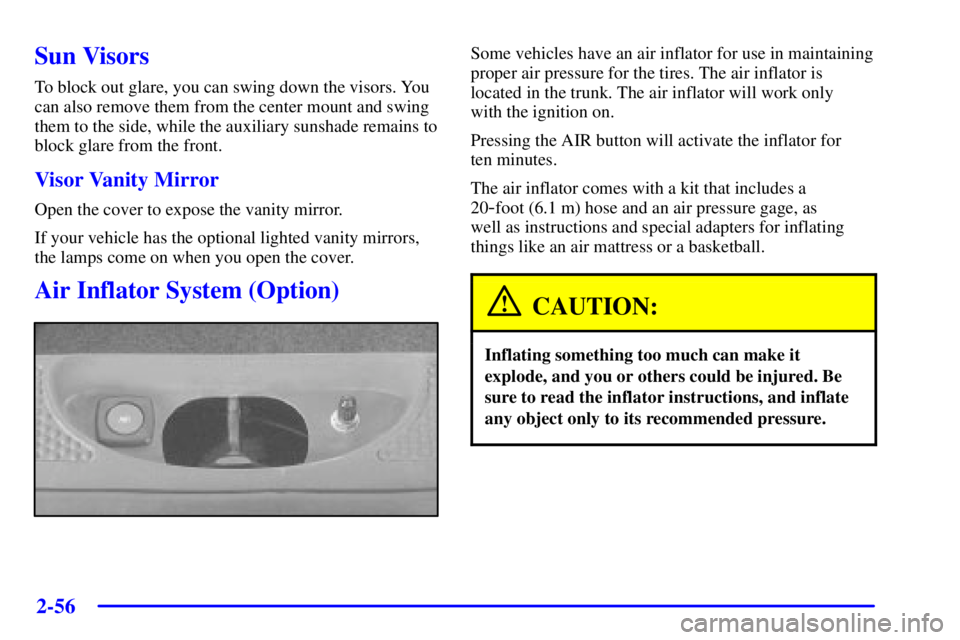
Air Inflator System (Option)
Some vehicles have an air inflator for use in maintaining
proper air pressure for the tires. The air inflator is
located in the trunk. The air inflator will work only
with the ignition on.
Pressing the AIR button will activate the inflator for
ten minutes.
The air inflator comes with a kit that includes a
20
-foot (6.1 m) hose and an air pressure gage, as
well as instructions and special adapters for inflating
things like an air mattress or a basketball.
CAUTION:
Inflating something too much can make it
explode, and you or others could be injured. Be
sure to read the inflator instructions, and inflate
any object only to its recommended pressure.
Page 146 of 413

2-79
To prevent engine overheating, the air conditioning
compressor will turn off automatically just prior to the
gage pointer entering the red area. As the engine cools
down, the air conditioning compressor will automatically
turn back on. On vehicles equipped with the DIC, the
message ENGINE HOT... A/C DISABLED will appear in
the DIC display and a warning chime will sound.
If the gage pointer moves into the red area, your engine
is too hot. On vehicles equipped with the systems
monitor, the CHECK GAGES light will come on and
a warning chime will sound.
On vehicles with a DIC, a CHECK GAGES
TEMPERATURE message will be displayed and a
warning chime will sound. See ªDIC Warnings and
Messagesº in the Index for more information.
The section ªProblems on the Road,º in this manual
explains what to do if your engine overheats.
See ªEngine Overheatingº in the Index.Tire Pressure Light (If Equipped)
The check tire pressure system can alert you to a large
change in the pressure of one tire. After the system has
been properly calibrated, the TIRE PRESS light will
come on if a pressure difference (low pressure) is
detected in one tire.
The light will stay on until you turn off the ignition or
reset (calibrate) the system. See ªCheck Tire Pressure
Systemº in the Index.
The TIRE PRESS light also comes on briefly when you
turn your ignition key to START. If the light doesn't
come on then, have it fixed so it will be there to tell you
if the pressure in a tire is low.
If the anti
-lock brake system warning light comes on, the
check tire pressure system may not be working properly.
See your dealer for service. Also, see ªAnti
-Lock Brake
System Warning Lightº in the Index.