Page 73 of 107
YOUR 106 IN DETAIL71
AIR BAGS* The airbag system has been desi- gned to maximise the safety of theoccupants in the event of seriouscollisions. It works in conjunctionwith the seat belts. The electronic detectors register and analyse any abrupt deceleration ofthe vehicle; if the triggering thresholdis reached the airbags inßate instant-ly and come between the occupantsand the vehicle. Immediately after the impact, the air-
bags deßate rapidly, so that they donot hinder the visibility of the occu-pants and their exit if necessary fromthe vehicle. The airbags are not deployed in the case of collisions which are notserious, for which the seat belt is suf-Þcient to ensure maximum protec-tion. The seriousness of a collisiondepends on the nature of the obs-tacle and the speed of the vehicle atthe moment of the collision. Airbags only operate when the ignition is switched on. Note: the gas escaping from the
cushion can be a minor irritant. FRONT AIR BAGS* These are folded in the centre of the steering wheel for the driver and in
the fascia for the front passenger.They are deployed simultaneously(except in cases where the airbag isdisarmed), for frontal impacts wherethere is a risk of injury to the head orchest.
-
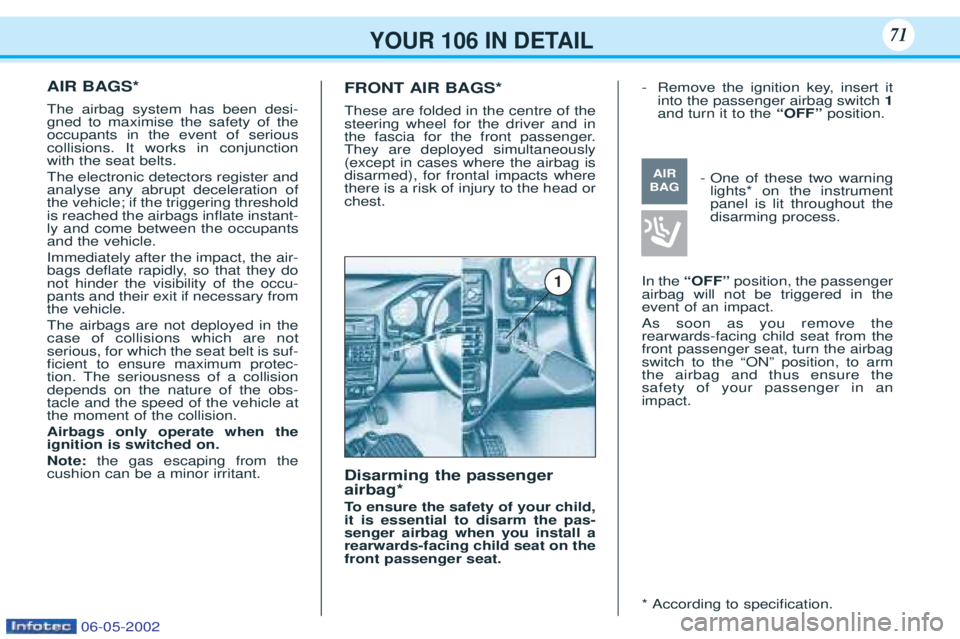
Remove the ignition key, insert itinto the passenger airbag switch 1
and turn it to the “OFF”position.
- One of these two warning lights* on the instrumentpanel is lit throughout thedisarming process.
In the “OFF” position, the passenger
airbag will not be triggered in theevent of an impact. As soon as you remove the rearwards-facing child seat from thefront passenger seat, turn the airbagswitch to the ÒONÓ position, to armthe airbag and thus ensure thesafety of your passenger in animpact. * According to speciÞcation.
Disarming the passenger airbag*
To ensure the safety of your child,
it is essential to disarm the pas- senger airbag when you install arearwards-facing child seat on thefront passenger seat.
1
AIR
BAG
06-05-2002
Page 75 of 107
YOUR 106 IN DETAIL73
WARNING
For the front and side airbags to be fully effective, observe the following safety rules:
¥W ear a correctly adjusted seat belt.
¥ Sit in a normal upright position.
¥ Do not leave an accessory, or any other object between the occupants of the front seats and the airbags. It could hamper the operation of the airbags or injure the occupants.
¥ All work on the airbag system is strictly forbidden unless it is carried out by qualiÞed personnel of the PEUGEOT network.
¥ After an accident or if the vehicle has been stolen or broken into, have the airbag systems checked.
¥ The airbag systems have been designed to be fully operational for 10 years after the vehicle has been registered. Havethem replaced by a PEUGEOT dealer after this period.
¥F ront airbags*
¥ Do not drive holding the steering wheel by its spokes or resting your hands on the centre part of the wheel.
¥ Smoke as little as possible; deployment of the airbags can cause burns or the risk of injury from a cigarette or pipe.
¥ Never remove or pierce the steering wheel or hit it violently.
¥ Side airbags*
¥ Never put covers on the front seats.
¥ Do not Þx or glue anything to the front seat backrests. This could cause injury to the chest or arms when the side airbaginßates.
¥ Do not sit with the upper part of the body any nearer to the door than necessary.
* According to speciÞcation06-05-2002
Page 77 of 107

YOUR 106 IN DETAIL73
WARNING
For the front and side airbags to be fully effective, observe the following safety rules:
¥W ear a correctly adjusted seat belt.
¥ Sit in a normal upright position.
¥ Do not leave an accessory, or any other object between the occupants of the front seats and the airbags. It could hamper the operation of the airbags or injure the occupants.
¥ All work on the airbag system is strictly forbidden unless it is carried out by qualiÞed personnel of the PEUGEOT network.
¥ After an accident or if the vehicle has been stolen or broken into, have the airbag systems checked.
¥ The airbag systems have been designed to be fully operational for 10 years after the vehicle has been registered. Havethem replaced by a PEUGEOT dealer after this period.
¥F ront airbags*
¥ Do not drive holding the steering wheel by its spokes or resting your hands on the centre part of the wheel.
¥ Smoke as little as possible; deployment of the airbags can cause burns or the risk of injury from a cigarette or pipe.
¥ Never remove or pierce the steering wheel or hit it violently.
¥ Side airbags*
¥ Never put covers on the front seats.
¥ Do not Þx or glue anything to the front seat backrests. This could cause injury to the chest or arms when the side airbaginßates.
¥ Do not sit with the upper part of the body any nearer to the door than necessary.
* According to speciÞcation06-05-2002
Page 78 of 107
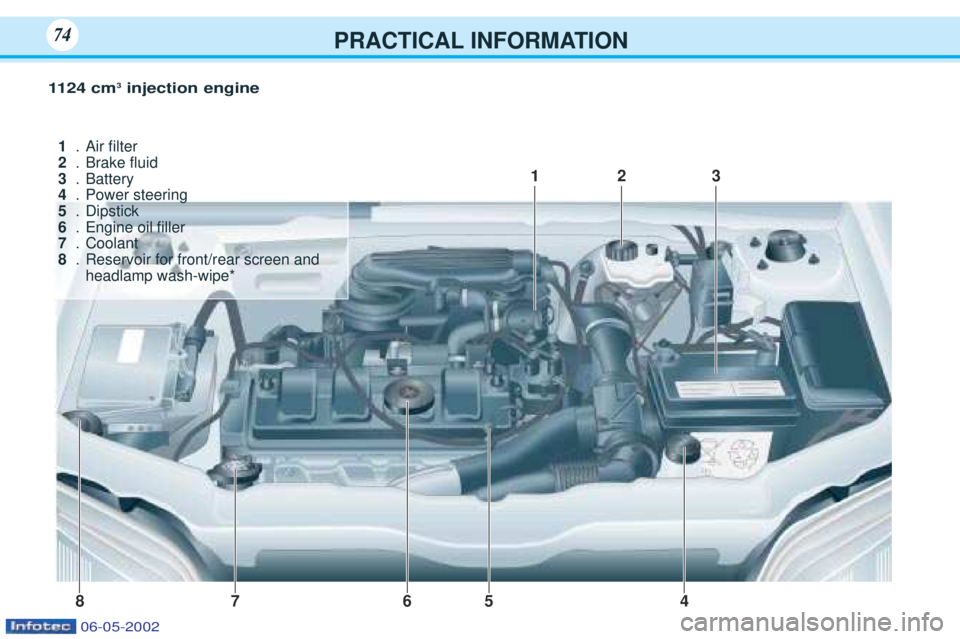
PRACTICAL INFORMATION7474
1124 cm 3
injection engine
4
1
3
5
6
87 2
1
.Air Þlter
2 .Brake ßuid
3 .Battery
4 .Power steering
5 .Dipstick
6 .Engine oil Þller
7 .Coolant
8 .Reservoir for front/rear screen and headlamp wash-wipe*
06-05-2002
Page 79 of 107
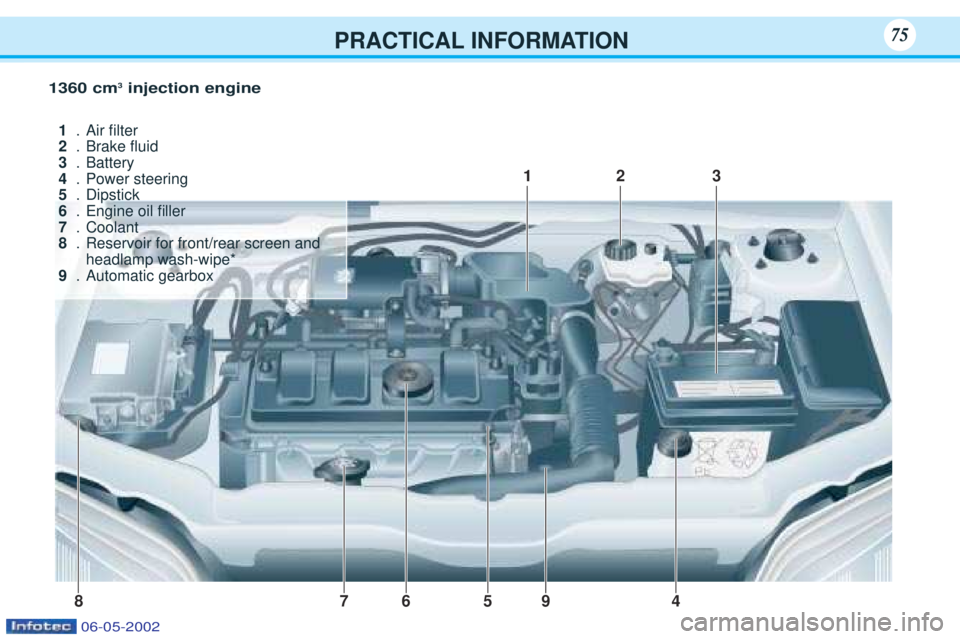
PRACTICAL INFORMATION75
1360 cm3
injection engine
4
1
3
5
6
87 2
9
1
.Air Þlter
2 .Brake ßuid
3 .Battery
4 .Power steering
5 .Dipstick
6 .Engine oil Þller
7 .Coolant
8 .Reservoir for front/rear screen and headlamp wash-wipe*
9 .Automatic gearbox
75
06-05-2002
Page 80 of 107
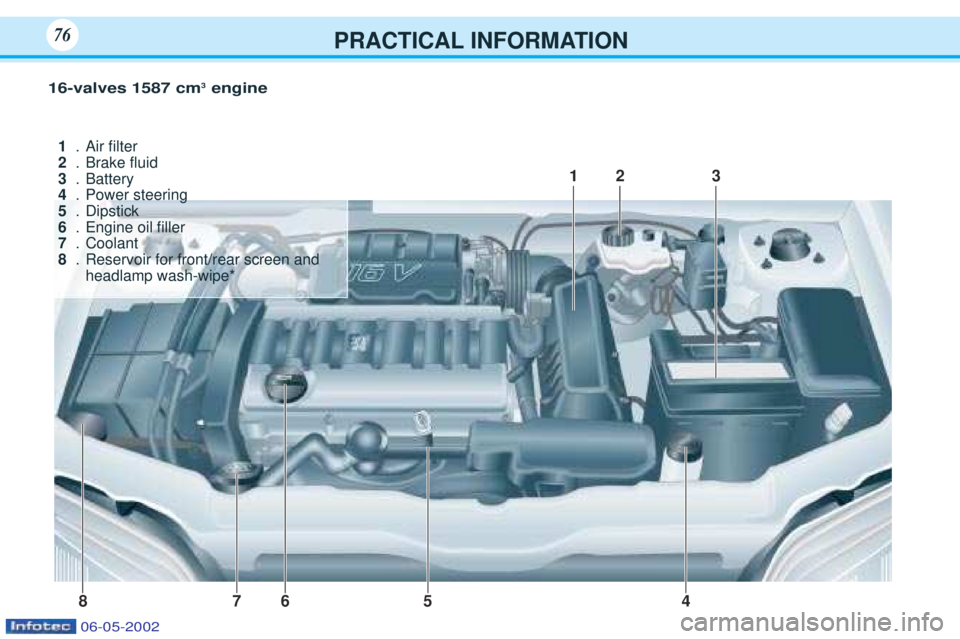
PRACTICAL INFORMATION7676
16-valves 1587 cm3
engine
4
1
3
6
87 2
5
1
.Air Þlter
2 .Brake ßuid
3 .Battery
4 .Power steering
5 .Dipstick
6 .Engine oil Þller
7 .Coolant
8 .Reservoir for front/rear screen and headlamp wash-wipe*
06-05-2002
Page 81 of 107
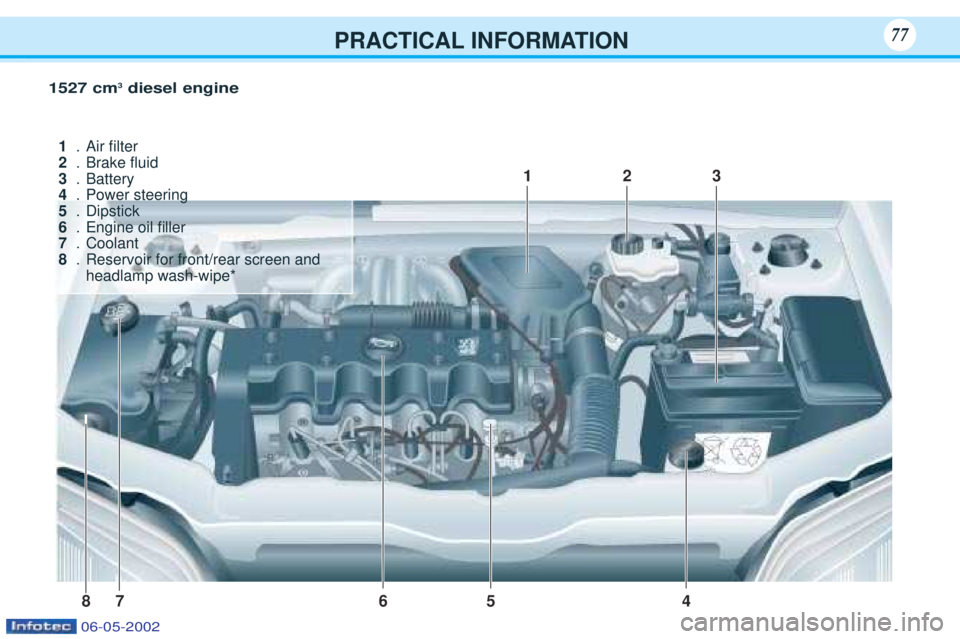
PRACTICAL INFORMATION7777
1527 cm3
diesel engine
4
1
3
5
6
87 2
1
.Air Þlter
2 .Brake ßuid
3 .Battery
4 .Power steering
5 .Dipstick
6 .Engine oil Þller
7 .Coolant
8 .Reservoir for front/rear screen and headlamp wash-wipe*
06-05-2002
Page 82 of 107
CHECKING THE LEVELS 1. Air filter
The air filter element must be changed at the recommendedintervals. If you drive in a dustyatmosphere, change it twice asoften. Follow the recommendations given in the maintenance schedule. 2. Brake fluid
The level must always be above the
DANGER mark on the reservoir. Inthe event of a signiÞcant drop in theßuid level, consult a PEUGEOT
dealer immediately. Use fluids
approved by the manufacturer,which conform to DOT 3 or DOT 4standards. 3. Battery
At the beginning of winter, have the battery checked by a PEUGEOT
dealer. In summer (30¡C and above) or if the battery is in heavy use, checkthe level of electrolyte; it must coverthe separator plates at all times. If
necessary, top up with distilled
water. 4. Power steering* When the engine is cold, the level must always be above the MINmark, close to the MAX mark. 5. Dipstick Check the oil level on ßat ground, with the engine cold and preferably
before the Þrst journey of the day. Never exceed the maximum level.
Check the level regularly.
6. T
opping up with oil
Y our oil must be changed in accor-
dance with the maintenance sche- dule. The oil must be topped up between oil changes. Regularly check and top-up the oil level. Maximum oil consumption is 0.5 litres per 600 miles (1000 km). 7. Coolant Engine cold: the coolant level must be between the min and max marksin the expansion chamber with the
cap removed. To close, turn the capto the second notch*. Cooling circuit Always use the coolant which is approved by the manufacturer
(PROCOR TM108 / GLYSANTING33 or REVKOGEL 2000). If this isnot possible, top up with distilledwater and have the protection level
checked by a PEUGEOT dealer. When the engine is hot, the coolant temperature is regulated by the fan.As the fan can operate with theignition key removed, and as thecooling circuit is pressurised,
do
not carry out any work for atleast an hour after switching offthe engine .
Note: the coolant does not need tobe renewed.
8. Front/rear screen and headlamp wash reservoir*
For optimum cleaning quality and
for your safety, it is best to use cleaning products approved byPEUGEOT (capacity 4.5 litreswithout headlamp wash, 5.5 litreswith headlamp wash). * According to speciÞcation
PRACTICAL INFORMATION7878
06-05-2002