Page 334 of 436
6-5
To provide cleaner air, all gasolines in the United States
are now required to contain additives that will help
prevent deposits from forming in your engine and fuel
system, allowing your emission control system to
function properly. Therefore, you should not have
to add anything to the fuel. In addition, gasolines
containing oxygenates, such as ethers and ethanol, and
reformulated gasolines may be available in your area to
contribute to clean air. General Motors recommends that
you use these gasolines, particularly if they comply with
the specifications described earlier.
NOTICE:
Your vehicle was not designed for fuel that
contains methanol. Don't use it. It can corrode
metal parts in your fuel system and also damage
plastic and rubber parts. That damage wouldn't
be covered under your warranty.
Fuels in Foreign Countries
If you plan on driving in another country outside the
United States or Canada, the proper fuel may be hard
to find. Never use leaded gasoline or any other fuel not
recommended in the previous text on fuel. Costly repairs
caused by use of improper fuel wouldn't be covered by
your warranty.
To check on fuel availability, ask an auto club, or
contact a major oil company that does business in
the country where you'll be driving.
Page 338 of 436
6-9
Checking Things Under the Hood
CAUTION:
An electric fan under the hood can start up and
injure you even when the engine is not running.
Keep hands, clothing and tools away from any
underhood electric fan.
CAUTION:
Things that burn can get on hot engine parts and
start a fire. These include liquids like fuel, oil,
coolant, brake fluid, windshield washer and other
fluids, and plastic or rubber. You or others could
be burned. Be careful not to drop or spill things
that will burn onto a hot engine.
Hood Release
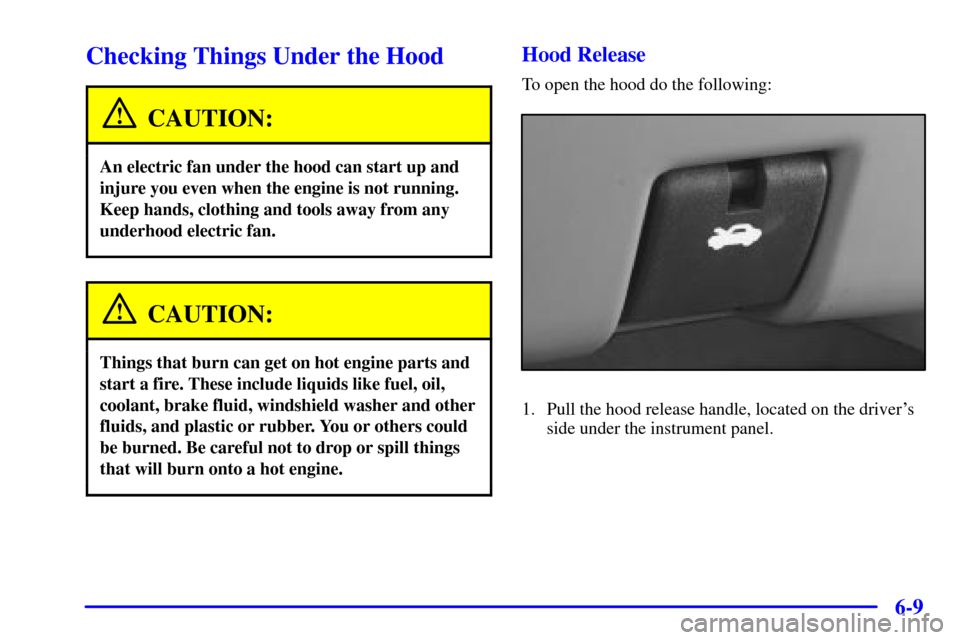
To open the hood do the following:
1. Pull the hood release handle, located on the driver's
side under the instrument panel.
Page 340 of 436
6-11 Engine Compartment Overview
When you lift the hood, you'll see these items:
A. Underhood Fuse and
Relay Center
B. Remote Positive (+) Terminal
C. Windshield Washer
Fluid ReservoirD. Radiator Pressure Cap
E. Power Steering Fluid Reservoir
F. Engine Oil Fill Cap
G. Engine Oil DipstickH. Transaxle Fluid Dipstick
I. Brake Master Cylinder Reservoir
J. Engine Air Cleaner/Filter
K. Engine Coolant Reservoir
Page 341 of 436
6-12
Before closing the hood, be sure all the filler caps are on
properly then follow these steps:
1. Lift the hood to relieve pressure off the hood prop.
2. Remove the hood prop from the slot in the hood.
3. Return the prop to its retainer.
4. Let the hood down and close it firmly.
Engine Oil
United States Canada
If the low engine oil level message appears on the
instrument panel, it means you need to check your
engine oil level right away. For more information,
see ªLow Engine Oil Level Messageº in the Index.
You should check your engine oil level regularly;
this is an added reminder.
Checking Engine Oil
It's a good idea to check your engine oil every time you
get fuel. In order to get an accurate reading, the oil must
be warm and the vehicle must be on level ground.
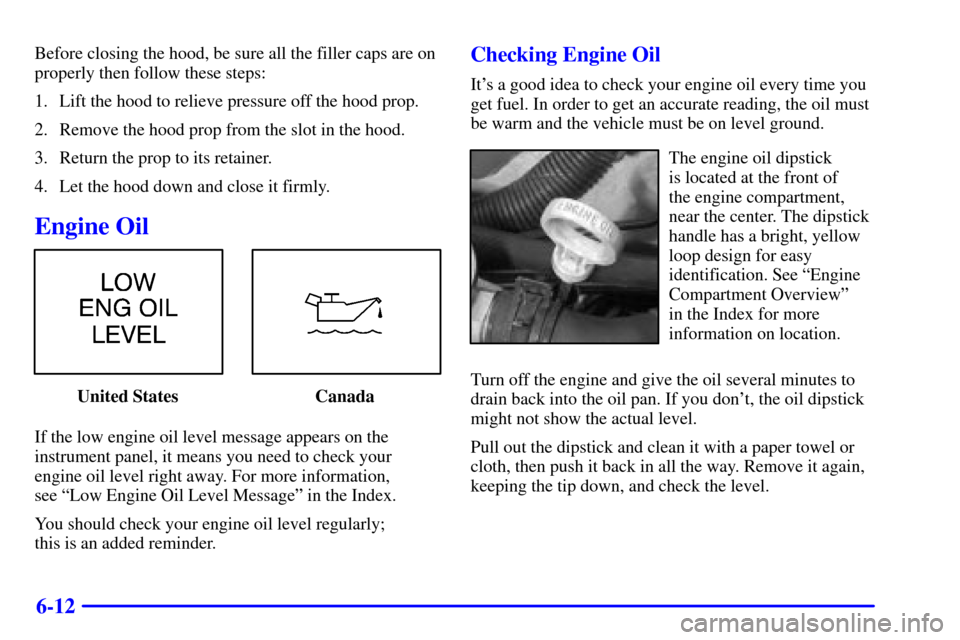
The engine oil dipstick
is located at the front of
the engine compartment,
near the center. The dipstick
handle has a bright, yellow
loop design for easy
identification. See ªEngine
Compartment Overviewº
in the Index for more
information on location.
Turn off the engine and give the oil several minutes to
drain back into the oil pan. If you don't, the oil dipstick
might not show the actual level.
Pull out the dipstick and clean it with a paper towel or
cloth, then push it back in all the way. Remove it again,
keeping the tip down, and check the level.
Page 342 of 436
6-13
When to Add Engine Oil
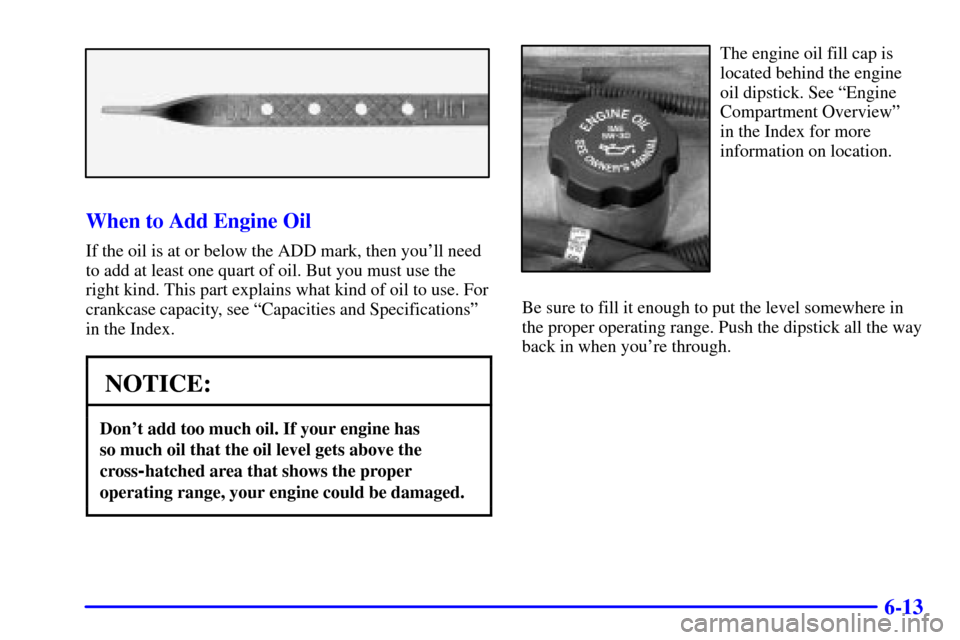
If the oil is at or below the ADD mark, then you'll need
to add at least one quart of oil. But you must use the
right kind. This part explains what kind of oil to use. For
crankcase capacity, see ªCapacities and Specificationsº
in the Index.
NOTICE:
Don't add too much oil. If your engine has
so much oil that the oil level gets above the
cross
-hatched area that shows the proper
operating range, your engine could be damaged.
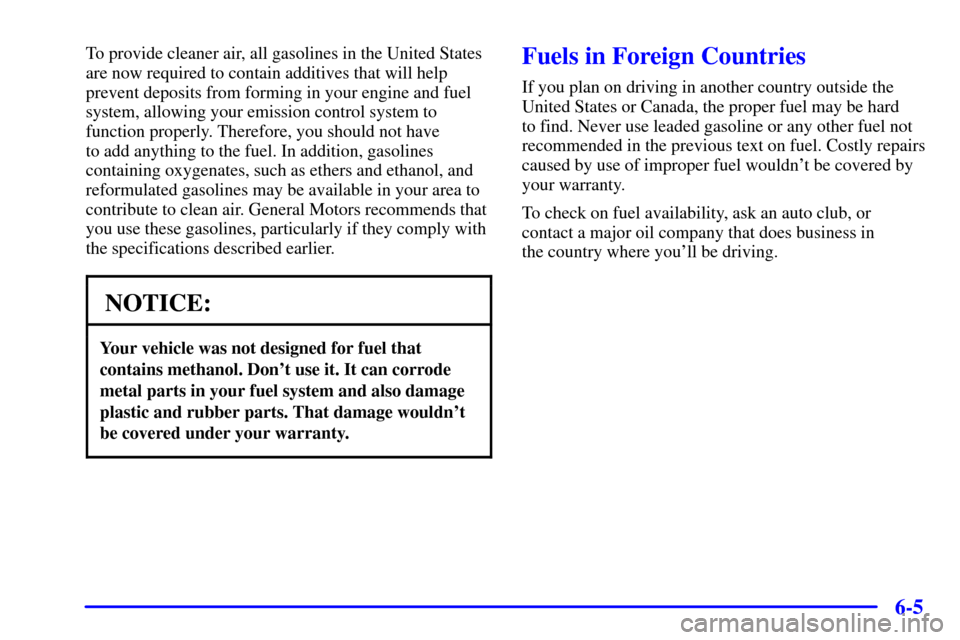
The engine oil fill cap is
located behind the engine
oil dipstick. See ªEngine
Compartment Overviewº
in the Index for more
information on location.
Be sure to fill it enough to put the level somewhere in
the proper operating range. Push the dipstick all the way
back in when you're through.
Page 343 of 436
6-14 What Kind of Engine Oil to Use
Oils recommended for your vehicle can be identified by
looking for the starburst symbol.
This symbol indicates that the oil has been certified by
the American Petroleum Institute (API). Do not use any
oil which does not carry this starburst symbol.
If you change your own oil,
be sure you use oil that has
the starburst symbol on the
front of the oil container.
If you have your oil
changed for you, be sure
the oil put into your engine
is American Petroleum
Institute certified for
gasoline engines.
You should also use the proper viscosity oil for your
vehicle, as shown in the following chart:
Page 344 of 436
6-15
As in the chart shown previously, SAE 5W-30 is best for
your vehicle. However, you can use SAE 10W
-30 if it's
going to be 0�F (
-18�C) or above. These numbers on
an oil container show its viscosity, or thickness. Do not
use other viscosity oils, such as SAE 20W
-50.
NOTICE:
Use only engine oil with the American
Petroleum Institute Certified For Gasoline
Engines starburst symbol. Failure to use the
recommended oil can result in engine damage
not covered by your warranty.
GM Goodwrench� oil meets all the requirements for
your vehicle.
If you are in an area where the temperature falls below
-20�F (-29�C), consider using either an SAE 5W-30
synthetic oil or an SAE 0W
-30 oil. Both will provide
easier cold starting and better protection for your engine
at extremely low temperatures.
Engine Oil Additives
Don't add anything to your oil. The recommended oils
with the starburst symbol are all you will need for good
performance and engine protection.
When to Change Engine Oil
Your vehicle has a computer that lets you know
when to change your engine oil. This is not based on
mileage, but on engine revolutions and engine operating
temperature. When the computer has calculated that
the oil needs changing, the GM Oil Life System� will
indicate that a change is necessary. The mileage between
oil and filter changes will vary depending on how you
drive your vehicle
-- usually between 3,000 miles
(5 000 km) and 10,000 miles (16 000 km) since
your last oil and filter change. Under severe conditions,
the system may come on before 3,000 miles (5 000 km).
Never drive your vehicle more than 10,000 miles
(16 000 km) or 12 months (whichever occurs first)
without an oil change.
The system won't detect dust in the oil. So, if you
drive in a dusty area, be sure to change your oil
and filter every 3,000 miles (5 000 km) or sooner.
Remember to reset the change engine oil message
whenever the oil is changed.
Page 345 of 436

6-16
How to Reset the Change Engine Oil Message
1. With the ignition key in RUN but the engine off,
repeatedly push the trip/reset button until OIL
is displayed.
2. Once OIL is displayed, push and hold the trip/reset
button for five seconds. The number will disappear
and be replaced by 100 (indicating 100% oil
life remaining).
3. Turn the key to OFF.
If the change engine oil message comes back on,
the engine oil life monitor has not reset.
Repeat the procedure.What to Do with Used Oil
Did you know that used engine oil contains certain
elements that may be unhealthy for your skin and could
even cause cancer? Don't let used oil stay on your skin
for very long. Clean your skin and nails with soap and
water, or a good hand cleaner. Wash or properly throw
away clothing or rags containing used engine oil.
See the manufacturer's warnings about the use and
disposal of oil products.
Used oil can be a real threat to the environment. If you
change your own oil, be sure to drain all free
-flowing
oil from the filter before disposal. Don't ever dispose of
oil by putting it in the trash, pouring it on the ground,
into sewers, or into streams or bodies of water. Instead,
recycle it by taking it to a place that collects used oil.
If you have a problem properly disposing of your used
oil, ask your dealer, a service station or a local recycling
center for help.