Page 41 of 436

1-29
How to Wear Safety Belts Properly
Adults
This part is only for people of adult size.
Be aware that there are special things to know about
safety belts and children. And there are different
rules for smaller children and babies. If a child
will be riding in your vehicle, see the part of this
manual called ªChildren.º Follow those rules for
everyone's protection.
First, you'll want to know which restraint systems
your vehicle has.
We'll start with the driver position.
Driver Position
This part describes the driver's restraint system.
Lap-Shoulder Belt
The driver has a lap-shoulder belt. Here's how to
wear it properly.
1. Close and lock the door.
2. Adjust the seat so you can sit up straight.
To see how, see ªSeatsº in the Index.
3. Pick up the latch plate and pull the belt across you.
Don't let it get twisted.
The shoulder belt may lock if you pull the belt across
you very quickly. If this happens, let the belt go back
slightly to unlock it. Then pull the belt across you
more slowly.
Page 42 of 436
1-30
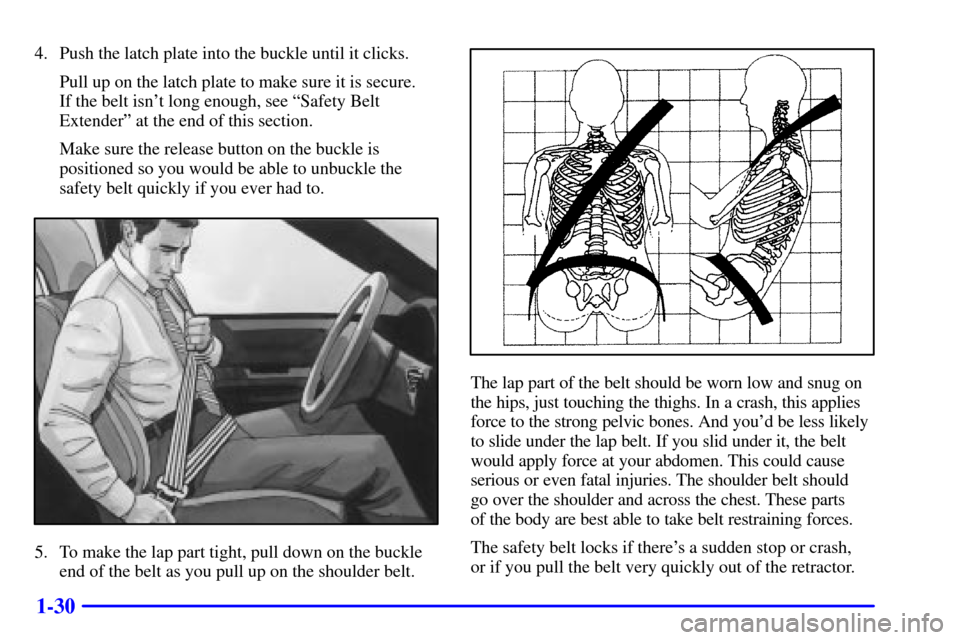
4. Push the latch plate into the buckle until it clicks.
Pull up on the latch plate to make sure it is secure.
If the belt isn't long enough, see ªSafety Belt
Extenderº at the end of this section.
Make sure the release button on the buckle is
positioned so you would be able to unbuckle the
safety belt quickly if you ever had to.
5. To make the lap part tight, pull down on the buckle
end of the belt as you pull up on the shoulder belt.
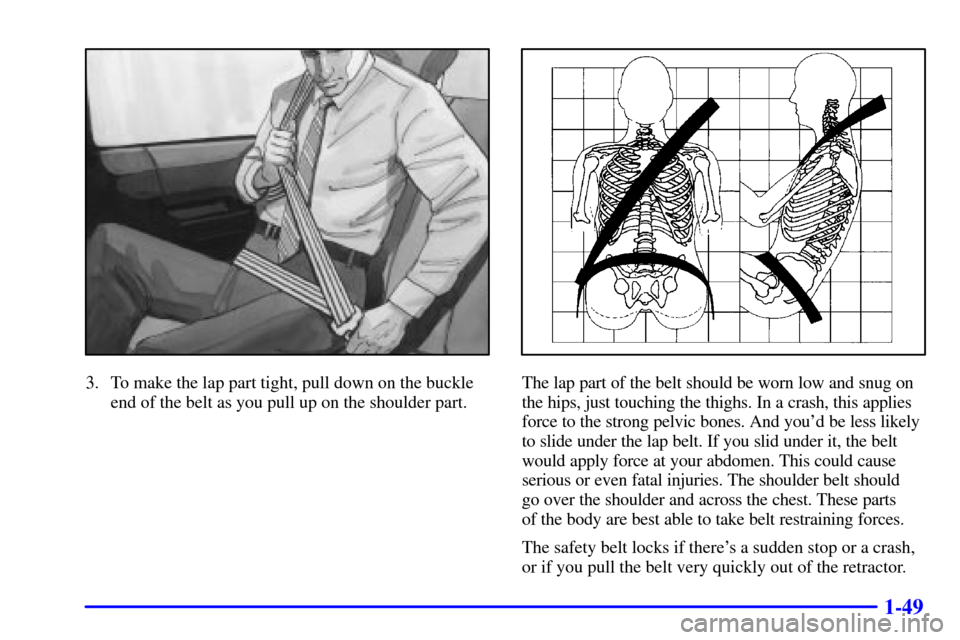
The lap part of the belt should be worn low and snug on
the hips, just touching the thighs. In a crash, this applies
force to the strong pelvic bones. And you'd be less likely
to slide under the lap belt. If you slid under it, the belt
would apply force at your abdomen. This could cause
serious or even fatal injuries. The shoulder belt should
go over the shoulder and across the chest. These parts
of the body are best able to take belt restraining forces.
The safety belt locks if there's a sudden stop or crash,
or if you pull the belt very quickly out of the retractor.
Page 43 of 436
1-31
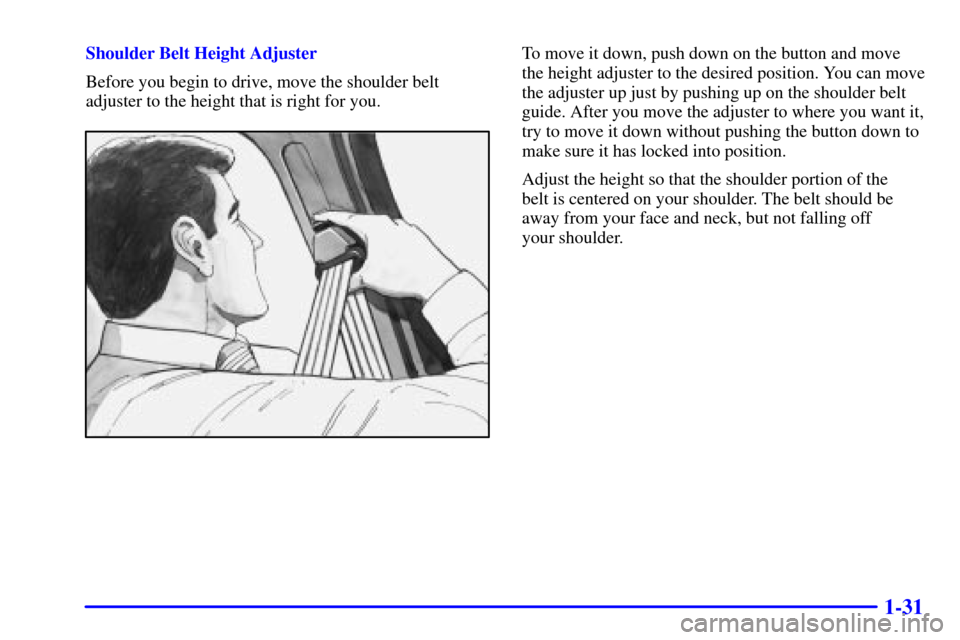
Shoulder Belt Height Adjuster
Before you begin to drive, move the shoulder belt
adjuster to the height that is right for you.To move it down, push down on the button and move
the height adjuster to the desired position. You can move
the adjuster up just by pushing up on the shoulder belt
guide. After you move the adjuster to where you want it,
try to move it down without pushing the button down to
make sure it has locked into position.
Adjust the height so that the shoulder portion of the
belt is centered on your shoulder. The belt should be
away from your face and neck, but not falling off
your shoulder.
Page 50 of 436
1-38
The best way to protect the fetus is to protect the
mother. When a safety belt is worn properly, it's
more likely that the fetus won't be hurt in a crash.
For pregnant women, as for anyone, the key to
making safety belts effective is wearing them properly.
Right Front Passenger Position
To learn how to wear the right front passenger's
safety belt properly, see ªDriver Positionº earlier in
this section.
The right front passenger's safety belt works the same
way as the driver's safety belt
-- except for two things.
If the belt stops before it reaches the buckle, tilt the latch
plate and keep pulling until you can buckle the belt.
On some vehicles, if you pull the shoulder portion of the
belt out all the way, you will engage the child restraint
locking feature. If this happens, just let the belt go back
all the way and start again.
Page 54 of 436
1-42
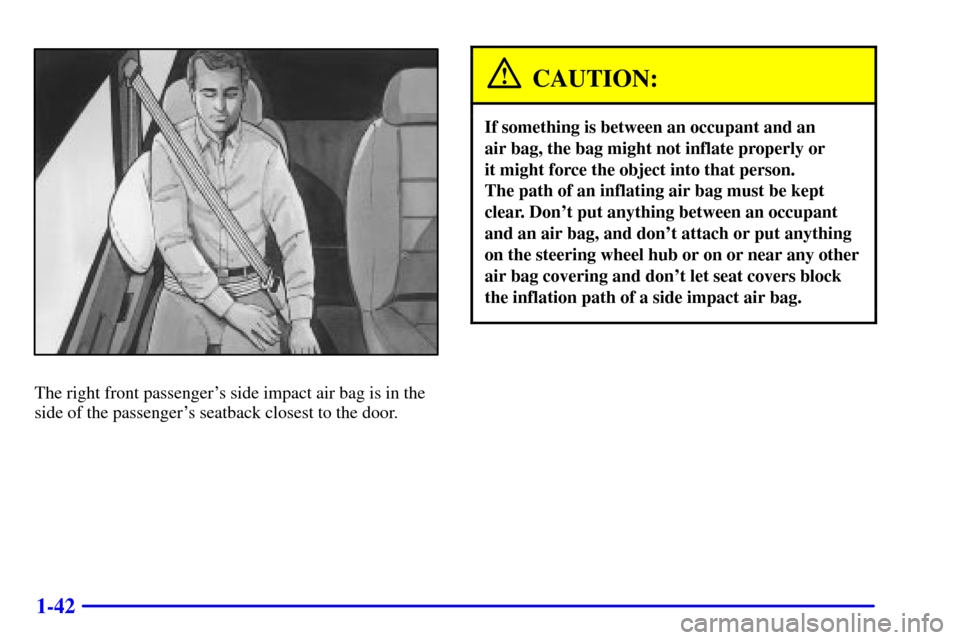
The right front passenger's side impact air bag is in the
side of the passenger's seatback closest to the door.
CAUTION:
If something is between an occupant and an
air bag, the bag might not inflate properly or
it might force the object into that person.
The path of an inflating air bag must be kept
clear. Don't put anything between an occupant
and an air bag, and don't attach or put anything
on the steering wheel hub or on or near any other
air bag covering and don't let seat covers block
the inflation path of a side impact air bag.
Page 59 of 436
1-47
Rear Seat Passengers
It's very important for rear seat passengers to buckle up!
Accident statistics show that unbelted people in the rear
seat are hurt more often in crashes than those who are
wearing safety belts.
Rear passengers who aren't safety belted can be thrown
out of the vehicle in a crash. And they can strike others
in the vehicle who are wearing safety belts.
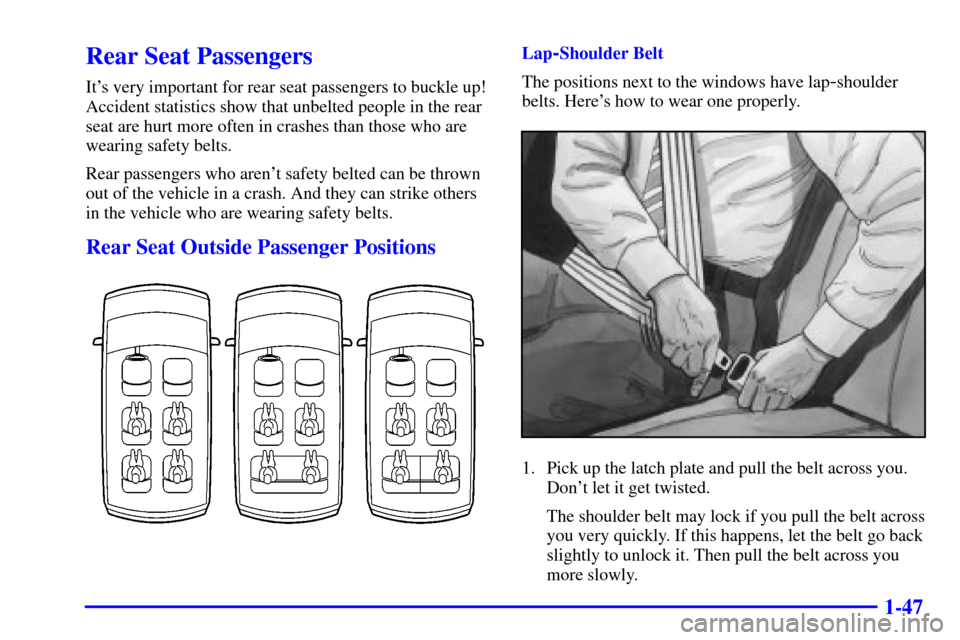
Rear Seat Outside Passenger Positions
Lap-Shoulder Belt
The positions next to the windows have lap
-shoulder
belts. Here's how to wear one properly.
1. Pick up the latch plate and pull the belt across you.
Don't let it get twisted.
The shoulder belt may lock if you pull the belt across
you very quickly. If this happens, let the belt go back
slightly to unlock it. Then pull the belt across you
more slowly.
Page 61 of 436
1-49
3. To make the lap part tight, pull down on the buckle
end of the belt as you pull up on the shoulder part.The lap part of the belt should be worn low and snug on
the hips, just touching the thighs. In a crash, this applies
force to the strong pelvic bones. And you'd be less likely
to slide under the lap belt. If you slid under it, the belt
would apply force at your abdomen. This could cause
serious or even fatal injuries. The shoulder belt should
go over the shoulder and across the chest. These parts
of the body are best able to take belt restraining forces.
The safety belt locks if there's a sudden stop or a crash,
or if you pull the belt very quickly out of the retractor.
Page 81 of 436
1-69
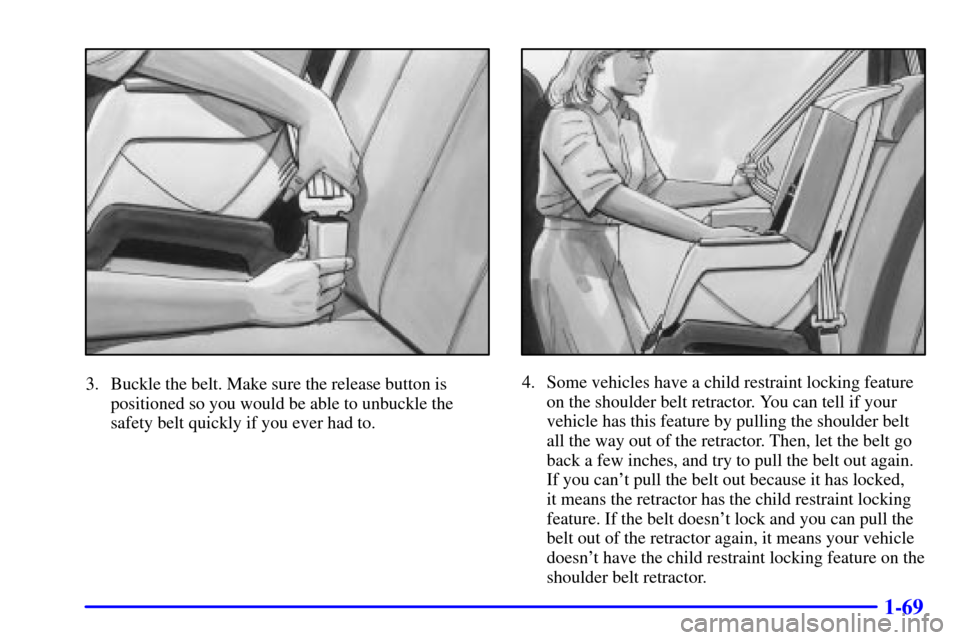
3. Buckle the belt. Make sure the release button is
positioned so you would be able to unbuckle the
safety belt quickly if you ever had to.4. Some vehicles have a child restraint locking feature
on the shoulder belt retractor. You can tell if your
vehicle has this feature by pulling the shoulder belt
all the way out of the retractor. Then, let the belt go
back a few inches, and try to pull the belt out again.
If you can't pull the belt out because it has locked,
it means the retractor has the child restraint locking
feature. If the belt doesn't lock and you can pull the
belt out of the retractor again, it means your vehicle
doesn't have the child restraint locking feature on the
shoulder belt retractor.