Page 127 of 346
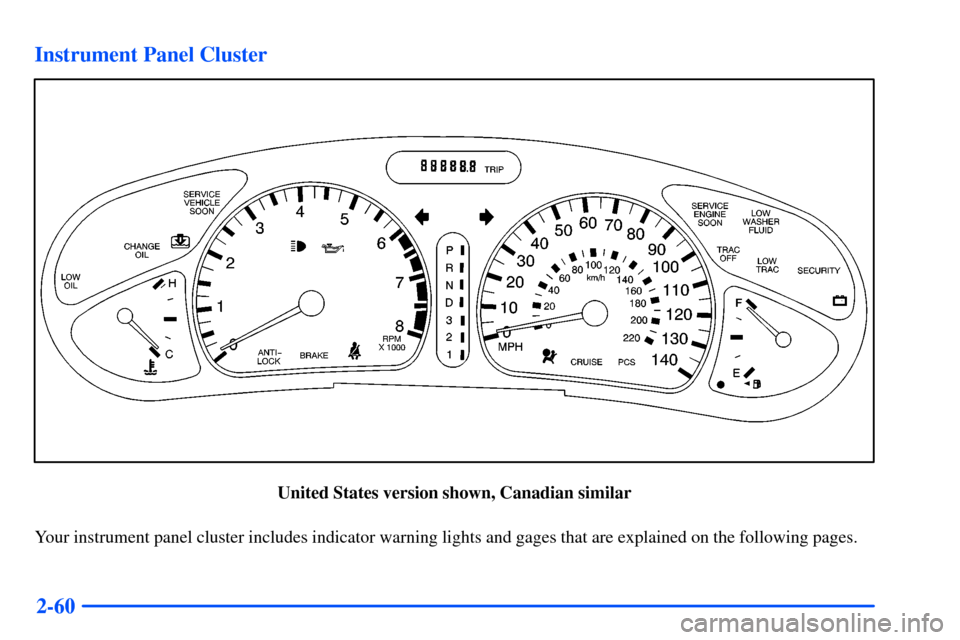
2-60 Instrument Panel Cluster
United States version shown, Canadian similar
Your instrument panel cluster includes indicator warning lights and gages that are explained on the following pages.
Page 130 of 346

2-63
Warning Lights, Gages and Indicators
This part describes the warning lights and gages that
may be on your vehicle. The pictures will help you
locate them.
Warning lights and gages can signal that something is
wrong before it becomes serious enough to cause an
expensive repair or replacement. Paying attention to
your warning lights and gages could also save you or
others from injury.
Warning lights come on when there may be or is a
problem with one of your vehicle's functions. As you
will see in the details on the next few pages, some
warning lights come on briefly when you start the
engine just to let you know they're working. If you
are familiar with this section, you should not be
alarmed when this happens.
Gages can indicate when there may be or is a problem
with one of your vehicle's functions. Often gages and
warning lights work together to let you know when
there's a problem with your vehicle.When one of the warning lights comes on and stays on
when you are driving, or when one of the gages shows
there may be a problem, check the section that tells you
what to do about it. Please follow this manual's advice.
Waiting to do repairs can be costly
-- and even
dangerous. So please get to know your warning lights
and gages. They're a big help.
Safety Belt Reminder Light
When the key is turned to ON, a chime will come on
for about eight seconds to remind people to fasten
their safety belts, unless the driver's safety belt is
already buckled.
The safety belt light will
also come on and stay on
for about 20 seconds,
then it will flash for
about 55 seconds.
If the driver's belt is already buckled, neither the chime
nor the light will come on.
Page 135 of 346

2-68 Precision Control System (PCS) Warning
Light (Option)
United States Canada
This light should come on briefly as you start your engine.
If the light doesn't come on then, have it serviced so it will
be ready to warn you if there's a problem.
If the PCS warning light comes on, it means there
may be a problem with your Precision Control System.
When this light comes on, so will the TRAC OFF light
and both the Precision Control System and the Traction
Control System will not be functioning. If these lights
come on, try to reset the system (stop; turn off the
engine; then start the engine again). If the PCS and
TRAC OFF lights remain on, it means there is a
problem and you should see your dealer for service.
Reduce your speed and drive accordingly.
Low Traction Active (LOW TRAC) Light
Your LOW TRAC
(Low Traction Active)
light may come on for one
of the following reasons:
�The Precision Control System (PCS) (if equipped)
is active and is adjusting brake pressure to help your
vehicle continue to go in the direction in which you
are steering. The PCS activates when the computer
senses that your vehicle is starting to spin, as might
happen if you hit a patch of ice or other slippery
surface on the road, and assists the driver by
selectively applying any one of the vehicle's brakes.
The system is designed to help you in bad weather
or other difficult driving situations by making the
most of whatever road conditions will allow. When
the system is on, you may hear a noise or feel a
vibration in the brake pedal. This is normal.
�The optional Traction Control System is active
and is limiting wheel spin. You may feel the system
working, but this is normal. Slippery road conditions
may exist, so adjust your driving accordingly.
Page 182 of 346

4-11 Precision Control System (Option)
If your vehicle is equipped with the Precision Control
System (PCS), the system helps your vehicle to go in the
direction you are steering in difficult driving conditions.
This is accomplished when the computer senses that
your vehicle is starting to spin and assists the driver by
selectively applying any one of the vehicle's brakes.
When the Precision Control
System is active, the LOW
TRAC light will come on.
Continue to steer in the direction you want the vehicle
to go and apply the brakes normally to slow the vehicle
as desired.
You may hear or feel the system working, but this is
normal. You should adjust your driving accordingly.
See ªLow Traction Active (LOW TRAC) Lightº in
the Index.
United States Canada
When you first start the vehicle, the PCS light should
come on briefly. If the light doesn't come on then, have
your vehicle serviced so it will be ready to warn you if
there is a problem.
If you ever see the PCS warning light come on, it means
there is a problem with the Precision Control System. If
both the PCS and TRAC OFF lights are on, neither of
the systems are functioning. You can try resetting the
system: stop, turn off the engine, wait a few seconds and
then start the engine again. If both lights are still on, you
should have your vehicle serviced.
Page 189 of 346

4-18
Here are some tips on night driving.
�Drive defensively.
�Don't drink and drive.
�Adjust your inside rearview mirror to reduce the
glare from headlamps behind you.
�Since you can't see as well, you may need to
slow down and keep more space between you and
other vehicles.
�Slow down, especially on higher speed roads. Your
headlamps can light up only so much road ahead.
�In remote areas, watch for animals.
�If you're tired, pull off the road in a safe place
and rest.
No one can see as well at night as in the daytime. But as
we get older these differences increase. A 50
-year-old
driver may require at least twice as much light to see the
same thing at night as a 20
-year-old.
What you do in the daytime can also affect your night
vision. For example, if you spend the day in bright
sunshine you are wise to wear sunglasses. Your eyes will
have less trouble adjusting to night. But if you're
driving, don't wear sunglasses at night.They may cut down on glare from headlamps, but they
also make a lot of things invisible.
You can be temporarily blinded by approaching
headlamps. It can take a second or two, or even several
seconds, for your eyes to readjust to the dark. When you
are faced with severe glare (as from a driver who
doesn't lower the high beams, or a vehicle with
misaimed headlamps), slow down a little. Avoid staring
directly into the approaching headlamps.
Keep your windshield and all the glass on your vehicle
clean
-- inside and out. Glare at night is made much
worse by dirt on the glass. Even the inside of the glass
can build up a film caused by dust. Dirty glass makes
lights dazzle and flash more than clean glass would,
making the pupils of your eyes contract repeatedly.
Remember that your headlamps light up far less of a
roadway when you are in a turn or curve. Keep your
eyes moving; that way, it's easier to pick out dimly
lighted objects. Just as your headlamps should be
checked regularly for proper aim, so should your eyes
be examined regularly. Some drivers suffer from night
blindness
-- the inability to see in dim light -- and
aren't even aware of it.
Page 264 of 346

6-23
A 50/50 mixture of clean, drinkable water and
DEX
-COOL� coolant will:
�Give freezing protection down to
-34�F (-37�C).
�Give boiling protection up to 265�F (129�C).
�Protect against rust and corrosion.
�Help keep the proper engine temperature.
�Let the warning lights and gages work as
they should.
NOTICE:
When adding coolant, it is important that you use
only DEX
-COOL� (silicate-free) coolant.
If coolant other than DEX-COOL is added to
the system, premature engine, heater core or
radiator corrosion may result. In addition, the
engine coolant will require change sooner
-- at
30,000 miles (50 000 km) or 24 months,
whichever occurs first. Damage caused by the
use of coolant other than DEX
-COOL� is not
covered by your new vehicle warranty.
What to Use
Use a mixture of one-half clean, drinkable water and
one
-half DEX-COOL� coolant which won't damage
aluminum parts. If you use this coolant mixture, you
don't need to add anything else.
CAUTION:
Adding only plain water to your cooling system
can be dangerous. Plain water, or some other
liquid like alcohol, can boil before the proper
coolant mixture will. Your vehicle's coolant
warning system is set for the proper coolant
mixture. With plain water or the wrong mixture,
your engine could get too hot but you wouldn't
get the overheat warning. Your engine could
catch fire and you or others could be burned.
Use a 50/50 mixture of clean, drinkable water
and DEX
-COOL� coolant.