Page 224 of 376

4-35 Trailer Wiring Harness
All of the electrical circuits required for your trailer
lighting system can be accessed at the driver's side rear
lamp connector. This connector is located under the
carpet in the rear corner of the trunk compartment.
Driving with a Trailer
Towing a trailer requires a certain amount of experience.
Before setting out for the open road, you'll want to
get to know your rig. Acquaint yourself with the feel
of handling and braking with the added weight of the
trailer. And always keep in mind that the vehicle you
are driving is now a good deal longer and not nearly as
responsive as your vehicle is by itself.
Before you start, check the trailer hitch and platform
(and attachments), safety chains, electrical connector,
lamps, tires and mirror adjustment. If the trailer has
electric brakes, start your vehicle and trailer moving
and then apply the trailer brake controller by hand to be
sure the brakes are working. This lets you check your
electrical connection at the same time.
During your trip, check occasionally to be sure that the
load is secure, and that the lamps and any trailer brakes
are still working.
Following Distance
Stay at least twice as far behind the vehicle ahead as you
would when driving your vehicle without a trailer. This
can help you avoid situations that require heavy braking
and sudden turns.
Passing
You'll need more passing distance up ahead when
you're towing a trailer. And, because you're a good
deal longer, you'll need to go much farther beyond
the passed vehicle before you can return to your lane.
Backing Up
Hold the bottom of the steering wheel with one hand.
Then, to move the trailer to the left, just move that
hand to the left. To move the trailer to the right, move
your hand to the right. Always back up slowly and,
if possible, have someone guide you.
Page 230 of 376

5-4
1. Check the other vehicle. It must have a 12-volt
battery with a negative ground system.
NOTICE:
If the other system isn't a 12-volt system with a
negative ground, both vehicles can be damaged.
2. Get the vehicles close enough so the jumper cables
can reach, but be sure the vehicles aren't touching
each other. If they are, it could cause a ground
connection you don't want. You wouldn't be able
to start your vehicle, and the bad grounding could
damage the electrical systems.
To avoid the possibility of the vehicles rolling, set
the parking brake firmly on both vehicles involved in
the jump start procedure. Put an automatic transaxle
in PARK (P) and a manual transaxle in NEUTRAL
before setting the parking brake.3. Turn off the ignition on both vehicles. Unplug
unnecessary accessories plugged into the cigarette
lighter or accessory power outlet. Turn off all lamps
that aren't needed as well as radios. This will avoid
sparks and help save both batteries. In addition, it
could save your radio.
4. Open the hoods and locate the other vehicle's battery
and your vehicle's remote positive (+) jump starting
terminal in the box on the passenger side of the
engine compartment. (Your vehicle's battery isn't
under the hood.)
CAUTION:
An electric fan can start up even when the engine
is not running and can injure you. Keep hands,
clothing and tools away from any underhood
electric fan.
Page 234 of 376
5-8
13. Remove the cables in reverse order to prevent
electrical shorting. Take care that they don't
touch each other or any other metal. Replace the
red positive (+)remote terminal cover to its
original position.
A. Remote Positive (+) Terminal
B. Good Battery
C. Heavy, Unpainted Metal Engine Part
Towing Your Vehicle
CAUTION:
To help avoid serious personal injury to you
or others:
�Never let passengers ride in a vehicle that is
being towed.
�Never tow faster than safe or posted speeds.
�Never tow with damaged parts not
fully secured.
�Never get under your vehicle after it has
been lifted by the tow truck.
�Always secure the vehicle on each side
with separate safety chains when towing it.
�Use only the correct hooks.
Page 256 of 376

6-
6-1
Section 6 Service and Appearance Care
Here you will find information about the care of your vehicle. This section begins with service and fuel information,
and then it shows how to check important fluid and lubricant levels. There is also technical information about your
vehicle, and a part devoted to its appearance care.
6
-2 Service
6
-3 Fuel
6
-10 Filling a Portable Fuel Container
6
-10 Checking Things Under the Hood
6
-15 Engine Oil
6
-20 Engine Air Cleaner/Filter
6
-23 Automatic Transaxle Fluid
6
-26 Engine Coolant
6
-31 Windshield Washer Fluid
6
-32 Brakes
6
-35 Battery
6
-37 Bulb Replacement
6
-48 Tires6
-58 Appearance Care
6
-58 Cleaning the Inside of Your Vehicle
6
-62 Cleaning the Outside of Your Vehicle
6
-64 Underbody Maintenance
6
-64 Chemical Paint Spotting
6
-65 GM Vehicle Care/Appearance Materials
6
-66 Vehicle Identification Number (VIN)
6
-67 Electrical System
6
-71 Removing the Rear Seat Cushion
6
-75 Replacement Bulbs
6
-76 Capacities and Specifications
6
-78 Normal Maintenance Replacement Parts
Page 262 of 376
6-7
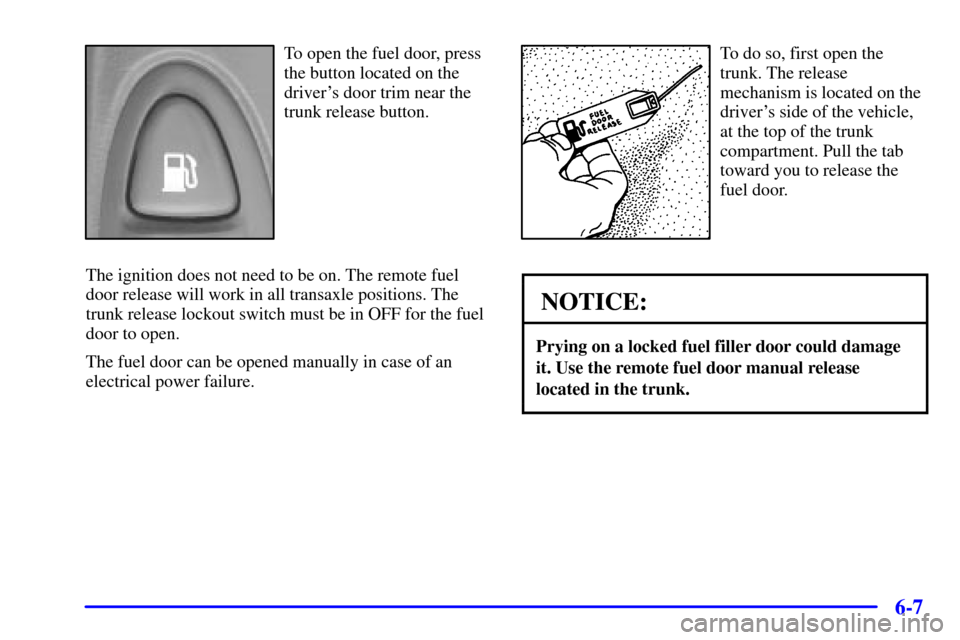
To open the fuel door, press
the button located on the
driver's door trim near the
trunk release button.
The ignition does not need to be on. The remote fuel
door release will work in all transaxle positions. The
trunk release lockout switch must be in OFF for the fuel
door to open.
The fuel door can be opened manually in case of an
electrical power failure.To do so, first open the
trunk. The release
mechanism is located on the
driver's side of the vehicle,
at the top of the trunk
compartment. Pull the tab
toward you to release the
fuel door.
NOTICE:
Prying on a locked fuel filler door could damage
it. Use the remote fuel door manual release
located in the trunk.
Page 268 of 376
6-13
A. Underhood Bussed Electrical Center
B. Windshield Washer Fluid Reservoir
C. Engine Coolant Surge Tank
D. Remote Positive (+) Terminal
E. Heavy, Unpainted Metal Engine Part
F. Passenger Compartment Air FilterG. Power Steering Fluid Reservoir
H. Engine Oil Fill Cap
I. Engine Oil Dipstick
J. Automatic Transaxle Fluid Dipstick
K. Brake Fluid Reservoir
L. Engine Air Cleaner/Filter
Page 269 of 376
6-14
4.0L V8 Engine
When you open the hood, you'll see:
A. Underhood Bussed
Electrical Center
B. Windshield Washer
Fluid Reservoir
C. Engine Coolant Surge Tank
D. Remote Positive (+)
Battery TerminalE. Power Steering Fluid Reservoir
F. Passenger Compartment
Air Filter
G. Remote Negative (
-) Terminal
H. Engine Oil Fill Cap
I. Engine Oil DipstickJ. Brake Fluid Reservoir
K. Automatic Transaxle
Fluid Dipstick
(near the air cleaner)
L. Engine Air Cleaner/Filter
Page 322 of 376

6-67
Electrical System
Add-On Electrical Equipment
NOTICE:
Don't add anything electrical to your vehicle
unless you check with your dealer first. Some
electrical equipment can damage your vehicle
and the damage wouldn't be covered by your
warranty. Some add
-on electrical equipment
can keep other components from working as
they should.
Your vehicle has an air bag system. Before attempting to
add anything electrical to your vehicle, see ªServicing
Your Air Bag
-Equipped Vehicleº in the Index.
Headlamp Wiring
The headlamp wiring is protected by a circuit breaker in
the wiring harness. An electrical overload will cause the
lamps to go on and off, or in some cases to remain off.
If this happens, have your headlamp system checked
right away.
Windshield Wiper Fuses
The windshield wiper motor is protected by an internal
circuit breaker and a fuse. If the motor overheats due to
heavy snow, etc., the wiper will stop until the motor
cools. If the overload is caused by some electrical
problem, have it fixed.
Power Windows and Other Power Options
Circuit breakers in the fuse panel protect the power
windows and other power accessories. When the current
load is too heavy, the circuit breaker opens and closes,
protecting the circuit until the problem is fixed.