Page 227 of 376
5-
5-1
Section 5 Problems on the Road
Here you'll find what to do about some problems that can occur on the road.
5
-2 Hazard Warning Flashers
5
-2 Other Warning Devices
5
-3 Jump Starting
5
-8 Towing Your Vehicle
5
-9 Engine Overheating5
-12 Cooling System
5
-18 If a Tire Goes Flat
5
-18 Changing a Flat Tire
5
-28 Compact Spare Tire
5
-29 If You're Stuck In: Sand, Mud, Ice or Snow
Page 244 of 376

5-18
If a Tire Goes Flat
It's unusual for a tire to ªblow outº while you're driving,
especially if you maintain your tires properly. If air goes
out of a tire, it's much more likely to leak out slowly.
But if you should ever have a ªblowout,º here are a
few tips about what to expect and what to do:
If a front tire fails, the flat tire will create a drag that
pulls the vehicle toward that side. Take your foot off
the accelerator pedal and grip the steering wheel firmly.
Steer to maintain lane position, and then gently brake to
a stop well out of the traffic lane.
A rear blowout, particularly on a curve, acts much like a
skid and may require the same correction you'd use in
a skid. In any rear blowout, remove your foot from
the accelerator pedal. Get the vehicle under control by
steering the way you want the vehicle to go. It may be
very bumpy and noisy, but you can still steer. Gently
brake to a stop
-- well off the road if possible.
If a tire goes flat, the next part shows how to use your
jacking equipment to change a flat tire safely.
Changing a Flat Tire
If a tire goes flat, avoid further tire and wheel damage
by driving slowly to a level place. Turn on your hazard
warning flashers.
CAUTION:
Changing a tire can cause an injury. The vehicle
can slip off the jack and roll over you or other
people. You and they could be badly injured.
Find a level place to change your tire. To help
prevent the vehicle from moving:
1. Set the parking brake firmly.
2. Put the shift lever in PARK (P).
3. Turn off the engine.
To be even more certain the vehicle won't move,
you can put blocks at the front and rear of the
tire farthest away from the one being changed.
That would be the tire on the other side of the
vehicle, at the opposite end.
Page 247 of 376
5-21 Removing the Flat Tire and Installing the
Spare Tire
1. Position the wheel wrench securely over the wheel
nuts to loosen, but don't remove them.
2. Attach the wheel wrench to the bolt on the end of
the jack to create a jack handle.
3. Turn the wheel wrench counterclockwise by hand to
lower the jack head until it fits under the vehicle.
Page 249 of 376
5-23
5. Raise the vehicle by turning the wheel wrench
clockwise on the jack. Raise the vehicle far enough
off the ground so there's enough room for the spare
tire to fit.
6. Remove all the wheel nuts and take off the flat tire.
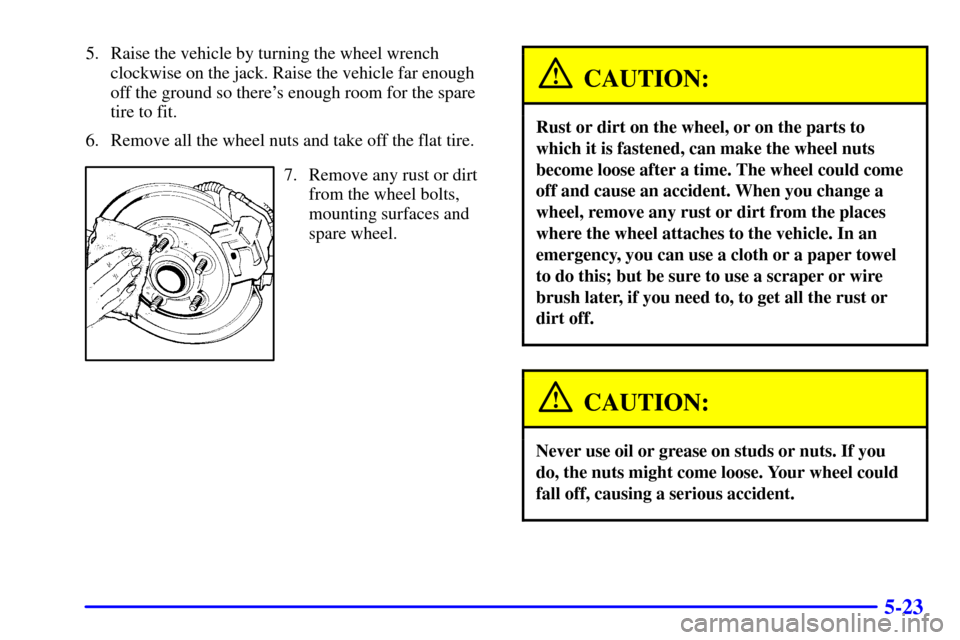
7. Remove any rust or dirt
from the wheel bolts,
mounting surfaces and
spare wheel.
CAUTION:
Rust or dirt on the wheel, or on the parts to
which it is fastened, can make the wheel nuts
become loose after a time. The wheel could come
off and cause an accident. When you change a
wheel, remove any rust or dirt from the places
where the wheel attaches to the vehicle. In an
emergency, you can use a cloth or a paper towel
to do this; but be sure to use a scraper or wire
brush later, if you need to, to get all the rust or
dirt off.
CAUTION:
Never use oil or grease on studs or nuts. If you
do, the nuts might come loose. Your wheel could
fall off, causing a serious accident.
Page 251 of 376

5-25
11. Using the wheel
wrench, tighten the
wheel nuts firmly in
a crisscross sequence
as shown.
CAUTION:
Incorrect wheel nuts or improperly tightened
wheel nuts can cause the wheel to become loose
and even come off. This could lead to an accident.
Be sure to use the correct wheel nuts. If you have
to replace them, be sure to get new GM original
equipment wheel nuts.
Stop somewhere as soon as you can and have
the nuts tightened with a torque wrench to
100 lb
-ft (140 N´m).
NOTICE:
Improperly tightened wheel nuts can lead to
brake pulsation and rotor damage. To avoid
expensive brake repairs, evenly tighten the wheel
nuts in the proper sequence and to the proper
torque specification.
12. When the flat tire has been repaired or replaced,
install the wheel cover. Be sure to position the
alignment pin on the cover with the notch in the
wheel. Apply pressure around the edge of the cap to
snap it in place. Do not use a hammer or mallet to
install the cover.
Store the wheel cover in the trunk until you have
replaced the compact spare tire with a regular tire.
NOTICE:
Wheel covers won't fit on your compact spare.
If you try to put a wheel cover on your compact
spare, you could damage the cover or the spare.
Page 252 of 376
5-26 Storing the Flat Tire and Tools
CAUTION:
Storing a jack, a tire or other equipment in the
passenger compartment of the vehicle could
cause injury. In a sudden stop or collision, loose
equipment could strike someone. Store all these
in the proper place.
Store the flat tire as far forward in the trunk as possible.
Store the jack and wheel wrench in their compartment in
the trunk. For storage, the jack must be raised until the
screw end is flush with the edge of the jack.
Page 254 of 376

5-28
Compact Spare Tire
Although the compact spare tire was fully inflated
when your vehicle was new, it can lose air after a time.
Check the inflation pressure regularly. It should be
60 psi (420 kPa).
After installing the compact spare on your vehicle,
you should stop as soon as possible and make sure
your spare tire is correctly inflated. The compact spare
is made to perform well at speeds up to 65 mph
(105 km/h) for distances up to 3,000 miles (5 000 km),
so you can finish your trip and have your full
-size tire
repaired or replaced where you want. You must calibrate
the Check Tire Pressure System after installing or
removing the compact spare. See ªCheck Tire Pressure
Systemº in the Index. Of course, it's best to replace
your spare with a full
-size tire as soon as you can.
Your spare will last longer and be in good shape in case
you need it again.
NOTICE:
When the compact spare is installed, don't take
your vehicle through an automatic car wash with
guide rails. The compact spare can get caught on
the rails. That can damage the tire and wheel, and
maybe other parts of your vehicle.
Don't use your compact spare on other vehicles.
And don't mix your compact spare tire or wheel with
other wheels or tires. They won't fit. Keep your spare
tire and its wheel together.
NOTICE:
Tire chains won't fit your compact spare. Using
them can damage your vehicle and can damage
the chains too. Don't use tire chains on your
compact spare.
Page 295 of 376

6-40
If your vehicle is damaged in an accident, the headlamp
aim may be affected. Aim adjustment to the low beam
may be necessary if it is difficult to see lane markers
(for horizontal aim), or if oncoming drivers flash their
high beams at you (for vertical aim). If you believe your
headlamps need to be re
-aimed, we recommend that you
take your vehicle to your dealer for service. However, it
is possible for you to re
-aim your headlamps as
described in the following procedure.
NOTICE:
To make sure your headlamps are aimed
properly, read all the instructions before
beginning. Failure to follow these instructions
could cause damage to headlamp parts.
The vehicle should be properly prepared as follows:
�The vehicle should be placed so the headlamps are
25 ft. (7.6 m) from a light colored wall or other
flat surface.
�The vehicle must have all four tires on a perfectly
level surface which is level all the way to the wall or
other flat surface.
�The vehicle should be placed so it is perpendicular to
the wall or other flat surface.
�The vehicle should not have any snow, ice or mud
attached to it.
�The vehicle should be fully assembled and all other
work stopped while headlamp aiming is being done.
�The vehicle should be normally loaded with a full
tank of fuel and one person or 160 lbs. (75 kg) on the
driver's seat.
�Tires should be properly inflated.
Headlamp aiming is done with the vehicle low beam
lamps. The high beam lamps will be correctly aimed if
the low beam lamps are aimed properly.
The headlamp aiming devices are under the hood near
the headlamps.