Page 146 of 340
3-4 Heating
On cold days, use FLOOR and the outside air button
with the temperature knob all the way in the red area.
The system will bring in outside air, heat it and send
it to the floor outlets.
Your vehicle has heat ducts that are directed toward the
rear seat. Keep the area under the front seats clear of
obstructions so that the heated air can reach the rear
seat passengers.
If your vehicle has an engine coolant heater, you can use
it to help your system provide warm air faster when it's
cold outside (0�F (
-18�C) or lower). An engine
coolant heater warms the coolant your engine and
heating system use to provide heat. See ªEngine
Coolant Heaterº in the Index.
Defogging and Defrosting Windows
Your system has two settings for clearing the front and
side windows. For each setting, adjust the temperature
knob as desired.
To defrost the front window quickly, turn the temperature
knob all the way in the red area. Use FRONT DEFROSTER
and adjust the fan to the highest speed. To warm passengers
while keeping the front window clean, use DEFOG.
Your vehicle is equipped with side window defogger
vents. The side window defogger vents are located
above the side instrument panel vents. To defrost the
side windows, turn the temperature knob all the way
in the red area. Use FLOOR and adjust the fan to
the highest speed.
To control fogging of the windows, turn the temperature
knob all the way in the red area. Use DEFOG and adjust
the fan to the highest speed.
To defog the side windows while using air conditioning,
use BI
-LEVEL and adjust the fan to the highest speed
and press the A/C button so that the indicator light is
glowing. For added airflow to the side windows aim
the side vents toward the windows and close the
center vents.
Page 148 of 340
3-6
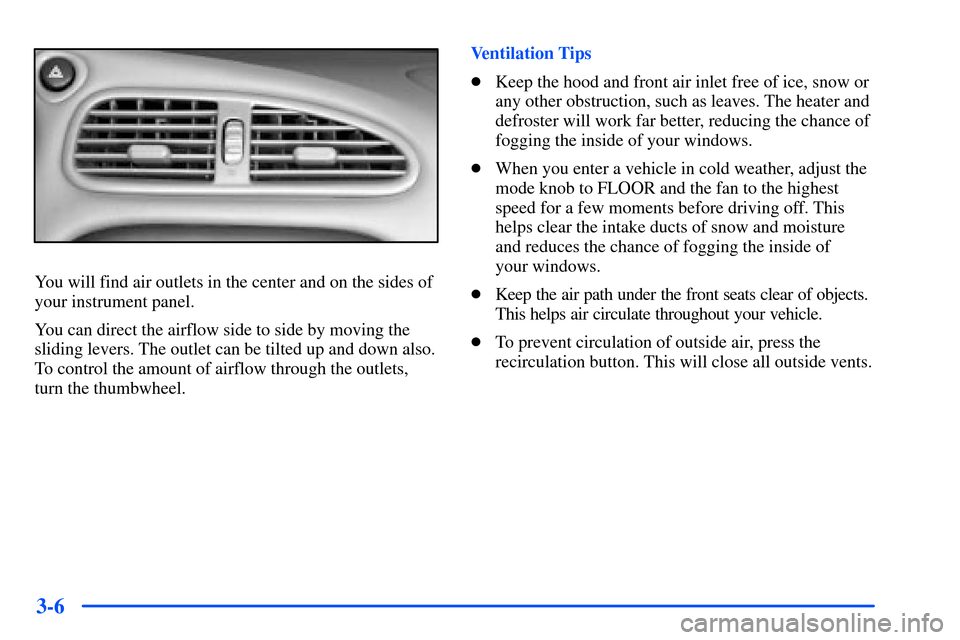
You will find air outlets in the center and on the sides of
your instrument panel.
You can direct the airflow side to side by moving the
sliding levers. The outlet can be tilted up and down also.
To control the amount of airflow through the outlets,
turn the thumbwheel.Ventilation Tips
�Keep the hood and front air inlet free of ice, snow or
any other obstruction, such as leaves. The heater and
defroster will work far better, reducing the chance of
fogging the inside of your windows.
�When you enter a vehicle in cold weather, adjust the
mode knob to FLOOR and the fan to the highest
speed for a few moments before driving off. This
helps clear the intake ducts of snow and moisture
and reduces the chance of fogging the inside of
your windows.
�Keep the air path under the front seats clear of objects.
This helps air circulate throughout your vehicle.
�To prevent circulation of outside air, press the
recirculation button. This will close all outside vents.
Page 198 of 340
4-31
To tow your vehicle with all four wheels on the ground,
follow these steps:
1. Position the vehicle to tow and then secure it.
2. Turn the ignition switch to OFF.
3. Set the parking brake.4. To prevent your battery from draining while towing,
remove the following fuses from the left side
instrument panel fuse block: ªWIPER,º ªPCM
ACCº and ªIPC/BFC ACC.º See ªInstrument Panel
Fuse Block
- Driver's Sideº in the Index for the
location of these fuses.
5. Turn the ignition switch to ACC.
6. Shift your transaxle to NEUTRAL (N).
7. Release the parking brake.
Remember to reinstall the fuses once you reach your
destination. To reinstall a fuse do the following:
1. Set the parking brake.
2. Remove the key from the ignition switch.
3. Put the fuse back in.
NOTICE:
Make sure that the towing speed does not exceed
65 mph (110 km/h), or your vehicle could be
badly damaged.
Page 207 of 340
4-40 Turn Signals When Towing a Trailer
When you tow a trailer, your vehicle may need a
different turn signal flasher and/or extra wiring. Check
with your dealer. The arrows on your instrument panel
will flash whenever you signal a turn or lane change.
Properly hooked up, the trailer lamps will also flash,
telling other drivers you're about to turn, change lanes
or stop.
When towing a trailer, the arrows on your instrument
panel will flash for turns even if the bulbs on the trailer
are burned out. Thus, you may think drivers behind you
are seeing your signal when they are not. It's important
to check occasionally to be sure the trailer bulbs are
still working.
Driving On Grades
Reduce speed and shift to a lower gear before you start
down a long or steep downgrade. If you don't shift
down, you might have to use your brakes so much that
they would get hot and no longer work well.
On a long uphill grade, shift down and reduce your
speed to around 45 mph (70 km/h) to reduce the
possibility of engine and transaxle overheating.
Page 211 of 340
5-2
Hazard Warning Flashers
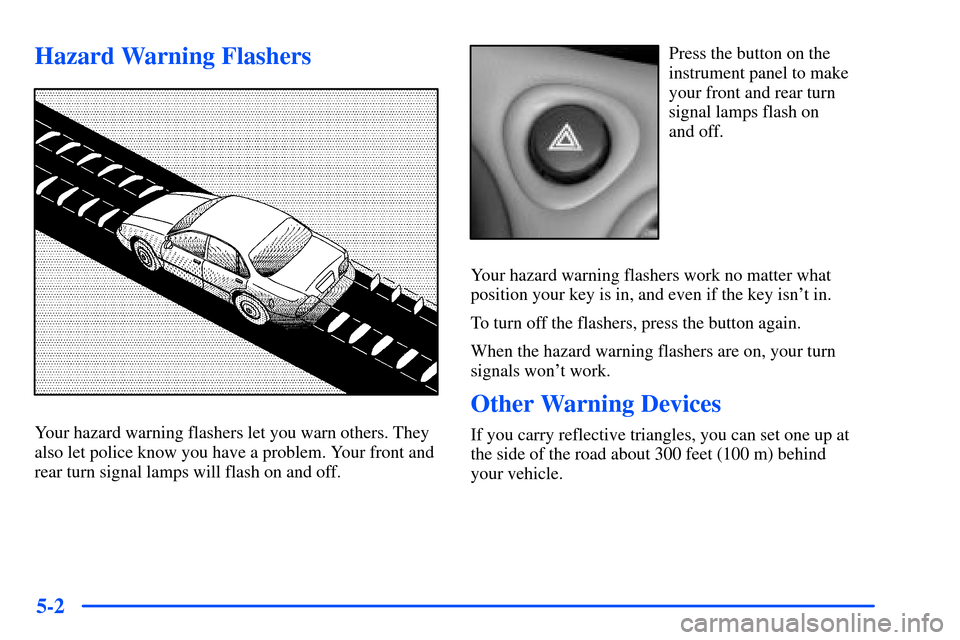
Your hazard warning flashers let you warn others. They
also let police know you have a problem. Your front and
rear turn signal lamps will flash on and off.
Press the button on the
instrument panel to make
your front and rear turn
signal lamps flash on
and off.
Your hazard warning flashers work no matter what
position your key is in, and even if the key isn't in.
To turn off the flashers, press the button again.
When the hazard warning flashers are on, your turn
signals won't work.
Other Warning Devices
If you carry reflective triangles, you can set one up at
the side of the road about 300 feet (100 m) behind
your vehicle.
Page 217 of 340
5-8
To disconnect the jumper cables from both vehicles, do
the following:
1. Disconnect the black negative (
-) cable from the
heavy, unpainted metal engine part on the vehicle
that had the dead battery.
2. Disconnect the black negative (
-) cable from
the negative (
-) terminal on the vehicle with
good battery.
3. Disconnect the red positive (+) cable from the
vehicle with the good battery.
4. Disconnect the red positive (+) cable from the
other vehicle.
Towing Your Vehicle
Consult your dealer or a professional towing service if
you need to have your vehicle towed. See ªRoadside
Assistanceº and ªRecreational Vehicle Towingº in
the Index.
Engine Overheating
You will find a coolant temperature gage and a low
coolant warning light on your vehicle's instrument
panel. See ªEngine Coolant Temperature Gageº and
ªLow Coolant Warning Lightº in the Index.
Page 242 of 340

6-4
Be sure the posted octane is at least 87. If the octane is
less than 87, you may get a heavy knocking noise when
you drive. If it's bad enough, it can damage your engine.
If you're using fuel rated at 87 octane or higher and you
hear heavy knocking, your engine needs service. But
don't worry if you hear a little pinging noise when
you're accelerating or driving up a hill. That's normal,
and you don't have to buy a higher octane fuel to get rid
of pinging. It's the heavy, constant knock that means
you have a problem.
If your vehicle is certified to meet California Emission
Standards (indicated on the underhood emission
control label), it is designed to operate on fuels that meet
California specifications. If such fuels are not available in
states adopting California emissions standards, your
vehicle will operate satisfactorily on fuels meeting federal
specifications, but emission control system performance
may be affected. The malfunction indicator lamp on your instrument panel
may turn on and/or your vehicle may fail a smog
-check
test. See ªMalfunction Indicator Lampº in the Index.
If this occurs, return to your authorized Oldsmobile dealer
for diagnosis to determine the cause of failure. In the event
it is determined that the cause of the condition is the
type of fuels used, repairs may not be covered by
your warranty.
Some gasolines that are not reformulated for low
emissions may contain an octane
-enhancing additive called
methylcyclopentadienyl manganese tricarbonyl (MMT);
ask your service station operator whether or not the fuel
contains MMT. General Motors does not recommend the
use of such gasolines. If fuels containing MMT are used,
spark plug life may be reduced and your emission control
system performance may be affected. The malfunction
indicator lamp on your instrument panel may turn on. If
this occurs, return to your authorized Oldsmobile dealer
for service.
Page 251 of 340
6-13
Engine Oil
If the LOW OIL
light appears on
the instrument panel,
it means you need to
check your engine oil
level right away.
3400 V6 Engine Only
For more information, see ªLOW OIL Lightº
in the Index.
You should check your engine oil level regularly; thiis
an added reminder.
Checking Engine Oil
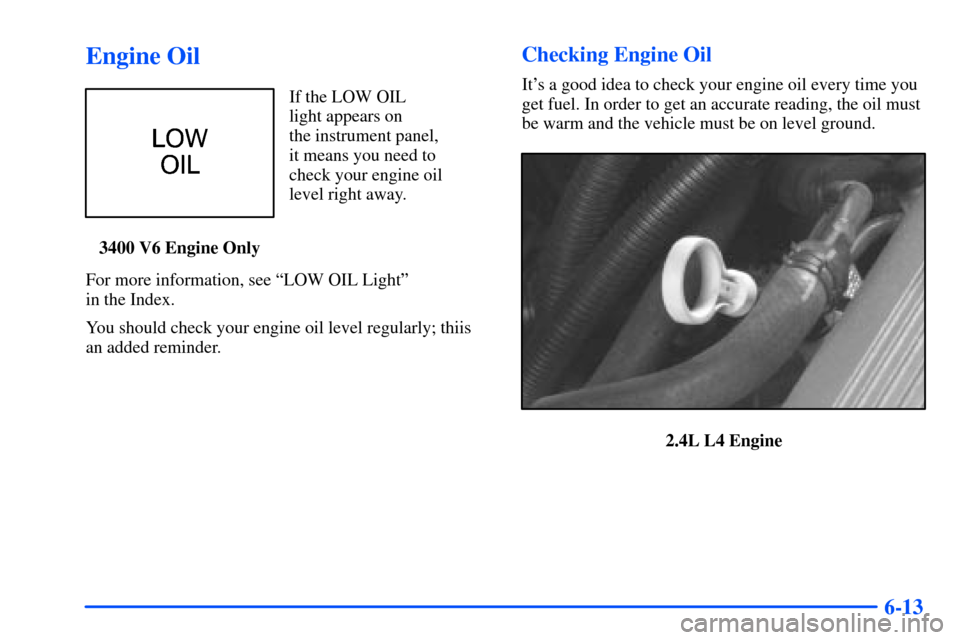
It's a good idea to check your engine oil every time you
get fuel. In order to get an accurate reading, the oil must
be warm and the vehicle must be on level ground.
2.4L L4 Engine