2001 NISSAN SENTRA technical
[x] Cancel search: technicalPage 201 of 240

Your new NISSAN has been designed to
have minimum maintenance requirements
with longer service intervals to save you
both time and money. However, some day-
to-day and regular maintenance is essential
to maintain your NISSAN's good mechani-
cal condition, as well as its emission and
engine performance.
It is the owner's responsibility to make sure
the specified periodic maintenance, as well
as general maintenance, is performed.
As the vehicle owner, you are the only one
who can ensure that your vehicle receives
proper maintenance. You are a vital link in
the maintenance chain.
General maintenance
General maintenance includes those items
which should be checked during normal
day-to-day operation of the vehicle. They
are essential if your vehicle is to continue to
operate properly. It is your responsibility to
perform these maintenance procedures
regularly as prescribed.
These checks or inspections can be done
by yourself, a qualified technician or, if you
prefer, an authorized NISSAN dealer.Periodic maintenance
The maintenance items listed under peri-
odic maintenance are required to be ser-
viced at regular intervals.
However, under severe driving conditions,
additional or more frequent maintenance is
required.
Where to go for service
If maintenance service is required or your
vehicle appears to malfunction, have the
systems checked and tuned by an autho-
rized NISSAN dealer.
NISSAN technicians are well-trained spe-
cialists who are kept up-to-date with the
latest service information through technical
bulletins, service tips, and in-dealership
training programs. They are completely
qualified to work on NISSAN vehiclesbe-
forethey work on your vehicle, rather than
after they have worked on it.
You can be confident that an authorized
NISSAN dealer's service department per-
forms the best job to meet the maintenance
requirements on your vehicle Ð in a reliable
and economical way.During the normal day-to-day operation of
the vehicle, general maintenance should be
performed regularly as prescribed in this
section. If you detect any unusual sounds,
vibrations or smells, be sure to check for the
cause or have an authorized NISSAN
dealer do it promptly. In addition, you should
notify an authorized NISSAN dealer if you
think repairs are required.
When performing any checks or maintenance
work, closely observe the precautions in the
``Do-it-yourself'' section of this manual.
EXPLANATION OF MAINTE-
NANCE ITEMS
Additional information on the following
items with an ``*'' is found in the ``Do-it-
yourself'' section of this manual.
EXTERIOR MAINTENANCE
Outside the vehicle
The maintenance items listed here should
be performed from time to time, unless
otherwise specified.
Tires* ÐCheck the pressure with a gauge
periodically when at a service station, in-
cluding the spare, and adjust to the speci-
MAINTENANCE
PRECAUTIONSGENERAL MAINTENANCE
9-2Maintenance
ZX
Page 205 of 240
![NISSAN SENTRA 2001 B15 / 5.G Owners Manual Schedule 1
Abbreviations: R = Replace I = Inspect. Correct or replace if necessary. [ ]: At the mileage intervals only
MAINTENANCE OPERATIONMAINTENANCE INTERVAL
Perform at number of miles,
kilometers](/manual-img/5/649/w960_649-204.png "NISSAN SENTRA 2001 B15 / 5.G Owners Manual Schedule 1
Abbreviations: R = Replace I = Inspect. Correct or replace if necessary. [ ]: At the mileage intervals only
MAINTENANCE OPERATIONMAINTENANCE INTERVAL
Perform at number of miles,
kilometers")
Schedule 1
Abbreviations: R = Replace I = Inspect. Correct or replace if necessary. [ ]: At the mileage intervals only
MAINTENANCE OPERATIONMAINTENANCE INTERVAL
Perform at number of miles,
kilometers or months,
whichever comes first.Miles ý 1,000 3.75 7.5 11.25 15 18.75 22.5 26.25 30 33.75 37.5 41.25 45 48.75 52.5 56.25 60
(km ý 1,000) (6) (12) (18) (24) (30) (36) (42) (48) (54) (60) (66) (72) (78) (84) (90) (96)
Months 3 6 9 12 15 18 21 24 27 30 33 36 39 42 45 48
Emission control system maintenance
Drive belts See NOTE (1)I*
Air cleaner filter See NOTE (2) [R] [R]
EVAP vapor linesI* I*
Fuel linesI* I*
Fuel filter See NOTE (3)*
Engine coolant See NOTE (4)R*
Engine oilRRRRRRRRRRRRRRRR
Engine oil filter (Use part No. 15208-65F01 or 15208-9E000 or equivalent)RRRRRRRRRRRRRRRR
Spark plugs (QG18DE engine) (PLATINUM-TIPPED type) Replace every 105,000 miles (169,000 km)
(SR20DE engine) (PLATINUM-TIPPED type) See NOTE (5) Replace every 105,000 miles (169,000 km)
Intake & exhaust valve clearance (QG18DE engine) See NOTE (6)*
NOTE: (1) After 60,000 miles (96,000 km) or 48 months, inspect every 15,000 miles (24,000 km) or 12 months.
(2) If operating mainly in dusty conditions, more frequent maintenance may be required.
(3) Maintenance-free item.
(4) After 60,000 miles (96,000 km) or 48 months, replace every 30,000 miles (48,000 km) or 24 months.
(5) Original equipment platinum-tipped plugs should be replaced at 105,000 miles (169,000 km). For SR engine, conventional spark plugs can be
used but should be replaced at 30,000 miles (48,000 km) intervals. (See ªTechnical and consumer informationº section for details.)
(6) If valve noise increases, inspect valve clearance.
* Maintenance items and intervals with an ``*'' are recommended by NISSAN for reliable vehicle operation. The owner need not perform such
maintenance in order to maintain the emission warranty or manufacturer recall liability. Other maintenance items and intervals are required.
9-6Maintenance
ZX
Page 207 of 240
![NISSAN SENTRA 2001 B15 / 5.G Owners Manual Schedule 2
Abbreviations: R = Replace I = Inspect. Correct or replace if necessary. [ ]: At the mileage intervals only
MAINTENANCE OPERATIONMAINTENANCE INTERVAL
Perform at number of miles,
kilometers](/manual-img/5/649/w960_649-206.png "NISSAN SENTRA 2001 B15 / 5.G Owners Manual Schedule 2
Abbreviations: R = Replace I = Inspect. Correct or replace if necessary. [ ]: At the mileage intervals only
MAINTENANCE OPERATIONMAINTENANCE INTERVAL
Perform at number of miles,
kilometers")
Schedule 2
Abbreviations: R = Replace I = Inspect. Correct or replace if necessary. [ ]: At the mileage intervals only
MAINTENANCE OPERATIONMAINTENANCE INTERVAL
Perform at number of miles,
kilometers or months, whichever comes first.Miles ý 1,000 7.5 15 22.5 30 37.5 45 52.5 60
(km ý 1,000) (12) (24) (36) (48) (60) (72) (84) (96)
Months 6 12 18 24 30 36 42 48
Emission control system maintenance
Drive belts See NOTE (1)I*
Air cleaner filter[R] [R]
EVAP vapor linesI* I*
Fuel linesI* I*
Fuel filter See NOTE (2)*
Engine coolant See NOTE (3)R*
Engine oilRRRRRRRR
Engine oil filter (Use part No. 15208-65F01 or 15208-9E000 or equivalent)RRRRRRRR
Spark plugs (QG18DE engine) (PLATINUM-TIPPED type) Replace every 105,000 miles (169,000 km)
(SR20DE engine) (PLATINUM-TIPPED type) See NOTE (4) Replace every 105,000 miles (169,000 km)
Intake & exhaust valve clearance (QG18DE engine) See NOTE (5)*
NOTE: (1) After 60,000 miles (96,000 km) or 48 months, inspect every 15,000 miles (24,000 km) or 12 months.
(2) Maintenance-free item
(3) After 60,000 miles (96,000 km) or 48 months, replace every 30,000 miles (48,000 km) or 24 months.
(4) Original equipment platinum-tipped plugs should be replaced at 105,000 miles (169,000 km). For SR engine, conventional spark plugs can be used but
should be replaced at 30,000 miles (48,000 km) intervals. (See ªTechnical and consumer informationº section for details.)
(5) If valve noise increases, inspect valve clearance.
* Maintenance items and intervals with an ``*'' are recommended by NISSAN for reliable vehicle operation. The owner need not perform such maintenance
in order to maintain the emission warranty or manufacturer recall liability. Other maintenance items and intervals are required.
9-8Maintenance
ZX
Page 210 of 240

10 Technical and consumer information
Capacities and recommended fuel/lubricants ......10-2
Fuel recommendation ......................................10-3
Engine oil and oil filter recommendation .........10-5
Recommended SAE viscosity number ............10-6
Air conditioner system refrigerant and
lubricant recommendations .............................10-7
Specifications .......................................................10-8
Engine .............................................................10-8
Wheels and tires..............................................10-9
Dimensions and weights .................................10-9
When traveling or registering your vehicle in
another country ..................................................10-10
Vehicle identification ..........................................10-10
Vehicle identification number (VIN)
plate ...............................................................10-10
Vehicle identification number
(chassis number) ...........................................10-10
Engine serial number ....................................10-11
F.M.V.S.S. certification label .........................10-11
Emission control information label ................10-12Tire placard....................................................10-12
Air conditioner specification label ..................10-12
Installing front license plate................................10-13
Vehicle loading information ................................10-14
Terms.............................................................10-14
Determining vehicle load capacity.................10-14
Loading tips ...................................................10-14
Towing a trailer...................................................10-15
Maximum load limits ......................................10-15
Towing load/specification chart .....................10-16
Towing safety ................................................10-16
Uniform tire quality grading ................................10-19
Emission control system warranty .....................10-20
Reporting safety defects (US only) ....................10-20
Readiness for inspection/maintenance (I/M)
test (US only) .....................................................10-20
Owner's manual/service manual order
information .....................................................10-22
In the event of a collision ..............................10-23
ZX
Page 211 of 240
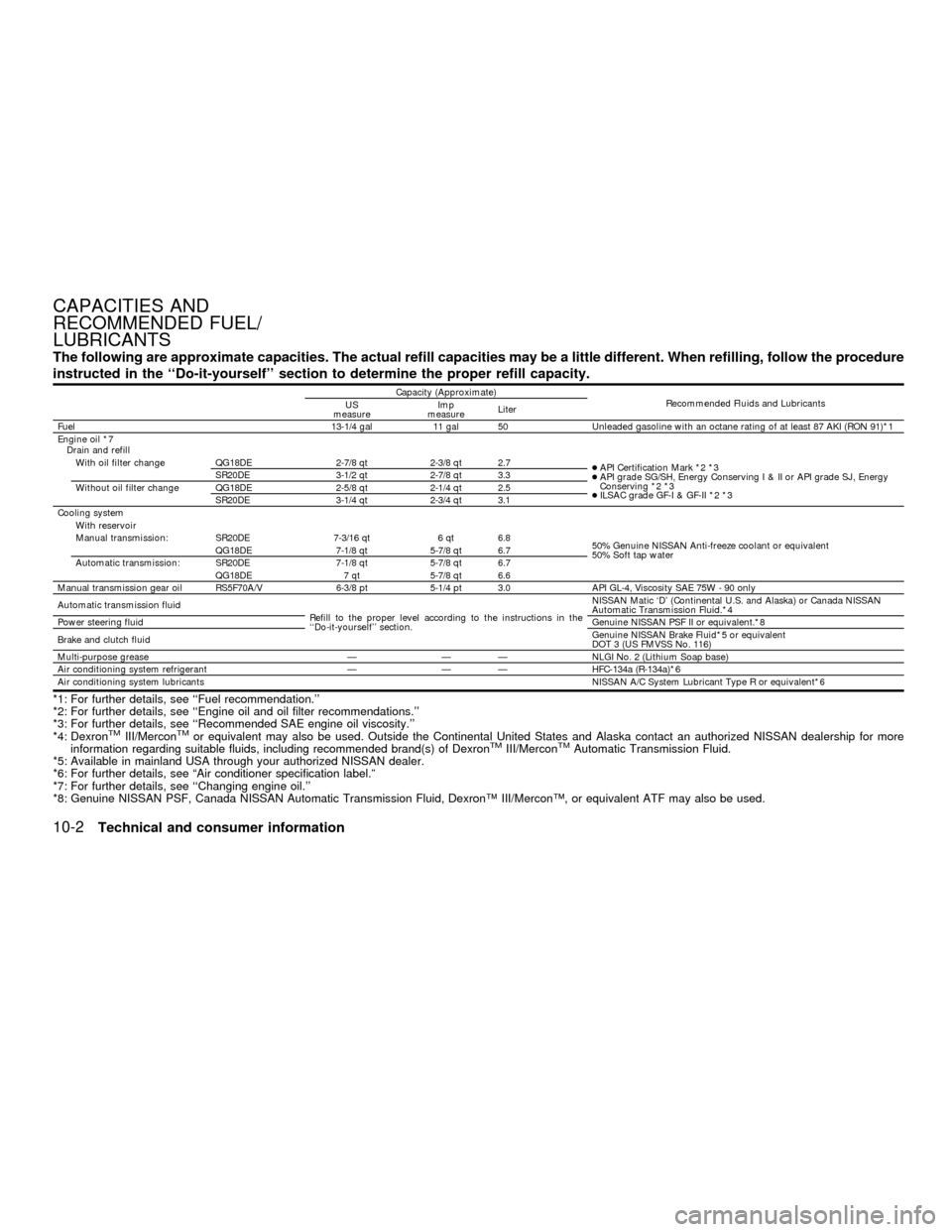
The following are approximate capacities. The actual refill capacities may be a little different. When refilling, follow the procedure
instructed in the ``Do-it-yourself'' section to determine the proper refill capacity.
Capacity (Approximate)
Recommended Fluids and Lubricants
US
measureImp
measureLiter
Fuel 13-1/4 gal 11 gal 50 Unleaded gasoline with an octane rating of at least 87 AKI (RON 91)*1
Engine oil *7
Drain and refill
With oil filter change QG18DE 2-7/8 qt 2-3/8 qt 2.7
cAPI Certification Mark *2 *3
cAPI grade SG/SH, Energy ConservingI&IIorAPIgrade SJ, Energy
Conserving *2 *3
cILSAC grade GF-I & GF-II *2 *3 SR20DE 3-1/2 qt 2-7/8 qt 3.3
Without oil filter change QG18DE 2-5/8 qt 2-1/4 qt 2.5
SR20DE 3-1/4 qt 2-3/4 qt 3.1
Cooling system
With reservoir
50% Genuine NISSAN Anti-freeze coolant or equivalent
50% Soft tap water Manual transmission: SR20DE 7-3/16 qt 6 qt 6.8
QG18DE 7-1/8 qt 5-7/8 qt 6.7
Automatic transmission: SR20DE 7-1/8 qt 5-7/8 qt 6.7
QG18DE 7 qt 5-7/8 qt 6.6
Manual transmission gear oil RS5F70A/V 6-3/8 pt 5-1/4 pt 3.0 API GL-4, Viscosity SAE 75W - 90 only
Automatic transmission fluid
Refill to the proper level according to the instructions in the
``Do-it-yourself'' section.NISSAN Matic `D' (Continental U.S. and Alaska) or Canada NISSAN
Automatic Transmission Fluid.*4
Power steering fluidGenuine NISSAN PSF II or equivalent.*8
Brake and clutch fluidGenuine NISSAN Brake Fluid*5 or equivalent
DOT 3 (US FMVSS No. 116)
Multi-purpose grease Ð Ð Ð NLGI No. 2 (Lithium Soap base)
Air conditioning system refrigerant Ð Ð Ð HFC-134a (R-134a)*6
Air conditioning system lubricantsNISSAN A/C System Lubricant Type R or equivalent*6
*1: For further details, see ``Fuel recommendation.''
*2: For further details, see ``Engine oil and oil filter recommendations.''
*3: For further details, see ``Recommended SAE engine oil viscosity.''
*4: Dexron
TMIII/MerconTMor equivalent may also be used. Outside the Continental United States and Alaska contact an authorized NISSAN dealership for more
information regarding suitable fluids, including recommended brand(s) of DexronTMIII/MerconTMAutomatic Transmission Fluid.
*5: Available in mainland USA through your authorized NISSAN dealer.
*6: For further details, see ªAir conditioner specification label.º
*7: For further details, see ``Changing engine oil.''
*8: Genuine NISSAN PSF, Canada NISSAN Automatic Transmission Fluid, DexronŸ III/MerconŸ, or equivalent ATF may also be used.
CAPACITIES AND
RECOMMENDED FUEL/
LUBRICANTS
10-2Technical and consumer information
ZX
Page 212 of 240
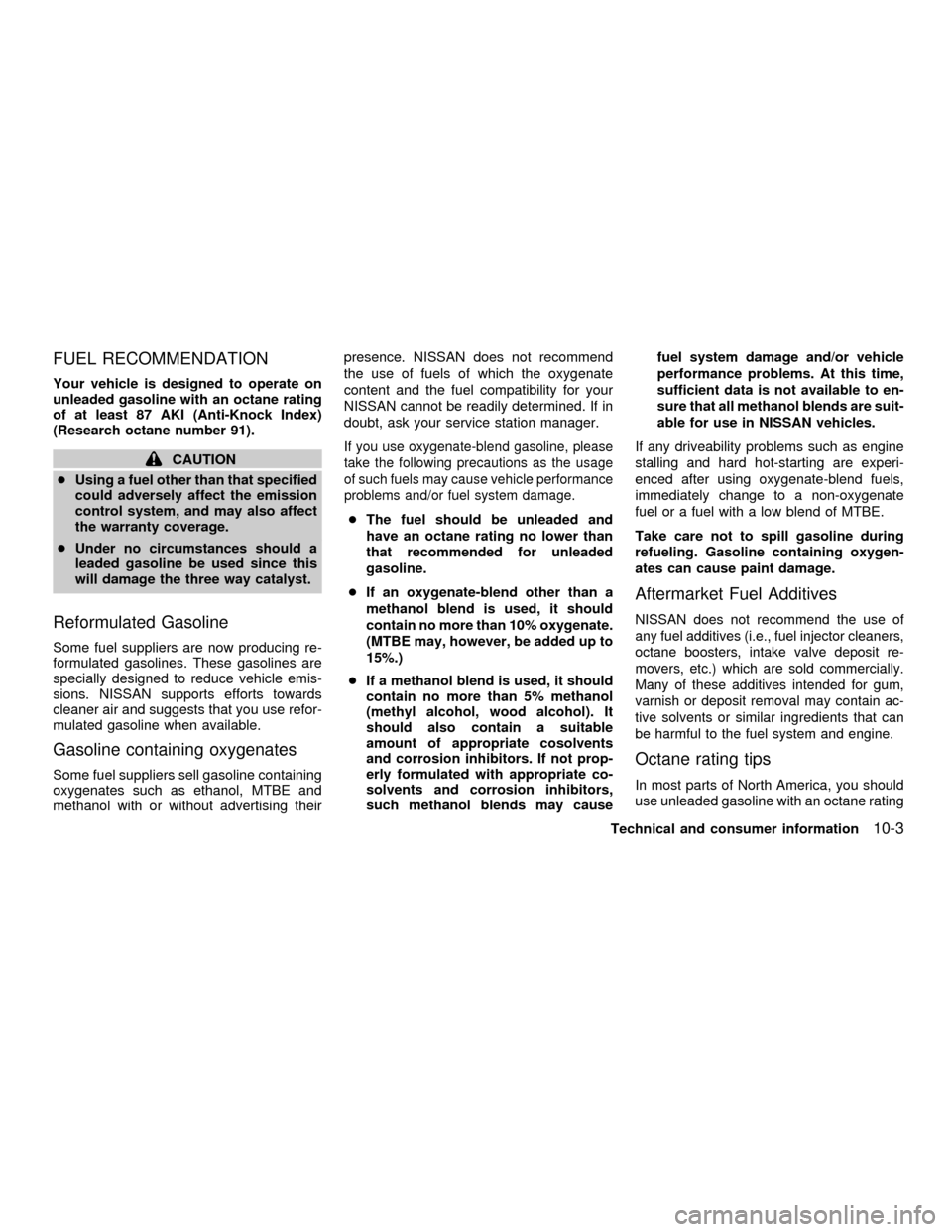
FUEL RECOMMENDATION
Your vehicle is designed to operate on
unleaded gasoline with an octane rating
of at least 87 AKI (Anti-Knock Index)
(Research octane number 91).
CAUTION
cUsing a fuel other than that specified
could adversely affect the emission
control system, and may also affect
the warranty coverage.
cUnder no circumstances should a
leaded gasoline be used since this
will damage the three way catalyst.
Reformulated Gasoline
Some fuel suppliers are now producing re-
formulated gasolines. These gasolines are
specially designed to reduce vehicle emis-
sions. NISSAN supports efforts towards
cleaner air and suggests that you use refor-
mulated gasoline when available.
Gasoline containing oxygenates
Some fuel suppliers sell gasoline containing
oxygenates such as ethanol, MTBE and
methanol with or without advertising theirpresence. NISSAN does not recommend
the use of fuels of which the oxygenate
content and the fuel compatibility for your
NISSAN cannot be readily determined. If in
doubt, ask your service station manager.
If you use oxygenate-blend gasoline, please
take the following precautions as the usage
of such fuels may cause vehicle performance
problems and/or fuel system damage.
cThe fuel should be unleaded and
have an octane rating no lower than
that recommended for unleaded
gasoline.
cIf an oxygenate-blend other than a
methanol blend is used, it should
contain no more than 10% oxygenate.
(MTBE may, however, be added up to
15%.)
cIf a methanol blend is used, it should
contain no more than 5% methanol
(methyl alcohol, wood alcohol). It
should also contain a suitable
amount of appropriate cosolvents
and corrosion inhibitors. If not prop-
erly formulated with appropriate co-
solvents and corrosion inhibitors,
such methanol blends may causefuel system damage and/or vehicle
performance problems. At this time,
sufficient data is not available to en-
sure that all methanol blends are suit-
able for use in NISSAN vehicles.
If any driveability problems such as engine
stalling and hard hot-starting are experi-
enced after using oxygenate-blend fuels,
immediately change to a non-oxygenate
fuel or a fuel with a low blend of MTBE.
Take care not to spill gasoline during
refueling. Gasoline containing oxygen-
ates can cause paint damage.
Aftermarket Fuel Additives
NISSAN does not recommend the use of
any fuel additives (i.e., fuel injector cleaners,
octane boosters, intake valve deposit re-
movers, etc.) which are sold commercially.
Many of these additives intended for gum,
varnish or deposit removal may contain ac-
tive solvents or similar ingredients that can
be harmful to the fuel system and engine.
Octane rating tips
In most parts of North America, you should
use unleaded gasoline with an octane rating
Technical and consumer information
10-3
ZX
Page 213 of 240
![NISSAN SENTRA 2001 B15 / 5.G Owners Manual of at least 87 AKI (Anti-Knock Index). How-
ever, you may use unleaded gasoline with
an octane rating as low as 85 AKI (Anti-
Knock Index) in high altitude areas (over
4,000 ft [1,219 m]) such as: Col](/manual-img/5/649/w960_649-212.png "NISSAN SENTRA 2001 B15 / 5.G Owners Manual of at least 87 AKI (Anti-Knock Index). How-
ever, you may use unleaded gasoline with
an octane rating as low as 85 AKI (Anti-
Knock Index) in high altitude areas (over
4,000 ft [1,219 m]) such as: Col")
of at least 87 AKI (Anti-Knock Index). How-
ever, you may use unleaded gasoline with
an octane rating as low as 85 AKI (Anti-
Knock Index) in high altitude areas (over
4,000 ft [1,219 m]) such as: Colorado, Mon-
tana, New Mexico, Utah, Wyoming, north-
eastern Nevada, southern Idaho, western
South Dakota, western Nebraska, and the
part of Texas which is directly south of New
Mexico.
Using unleaded gasoline with an octane
rating lower than stated above can cause
persistent, heavy ``spark knock.'' (``Spark
knock'' is a metallic rapping noise.) If
severe, this can lead to engine damage. If
you detect a persistent heavy spark
knock even when using gasoline of the
stated octane rating, or if you hear steady
spark knock while holding a steady
speed on level roads, have an authorized
NISSAN dealer correct the condition.
Failure to correct the condition is misuse
of the vehicle, for which NISSAN is not
responsible.
Incorrect ignition timing may result in spark
knock, after-run and/or overheating, which
may cause excessive fuel consumption or
engine damage. If any of the above symp-toms are encountered, have your vehicle
checked at an authorized NISSAN dealer or
other competent service facility.
However, now and then you may notice
light spark knock for a short time while
accelerating or driving up hills. This is
not a cause for concern, because you
get the greatest fuel benefit when there
is light spark knock for a short time
under heavy engine load.
10-4Technical and consumer information
ZX
Page 214 of 240

ENGINE OIL AND OIL FILTER
RECOMMENDATION
Selecting the correct oil
It is essential to choose engine oil with the
correct quality and viscosity to ensure sat-
isfactory engine life and performance. NIS-
SAN recommends the use of a low friction
oil (energy conserving oil) in order to im-
prove fuel economy and conserve energy.
Oils which do not have the specified quality
label should not be used as they could
cause engine damage.
Only those engine oils with the AmericanPetroleum Institute (API) CERTIFICATION
MARK on the front of the container should
be used. This type of oil supersedes the
existing API SG, SH, or SJ and Energy
ConservingI&IIcategories.
If you cannot find engine oil with the API
CERTIFICATION MARK, use an API grade
SG/SH, Energy ConservingI&IIorAPI
grade SJ, Energy Conserving oil. An oil with
a single designation SG or SH, or in combi-
nation with other categories (for example,
SG/CC or SG/CD) may also be used if one
with the API CERTIFICATION MARK can-
not be found. An ILSAC grade GF-I & GF-II
oil can also be used.Mineral based or synthetic type oils may be
used in your NISSAN vehicle. However,
these oils must meet the API quality and
SAE viscosity ratings specified for your ve-
hicle. Do not mix mineral based and syn-
thetic type oils in the engine.
Oil additives
NISSAN does not recommend the use of oil
additives. The use of an oil additive is not
necessary when the proper oil type is used
and maintenance intervals are followed.
Oil which may contain foreign matter or has
been previously used should not be used.
Oil viscosity
The engine oil viscosity or thickness
changes with temperature. Because of this,
it is important to select the engine oil viscos-
ity based on the temperatures at which the
vehicle will be operated before the next oil
change. The chart ``Recommended SAE
viscosity number'' shows the recommended
oil viscosities for the expected ambient tem-
peratures. Choosing an oil viscosity other
than that recommended could cause seri-
ous engine damage.
ATI0645
Technical and consumer information10-5
ZX