2001 NISSAN QUEST maintenance schedule
[x] Cancel search: maintenance schedulePage 270 of 304
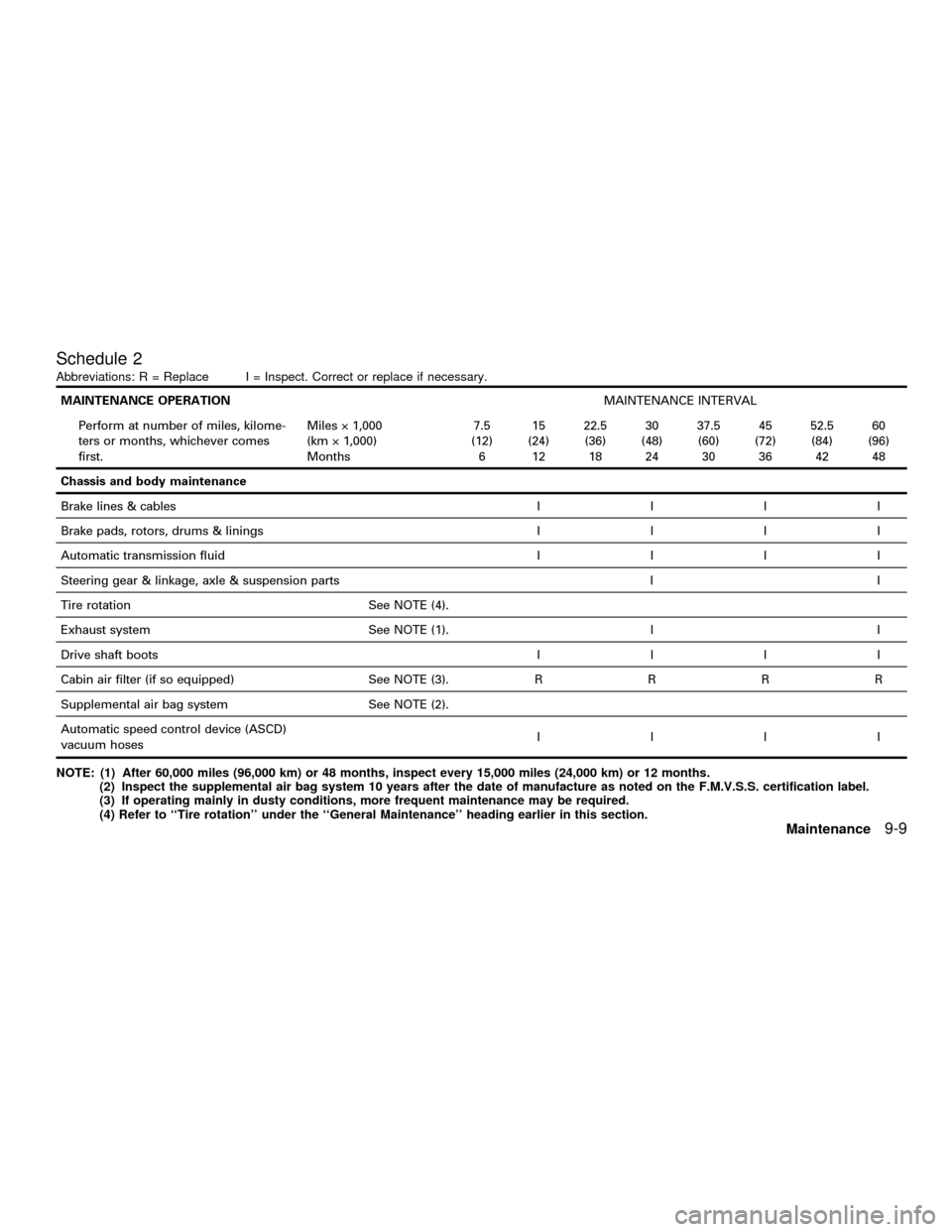
Schedule 2
Abbreviations: R = Replace I = Inspect. Correct or replace if necessary.
MAINTENANCE OPERATIONMAINTENANCE INTERVAL
Perform at number of miles, kilome-
ters or months, whichever comes
first.Miles ý 1,000
(km ý 1,000)
Months7.5
(12)
615
(24)
1222.5
(36)
1830
(48)
2437.5
(60)
3045
(72)
3652.5
(84)
4260
(96)
48
Chassis and body maintenance
Brake lines & cablesIIII
Brake pads, rotors, drums & liningsIIII
Automatic transmission fluidIIII
Steering gear & linkage, axle & suspension parts I I
Tire rotation See NOTE (4).
Exhaust system See NOTE (1). I I
Drive shaft bootsIIII
Cabin air filter (if so equipped) See NOTE (3).RRRR
Supplemental air bag system See NOTE (2).
Automatic speed control device (ASCD)
vacuum hosesIIII
NOTE: (1) After 60,000 miles (96,000 km) or 48 months, inspect every 15,000 miles (24,000 km) or 12 months.
(2) Inspect the supplemental air bag system 10 years after the date of manufacture as noted on the F.M.V.S.S. certification label.
(3) If operating mainly in dusty conditions, more frequent maintenance may be required.
(4) Refer to ``Tire rotation'' under the ``General Maintenance'' heading earlier in this section.
Maintenance9-9
ZX
Page 271 of 304

Additional information on the following
items with an ``*'' is found in the ``Do-it-
yourself operations'' section of this
manual.
Emission control system
maintenance
Drive belts* ÐCheck drive belts for wear,
fraying or cracking and also for proper ten-
sion. Replace any damaged drive belts.
Air cleaner filter ÐUnder normal driving
conditions, the air cleaner filter should be
replaced in accordance with the maintenance
schedule. However, driving the vehicle in
dusty areas may cause rapid clogging of the
element. Consequently, the element may
have to be replaced more frequently.
EVAP vapor lines ÐCheck vapor lines
and connections for leaks, looseness or
deterioration. If leaks are found, replace
them.
Fuel lines ÐCheck the fuel hoses, piping
and connections for leaks, looseness or
deterioration. Replace any damaged parts.
Fuel filter ÐIf the vehicle is operated under
extremely adverse weather conditions or in
areas where ambient temperatures are ei-ther extremely low or extremely high, the
filter might become clogged. In such an
event, replace the filter immediately.
Engine coolant* ÐChanging engine cool-
ant can be performed by your NISSAN
dealer or procedures can be found in the
Service Manual. Improper air relief after
changing coolant can result in reduced
heater performance and overheating.
Engine oil & oil filter* ÐUnder normal
driving conditions, the engine oil and oil filter
should be replaced in accordance with the
maintenance schedule. However, under se-
vere driving conditions, they may have to be
replaced more frequently.
Spark plugs* ÐReplace with new plugs
having the correct heat range.
Timing belt ÐReplace the timing belt for
driving the camshaft.
Chassis and body maintenance
Brake lines & cables ÐCheck the brake
lines and hoses (including brake booster
vacuum hoses, connections & check valve)
and parking brake cables for proper attach-
ment, leaks, cracks, chafing, abrasion, de-
terioration, etc.Brake pads, rotors, drums & linings Ð
Check these and the other brake compo-
nents for wear, deterioration and leaks. Un-
der severe driving conditions, they may
have to be inspected more frequently.
Automatic transmission fluid* ÐCheck
the fluid level and visually inspect for signs
of leakage.
Under severe driving conditions, the fluid
should be replaced at the specified interval.
Steering gear & linkage, axle & suspen-
sion parts, and drive axle shaft boots Ð
Check for damage, looseness and leakage of
oil or grease. Under severe driving condi-
tions, they may have to be inspected more
frequently.
Exhaust system ÐVisually check the ex-
haust pipes, muffler, and hangers for proper
attachment, leaks, cracks, chafing, abra-
sion, deterioration, etc. Under severe driv-
ing conditions, inspection should be per-
formed more frequently.
Supplemental air bag system ÐCheck
the supplemental air bag system compo-
nents for proper attachment, damage, de-
formities, cracks, rust, etc. Work around and
EXPLANATION OF
MAINTENANCE ITEMS
9-10Maintenance
ZX
Page 272 of 304

on the supplemental air bag system should
be done by an authorized NISSAN dealer.
Cabin air filter ÐUnder normal driving
conditions, the cabin air filter should be
replaced in accordance with the mainte-
nance schedule. However, driving the ve-
hicle in dusty areas may cause rapid clog-
ging of the element. Consequently, the
element may have to be replaced more
frequently.
Automatic speed control device (ASCD)
vacuum hoses ÐCheck vacuum hoses
between ASCD actuator and ASCD pump
for breakage, cracks or fractures.
Maintenance
9-11
ZX
Page 280 of 304
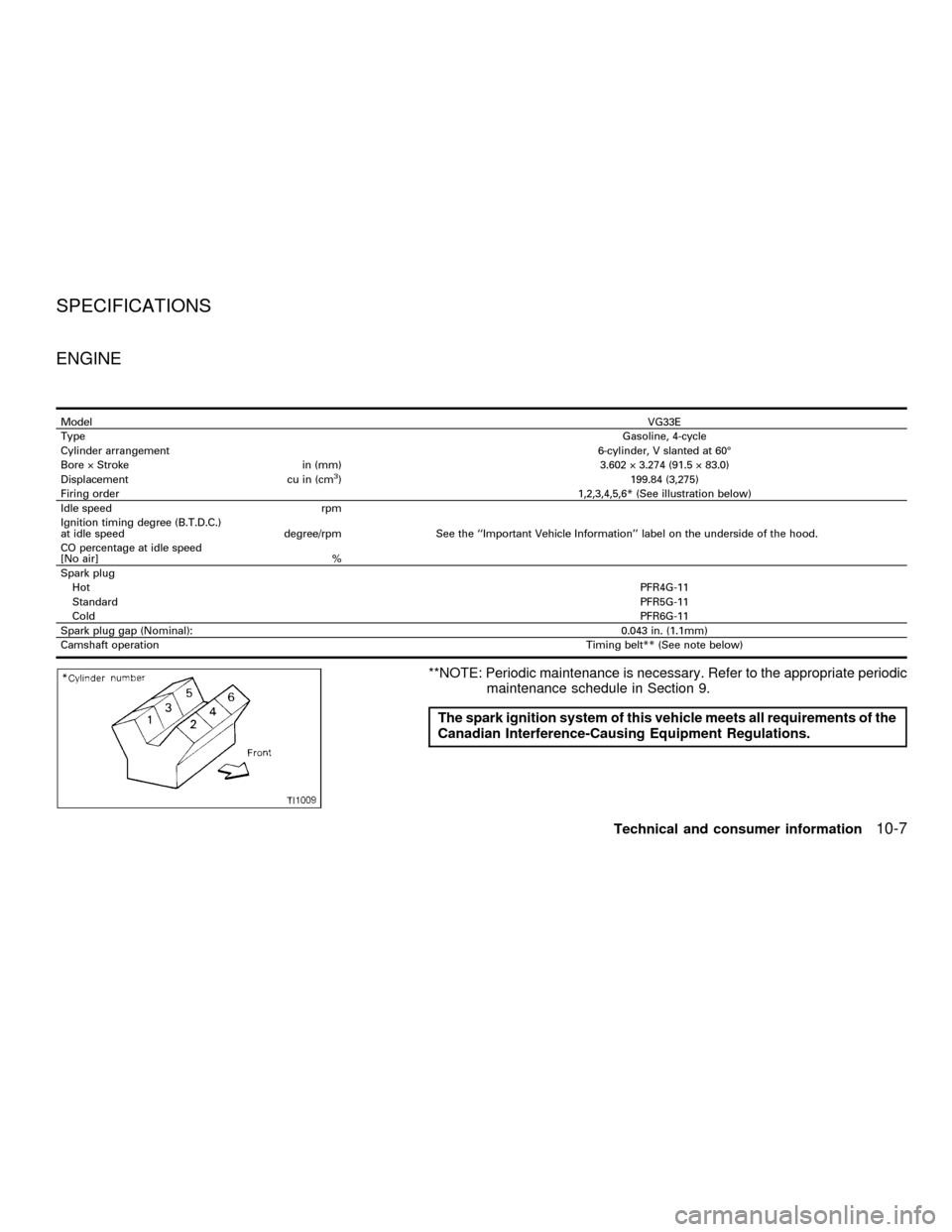
ENGINE
ModelVG33E
TypeGasoline, 4-cycle
Cylinder arrangement6-cylinder, V slanted at 60É
Bore ý Stroke in (mm) 3.602 ý 3.274 (91.5 ý 83.0)
Displacement cu in (cm
3) 199.84 (3,275)
Firing order1,2,3,4,5,6* (See illustration below)
Idle speed rpm
See the ``Important Vehicle Information'' label on the underside of the hood. Ignition timing degree (B.T.D.C.)
at idle speed degree/rpm
CO percentage at idle speed
[No air] %
Spark plug
HotPFR4G-11
StandardPFR5G-11
ColdPFR6G-11
Spark plug gap (Nominal):0.043 in. (1.1mm)
Camshaft operationTiming belt** (See note below)
**NOTE: Periodic maintenance is necessary. Refer to the appropriate periodic
maintenance schedule in Section 9.
The spark ignition system of this vehicle meets all requirements of the
Canadian Interference-Causing Equipment Regulations.
SPECIFICATIONS
Technical and consumer information10-7
ZX
Page 291 of 304
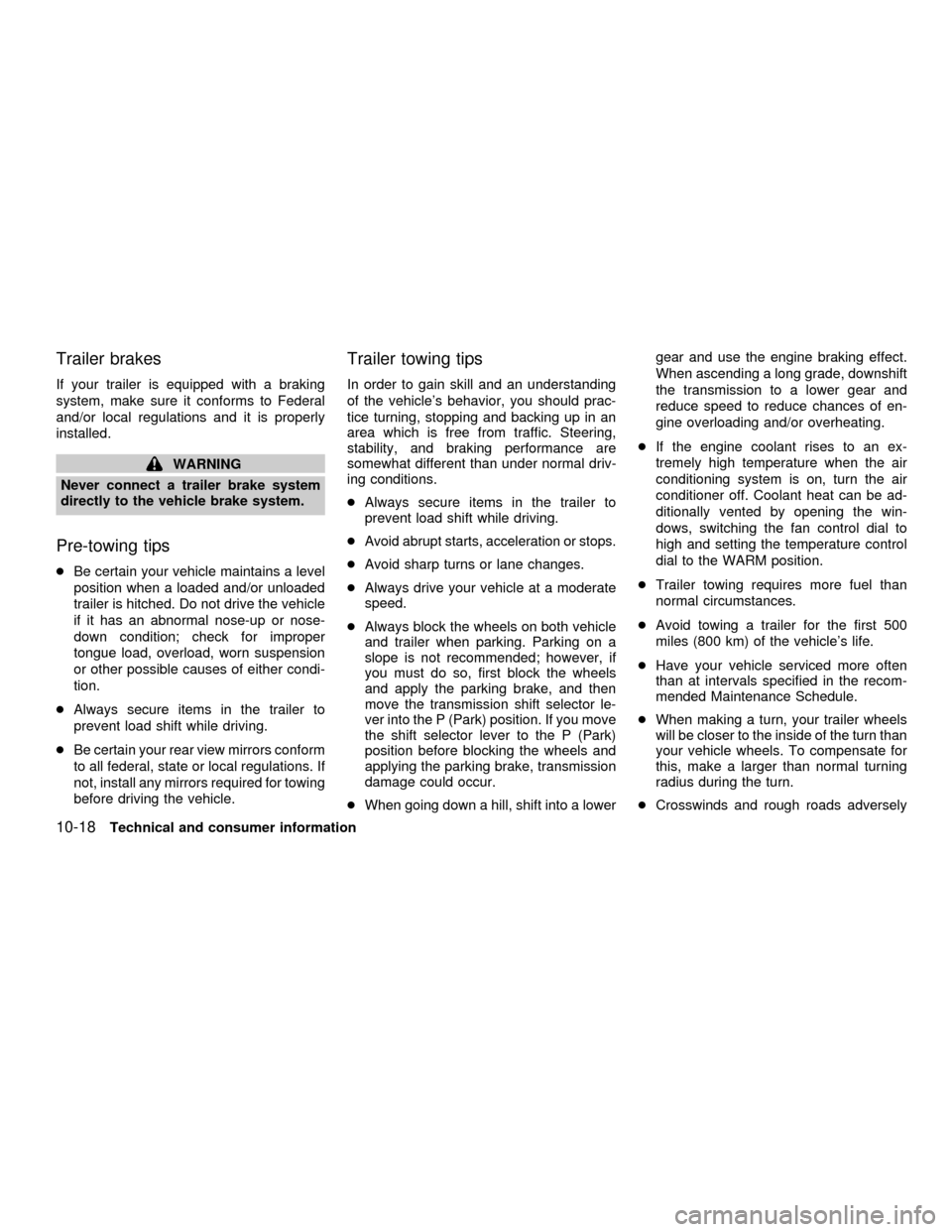
Trailer brakes
If your trailer is equipped with a braking
system, make sure it conforms to Federal
and/or local regulations and it is properly
installed.
WARNING
Never connect a trailer brake system
directly to the vehicle brake system.
Pre-towing tips
cBe certain your vehicle maintains a level
position when a loaded and/or unloaded
trailer is hitched. Do not drive the vehicle
if it has an abnormal nose-up or nose-
down condition; check for improper
tongue load, overload, worn suspension
or other possible causes of either condi-
tion.
cAlways secure items in the trailer to
prevent load shift while driving.
cBe certain your rear view mirrors conform
to all federal, state or local regulations. If
not, install any mirrors required for towing
before driving the vehicle.
Trailer towing tips
In order to gain skill and an understanding
of the vehicle's behavior, you should prac-
tice turning, stopping and backing up in an
area which is free from traffic. Steering,
stability, and braking performance are
somewhat different than under normal driv-
ing conditions.
cAlways secure items in the trailer to
prevent load shift while driving.
c
Avoid abrupt starts, acceleration or stops.
cAvoid sharp turns or lane changes.
cAlways drive your vehicle at a moderate
speed.
cAlways block the wheels on both vehicle
and trailer when parking. Parking on a
slope is not recommended; however, if
you must do so, first block the wheels
and apply the parking brake, and then
move the transmission shift selector le-
ver into the P (Park) position. If you move
the shift selector lever to the P (Park)
position before blocking the wheels and
applying the parking brake, transmission
damage could occur.
cWhen going down a hill, shift into a lowergear and use the engine braking effect.
When ascending a long grade, downshift
the transmission to a lower gear and
reduce speed to reduce chances of en-
gine overloading and/or overheating.
cIf the engine coolant rises to an ex-
tremely high temperature when the air
conditioning system is on, turn the air
conditioner off. Coolant heat can be ad-
ditionally vented by opening the win-
dows, switching the fan control dial to
high and setting the temperature control
dial to the WARM position.
cTrailer towing requires more fuel than
normal circumstances.
cAvoid towing a trailer for the first 500
miles (800 km) of the vehicle's life.
cHave your vehicle serviced more often
than at intervals specified in the recom-
mended Maintenance Schedule.
cWhen making a turn, your trailer wheels
will be closer to the inside of the turn than
your vehicle wheels. To compensate for
this, make a larger than normal turning
radius during the turn.
cCrosswinds and rough roads adversely
10-18Technical and consumer information
ZX
Page 301 of 304

M
Maintenance
General maintenance ............................. 9-2
Inside the vehicle.................................... 9-3
Maintenance precautions ....................... 8-2
Outside the vehicle ................................. 9-2
Periodic maintenance schedules ............ 9-5
Seat belt maintenance.......................... 1-54
Under the hood and vehicle ................... 9-4
Malfunction indicator lamp (MIL) ............... 2-10
Manual front seat adjustment ...................... 1-3
Manual vent windows ................................ 2-31
Map lights .................................................. 2-34
Map pocket ................................................ 2-23
Mirror
Outside mirrors ..................................... 3-15
Vanity mirror ......................................... 3-12
Multi-remote control system ........................ 3-6
Multi-remote controller battery
replacement ............................................... 8-22
O
Odometer ..................................................... 2-4
Oil
Capacities and recommended fuel/
lubricants .............................................. 10-2
Changing engine oil................................ 8-6
Changing engine oil filter........................ 8-7
Checking engine oil level ....................... 8-5Engine oil ................................................ 8-5
Engine oil and oil filter
recommendation ................................... 10-4
Engine oil viscosity ............................... 10-5
Outside mirrors .......................................... 3-15
Overdrive switch .......................................... 5-8
Overheat
If your vehicle overheats ...................... 6-10
Owner's manual/service manual order
information ............................................... 10-22
P
Parcel Shelf ............................................... 2-27
Parking
Parking brake check ............................. 8-19
Parking brake operation ......................... 5-9
Parking/parking on hills ........................ 5-13
Periodic maintenance schedules ................. 9-5
Personal reading light ................................ 2-33
Power
Power door locks ............................ 3-2, 3-4
Power steering fluid ...................... 10-2, 8-9
Power support front seat ........................ 1-4
Power vent windows............................. 2-31
Power windows..................................... 2-29
Precautions
Maintenance precautions ....................... 8-2
Precautions on seat belt usage............ 1-39
Precautions when starting and driving ... 5-2
Push starting .............................................. 6-10R
Radio
Car phone or CB radio ......................... 4-46
FM-AM radio with cassette player ........ 4-19
FM-AM radio with cassette player and
compact disc (CD) player ..................... 4-25
Readiness for inspection maintenance
(I/M) test................................................... 10-21
Rear door ................................................... 3-10
Rear door lock ........................................... 3-10
Rear power socket..................................... 2-21
Rear seat air conditioner ........................... 4-14
Rear window defogger switch ................... 2-15
Rear window wiper and washer
switches ..................................................... 2-15
Refrigerant recommendation ..................... 10-6
Registering your vehicle in another
country ..................................................... 10-10
Remote keyless entry system
(See multi-remote control system) .............. 3-6
Removing and installing the second row
bench seat ................................................. 1-12
Reporting safety defects (USA) ............... 10-20
S
Safety
Child safety sliding door lock ................. 3-5
Reporting safety defects (USA) .......... 10-20
Seat belt
Precautions on seat belt usage............ 1-39
11-4
ZX