2001 NISSAN PATHFINDER steering
[x] Cancel search: steeringPage 195 of 289
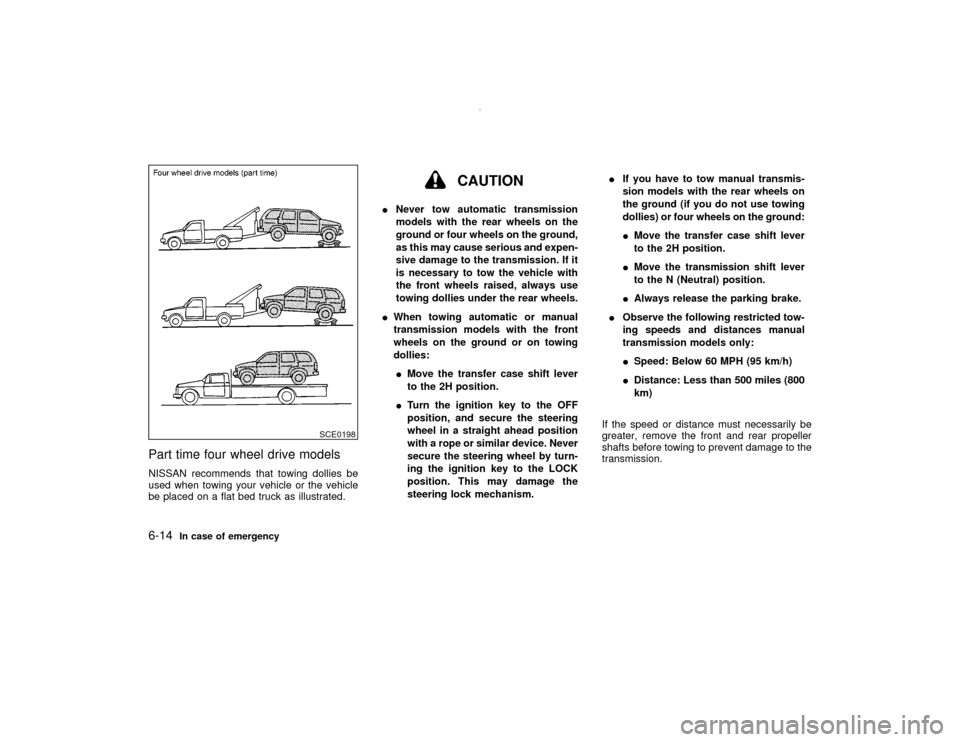
Part time four wheel drive modelsNISSAN recommends that towing dollies be
used when towing your vehicle or the vehicle
be placed on a flat bed truck as illustrated.
CAUTION
INever tow automatic transmission
models with the rear wheels on the
ground or four wheels on the ground,
as this may cause serious and expen-
sive damage to the transmission. If it
is necessary to tow the vehicle with
the front wheels raised, always use
towing dollies under the rear wheels.
IWhen towing automatic or manual
transmission models with the front
wheels on the ground or on towing
dollies:
IMove the transfer case shift lever
to the 2H position.
ITurn the ignition key to the OFF
position, and secure the steering
wheel in a straight ahead position
with a rope or similar device. Never
secure the steering wheel by turn-
ing the ignition key to the LOCK
position. This may damage the
steering lock mechanism.IIf you have to tow manual transmis-
sion models with the rear wheels on
the ground (if you do not use towing
dollies) or four wheels on the ground:
IMove the transfer case shift lever
to the 2H position.
IMove the transmission shift lever
to the N (Neutral) position.
IAlways release the parking brake.
IObserve the following restricted tow-
ing speeds and distances manual
transmission models only:
ISpeed: Below 60 MPH (95 km/h)
IDistance: Less than 500 miles (800
km)
If the speed or distance must necessarily be
greater, remove the front and rear propeller
shafts before towing to prevent damage to the
transmission.
SCE0198
6-14
In case of emergency
Z
00.1.10/R50-D/V5
X
Page 206 of 289

8 Do-it-yourselfMaintenance precautions .......................................... 8-2
Engine compartment check locations ....................... 8-4
Engine cooling system .............................................. 8-6
Checking engine coolant level ............................. 8-6
Changing engine coolant ..................................... 8-7
Engine oil ................................................................ 8-10
Checking engine oil level ................................... 8-10
Changing engine oil ........................................... 8-11
Changing engine oil filter ................................... 8-12
Automatic transmission fluid ................................... 8-13
Temperature conditions for checking ................. 8-14
Power steering fluid ................................................ 8-15
Brake and clutch fluid ............................................. 8-15
Brake fluid .......................................................... 8-15
Clutch fluid.......................................................... 8-16
Window washer fluid ............................................... 8-17
Window washer fluid reservoir ........................... 8-17
Battery ..................................................................... 8-18
Jump starting ...................................................... 8-18
Drive belts ............................................................... 8-19
Spark plugs ............................................................. 8-19
Replacing spark plugs ........................................ 8-19Air cleaner ............................................................... 8-20
Windshield wiper blades ......................................... 8-21
Cleaning ............................................................. 8-21
Replacing............................................................ 8-21
Parking brake and brake pedal ............................... 8-22
Checking parking brake ..................................... 8-22
Checking brake pedal ........................................ 8-22
Brake booster ..................................................... 8-23
Clutch pedal ............................................................ 8-24
Checking clutch pedal ........................................ 8-24
Fuses....................................................................... 8-24
Engine compartment .......................................... 8-24
Passenger compartment .................................... 8-25
Multi-remote controller battery replacement....... 8-25
Lights ....................................................................... 8-27
Headlights........................................................... 8-28
Wheels and tires ..................................................... 8-31
Tire pressure ...................................................... 8-31
Types of tires...................................................... 8-32
Tire chains .......................................................... 8-33
Changing wheels and tires ................................. 8-33
Clutch housing drain............................... 8-37Z
00.1.10/R50-D/V5
X
Page 220 of 289
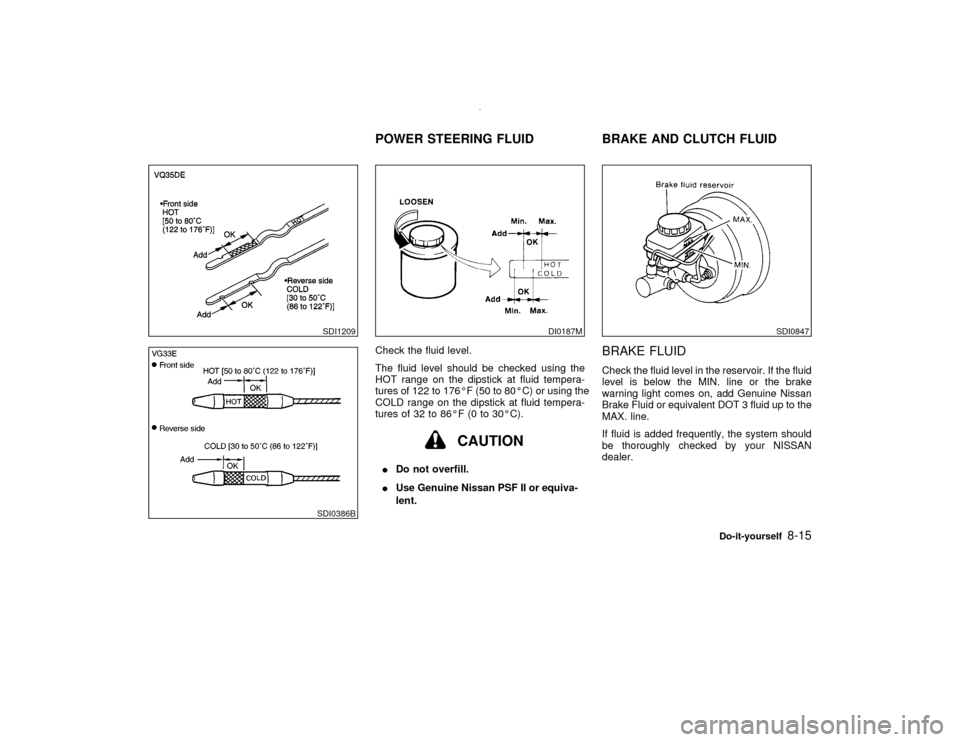
Check the fluid level.
The fluid level should be checked using the
HOT range on the dipstick at fluid tempera-
tures of 122 to 176ÉF (50 to 80ÉC) or using the
COLD range on the dipstick at fluid tempera-
tures of 32 to 86ÉF (0 to 30ÉC).
CAUTION
IDo not overfill.
IUse Genuine Nissan PSF II or equiva-
lent.
BRAKE FLUIDCheck the fluid level in the reservoir. If the fluid
level is below the MIN. line or the brake
warning light comes on, add Genuine Nissan
Brake Fluid or equivalent DOT 3 fluid up to the
MAX. line.
If fluid is added frequently, the system should
be thoroughly checked by your NISSAN
dealer.
SDI1209SDI0386B
DI0187M
SDI0847
POWER STEERING FLUID BRAKE AND CLUTCH FLUID
Do-it-yourself
8-15
Z
00.1.10/R50-D/V5
X
Page 246 of 289

Wheel nuts*:
When checking the tires, make sure no nuts
are missing, and check for any loose nuts.
Tighten if necessary.
Tire rotation*:
Tires should be rotated every 7,500 miles
(12,000 km). However, the timing for tire rota-
tion may vary according to your driving habits
and road surface conditions.
Wheel alignment and balance:
If the vehicle should pull to either side while
driving on a straight and level road, or if you
detect uneven or abnormal tire wear, there
may be a need for wheel alignment.
If the steering wheel or seat vibrates at normal
highway speeds, wheel balancing may be
needed.
Windshield wiper blades*:
Check for cracks or wear if they do not wipe
properly.
Doors and engine hood:
Check that all doors and the engine hood,
operate properly. Also ensure that all latches
lock securely. Lubricate hinges, latches, rollers
and links if necessary. Make sure that the
secondary latch keeps the hood from openingwhen the primary latch is released.
When driving in areas using road salt or other
corrosive materials, check lubrication fre-
quently.
Inside the vehicleLights*:
Make sure that the headlights, stop lights, tail
lights, turn signal lights, and other lights are all
operating properly and installed securely. Also
check headlight aim.INTERIOR MAINTENANCEThe maintenance items listed here should be
checked on a regular basis, such as when
performing periodic maintenance, cleaning the
vehicle, etc.
Warning lights and chimes:
Make sure that all warning lights and chimes
are operating properly.
Windshield wiper and washer*:
Check that the wipers and washer operate
properly and that the wipers do not streak.Windshield defroster:
Check that the air comes out of the defroster
outlets properly and in sufficient quantity when
operating the heater or air conditioner.
Steering wheel:
Check for changes in the steering conditions,
such as excessive freeplay, hard steering or
strange noises.
Seats:
Check seat position controls such as seat
adjusters, seatback recliner, etc. to ensure
they operate smoothly and that all latches lock
securely in every position. Check that the head
restraints move up and down smoothly and
that the locks (if so equipped) hold securely in
all latched positions.
Seat belts:
Check that all parts of the seat belt system
(e.g. buckles, anchors, adjusters and retrac-
tors) operate properly and smoothly, and are
installed securely. Check the belt webbing for
cuts, fraying, wear or damage.
Accelerator pedal:
Check the pedal for smooth operation and
make sure the pedal does not catch or require
Maintenance
9-3
Z
00.1.10/R50-D/V5
X
Page 247 of 289

uneven effort. Keep the floor mats away from
the pedal.
Clutch pedal*:
Make sure the pedal operates smoothly and
check that it has the proper free travel.
Brakes:
Check that the brakes do not pull the vehicle to
one side when applied.
Brake pedal and booster*:
Check the pedal for smooth operation and
make sure it has the proper distance under it
when depressed fully. Check the brake
booster function. Be certain to keep floormats
away from the pedal.
Parking brake*:
Check that the lever has the proper travel and
confirm that your vehicle is held securely on a
fairly steep hill with only the parking brake
applied.
Automatic transmission P (Park) position
mechanism:
On a fairly steep hill check that your vehicle is
held securely with the selector lever in the P
position without applying any brakes.
Under the hood and vehicleThe maintenance items listed here should be
checked periodically e.g. each time you check
the engine oil or refuel.
Windshield washer fluid*:
Check that there is adequate fluid in the tank.
Engine oil level*:
Check the level after parking the vehicle on a
level spot and turning off the engine. (Be sure
to wait a few minutes to allow the oil to drain
back into the sump.)
Brake and clutch fluid levels*:
Make sure that the brake and clutch fluid level
is between the MAX and MIN lines on the
reservoir.
Power steering fluid level* and lines:
Check the level when the fluid is cold and the
engine is turned off. Check the lines for proper
attachment, leaks, cracks, etc.
Automatic transmission fluid level*:
Check the level after putting the selector lever
in P (Park) with the engine idling.Engine coolant level*:
Check the coolant level when the engine is
cold.
Radiator and hoses:
Check the front of the radiator and clean off
any dirt, insects, leaves, etc., that may have
accumulated. Make sure the hoses have no
cracks, deformation, rot or loose connections.
Engine drive belts*:
Make sure that no belt is frayed, worn, cracked
or oily.
Battery*:
Check the fluid level in each cell. It should be
between the MAX and MIN lines.
Exhaust system:
Make sure there are no loose supports, cracks
or holes. If the sound of the exhaust seems
unusual or there is a smell of exhaust fumes,
immediately locate the trouble and correct it.
See ªPrecautions when starting and drivingº in
the ª5. Starting and drivingº section for exhaust
gas (carbon monoxide).
Underbody:
The underbody is frequently exposed to corro-
sive substances such as those used on icy
9-4
Maintenance
Z
00.1.10/R50-D/V5
X
Page 250 of 289
![NISSAN PATHFINDER 2001 R50 / 2.G Owners Manual Schedule 1Abbreviations: R = Replace I = Inspect. Correct or replace if necessary. L = Lubricate [ ]: At the mileage intervals onlyMAINTENANCE OPERATIONMAINTENANCE INTERVAL
Perform at number of miles,](/manual-img/5/647/w960_647-249.png "NISSAN PATHFINDER 2001 R50 / 2.G Owners Manual Schedule 1Abbreviations: R = Replace I = Inspect. Correct or replace if necessary. L = Lubricate [ ]: At the mileage intervals onlyMAINTENANCE OPERATIONMAINTENANCE INTERVAL
Perform at number of miles,")
Schedule 1Abbreviations: R = Replace I = Inspect. Correct or replace if necessary. L = Lubricate [ ]: At the mileage intervals onlyMAINTENANCE OPERATIONMAINTENANCE INTERVAL
Perform at number of miles, kilometers
or months, whichever comes first.Miles´1,000 3.75 7.5 11.25 15 18.75 22.5 26.25 30 33.75 37.5 41.25 45 48.75 52.5 56.25 60
(km´1,000) (6) (12) (18) (24) (30) (36) (42) (48) (54) (60) (66) (72) (78) (84) (90) (96)
Months 3 6 9 12 15 18 21 24 27 30 33 36 39 42 45 48
Chassis and body maintenance
Brake lines & cablesIIII
Brake pads, rotors, drums & liningsIIIIIIII
Automatic transmission & (All-mode 4WD)
transfer fluid, manual transmission & differ-
ential gear oil (exc. LSD)See NOTE (1)IIII
Limited-slip differential (LSD) gear oil See NOTE (1)IRIR
Steering gear, linkage & transfer gear, axle & suspension partsIIIIIIII
Tire rotation See NOTE (2)
Drive shaft boots (
) IIIIIIII
Propeller shaft See NOTE (3)LLLLLLLL
Front wheel bearing grease (4x2)II
Front wheel bearing grease (
) See NOTE (4)IRIR
Exhaust systemIIIIIIII
Supplemental air bag system and supple-
mental side air bag systems (if so
equipped)See NOTE (5)
Automatic Speed Control Device (ASCD) vacuum hosesIIII
NOTE: (1) If towing a trailer, using a camper or a car-top carrier, or driving on rough or muddy roads, change (not just inspect) oil at every 30,000 miles(48,000 km)
or 24 months except for LSD. Change LSD gear oil every 15,000 miles (24,000 km) or 12 months.
(2) Refer to ªTire rotationº under the ªGeneral maintenanceº heading earlier in this section.
(3) The propeller shaft should be re-greased after being immersed in water.
(4) If operating frequently in water, replace grease every 3,750 miles (6,000 km) or 3 months.
(5) Inspect the supplemental air bag system 10 years after the date of manufacture noted on the F.M.V.S.S. certification label.
Maintenance
9-7
Z
00.1.10/R50-D/V5
X
Page 252 of 289
![NISSAN PATHFINDER 2001 R50 / 2.G Owners Manual Schedule 2Abbreviations: R = Replace I = Inspect. Correct or replace if necessary. L = Lubricate [ ]: At the mileage intervals onlyMAINTENANCE OPERATIONMAINTENANCE INTERVAL
Perform at number of miles,](/manual-img/5/647/w960_647-251.png "NISSAN PATHFINDER 2001 R50 / 2.G Owners Manual Schedule 2Abbreviations: R = Replace I = Inspect. Correct or replace if necessary. L = Lubricate [ ]: At the mileage intervals onlyMAINTENANCE OPERATIONMAINTENANCE INTERVAL
Perform at number of miles,")
Schedule 2Abbreviations: R = Replace I = Inspect. Correct or replace if necessary. L = Lubricate [ ]: At the mileage intervals onlyMAINTENANCE OPERATIONMAINTENANCE INTERVAL
Perform at number of miles, kilometers or
months, whichever comes first.Miles´1,000 7.5 15 22.5 30 37.5 45 52.5 60
(km´1,000) (12) (24) (36) (48) (60) (72) (84) (96)
Months 6 12 18 24 30 36 42 48
Chassis and body maintenance
Brake lines & cablesIIII
Brake pads, rotors, drums & liningsIIII
Automatic transmission & (All-mode 4WD) transfer fluid, manual
transmission & differential gear oil (exc. LSD)IIII
Limited-slip differential (LSD) gear oilIRIR
Steering gear, linkage & transfer gear, axle & suspension parts I I
Tire rotation See NOTE (1)
Drive shaft boots (
) IIII
Propeller shaft See NOTE (2)LLLL
Front wheel bearing grease (4x2)II
Front wheel bearing grease (
) IRIR
Exhaust systemII
Supplemental air bag system and supplemental
side air bag systems (if so equipped)See NOTE (3)
Automatic Speed Control Device (ASCD) vacuum hosesIIII
NOTE: (1) Refer to ªTire rotationº under the ªGeneral maintenanceº heading earlier in this section.
(2) The propeller shaft should be re-greased after being immersed in water.
(3) Inspect the supplemental air bag system 10 years after the date of manufacture noted on the F.M.V.S.S. certification label.
Maintenance
9-9
Z
00.1.10/R50-D/V5
X
Page 253 of 289

Maintenance for off-road driving
(
only)
Whenever you drive offroad through sand,
mud or water as deep as the wheel hub, more
frequent maintenance may be required of the
following items:G
Brake pads and discs
G
Brake lining and drums
G
Brake lines and hoses
G
Wheel bearing grease
G
Differential, transmission and transfer oil
G
Steering linkage
G
Propeller shafts and front drive shafts
G
Air cleaner filter
G
Clutch housing (See ªClutch housing drainº
in the ª8. Do-it-yourselfº section for check-
ing water entry.)
These items should be checked frequently to
assure safe and proper operation of your ve-
hicle.
EXPLANATION OF MAINTENANCE
ITEMS
Emission control system
maintenanceAdditional information on the following
items with * is found in the ª8. Do-it-
yourselfº section.
Drive belts*:
Check drive belts for wear, fraying or cracking
and also for proper tension. Replace the drive
belts if found damaged.
Air cleaner filter:
Under normal driving conditions, the air
cleaner filter should be replaced in accordance
with the maintenance schedule. However,
driving the vehicle in dusty areas may cause
more rapid clogging of the element. Conse-
quently, the element may have to be replaced
more frequently.
EVAP vapor lines:
Check vapor lines and connections for failure
or looseness. If leaks are found, replace the
lines.
Fuel lines:
Check the fuel hoses, piping and connectionsfor leaks, looseness or deterioration. Replace
any parts if they are damaged.
Fuel filter:
When the filter becomes clogged, the vehicle
speed cannot be increased as the driver
wishes. In such an event, replace the filter.
Engine coolant*:
Flush and refill the cooling system.
Engine oil & oil filter*:
Under normal driving conditions, the engine oil
and oil filter should be replaced in accordance
with the maintenance schedule. However, un-
der severe driving conditions, they may have
to be replaced more frequently.
Spark plugs*:
Replace with new plugs having the correct
heat range.
Intake & exhaust valve clearance:
Check the valve clearance if valve noise in-
creases.
Timing belt:
Replace the timing belt for driving the cam-
shafts.
9-10
Maintenance
Z
00.1.10/R50-D/V5
X