2001 NISSAN PATHFINDER tire pressure
[x] Cancel search: tire pressurePage 241 of 289

WARNING
IThe TEMPORARY USE ONLY spare
tire should be used only for emer-
gency. It should be replaced by the
standard tire at the first opportunity.
IDrive carefully while the TEMPO-
RARY USE ONLY spare tire is in-
stalled.
Avoid sharp turns and abrupt braking
while driving.
IPeriodically check the TEMPORARY
USE ONLY spare tire inflation pres-
sure, and always keep it at 28 psi (190
kPa, 1.9 bar).
IAlways keep the pressure of the full
size spare tire (if so equipped) at the
recommended pressure for standard
tires, as indicated on the tire placard.
For tire placard location, see ªTire
placardº in the ª10. Technical and
consumer informationº section.
IDo not drive your vehicle at speeds
faster than 50 MPH (80 km/h).IWhen driving on roads covered with
snow or ice, the small size spare tire
should be used on the rear wheel and
the original tire used on the front
wheels (drive wheels). Use tire chains
only on the front two original tires.
ITire tread of the TEMPORARY USE
ONLY spare tire will wear at a faster
rate than the original tire. Replace the
TEMPORARY USE ONLY spare tire as
soon as the tread wear indicators
appear.
IDo not use the TEMPORARY USE
ONLY spare tire on other vehicles.
IDo not use more than one TEMPO-
RARY USE ONLY spare tire at the
same time.
IDo not tow a trailer while the TEMPO-
RARY USE ONLY spare tire is in-
stalled.
CAUTION
IDo not use tire chains on a TEMPO-
RARY USE ONLY spare tire. Tire
chains will not fit properly on the
TEMPORARY USE ONLY spare tire
and may cause damage to the ve-
hicle.
IBecause the TEMPORARY USE ONLY
spare tire is smaller than the original
tire, ground clearance is reduced. To
avoid damage to the vehicle do not
drive over obstacles. Also do not
drive the vehicle through an auto-
matic car wash since it may get
caught.
8-36
Do-it-yourself
Z
00.1.10/R50-D/V5
X
Page 245 of 289

Your new NISSAN has been designed to have
minimum maintenance requirements with
longer service intervals to save you both time
and money. However, some day-to-day and
regular maintenance is essential to maintain
your NISSAN's good mechanical condition, as
well as its emission and engine performance.
It is the owner's responsibility to make sure
that the specified maintenance, as well as
general maintenance, is performed.
As the vehicle owner, you are the only one
who can ensure that your vehicle receives the
proper maintenance care. You are a vital link
in the maintenance chain.
General maintenance:
General maintenance includes those items
which should be checked during normal day-
to-day operation of the vehicle. They are es-
sential if your vehicle is to continue to operate
properly. It is your responsibility to perform
these procedures regularly as prescribed.
These checks or inspections can be done by
yourself, a qualified technician or, if you prefer,
your NISSAN dealer.
Periodic maintenance:
The maintenance items listed in this part are
required to be serviced at regular intervals.However, under severe driving conditions, ad-
ditional or more frequent maintenance will be
required.
Where to go for service:
If maintenance service is required or your
vehicle appears to malfunction, have the sys-
tems checked and tuned by an authorized
NISSAN dealer.
NISSAN technicians are well-trained special-
ists and are kept up to date with the latest
service information through technical bulletins,
service tips, and in-dealership training pro-
grams. They are completely qualified to work
on NISSAN's vehicles before they work on
your vehicle, rather than after they have
worked on it.
You can be confident that your NISSAN deal-
er's service department performs the best job
to meet the maintenance requirements on your
vehicle Ð in a reliable and economic way.During the normal day-to-day operation of the
vehicle, general maintenance should be per-
formed regularly as prescribed in this section.
If you detect any unusual sounds, vibrations or
smell, be sure to check for the cause or have
your NISSAN dealer do it promptly. In addition,
you should notify your NISSAN dealer if you
think that repairs are required.
When performing any checks or maintenance
work, see ªMaintenance precautionsº in the ª8.
Do-it-yourselfº section.
EXTERIOR MAINTENANCEAdditional information on the following
items with * is found in the ª8. Do-it-
yourselfº section.Outside the vehicleThe maintenance items listed here should be
performed from time to time, unless otherwise
specified.
Tires*:
Check the pressure with a gauge periodically
when at a service station, including the spare,
and adjust to the specified pressure if neces-
sary. Check carefully for damage, cuts or
excessive wear.
MAINTENANCE PRECAUTIONS GENERAL MAINTENANCE9-2
Maintenance
Z
00.1.10/R50-D/V5
X
Page 269 of 289
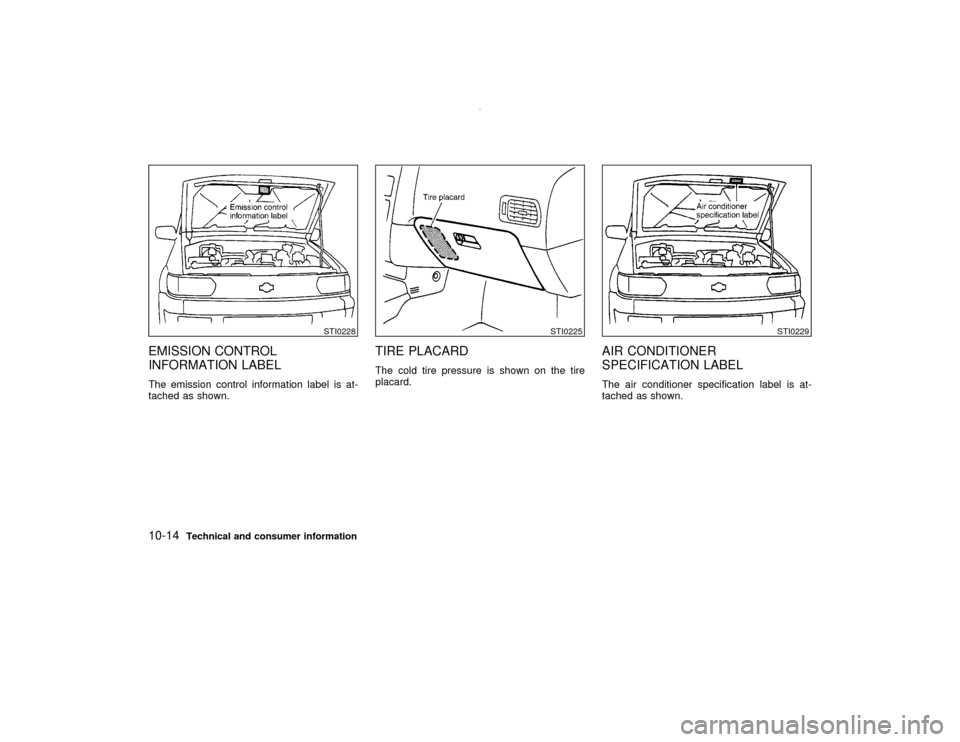
EMISSION CONTROL
INFORMATION LABELThe emission control information label is at-
tached as shown.
TIRE PLACARDThe cold tire pressure is shown on the tire
placard.
AIR CONDITIONER
SPECIFICATION LABELThe air conditioner specification label is at-
tached as shown.
STI0228
STI0225
STI0229
10-14
Technical and consumer information
Z
00.1.10/R50-D/V5
X
Page 274 of 289

IAfter the hitch is removed, seal the
bolt holes to prevent exhaust fumes,
water or dust from entering the pas-
senger compartment.
IRegularly check all hitch mounting
bolts are securely mounted.
ITo reduce the possibility of additional
damage if your vehicle is struck from
the rear, where practical, remove the
hitch and/or receiver when not in use.
INever connect a trailer brake system
directly to the vehicle brake system.Tire pressuresIWhen towing a trailer, inflate the vehicle
tires to the recommended cold tire pressure
indicated on the tire placard (affixed to the
glove box lid).
ITrailer tire condition, size, load rating and
proper inflation pressure should be in ac-
cordance with the trailer and tire manufac-
turers' specifications.Safety chainsAlways use a suitable chain between yourvehicle and the trailer. The chain should be
crossed and should be attached to the hitch,
not to the vehicle bumper or axle. Be sure to
leave enough slack in the chain to permit
turning corners.
Trailer lightsTrailer lights should comply with Federal
and/or local regulations.
When wiring vehicle for towing connection,
connect stop and tail light pickup into the
vehicle electrical circuit at point between
the sensor and stop light switch or light
switch.Trailer brakesIf your trailer is equipped with a braking sys-
tem, make sure it conforms to Federal and/or
local regulations and that it is properly in-
stalled.
WARNING
Never connect a trailer brake system
directly to the vehicle brake system.Trailer towing tipsIn order to gain skill and an understanding ofthe vehicle's behavior, you should practice
turning, stopping and backing up in an area
which is free from traffic. Steering stability and
braking performance will be somewhat differ-
ent than under normal driving conditions.
IAlways secure items in the trailer to prevent
load shift while driving.
IAvoid abrupt starts, acceleration or stops.
IAvoid sharp turns or lane changes.
IAlways drive your vehicle at a moderate
speed.
IAlways block the wheels on both vehicle
and trailer when parking. Parking on a
slope is not recommended; however, if you
must do so, and if your vehicle is equipped
with automatic transmission, first block the
wheels and apply the parking brake, and
then move the transmission selector lever
into the P position. If you move the selector
lever to the P position before blocking the
wheels and applying the parking brake,
transmission damage could occur.
IWhen going down a hill, shift into a lower
gear and use the engine braking effect.
When ascending a long grade, downshift
the transmission to a lower gear and reduce
speed to reduce chances of engine over-
loading and/or overheating.
Technical and consumer information
10-19
Z
00.1.10/R50-D/V5
X
Page 287 of 289

Ignition switch automatic transmission
models ......................................................... 5-6
Ignition switch manual transmission
models ......................................................... 5-7
Overdrive switch ........................................ 5-13
Power door lock switch ............................... 3-4
Turn signal switch ..................................... 2-22
T
Tachometer ....................................................... 2-4
Temperature display ......................................... 2-6
Temperature gauge, Engine coolant temperature
gauge ................................................................ 2-4
Theft (Nissan Vehicle Immobilizer System),
Engine start..................................................... 2-16
Three way catalyst ............................................ 5-3
Tilting steering wheel ...................................... 3-14
Tire
Flat tire ........................................................ 6-2
Uniform tire quality grading ..................... 10-20
Tires
Spare tire ................................................... 8-36
Tire chains ................................................. 8-34
Tire placard ............................................. 10-14
Tire pressure ............................................. 8-32
Tire rotation ............................................... 8-34
Type of tires .............................................. 8-33
wheel/tire size.......................................... 10-11
Wheels and tires ....................................... 8-32
Tonneau cover ................................................ 2-33
Top tether strap child restraints ...................... 1-40
Towing
Tow truck towing ....................................... 6-12Towing a trailer........................................ 10-16
Towing load/specification chart ............... 10-16
Towing safety .......................................... 10-18
Trailer towing ................................................ 10-16
Transceiver, Integrated HomeLink
Universal
Transceiver ..................................................... 2-40
Transfer case shifting procedures ......... 5-21, 5-23
Transmission
Automatic transmission fluid (ATF) ........... 8-13
Driving with automatic transmission.......... 5-10
Driving with manual transmission ............. 5-14
Transmission selector lever lock
release ....................................................... 5-13
Transmitter (See multi-remote control
system) ............................................................. 3-5
Traveling or registering your vehicle in another
country .......................................................... 10-12
Turn signal switch ........................................... 2-22
U
Underbody cleaning .......................................... 7-3
Uniform tire quality grading........................... 10-20
V
Vanity mirror light ............................................ 2-40
Vehicle
Dimensions and weights ......................... 10-11
Identification number (VIN) ..................... 10-12
Loading information ................................. 10-15
Vehicle recovery, (freeing a stuck vehicle)..... 6-15
Vehicle security system .................................. 2-15
Ventilators ......................................................... 4-2W
Warning, Hazard warning flasher switch ........ 2-23
Warning labels, Air bag warning labels .......... 1-20
Warning light
4WD warning light ..................................... 5-28
Air bag warning light ........................ 1-21, 2-12
Brake warning light.................................... 2-10
Door open.................................................. 2-11
Low fuel warning light ............................... 2-12
Seat belt warning light and chime............. 2-12
Warning/indicator lights and chimes ................. 2-9
Warranty, Emission control system
warranty ........................................................ 10-21
Washer switch
Rear window wiper and washer switch ..... 2-18
Windshield wiper and washer switch ........ 2-18
Washing ............................................................ 7-2
Waxing .............................................................. 7-2
Weights (See dimensions and weights) ....... 10-11
Wheel/tire size .............................................. 10-11
Wheels and tires ............................................. 8-31
Cleaning aluminum alloy wheels................. 7-3
Window washer fluid ....................................... 8-17
Window(s)
Cleaning ...................................................... 7-3
Power windows ......................................... 2-35
Windshield wiper and washer switch.............. 2-17
Wiper
Blades........................................................ 8-21
Rear window wiper and washer switch ..... 2-18
Windshield wiper and washer switch ........ 2-18
Z
00.1.10/R50-D/V5
X
11-6
Page 288 of 289

FUEL RECOMMENDATION:VG33E engine:
Your vehicle is designed to operate on un-
leaded gasoline with an octane rating of at
least 87 AKI (Anti-Knock Index) number (Re-
search octane number 91).
VQ35DE engine:
Your vehicle is designed to operate on un-
leaded gasoline with an octane rating of at
least 91 AKI (Anti-Knock Index) number (Re-
search octane number 96).
CAUTION
Using a fuel other than that specified
could adversely affect the emission con-
trol devices and systems, and could
also affect the warranty coverage.
Under no circumstances should a
leaded gasoline be used since this will
damage the three way catalyst.
For additional information, see ªCapacities and
recommended fuel/lubricantsº in the ª10.
Technical and consumer informationº section.
ENGINE OIL RECOMMENDATION:IAPI Certification Mark
IAPI grade SG/SH, Energy ConservingI&II
or API grade SJ, Energy Conserving.
IILSAC grade GF-I & GF-II.
ISAE 5W-30 viscosity oil is preferred for all
ambient temperatures.
See ªCapacities and recommended
fuel/lubricantsº in the ª10. Technical and con-
sumer informationº section for engine oil and
oil filter recommendation.COLD TIRE PRESSURES:See the tire placard affixed to the glove box.NEW VEHICLE BREAK-IN
PROCEDURES
RECOMMENDATION:During the first 1,000 miles (1,600 km) of
vehicle use, follow the recommendations out-
lined in the ªBreak-in scheduleº Information
found in the ª5. Starting and drivingº section of
this Owner's Manual. Follow these recommen-
dations for the future reliability and economy of
your new vehicle.
GAS STATION INFORMATION
Z
00.1.10/R50-D/V5
X