Page 22 of 341

19 Instruments and controls
Technical
data Instruments
and controlsOperation DrivingInstrument
cluster displayPractical hints Car care Index 1Parking assist warning indicators, see page 226
2Side defroster outlet
3Side air outlet, adjustable
4Air volume control for side air outlet
5Exterior lamp switch, see page 119
6Parking brake release, see page 202
7Hood lock release, see page 257
8Combination switch, see page 122
9Cruise control switch, see page 212
10Instrument cluster, see page 86
11Multifunction steering wheel, see page 92
Horn (with electronic key in steering lock
position 1 or 2),
Airbag, see page 70
12Steering lock with ignition / starter switch, see
page 190
13Voice recognition system switch, see separate
operating instructions
14Center air outlets, adjustable15Air volume control for center air outlets
16Left front seat heater switch, see page 55
Left front seat ventilation switch, see page 58
17Headlamp washer switch, see page 121
18Rear seat head restraints switch, see page 53
19Hazard warning f lasher switch, see page 125
20Central locking switch, see page 37
21Tow-away alarm switch, see page 45
Indicator lamp for antitheft alarm system, see
page 43
22Right front seat heater switch, see page 55
Right front seat ventilation switch, see page 58
23Glove box (illuminated with electronic key in
steering lock position 1 or 2)
24Automatic climate control, see page 126
Rear window defroster switch
Activated charcoal filter switch
25Audio system, see page 135
26Storage / eyeglasses compartment
Page 74 of 341

71 Restraint systems
Technical
data Instruments
and controlsOperationDrivingInstrument
cluster displayPractical hints Car care Index The following system components are monitored or
undergo a selfcheck: crash-sensor(s), airbag ignition
circuits, front seat belt buckles, emergency tensioning
retractors, seat sensor.
Initially, when the electronic key is turned from steering
lock position 0 to position 1 or 2, malfunctions in the
crash-sensors are detected and indicated (the “SRS”
indicator lamp stays on longer than 4 seconds or does
not come on).
Have the system checked at your authorized
Mercedes-Benz Center immediately.
In the operational mode, after the indicator lamp has
gone out following the initial check, interruptions or
short circuits in the airbag ignition circuit and in the
driver and front passenger seat belt buckle harnesses,
and low voltage in the entire system are detected and
indicated.Note:
See page 236 for information on the Supplemental
Restraint System (SRS) indicator lamp.
Wa r n i n g !
In the event a malfu nction of th e “SRS” is indic ated
as outlined above, the “SRS” may not be
operational. For your safety, we strongly
recommend that you visit an authorized
Mercedes-Benz Center immediately to have the
system checked; otherwise the “SRS” may not be
activated when needed in an accident, which could
result in serious or fatal injury, or it might deploy
unexpectedly and unnecessarily which could also
result in injury.
Page 120 of 341

117 Engine oil level indicator
Technical
data Instruments
and controlsOperationDrivingInstrument
cluster displayPractical hints Car care Index Engine oil level indicator
To check the engine oil level, park vehicle on level
ground, with engine at normal operational temperature.
Check oil level approximately 5 minutes after stopping
the engine, allowing for the oil to return to the oil pan.Turn the electronic key in steering lock to position 2.
To call up the trip odometer and main odometer, press
button è or ÿ on the multifunction steering
wheel until the display appears. See page 96.
Press button j or k on the multifunction
steering wheel repeatedly until the “MEASUREMENT
CORRECT – ONLY IF VEH. LEVEL” engine oil level
indicator appears. This indicator is only a reminder.
Measurement can be cancelled by pressing button j
or k if the vehicle is not parked on level ground. An
incorrect reading will be recorded if you do not cancel
the measurement. Move the vehicle to level ground and
measure again.
The electronic key in steering lock is not in position 2 if
the “ENGINE OIL LEVEL – SWITCH ON IGNITION”
message appears.
The “ENGINE OIL LEVEL – MEASURING NOW”
message is displayed after approximately 3 seconds.
Page 142 of 341
139 Audio system
Technical
data Instruments
and controlsOperationDrivingInstrument
cluster displayPractical hints Car care Index Operation
Switching on and off
Press the control knob .
Th e ra dio is switch ed of f wh en the ignition key is tu rned
to position 0 or removed from the ignition. The radio is
switched on again when the ignition key is turned to
position 1 or 2.
Note:
The radio can also be switched on even if the ignition
key is not inserted, but will switch itself off
automatically after one hour to conserve vehicle battery
power.
Adjusting the volume
Turn the control knob - turning the knob clockwise will
increase the volume, counterclockwise will decrease the
volume.Audio functions
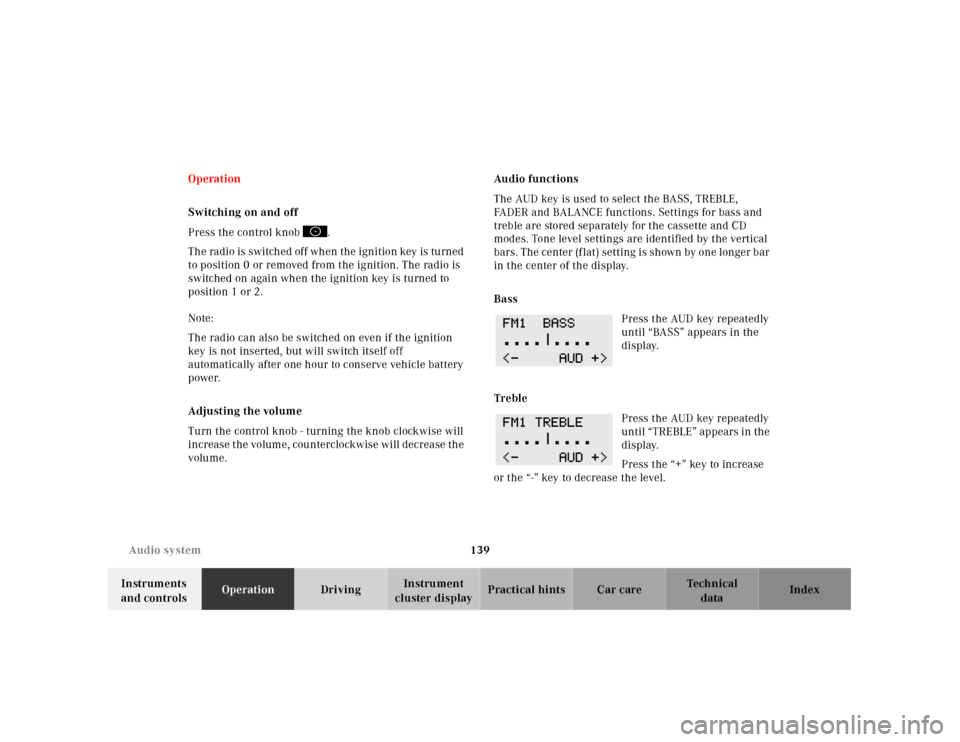
The AUD key is used to select the BASS, TREBLE,
FADER and BALANCE functions. Settings for bass and
treble are stored separately for the cassette and CD
modes. Tone level settings are identified by the vertical
bars. The center (flat) setting is shown by one longer bar
in the center of the display.
Bass
Press the AUD key repeatedly
until “BASS” appears in the
display.
Treble
Press the AUD key repeatedly
until “TREBLE” appears in the
display.
Press the “+” key to increase
or the “-” key to decrease the level.