Page 232 of 341
229 What you should know at the gas station
Technical
data Instruments
and controlsOperationDrivingInstrument
cluster displayPractical hints Car care Index What you should know at the gas station
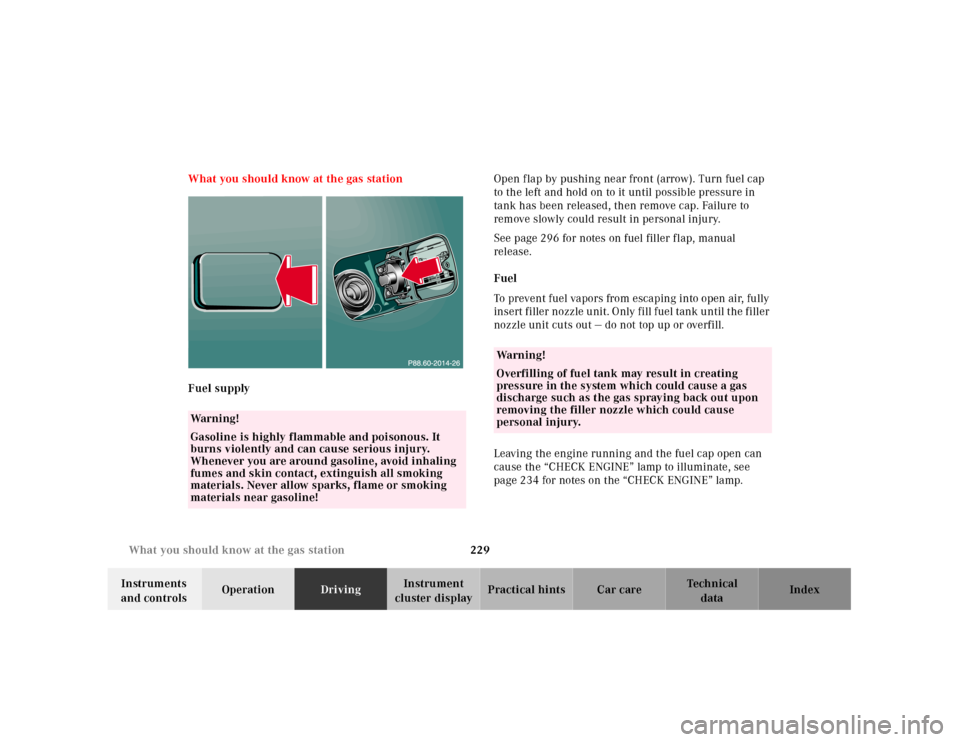
Fuel supplyOpen flap by pushing near front (arrow). Turn fuel cap
to the left and hold on to it until possible pressure in
tank has been released, then remove cap. Failure to
remove slowly could result in personal injury.
See page 296 for notes on fuel filler flap, manual
release.
Fuel
To prevent fuel vapors from escaping into open air, fully
insert filler nozzle unit. Only fill fuel tank until the filler
nozzle unit cuts out — do not top up or overfill.
Leaving the engine running and the fuel cap open can
cause the “CHECK ENGINE” lamp to illuminate, see
page 234 for notes on the “CHECK ENGINE” lamp.
Wa r n i n g !
Gasoline is highly flammable and poisonous. It
burns violently and can cause serious injury.
Whenever you are around gasoline, avoid inhaling
fumes and skin contact, extinguish all smoking
materials. Never allow sparks, flame or smoking
materials near gasoline!
Wa r n i n g !
Overfilling of fuel tank may result in creating
pressure in the system which could cause a gas
discharge such as the gas spraying back out upon
removing the filler nozzle which could cause
personal injury.
Page 233 of 341
230 What you should know at the gas station
Technical
data Instruments
and controlsOperationDrivingInstrument
cluster displayPractical hints Car care Index
Fuel tank capacity approximately 21.1 US gal (80.0 l).
This includes approximately 2.6 US gal (10.0 l) reserve.
Use premium unleaded gasoline:
Posted Octane Index 91 (Average of 96 RON / 86 MON).
Engine oil
Engine oil level check, see page 260.
Fil l qua ntity between u pper a nd l owe r dipstick ma rking
level: 2.1 US qt (2.0 l).
Recommended engine oils, see Approved Service
Products sheet.
Coolant
For normal replenishing, use water (potable water
quality).
For further information (e.g. anticorrosion /antifreeze),
see page 322.
Spark plugs
Approved spark plugs, see page 316.Tire pressure
For tire pressure, refer to tire pressure label inside the
fuel filler flap.
Air conditioner
R-134a refrigerant and special PAG lubricant, see
page 318.
Bulbs
High and low beams: H7 (55 W),
low beam: Xenon (optional)
fog lamps: H1 (55 W),
turn signal lamps,
front 1156 NA (26.9 / 5 W / 32 / 4 cp),
parking and standing lamps, front: H 6W (6 W)
side marker lamps, front: 5 W / 4 cp,
turn signal lamps, rear: 21 W / 24 cp,
stop, tail and parking lamp: 21 W / 4 cp,
tail, parking and side marker lamp: 5 W / 4 cp,
rear fog lamp, driver´s side: 21 W / 32 cp,
backup lamps: 21 W / 32 cp,
license plate lamps: 5 W / 4 cp
Page 322 of 341
319 Fuels, coolants, lubricants etc. - capacities
Technical
data Instruments
and controlsOperation DrivingInstrument
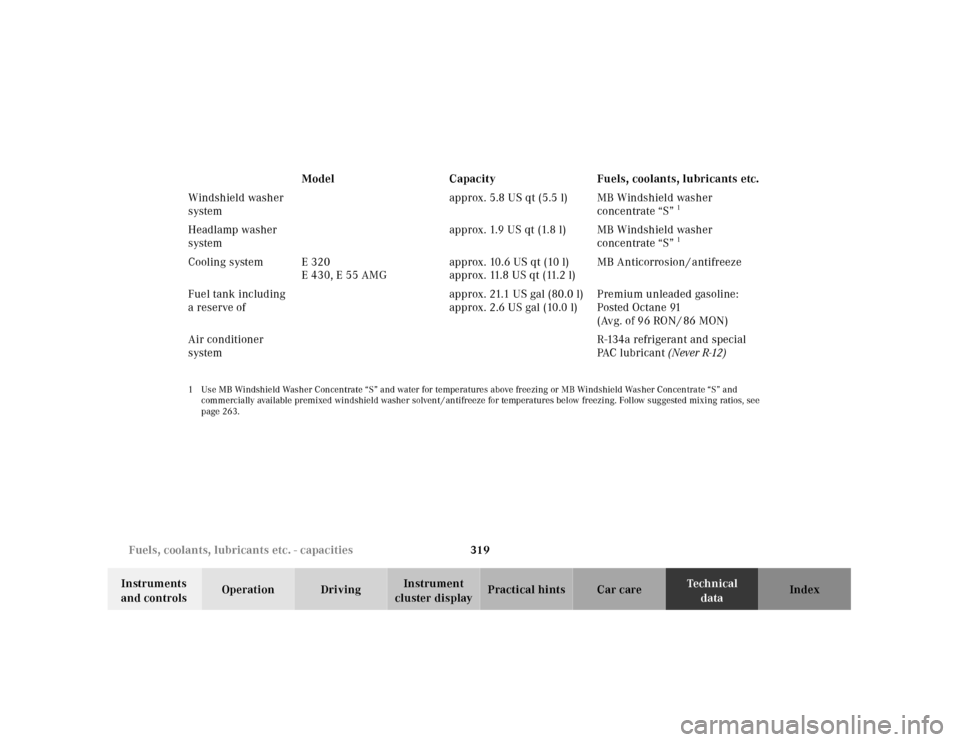
cluster displayPractical hints Car care Index Windshield washer
systemapprox. 5.8 US qt (5.5 l) MB Windshield washer
concentrate “S” 1
Headlamp washer
systemapprox. 1.9 US qt (1.8 l) MB Windshield washer
concentrate “S”
1
Cooling system E 320
E 430, E 55 AMGapprox. 10.6 US qt (10 l)
approx. 11.8 US qt (11.2 l)MB Anticorrosion / antifreeze
Fuel tank including
a reserve ofapprox. 21.1 US gal (80.0 l)
approx. 2.6 US gal (10.0 l)Premium unleaded gasoline:
Posted Octane 91
(Avg. of 96 RON / 86 MON)
Air conditioner
systemR-134a refrigerant and special
PA C l u b r i c a n t (Never R-12)1 Use MB Windshield Washer Concentrate “S” and water for temperatures above freezing or MB Windshield Washer Concentrate “S” and
commercially available premixed windshield washer solvent / antifreeze for temperatures below freezing. Follow suggested mixing ratios, see
page 263.
Model Capacity Fuels, coolants, lubricants etc.
Page 324 of 341
321 Fuels, coolants, lubricants etc. - capacities
Technical
data Instruments
and controlsOperation DrivingInstrument
cluster displayPractical hints Car care Index Premium unleaded gasoline
Caution!
To maintain the engine‘s durability and performance,
premium unleaded gasoline must be used. If premium
unleaded is not available and low octane fuel is used,
follow these precautions:
•have the fuel tank filled only partially with unleaded
regular and fill up with premium unleaded as soon
as possible,
•avoid full throttle driving and abrupt acceleration,
•do not exceed an engine speed of 3000 rpm, if the
vehicle is loaded with a light load such as two
persons and no luggage,
•do not exceed
2/3 of maximum accelerator pedal
position, if the vehicle is fully loaded or operating in
mountainous terrain.Fuel requirements
Use only Premium unleaded meeting ASTM
standa rd D 439:
The octane number (posted at the pump) must be
91 min. It is an average of both the Research (R) octane
number and the Motor (M) octane number: [(R+M) / 2].
This is also known as ANTI-KNOCK INDEX.
Unleaded gasoline containing oxygenates such as
Ethanol, IPA, IBA and TBA can be used provided the
ratio of any one of these oxygenates to gasoline does not
exceed 10%, MTBE not to exceed 15%.
The ratio of Methanol to gasoline must not exceed 3%
plus additional cosolvents.
Using mixtures of Ethanol and Methanol is not allowed.
Gasohol, which contains 10% Ethanol and 90% unleaded
gasoline, can be used.
These blends must also meet all other fuel requirements
such as resistance to spark knock, boiling range, vapor
pressure etc..