2001 MERCEDES-BENZ CLK320 Engine light
[x] Cancel search: Engine lightPage 253 of 325
250 Engine compartment
Te ch n ica l
data Instruments
and controlsOperation DrivingInstrument
cluster displayPractical hintsCar care Index
To o pen :
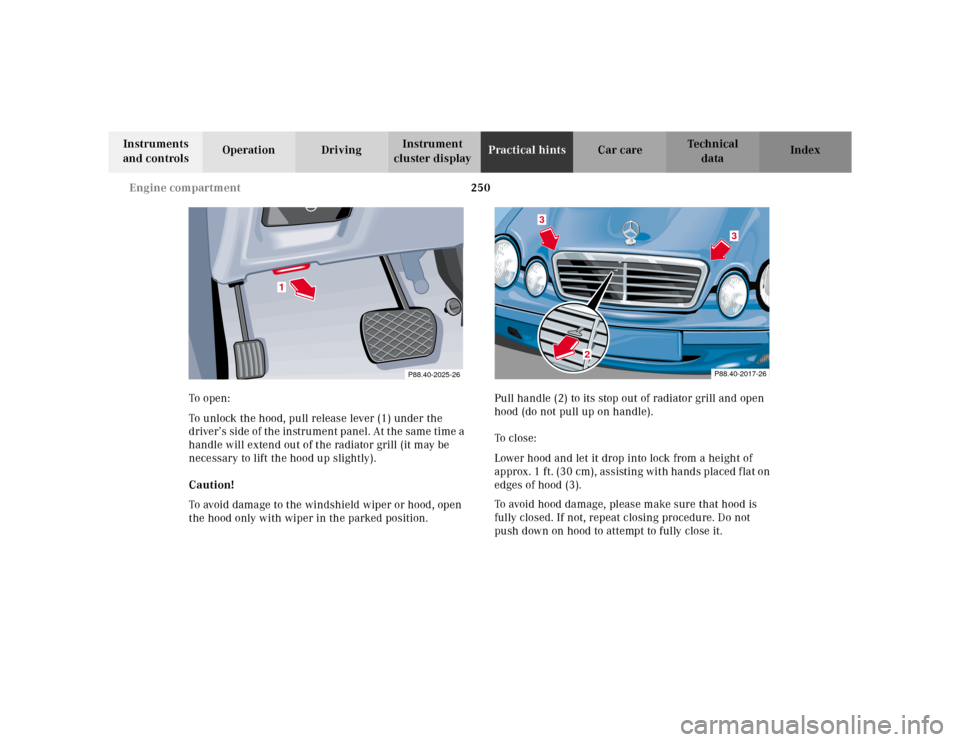
To unlock the hood, pull release lever (1) under the
driver’s side of the instrument panel. At the same time a
handle will extend out of the radiator grill (it may be
necessary to lift the hood up slightly).
Caution!
To avoid damage to the windshield wiper or hood, open
the hood only with wiper in the parked position.Pull handle (2) to its stop out of radiator grill and open
hood (do not pull up on handle).
To c l o s e :
Lower hood and let it drop into lock from a height of
approx. 1 ft. (30 cm), assisting with hands placed flat on
edges of hood (3).
To avoid hood damage, please make sure that hood is
fully closed. If not, repeat closing procedure. Do not
push down on hood to attempt to fully close it.
P88.40-2025-26
1
P88.40-2017-26
3
2
3
Page 272 of 325
269 Jump starting
Te ch n ica l
data Instruments
and controlsOperation DrivingInstrument
cluster displayPractical hintsCar care Index Proceed as follows:
1. Position the vehicle with the charged battery so that
the jumper cables will reach, but never let the
vehicles touch. Make sure the jumper cables do not
have loose or missing insulation.
2. On both vehicles:
•Turn off engine and all lights and accessories,
except hazard warning flashers or work lights.
•Apply parking brake and shift selector lever to
position “P”.
Important!
3. Clamp one end of the first jumper cable to the
positive (+) under hood terminal of the discharged
battery and the other end to the positive (+) terminal
of the charged battery. Make sure the cable clamps
do not touch any other metal parts.
4. Clamp one end of the second jumper cable to the
grounded negative (–) terminal of the charged
battery and the final connection to the negative (–)
terminal (2) of the discharged battery.Important!
5. Start engine of the vehicle with the charged battery
and run at high idle. Make sure the cables are not
on or near pulleys, fans, or other parts that move
when the engine is started. Allow the discharged
battery to charge for a few minutes. Start engine of
the disabled vehicle in the usual manner.
6. After the engine has started, remove jumper cables
by exactly reversing the above installation
sequence, starting with the last connection made
first. When removing each clamp, make sure that it
does not touch any other metal while the other end
is still attached.
Notes:
If engine does not run after several unsuccessful
starting attempts, have it checked at the nearest
authorized Mercedes-Benz Center.
Excessive unburned fuel may damage the catalytic
converter.
Page 292 of 325
289 Contents – Vehicle care
Te ch n ica l
data Instruments
and controlsOperation DrivingInstrument
cluster displayPractical hintsCar careIndex
Vehicle careCleaning and care
of the vehicle .............................290
Power washer .............................. 291
Paintwork, painted body
components ................................. 291
Tar stains ..................................... 291
Engine cleaning ..........................292
Vehicle washing .........................292
Ornamental moldings ................292
Headlamps, taillamps,
turn signal lenses ......................292Window cleaning ....................... 293
Wiper blade ................................ 293
Light alloy wheels ..................... 293
Instrument cluster ..................... 293
Steering wheel and
gear selector lever ..................... 293
Cup holder .................................. 294
Seat belts ..................................... 294
Hard plastic trim items ............. 294
Headliner and shelf
below rear window .................... 294
Upholstery .................................. 294
Plastic and rubber parts ........... 294
Page 295 of 325
292 Cleaning and care of the vehicle
Te ch n ica l
data Instruments
and controlsOperation DrivingInstrument
cluster displayPractical hintsCar careIndex
Engine cleaning
Prior to cleaning the engine compartment make sure to
protect electrical components and connectors from the
intrusion of water and cleaning agents.
Corrosion protection, such as MB Anticorrosion Wax
should be applied to the engine compartment after
every engine cleaning. Before applying, all control
linkage bushings and joints should be lubricated. The
poly-V-belt and all pulleys should be protected from any
wax.
Ve h i c l e w a s h i n g
Do not use hot water or wash your vehicle in direct
sunlight. Use only a mild car wash detergent, such as
Mercedes-Benz approved Car Shampoo.
Thoroughly spray the vehicle with a diffused jet of
water. Direct only a very weak spray towards the
ventilation intake. Use plenty of water and rinse the
sponge and chamois frequently.
Rinse with clear water and thoroughly wipe dry with a
chamois. Do not allow cleaning agents to dry on the
finish.In the winter, thoroughly remove all traces of road salt
as soon as possible.
When washing the underbody, do not forget to clean the
inner sides of the wheels.
Ornamental moldings
For regular cleaning and care of very dirty chrome-
plated parts, use a chrome cleaner.
Headlamps, taillamps, turn signal lenses
Use a mild car wash detergent, such as Mercedes-Benz
approved Car Shampoo, with plenty of water.
To prevent scratches, never apply strong force and use
only a soft, non-scratchy cloth when cleaning the lenses.
Do not attempt to wipe dirty lenses with a dry cloth or
sponge.
Page 307 of 325
304 Fuels, coolants, lubricants etc.
Te ch n ica l
data Instruments
and controlsOperation DrivingInstrument
cluster displayPractical hints Car care Index
Premium unleaded gasoline
Caution!
To maintain the engine’s durability and performance,
premium unleaded gasoline must be used. If premium
unleaded is not available and low octane fuel is used,
follow these precautions:
•have the fuel tank filled only partially with unleaded
regular and fill up with premium unleaded as soon
as possible,
•avoid full throttle driving and abrupt acceleration,
•do not exceed an engine speed of 3000 rpm, if the
vehicle is loaded with a light load such as two
persons and no luggage,
•do not exceed 2/3 of maximum accelerator pedal
position, if the vehicle is fully loaded or operating in
mountainous terrain.Fuel requirements
Use only Premium unleaded meeting ASTM
standard D 439:
The octane number (posted at the pump) must be
91 min. It is an average of both the Research (R) octane
number and the Motor (M) octane number: (R+M)/2).
This is also known as ANTI-KNOCK INDEX.
Unleaded gasoline containing oxygenates such as
Ethanol, IPA, IBA and TBA can be used provided the
ratio of any one of these oxygenates to gasoline does not
exceed 10%, MTBE not to exceed 15%.
The ratio of Methanol to gasoline must not exceed 3%
plus additional cosolvents.
Using mixtures of Ethanol and Methanol is not allowed.
Gasohol, which contains 10% Ethanol and 90% unleaded
gasoline, can be used.
These blends must also meet all other fuel requirements
such as resistance to spark knock, boiling range, vapor
pressure etc..
Page 318 of 325
315 Index
Te ch n ica l
data Instruments
and controlsOperation DrivingInstrument
cluster displayPractical hints Car careIndex
KKeys, vehicle ..................................................................... 24LLamps, exterior
Fog lamps ....................................................................114
Headlamp, adjusting ................................................278
Headlamps ..................... 114, 239, 240, 274, 278, 292
Low and high beam .......................................... 117, 275
Parking lamp ..............................................................114
Parking lamps ...........................................................275
Replacing bulbs .........................................................273
Side marker lamp, front ...........................................277
Standing lamp ............................................................114
Standing lamps ..........................................................275
Taillamp assemblies ......................................... 114, 276
Turn signal lamp ............................................... 117, 275
Layout of poly-V-belt drive ............................................298
LIGHT SENSOR - malfunction
and warning messages ............................................240
Lighter ............................................................................. 158
LIGHTING SYSTEM - malfunction
and warning messages ............................................239Limp home mode (Automatic transmission) ............. 199
Loading instructions ...................................................... 160
Locking and unlocking .................................................... 30
Low engine coolant level warning .............................. 237
MMaintenance ...................................................................175
Malfunction and indicator lamps
in the instrument cluster ........................................ 226
Malfunction and warning messages ...........................231
ABS-SYSTEM ............................................................. 234
BATTERY/ALTERNATOR ......................................... 233
BRAKE ASSIST ......................................................... 234
BRAKE FLUID ........................................................... 235
BRAKE LINING WEAR ............................................ 235
COOLANT (coolant level) ........................................ 237
COOLANT TEMP. (coolant temperature) .............. 238
DISPLAY DEFECTIVE (engine control unit) ........ 232
DISPLAY DEFECTIVE (several systems) ............... 232
ELEC. STABIL. PROGR. ............................................ 242
ENGINE FAN ............................................................. 236
ENGINE OIL LEVEL .................................................. 241
LIGHT SENSOR ......................................................... 240
LIGHTING SYSTEM .................................................. 239