Page 140 of 232
The high-current fuses are coded as follows.
Fuse/RelayLocation Fuse Amp
Rating Power Distribution Box Description
Horn 15A Horn
H/L LH 15A* Headlamp (High/Low Left, High Beams)
H/L RH 15A* Headlamp (High/Low Right,, High Beams) EEC 5A* EEC (KPWR)
HEGO 15A* HEGO 1,2, CMS 1,2, VMV FUEL 20A* Fuel Pump, EEC (FPM)
DIODE Ð Ð
MAIN 120A
HEGO 15A
ALT 15A FOG 20A (DRL) 5A
PWR 1 15A
(ABS) 25A PWR 2
15A
A/C 15A FUEL
20A DIODE DIODE
H/L LH
15A H/L RH
15A EEC 5A
HEGO
15A
HORN
15A
FUEL20A DIODE DIODE
H/L LH
15A H/L RH
15A EEC 5A
INJ
30A
HTR 40A
BTN 1 40ABTN 240AR DEF30AIG
MAIN 40A
H/L
RELAY MICRO
MAIN FAN(ABS) 60AST RELAY ISO DEF RELAY
ISO ADD FAN 2
ISO
A/C RELAYMICRO
FOG RELAY
MICRO
MAIN FAN ISO
ADD FAN
ISO
EEC MAIN
ISO FUEL PUMP
ISO
ALT 15A
FOG 20A (DRL) 15A
PWR 115A
DRLZ 15A
HLEV 10A
(ABS)25A PWR 2
15A
A/C 15A
40/50A
ADD
FAN
40/50A
Roadside emergencies
140
Page 142 of 232

Fuse/RelayLocation Fuse Amp
Rating Power Distribution Box Description
FUEL
PUMP ISO Ð Fuel Pump Relay
MAIN FAN ISO Ð Low Speed Fan Control Relay
(2.0L Engine)
High Speed Fan Control Relay 1
(3.0L Engine)
ADD FAN ISO Ð High Speed Fan Control Relay 1
(2.0L Engine)
Low Speed Fan Control Relay
(3.0L Engine)
DEF RELAY ISO Ð Rear Defroster Relay
ST RELAY ISO Ð Starter Relay
ADD FAN 2 ISO Ð High Speed Fan Control Relay 2
(3.0L Engine)
Medium Speed Fan Control Relay
(2.0L Engine)
FOG RELAY MICRO Ð Foglamp Relay
A/C RELAY MICRO Ð A/C Clutch Relay
CHANGING THE TIRES
If you get a flat tire while driving, do not apply the brake heavily.
Instead, gradually decrease your speed. Hold the steering wheel firmly
and slowly move to a safe place on the side of the road.
Temporary spare tire information
Your vehicle may have a temporary or conventional spare tire. The
temporary spare tire for your vehicle is labeled as such. It is smaller than
a regular tire and is designed for emergency use only. Replace this tire
with a full-size tire as soon as possible.
Roadside emergencies
142
Page 150 of 232
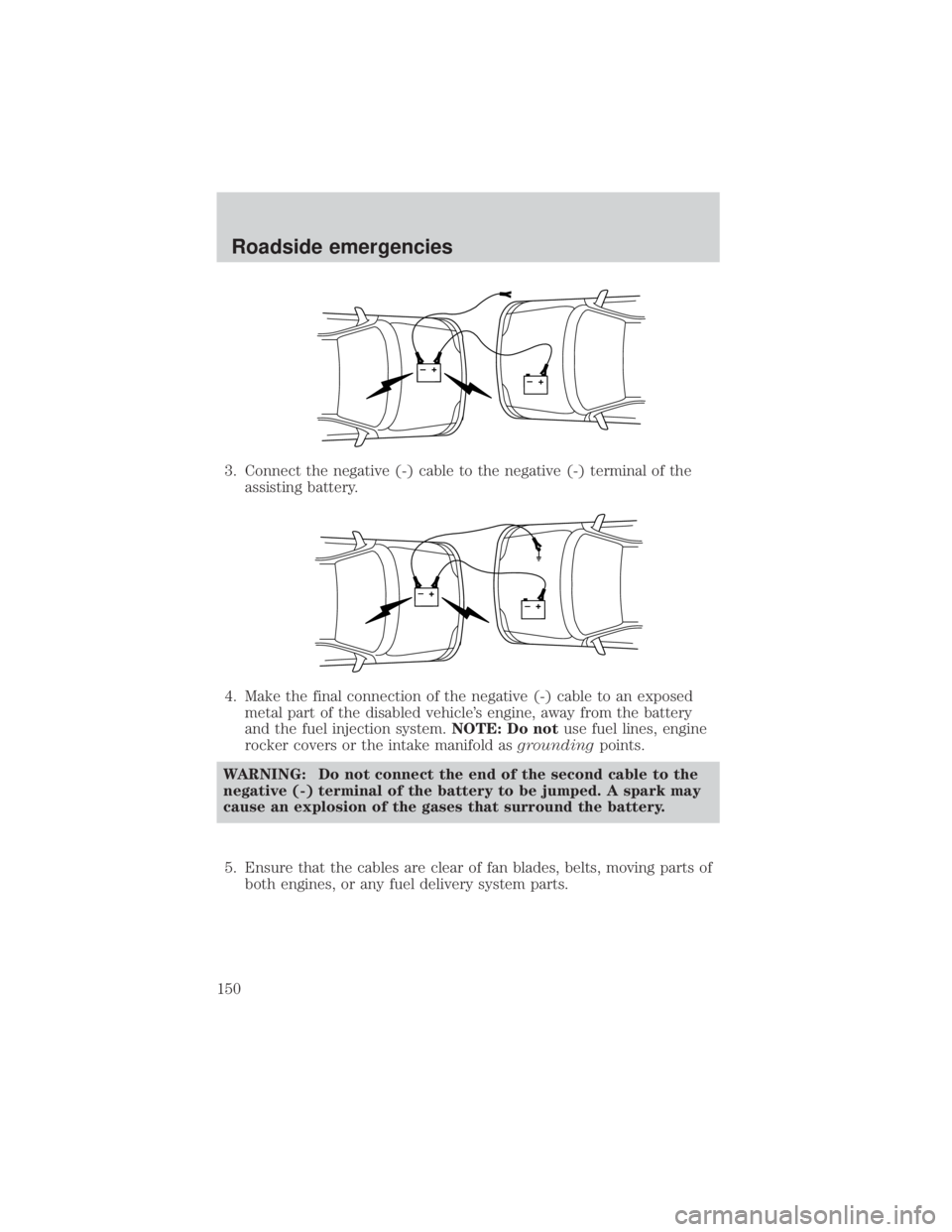
3. Connect the negative (-) cable to the negative (-) terminal of theassisting battery.
4. Make the final connection of the negative (-) cable to an exposed metal part of the disabled vehicle's engine, away from the battery
and the fuel injection system. NOTE: Do notuse fuel lines, engine
rocker covers or the intake manifold as groundingpoints.
WARNING: Do not connect the end of the second cable to the
negative (-) terminal of the battery to be jumped. A spark may
cause an explosion of the gases that surround the battery.
5. Ensure that the cables are clear of fan blades, belts, moving parts of both engines, or any fuel delivery system parts.
+–+–
+–+–
Roadside emergencies
150
Page 156 of 232

SCHEDULE 1
I: Inspect and repair, clean, adjust, or replace if necessary
(Oil-permeated air filter cannot be cleaned using the air-blow method)
R: Replace
L: Lubricate
Maintenance ItemMaintenance Interval (Number of months or km (miles),
whichever comes first)
Months 6 12 18 24 30 36 42 48 54 60 66 72
x 1000 Km 12 24 36 48 60 72 84 96 108 120 132 144
(x 1000 Miles) (7.5) (15) (22.5) (30) (37.5) (45) (52.5) (60) (67.5) (75) (82.5) (95)
ENGINE
Engine valve clearance
(for 2.0L engine) I
Engine timing belt (for 2.0L engine) Replace every 144,000 km (90,000 miles)
Engine oil R RRRRRRRRRR R
Oil filter R RRRRRRRRRR R
Drive belts I I I
PCV valve (for 2.0L engine) *1 Replace every 96,000 km (60,000 miles
PCV valve (for 3.0L engine) *1 Replace every 160,000 km (100,000 miles)
Hoses and tubes for
emission *1 I
IGNITION SYSTEM
Spark plugs (PLATINUM-TIPPED
type) Replace every 160,000 km (100,000 miles)
FUEL SYSTEM
Air cleaner filter R R R
Fuel filter *1 R R R
Fuel lines and hoses *1 I I I
COOLING SYSTEM
Cooling system I I I
Engine coolant Replace at first 72,000 km (45,000 miles) or 36 months; after that, every 48,000 km (30,000
miles) or 24 months
Maintenance and care
156
Page 158 of 232

SCHEDULE 2
I: Inspect and repair, clean, adjust, or replace if necessary
(Oil-permeated air filter cannot be cleaned using the air-blow method)
R: Replace
L: Lubricate
Maintenance ItemMaintenance Interval (Number of months or km (miles),
whichever comes first)
Months 4 8 12 16 20 24 28 32 36 40 44 48
x 1000 Km 8 16 24 32 40 48 56 64 72 80 88 96
(x 1000 Miles) (5) (10) (15) (20) (25) (30) (35) (40) (45) (50) (55) (60)
ENGINE
Engine valve clearance
(for 2.0L engine) I
Engine timing belt (for 2.0L engine) Replace every 144,000 km (90,000 miles)
Engine oil R RRRRRRRRRR R
Engine oil (for Puerto Rico) Replace every 4,800 km (3,000 miles) (or 3 months)
Oil filter R RRRRRRRRRR R
Drive belts I I
PCV valve (for 2.0L engine) *1 Replace every 96,000 km (60,000 miles)
PCV valve (for 3.0L engine) *1 Replace every 160,000 km (100,000 miles)
Hoses and tubes for emission *1 I
IGNITION SYSTEM
Spark plugs
(PLATINUM TIPPED type) Replace every 160,000 km (100,000 miles)
FUEL SYSTEM
Air cleaner filter I R I R
Fuel filter *1 R R
Fuel lines & hoses *1 I I
COOLING SYSTEM
Cooling system I I
Engine coolant Replace at first 72,000 km (45,000 miles) or 36 months; after that, every 48,000 km (30,000
miles) or 24 months
Engine coolant level I IIIIIIIIII I
Maintenance and care
158
Page 160 of 232

SERVICE RECOMMENDATIONS
To help you service your vehicle:
²We highlight do-it-yourself items in the engine compartment for easy
location.
² We provide a Scheduled Maintenance section which makes tracking
routine service easy.
If your vehicle requires professional service, your dealership can provide
necessary parts and service. Check your ªWarranty Informationº to find
out which parts and services are covered.
Use only recommended fuels, lubricants, fluids and service parts
conforming to specifications. Genuine Mazda parts are designed and built
to provide the best performance in your vehicle.
PRECAUTIONS WHEN SERVICING YOUR VEHICLE
Be especially careful when inspecting or servicing your vehicle. To avoid
damage and/or personal injury:
² Do not work on a hot engine.
² When the engine is running, make sure that loose clothing, jewelry or
long hair does not get caught up in moving parts.
² Do not work on a vehicle with the engine running in an enclosed
space, unless you are sure you have enough ventilation.
² Keep all lit cigarettes, open flames and other lit material away from
the battery and all fuel related parts.
If you disconnect the battery, the engine must ªrelearnº its idle
conditions before your vehicle will drive properly, as explained in Battery
in this chapter.
Maintenance and care
160
Page 170 of 232

WARNING: Do not let the fluid level in the reservoir for the
master cylinder fall below the MIN mark. If master cylinder
runs dry, this may cause the brakes to fail.
CLUTCH FLUID (MANUAL TRANSAXLE)
The clutch master cylinder and
brake master cylinder are part of
the same system; both are refillable
through the brake master cylinder
with brake fluid. For more
information on brake fluid
maintenance, refer to Brake fluidin
this chapter.
WARNING: Brake fluid is toxic. If brake fluid contacts the
eyes, flush eyes with running water for 15 minutes. Seek
medical if irritation persists. If taken internally, drink water
and induce vomiting. Seek medical attention immediately.
WINDSHIELD WASHER FLUID
Checking and adding washer fluid
Check the washer fluid whenever
you stop for fuel. The reservoir is
highlighted with a
symbol.
If the level is low, add enough fluid
to fill the reservoir. In very cold
weather, do not fill the reservoir all
the way.
Only use a washer fluid that meets Mazda specifications. Refer to
Lubricant specifications in theCapacities and specifications chapter.
Maintenance and care
170
Page 181 of 232

WARNING: Keep batteries out of reach of children. Batteries
contain sulfuric acid. Avoid contact with skin, eyes or clothing.
Shield your eyes when working near the battery to protect
against possible splashing of acid solution. In case of acid
contact with skin or eyes, flush immediately with water for a
minimum of 15 minutes and get prompt medical attention. If
acid is swallowed, call a physician immediately.
WARNING: Battery posts, terminals and related accessories
contain lead and lead compounds. Wash hands after handling.
Because your vehicle's engine is electronically controlled by a computer,
some control conditions are maintained by power from the battery. When
the battery is disconnected or a new battery is installed, the engine must
relearn its idle and fuel trim strategy for optimum driveability and
performance. To begin this process: 1. With the vehicle at a complete stop, set the parking brake.
2. Put the gearshift in P (Park) (automatic transmission) or the neutral position (manual transmission), turn off all accessories and start the
engine.
3. Run the engine until it reaches normal operating temperature.
4. Allow the engine to idle for at least one minute.
5. Turn the A/C on and allow the engine to idle for at least one minute.
6. Drive the vehicle to complete the relearning process.
NOTE:
² The vehicle may need to be driven to relearn the idle and fuel trim
strategy.
² If you do not allow the engine to relearn its idle trim, the idle
quality of your vehicle may be adversely affected until the idle
trim is eventually relearned.
When the battery is disconnected or a new battery installed, the
transmission must relearn its adaptive strategy. As a result of this, the
transmission may shift firmly. This operation is considered normal and
will not affect function or durability of the transmission. Over time the
adaptive learning process will fully update transmission operation to its
optimum shift feel.
Maintenance and care
181