2001 MAZDA MODEL TRIBUTE 4WD brake light
[x] Cancel search: brake lightPage 114 of 232
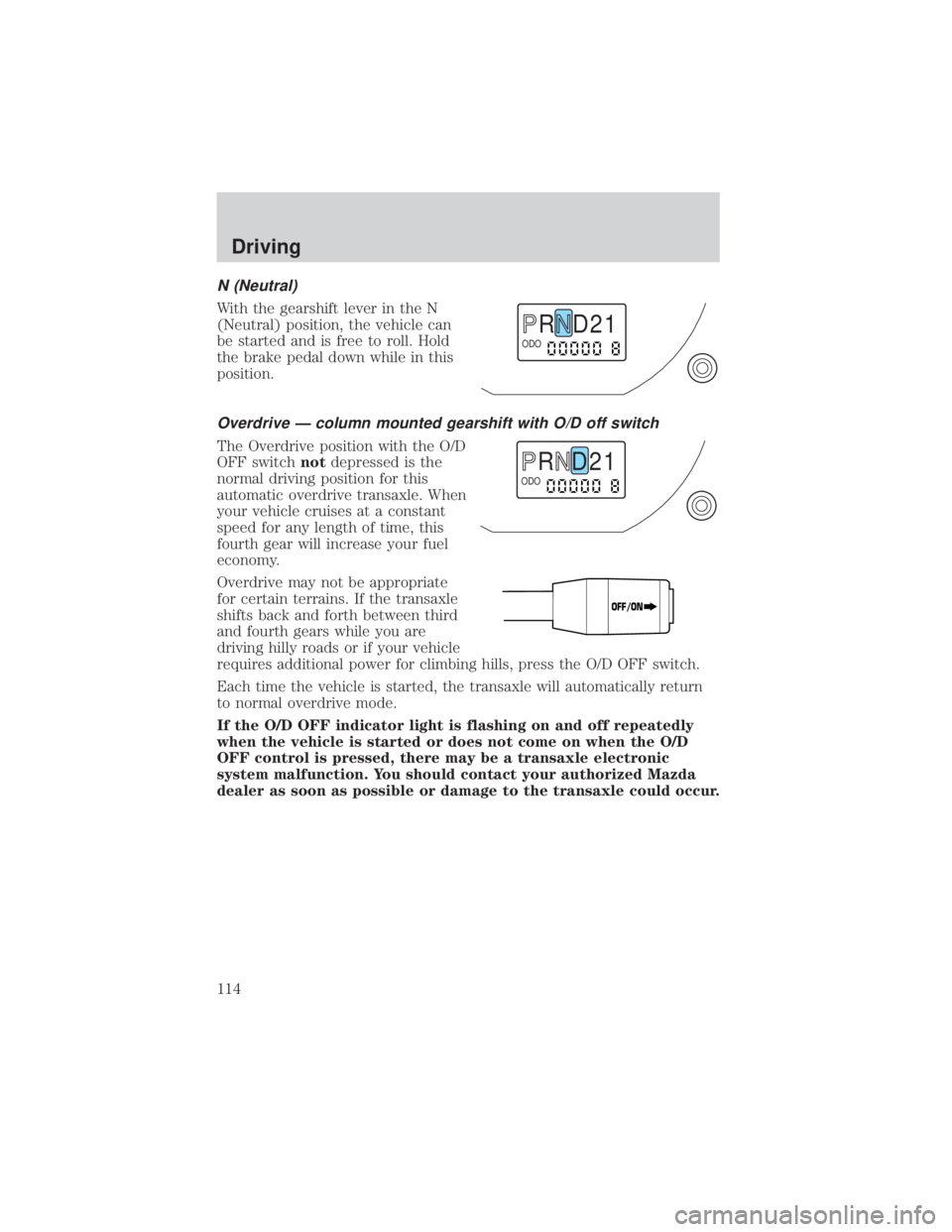
N (Neutral)
With the gearshift lever in the N
(Neutral) position, the vehicle can
be started and is free to roll. Hold
the brake pedal down while in this
position.
Overdrive Ð column mounted gearshift with O/D off switch
The Overdrive position with the O/D
OFF switchnotdepressed is the
normal driving position for this
automatic overdrive transaxle. When
your vehicle cruises at a constant
speed for any length of time, this
fourth gear will increase your fuel
economy.
Overdrive may not be appropriate
for certain terrains. If the transaxle
shifts back and forth between third
and fourth gears while you are
driving hilly roads or if your vehicle
requires additional power for climbing hills, press the O/D OFF switch.
Each time the vehicle is started, the transaxle will automatically return
to normal overdrive mode.
If the O/D OFF indicator light is flashing on and off repeatedly
when the vehicle is started or does not come on when the O/D
OFF control is pressed, there may be a transaxle electronic
system malfunction. You should contact your authorized Mazda
dealer as soon as possible or damage to the transaxle could occur.
R D 2 1ODO
R D 2 1ODO
OFF/ON
Driving
114
Page 122 of 232
²Maintain steering wheel control at all times, especially in
rough terrain. Since sudden changes in terrain can result in
abrupt steering wheel motion, make sure you grip the steering
wheel from the outside. Do not grip the spokes.
² Drive cautiously to avoid vehicle damage from concealed
objects such as rocks and stumps.
You should either know the terrain or examine maps of the area before
driving. Map out your route before driving in the area.
If your vehicle gets stuck
If the vehicle is stuck in mud or snow select the 4x4 ON operating mode.
It may be rocked out by shifting from forward and reverse gears,
stopping between shifts, in a steady pattern. Press lightly on the
accelerator in each gear.
² Do not rock the vehicle if the engine is not at normal operating
temperature or damage to the transaxle may occur.
²
Do not rock the vehicle for more than a few minutes or damage
to the transaxle and tires may occur or the engine may overheat.
WARNING: Do not spin the wheels at over 56 km/h (35 mph).
The tires may fail and injure a passenger or bystander.
Sand
When driving over sand, try to keep all four wheels on the most solid
area of the trail. Do not reduce the tire pressures but shift to a lower
gear and drive steadily through the terrain. Apply the accelerator slowly
and avoid spinning the wheels.
Mud and water
NOTE:
² If you must drive through high water, drive slowly. Traction or brake
capability may be limited.
² When driving through water, determine the depth; avoid water higher
than the bottom of the hubs (if possible) and proceed slowly. If the
ignition system gets wet, the vehicle may stall.
² Once through water, always try the brakes. Wet brakes do not stop the
vehicle as effectively as dry brakes. Drying can be improved by moving
your vehicle slowly while applying light pressure on the brake pedal.
Driving
122
Page 127 of 232

If driving through deep or standing water is unavoidable, proceed very
slowly. Never drive through water that is higher than the bottom of the
hubs (for trucks) or the bottom of the wheel rims (for cars).
Once through the water, always try the brakes. Wet brakes do not stop
the vehicle as effectively as dry brakes. Drying can be improved by
moving your vehicle slowly while applying light pressure on the brake
pedal.
Driving through deep water where the transmission vent tube is
submerged may allow water into the transmission and cause
internal transmission damage.
TRAILER TOWING
Trailer towing with your vehicle may require the use of a trailer tow
option package.
Trailer towing puts additional loads on your vehicle's engine, transaxle,
axle, brakes, tires, and suspension. For your safety and to maximize
vehicle performance, be sure to use the proper equipment while towing.
Follow these guidelines to ensure safe towing procedure:
²Stay within your vehicle's load limits.
² Thoroughly prepare your vehicle for towing. Refer to Preparing to
tow in this chapter.
² Use extra caution when driving while trailer towing. Refer to Driving
while you tow in this chapter.
² Service your vehicle more frequently if you tow a trailer. Refer to the
ªScheduled Maintenanceº section of this manual.
² Do not tow a trailer until your vehicle has been driven at least 800 km
(500 miles).
² Refer to the instructions included with towing accessories for the
proper installation and adjustment specifications.
Do not exceed the maximum loads listed on the Certification label. For
load specification terms found on the label, refer to Vehicle loadingin
this chapter. Remember to figure in the tongue load of your loaded
vehicle when figuring the total weight.
Driving
127
Page 141 of 232

Fuse/RelayLocation Fuse Amp
Rating Power Distribution Box Description
DIODE Ð Ð
H/L RELAY MICRO Ð Headlamp (High/Low, Right/Left Relay)
ÐÐÐ
INJ 30A** EEC (VPWR), EVR, MAF, IAC, Bulkhead
MAIN 120A Main ALT 15A* Alternator/ Regulator
(DRL) 15A* DRL Unit (feed), DRL Relay
(DRLZ)
(HELV) 15A*(DRLZ)
10A(HLEV) Daytime Running Lamps (DRL) Module,
HLEV
PWR 1 15A* Auxiliary Power Point FOG 20A* Foglamps RH/LH, Foglamp IndicatorA/C 15A* A/C Clutch
(ABS) 25A* Anti-Lock Brake System SOL
PWR 2 15A* Auxiliary Power Point
IG MAIN 40A** Starter HTR 40A** Blower Motor, Blower Motor Relay
BTN 1 40A** JB Ð Acc. Relay, Radio, Cigar Lighter, Cluster, Power Mirror, GEM, Electronic
Flasher Control
(ABS) 60A** Anti-Lock Brake System Motor
BTN 2 40A** JB Ð Radio, Cluster, Dome Lamps, Map Lamps, Cargo Lamps, Cruise Control, Power
Seat, Horn
MAIN FAN 40A** (2.0L)
50A(3.0L) Main Fan
R DEF 30A** Rear Defroster
ADD FAN 40A**(2.0L) 50A(3.0L)Add Fan
EEC MAIN ISO Ð EEC Relay
Roadside emergencies
141
Page 159 of 232
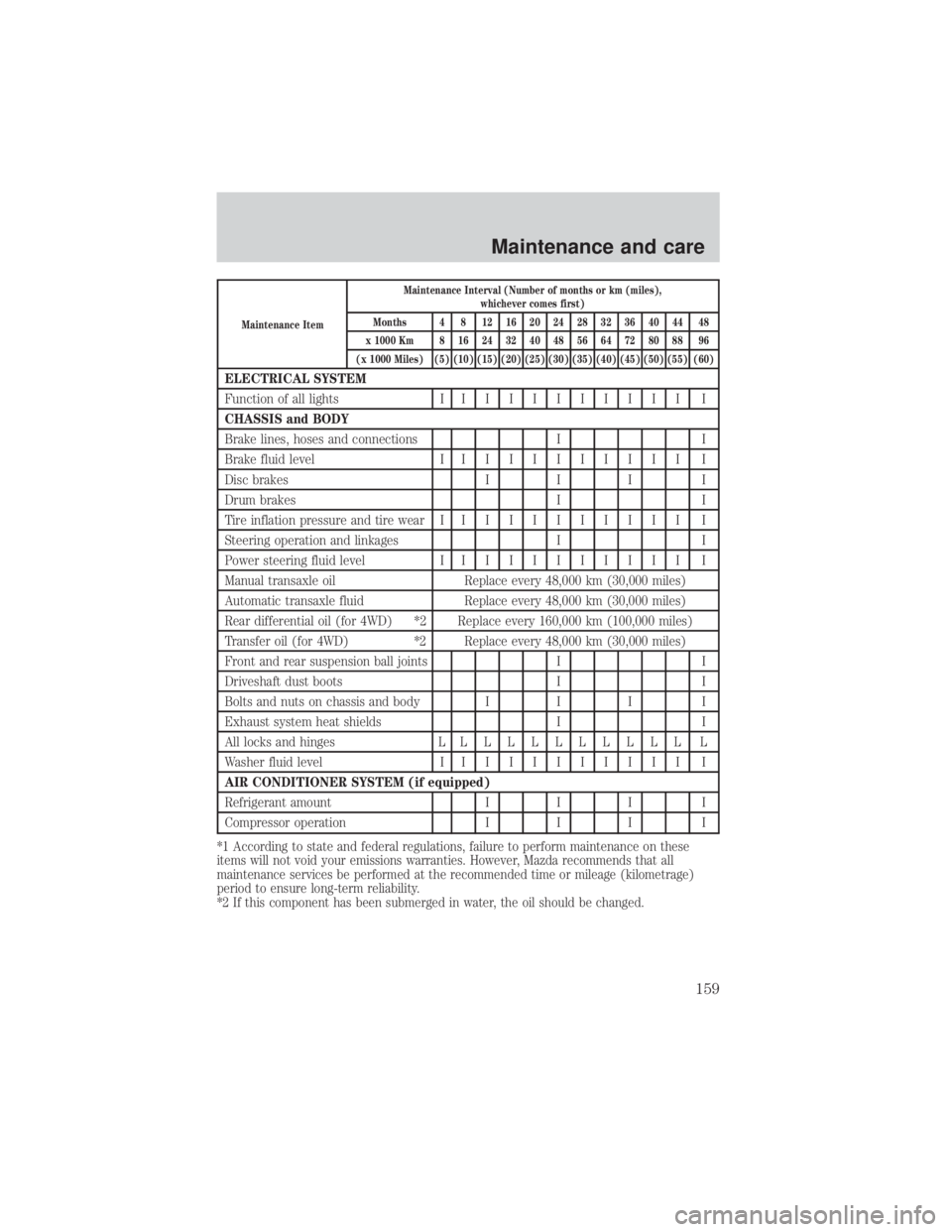
Maintenance ItemMaintenance Interval (Number of months or km (miles),
whichever comes first)
Months 4 8 12 16 20 24 28 32 36 40 44 48
x 1000 Km 8 16 24 32 40 48 56 64 72 80 88 96
(x 1000 Miles) (5) (10) (15) (20) (25) (30) (35) (40) (45) (50) (55) (60)
ELECTRICAL SYSTEM
Function of all lights IIIIIIIIIII I
CHASSIS and BODY
Brake lines, hoses and connections I I
Brake fluid level I IIIIIIIIII I
Disc brakes I I I I
Drum brakes I I
Tire inflation pressure and tire wear I IIIIIIIIII I
Steering operation and linkages I I
Power steering fluid level I IIIIIIIIII I
Manual transaxle oil Replace every 48,000 km (30,000 miles)
Automatic transaxle fluid Replace every 48,000 km (30,000 miles)
Rear differential oil (for 4WD) *2 Replace every 160,000 km (100,000 miles)
Transfer oil (for 4WD) *2 Replace every 48,000 km (30,000 miles)
Front and rear suspension ball joints I I
Driveshaft dust boots I I
Bolts and nuts on chassis and body I I I I
Exhaust system heat shields I I
All locks and hinges L LLLLLLLLLL L
Washer fluid level I IIIIIIIIII I
AIR CONDITIONER SYSTEM (if equipped)
Refrigerant amount I I I I
Compressor operation I I I I
*1 According to state and federal regulations, failure to perform maintenance on these
items will not void your emissions warranties. However, Mazda recommends that all
maintenance services be performed at the recommended time or mileage (kilometrage)
period to ensure long-term reliability.
*2 If this component has been submerged in water, the oil should be changed.
Maintenance and care
159
Page 170 of 232

WARNING: Do not let the fluid level in the reservoir for the
master cylinder fall below the MIN mark. If master cylinder
runs dry, this may cause the brakes to fail.
CLUTCH FLUID (MANUAL TRANSAXLE)
The clutch master cylinder and
brake master cylinder are part of
the same system; both are refillable
through the brake master cylinder
with brake fluid. For more
information on brake fluid
maintenance, refer to Brake fluidin
this chapter.
WARNING: Brake fluid is toxic. If brake fluid contacts the
eyes, flush eyes with running water for 15 minutes. Seek
medical if irritation persists. If taken internally, drink water
and induce vomiting. Seek medical attention immediately.
WINDSHIELD WASHER FLUID
Checking and adding washer fluid
Check the washer fluid whenever
you stop for fuel. The reservoir is
highlighted with a
symbol.
If the level is low, add enough fluid
to fill the reservoir. In very cold
weather, do not fill the reservoir all
the way.
Only use a washer fluid that meets Mazda specifications. Refer to
Lubricant specifications in theCapacities and specifications chapter.
Maintenance and care
170
Page 204 of 232

Replacing front parking lamp/turn signal bulbs
For bulb replacement, see an authorized Mazda dealer.
Replacing high-mount brake lamp bulbs
For bulb replacement, see an authorized Mazda dealer.
Replacing the interior bulbs
Check the operation of the following interior bulbs frequently:
²interior overhead lamp
² map lamp
For bulb replacement, see an authorized Mazda dealer.
USING THE RIGHT BULBS
Replacement bulbs are specified in the chart below. Headlamp bulbs
must be marked with an authorized ªD.O.T.º for North America and an
ªEº for Europe to assure lamp performance, light brightness and pattern
and safe visibility.
NOTE: The correct bulbs will not damage the lamp assembly or void the
lamp assembly warranty and will provide quality bulb burn time.
Function Number of bulbs Trade number
Park/turn lamps (front) 2 3157 AK (amber)
Headlamps 2 9007
Rear stop/tail lamps 2 3157K
Rear turn lamps 2 3156K
Rear license plate lamps 2 3156K/168
Backup lamp 2 3156K
Rear/turn/sidemarker 2 916NA (amber)
Fog lamp (if equipped) 2 899
Cargo lamp 1 211-2
Interior overhead lamp 1 912 (906)
Front door courtesy lamp 1 168
Map lamps 2 168 (T10)
Ashtray lamp 1 161
All replacement bulbs are clear in color except where noted.
To replace all instrument panel lights - see your dealer.
Maintenance and care
204
Page 225 of 232

A
Air bag supplemental restraint
system ....................................83, 88and child safety seats ..............85
description ..........................83, 88
disposal ......................................92
driver air bag ......................86, 90
indicator light ...............10, 87, 91
operation .............................86, 90
passenger air bag ...............86, 90
side air bag ................................88
Air cleaner filter .......................182
Air conditioning ..........................20
All Wheel Drive (AWD),
driving off road ...................19, 120
Antifreeze (see Engine
coolant) .....................................171
Anti-lock brake system
(see Brakes) ......................107±108
Anti-theft system ........................65 arming the system ....................65
disarming a triggered system ..66
warning light .............................11
Audio system (see Radio) .........23
Automatic transaxle .................111 driving with .............................113
fluid, adding ............................177
fluid, checking ........................177
Automatic transmission fluid, refill capacities ..............212
Auxiliary power point .................54
Axle refill capacities ........................212 B
Battery .......................................179
acid, treating emergencies .....179
charging system
warning light .............................12
jumping a disabled battery ....147
maintenance-free ....................179
servicing ..................................179
Brakes ........................................107 anti-lock ...........................107±108
anti-lock brake system
(ABS) warning light .........10, 108
brake warning light ..................10
fluid, checking and adding ....169
fluid, refill capacities ..............212
fluid, specifications .................214
lubricant specifications ..........214
parking ....................................109
shift interlock ..........................111
Break-in period .............................3
C
Capacities for refilling fluids ....212
Cargo cover .................................55
Certification Label ....................216
Child safety restraints ................92 child safety belts ......................92
Child safety seats ..................93±94 attaching with tether straps ....97
in front seat ..............................95
in rear seat ................................95
LATCH .......................................99
Cleaning your vehicle ...............206 engine compartment ..............208
exterior ....................................207
exterior lamps .........................209
instrument panel ....................210
Index
225