2001 LAND ROVER FREELANDER warning
[x] Cancel search: warningPage 57 of 1007
GENERAL INFORMATION
03-26
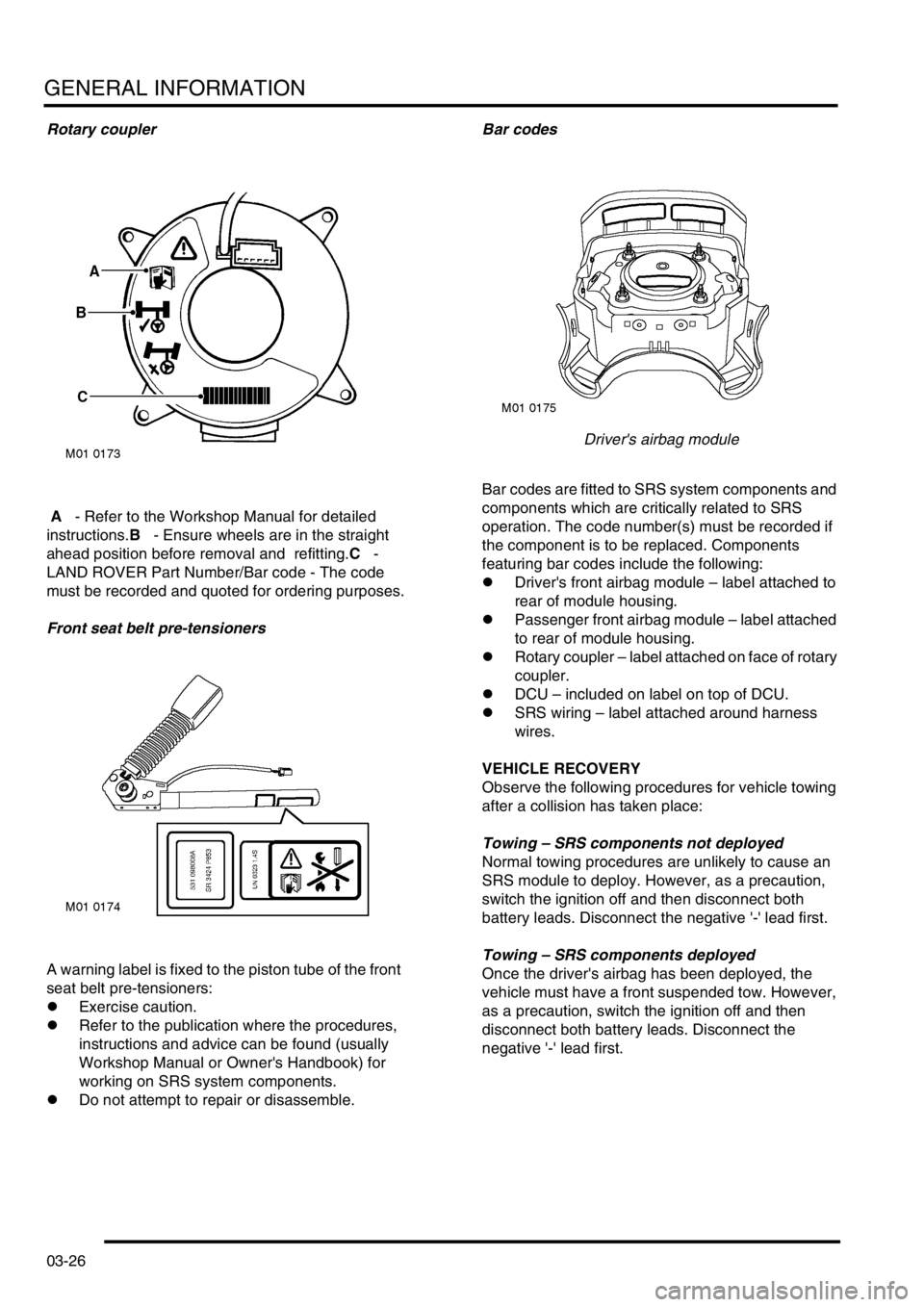
Rotary coupler
A - Refer to the Workshop Manual for detailed
instructions.B - Ensure wheels are in the straight
ahead position before removal and refitting.C -
LAND ROVER Part Number/Bar code - The code
must be recorded and quoted for ordering purposes.
Front seat belt pre-tensioners
A warning label is fixed to the piston tube of the front
seat belt pre-tensioners:
lExercise caution.
lRefer to the publication where the procedures,
instructions and advice can be found (usually
Workshop Manual or Owner's Handbook) for
working on SRS system components.
lDo not attempt to repair or disassemble.Bar codes
Driver's airbag module
Bar codes are fitted to SRS system components and
components which are critically related to SRS
operation. The code number(s) must be recorded if
the component is to be replaced. Components
featuring bar codes include the following:
lDriver's front airbag module – label attached to
rear of module housing.
lPassenger front airbag module – label attached
to rear of module housing.
lRotary coupler – label attached on face of rotary
coupler.
lDCU – included on label on top of DCU.
lSRS wiring – label attached around harness
wires.
VEHICLE RECOVERY
Observe the following procedures for vehicle towing
after a collision has taken place:
Towing – SRS components not deployed
Normal towing procedures are unlikely to cause an
SRS module to deploy. However, as a precaution,
switch the ignition off and then disconnect both
battery leads. Disconnect the negative '-' lead first.
Towing – SRS components deployed
Once the driver's airbag has been deployed, the
vehicle must have a front suspended tow. However,
as a precaution, switch the ignition off and then
disconnect both battery leads. Disconnect the
negative '-' lead first.
Page 58 of 1007
GENERAL INFORMATION
03-27
SRS component manual deployment
If a vehicle is to be scrapped and contains an
undeployed airbag module, the module must be
manually deployed. Always observe the following
precautions:
WARNING: Only personnel who have undergone
the appropriate training should undertake
deployment of airbag and seat belt pre-tensioner
modules.
WARNING: A deployed airbag or seatbelt pre-
tensioner is very hot, DO NOT return to a
deployed airbag module until at least 30 minutes
have elapsed since deployment.
WARNING: Only use approved deployment
equipment, and only deploy SRS components in
a well ventilated designated area. Ensure SRS
components are not damaged or ruptured before
deployment. Notify the relevant authorities.
WARNING: If a vehicle is to be scrapped,
undeployed airbag modules and pre-tensioner
units must be deployed in accordance with the
instructions in this manual.
WARNING: Contact with chemicals from
deployed and damaged SRS components could
present a health hazard, wear protective clothing
when handling. DO NOT eat, drink or smoke
when handling SRS components.
WARNING: Deployment of airbag modules and
seatbelt pre-tensioners can cause injury to
personnel in the close vicinity of the deploying
unit. In case of injury seek urgent medical advice.
Possible sources of injury include:
limpact - due to inflating airbag or pre-
tensioner operation causing component
'kick'.
l hearing - due to noise produced by
deploying airbags and seatbelt pre-
tensioner units.
l burns - hot component parts and gases.
l irritation to eyes and lungs - from deploying
gases or combustion residue.
WARNING: Ensure the SRS component to be
deployed is securely fastened to its mounting.WARNING: Deployment procedures detailed in
this manual should be strictly adhered to.
Compliance with the following precautions
MUST be ensured:
lOnly use deployment equipment approved
for the intended purpose.
lBefore commencing deployment procedure,
ensure the deployment tool functions
properly by performing the self test
procedure detailed in the SRS Repairs
section of this manual.
lDeployment of airbag/pre-tensioner
modules should be performed in a well
ventilated area which has been designated
for the purpose.
lEnsure airbag/pre-tensioner modules are
not damaged or ruptured before attempting
to deploy.
lNotify the relevant authorities of intention to
deploy airbag and pre-tensioner units.
lWhen deploying airbag and seatbelt pre-
tensioner units, ensure that all personnel are
at least 15 metres away from the deployment
zone.
lEnsure deployment tool is connected
correctly, in compliance with the
instructions detailed in this manual. In
particular, ensure deployment tool is NOT
connected to battery supply before
connecting to the airbag or seatbelt pre-
tensioner module connector.
lWhen deploying seatbelt pre-tensioners in
the vehicle, ensure the pre-tensioner unit is
fully secured to its fixing point.
lWhen removing deployed airbag and
seatbelt pre-tensioner modules, wear
protective clothing. Use gloves and seal
deployed units in a plastic bag.
lFollowing deployment of any component of
the SRS system within the vehicle, all SRS
components must be replaced. DO NOT re-
use or salvage any parts of the SRS system.
lDo not lean over airbag modules or seatbelt
pre-tensioner units when connecting
deployment equipment.
WARNING: During deployment parts of the
airbag module become hot enough to burn you.
Wait 30 minutes after deployment before
touching the airbag module.
Page 60 of 1007
GENERAL INFORMATION
03-29
Air conditioning system precautions
General
The air conditioning system contains fluids and
components which could be potentially hazardous to
the service engineer or the environment if not
serviced and handled correctly. The following
guidelines are intended to alert the service engineer
to potential sources of danger and emphasise the
importance of ensuring the integrity of the Air
Conditioning operating conditions and components
fitted to the vehicle.
Where necessary, additional specific precautions are
detailed in the relevant sections of this Manual which
should be referred to prior to commencing repair
operations.
The refrigerant used in the air conditioning system is
HFC-134a (Hydrofluorocarbon) R134a. Always
adhere to the following precautions:
WARNING: Servicing must only be carried out by
personnel familiar with both the vehicle system
and the charging and testing equipment. All
operations must be carried out in a well
ventilated area away from open flame and heat
sources.
WARNING: Do not allow a refrigerant container to
be heated by direct flame or to be placed near
any heating appliance. A refrigerant container
must not be heated above 50
°C.
Do not leave a container of refrigerant without its
cap fitted. Do not transport a container of
refrigerant that is unrestrained, especially in the
boot of a car.
WARNING: Do not smoke or weld in areas where
R134a is in use. Inhalation of concentrations of
vapour can cause dizziness, disorientation,
incoordination, narcosis, nausea or vomiting.
R134a is odourless and colourless. Do not
handle or discharge in an enclosed area, or any
area where the vapour and liquid can come in
contact with a naked flame or hot metal. R134a is
not flammable but can cause a highly toxic gas.
WARNING: Do not allow fluids other than R134a
or compressor lubricant to enter the air
conditioning system. Spontaneous combustion
may occur.WARNING: R134a is a hazardous liquid and when
handled incorrectly can cause serious injury.
Suitable protective clothing, consisting of face
protection, heat proof gloves, rubber boots and
rubber apron or waterproof overalls, must be
worn when carrying out operations on the air
conditioning system.
WARNING: Due to its low evaporating
temperature, R134a must be handled with care.
R134a splashed on any part of the body will
cause immediate freezing of that area. Also,
refrigerant cylinders and replenishment trolleys
when discharging will freeze skin to them if
contact is made.
WARNING: Under no circumstances should
refrigerant hoses be disconnected without first
discharging the system.
Do not disconnect any pipes in an air
conditioning refrigeration system unless trained
and instructed to do so. A refrigerant is used
which can cause blindness if allowed to contact
eyes.
WARNING: Refrigerant must always be recycled
before re-use to ensure that the purity of the
refrigerant is high enough for safe use in the air
conditioning system.
Recycling should always be carried out with
equipment which is design certified by
Underwriter Laboratory Inc. for compliance with
SAE J1991. Other equipment may not recycle
refrigerant to the required level of purity.
A R134a Refrigerant Recovery Recycling
Recharging Station must not be used with any
other type of refrigerant.
Refrigerant R134a from domestic and
commercial sources must not be used in motor
vehicle air conditioning systems.
Page 140 of 1007

LIFTING AND TOWING
08-1
LIFTING AND TOWING
Jacking
The following instructions must be carried out before
raising the vehicle off the ground:
lUse a solid level surface.
lApply parking brake.
lSelect 1st. gear in main gearbox and ensure
HDC is not selected.
CAUTION: To avoid damage to under body
components of the vehicle, adhere to the
following jacking procedures:
DO NOT POSITION JACKS OR AXLE STANDS
UNDER THE FOLLOWING COMPONENTS:
lBumpers
lBrake or Fuel lines
lExhaust pipe
lSuspension components
lSteering rack and linkages
lFuel tank
lEngine sump
lGearbox
lIRD unit
Jack or support vehicle only on approved jacking
points as detailed in the following illustration:
Front (hydraulic jack) and side (vehicle jack) jacking
pointsSafety stand positions under longitudinal members
Rear (hydraulic jack) and side (vehicle jack) jacking
points
Vehicle jack
The jack provided with the vehicle is only intended to
be used in an emergency, for changing a tyre. Do
NOT use the jack for any other purpose. Refer to the
Owner's Handbook for vehicle jack location points
and procedure. Never work under a vehicle only
supported by the vehicle jack.
Hydraulic jack
A hydraulic jack with a minimum 1500 kg (3,300 lbs)
load capacity must be used.
WARNING: Do not work on or under a vehicle
supported only by a jack. Always support the
vehicle on safety stands.
Page 142 of 1007

LIFTING AND TOWING
08-3
If the front of the vehicle is to be trailed, turn ignition
key to position 'I' to release steering lock.
WARNING: Do not turn the starter switch to
position '0' or remove the ignition key while the
vehicle is being towed.
CAUTION: If it is considered unsafe to turn the
starter switch to position '1' due to accident
damage or an electrical fault; disconnect the
battery before turning the ignition switch.
CAUTION: The steering wheel and/or linkage
must be secured in a straight ahead position. DO
NOT use the steering lock mechanism for this
purpose.
CAUTION: Under no circumstances should the
vehicle be towed or recovered by means of
lashing to the rear subframe. Serious damage to
the subframe and body could result.
CAUTION: Only use the rear towing eye for
towing another vehicle.
Towing eyes
The towing eyes at the front and rear of the vehicle
are designed for vehicle recovery purposes only and
must not be used to tow a trailer or caravan.
Front and rear towing eyes
A single towing eye is provided in the front spoiler.
Only use when the vehicle is to be towed with all four
wheels on the ground.
A single towing eye is provided in the rear RH spoiler.
Only use when towing another vehicle.Transporting the vehicle by trailer
Lashing rings are provided at the front and rear of the
body to facilitate the securing of the vehicle to a
trailer or other means of transportation.
CAUTION: Underbody components must not be
used as lashing points. The lashing rings must
not be used for towing.
Install the vehicle on trailer and apply the parking
brake. Select neutral.
Lashing eyes
Lashing rings are provided at the front and rear of the
vehicle for use when transporting by trailer. DO NOT
use lashing eyes for towing purposes.
Front lashing eye
Rear lashing eyes
Page 143 of 1007

LIFTING AND TOWING
08-4
Emergency starting
WARNING: Battery fluid (electrolyte) contains
sulphuric acid. It may cause severe burns if it
gets on your skin or in your eyes. Wear
protective clothing and a face shield.
If electrolyte gets on your skin or clothes,
immediately rinse it off with water.
If electrolyte gets in your eyes, immediately flush
eyes with water for at least 15 minutes and seek
medical help.
To Jump Start - Negative Ground Battery
Position vehicles so that jump leads will reach,
ensuring that vehicles DO NOT TOUCH,
alternatively a fully charged slave battery may be
positioned on the floor adjacent to the vehicle.
Ensure that:
lthe ignition and all electrical accessories are
switched off
lthe parking brake is applied and neutral is
selected on gearbox
Connect the jump leads as follows:
WARNING: Making final cable connection could
cause an electrical arc, which if made near
battery could cause an explosion.
aConnect one end of first jumper cable to
positive (+) terminal of booster battery.
bConnect other end of first jumper cable to
positive (+) terminal of discharged battery.
cConnect one end of second jumper cable to
negative terminal of booster battery.
dConnect other end of second jumper cable to a
good earth point on the engine, NOT TO
NEGATIVE TERMINAL OF DISCHARGED
BATTERY.
CAUTION: Keep jumper leads away from moving
parts, pulleys, drive belts and fan blade
assembly.If the booster battery is installed in another vehicle,
start engine and allow to idle.
Start engine of vehicle with discharged battery,
following starting procedure in Owners' Handbook.
CAUTION: If vehicle fails to start within a
maximum time of 12 seconds, switch ignition off
and investigate cause. Failure to follow this
instruction could result in irreparable damage to
catalyst.
To disconnect:
l Remove negative (-) jumper cable from the
engine and then terminal of booster battery.
lRemove positive (+) jumper cable from positive
terminals of booster battery and discharged
battery.
Page 145 of 1007

CAPACITIES, FLUIDS, LUBRICANTS AND SEALANTS
09-2
Fluids
Fuel
Always use the following recommended fuels:
Petrol engines
Use unleaded petrol with a minimum octane rating of
95 RON to ENN 228 specification.
In an emergency (and only if the correct fuel is
unavailable), lower octane rated fuel can be used for
very limited periods of moderate, low speed
motoring, provided engine 'knocking' does not occur.
Fuels of 90 RON is used in certain markets; 90 RON
fuel can be used regularly ONLY if the engine has
been tuned specifically to suit low octane fuel.
Certain markets use fuel containing a 23% Ethanol
additive.
K1.8 and KV6 engines are also available for use with
a low octane leaded fuel specification in some
markets.
Diesel engines
Use a good quality diesel fuel or automotive gas oil
(AGO) conforming to EN 590 specification.
It is important that the sulphur content of diesel fuel
does not exceed 0.3%.
Ensure the fuel filter element is changed at the
recommended intervals.
+ MAINTENANCE, MAINTENANCE, Fuel
Filter - Diesel.
Brake Fluid
Use only DOT 4 brake fluid. DO NOT use brake fluid
of a different specification.
PAS fluid
Use Texaco 9226 fluid.Anti-freeze solutions
The overall anti-freeze concentration should not fall,
by volume, below 50% to ensure that the anti-
corrosion properties of the coolant are maintained.
Anti-freeze concentrations greater than 60% are not
recommended as cooling efficiency will be impaired.
Use Havoline Extended Life Coolant (XLC), or any
ethylene glycol based anti-freeze (containing no
methanol) with only Organic Acid Technology (OAT)
corrosion inhibitors, to protect the cooling system.
CAUTION: No other anti-freeze should be used
with Havoline Extended Life Coolant.
The cooling system should be drained, flushed and
refilled with the correct amount of anti-freeze
solution at the intervals given on the Service
Maintenance Check Sheet.
After filling with anti-freeze solution, attach a warning
label to a prominent position on the vehicle stating
the type of anti-freeze contained in the cooling
system to ensure that the correct type is used for
topping-up.
The following recommended quantities of anti-freeze
will provide frost protection to -36 °C (-33 °F):
Engine – Td4
Engine – K1.8
Engine – KV6
Concentration 50%
Amount of anti-freeze 3.75 litres
(6.625 imp. pts)
Concentration 50%
Amount of anti-freeze 2.9 litres
(5.125 imp. pts)
Concentration 50%
Amount of anti-freeze 3.9 litres
(6.875 imp. pts, )
Page 151 of 1007

MAINTENANCE
10-4 MAINTENANCE
Seats and Seat Belts
Check
1.Check seat frames are secured to floor and
show no signs of movement.
2.Check operation of seat slide and tilt
mechanisms, ensuring there is no excessive
play between seat cushion and seat back.
3.Check tightness of accessible seat fixings.
4.Fully extract seat belt and allow it to return
under its own recoil mechanism.
5.Check entire length of seat belt webbing for
signs of fraying or damage. Repeat for all belts.
6.Check security of seat belt upper mountings.
7.Check for correct operation of seat belt height
adjusters.
8.Check security of seat belt buckle mountings.
9.Connect each belt to the correct buckle, check
seat belt buckle and tongue are secure.
Release seat belt buckle and check for correct
operation.
10.Check tightness of accessible seat belt
mountings.
Lamps, Horns and Warning Indicators
Check
1.Switch on side, head and tail lights and check
operation.
2.Check headlamp dim/dip operation.
3.Check headlamp levelling operation.
4.Check turn signals and hazard warning lights
operation.
5.Press brake pedal and check operation of
brake lights.
6.Check all exterior lamp lenses for clarity and
condition. Pay particular attention to head lamp
lenses for signs of stone chips or damage.
7.Check horn for loud clear sound.
8.Check operation of all instrument pack warning
and indicator lights.
9.Check for correct operation of interior courtesy
lights.
10.Switch on headlamps (with ignition switch at 'O'
position) and check light reminder warning
operates when door is opened.