�Ø�Ø �Ø�Ø�Ø�Ø�Ø�Ø�Ø�Ø �Ø �Ø �Ø �Ø�Ø�Ø�Ø�Ø�Ø�Ø�Ø
�Ì�Ì
�Î
�Ì
CONT INUED
Maint enance
161
Severe Conditions:
A, B, C, D, E
AB C D E
Driving less than 5 miles (8 km) per trip or, in freezing temperatures, driving less than 10 miles (16 km) p
er trip.
Driving in extremely hot (over 90°F/32°C) conditions.
Extensive idling or long periods of stop-and-go driving.
Driving with a roof rack, or driving in mountainous conditions.
Driving on muddy, dusty, or de-iced roads.
Use this schedule if your vehicle is MAINLY driven in any of the following Severe Conditions, o
r normally driven in Canada; otherwise use the Normal
Schedule. Service at the indicated distance or time, whichever comes first. Do the items in as required for each distance/time.
3,750 mi/6,000 km/-
7,500 mi/12,000 km/6 mos
11,250 mi/18,000 km/-
15,000 mi/24,000 km/1 yr
18,750 mi/30,000 km/-
22,500 mi/36,000 km/1½ yrs
26,250 mi/42,000 km/-
30,000 mi/48,000 km/2 yrs
33,750 mi/54,000 km/-
37,500 mi/60,000 km/2½ yrs
41,250 mi/66,000 km/-
45,000 mi/72,000 km/3 yrs
48,750 mi/78,000 km/-
52,500 mi/84,000 km/3½ yrs
56,250 mi/90,000 km/-
60,000 mi/96,000 km/3 yrs
60,000 mi/96,000 km/4 yrs
63,750 mi/102,000 km/- Do items in A.
Do items in A, B.
Do items in A.
DoitemsinA,B,C.
Do items in A.
Do items in A, B.
Do items in A.
DoitemsinA,B,C,D.
Do items in A.
Do items in A, B.
Do items in A.
DoitemsinA,B,C,E.
Do items in A.
Do items in A, B.
Do items in A.
Replace transmission fluid (MT).
DoitemsinA,B,C,D.
Do items in A. Replace engine oil and filter.
Inspect front and rear brakes.
Rotate tires (follow pattern on page 195 ).
Inspect tie rod ends, steering gear box and boots.
Inspect suspension components.
Inspect driveshaft boots.
Replace air cleaner element.
Check parking brake adjustment.
Lubricate all hinges, locks, and latches with
multipurpose grease.
Inspect brake hoses and lines (including ABS).
Check all fluid levels, condition of fluids, and check
for leaks.
Inspect cooling system hoses and connections.
Inspect exhaust system.
Inspect fuel lines and connections.
Check all lights.
Inspect the underbody.
Inspect and adjust drive belts.
Replace transmission fluid (CVT).
Replace dust and pollen filter.
Replace brake fluid every 3 years (independent ofmileage).
·····
Check engine oil and coolant at each fuel stop. See information on maintenance and emissions warranty, last column, page .
NOTE: :
157
1
Maintenance Schedule for Severe Conditions (listed by distance/time)
Periodically check the engine’s
radiator and air conditioning
condenser f or leaves, insects, and
dirt stuck to the f ront surf ace. These
block the air f low and reduce cooling
ef f iciency. Use a light spray f rom a
hose or a sof t brush to remove them.If the air conditioning does not get as
cold as before, have your dealer
check the system. Recharge the
system with Ref rigerant HFC-134a
(R-134a). (See Specif ications on page
.)
Run the air conditioning at least once
a week during the cold weather
months. Run it f or at least ten
minutes while you are driving at a
steady speed with the engine at
normal operating temperature. This
circulates the lubricating oil con-
tained in the ref rigerant.
Your car’s air conditioning is a sealed
system. Any major maintenance,
such as recharging, should be done
by a qualif ied mechanic. You can do
a couple of things to make sure the
air conditioning works ef f iciently.
245
Maint enance
Air Conditioning System (Optional)
190
AAIIRRCCOONNDDIITTIIOONNIINNGGCCOONNDDEENNSSEERR Whenever you have the air conditioning
system serviced, make sure the service
f acility uses a ref rigerant recycling
system. This system captures the
ref rigerant f or reuse. Releasing
ref rigerant into the atmosphere can
damage the environment.
The condenser and radiator f ins bend
easily. Only use a low-pressure spray
or sof t-bristle brush to clean them.
�Î�Î
�Î�ÎIf you must drive the car a short
distance in this condition, drive
slowly and cautiously.
Slow down by shif ting to a lower
gear, and pull to the side of the road
when it is saf e. Because of the
longer distance needed to stop, it is
hazardous to drive the car. You
should have it towed, and repaired as
soon as possible. (See
on page .)
However, if the brake pedal does not
f eel normal, you should take
immediate action. Because of the
brake system’s dual-circuit design, a
problem in one part of the system
will still give you braking at two
wheels. You will f eel the brake pedal
go down much f arther bef ore the car
begins to slow down, and you will
have to press harder on the pedal.
The distance needed to stop will be
much longer.
If it comes on at any other time, it
indicates a problem with the car’s
brake system. In most cases, the
problem is a low f luid level in the
brake f luid reservoir. Press lightly on
the brake pedal to see if it f eels
normal. If it does, check the brake
f luid level the next time you stop at a
service station (see page ). If the
fluid level is low, take the car to your
dealer and have the brake system
inspected f or leaks or worn brake
pads.
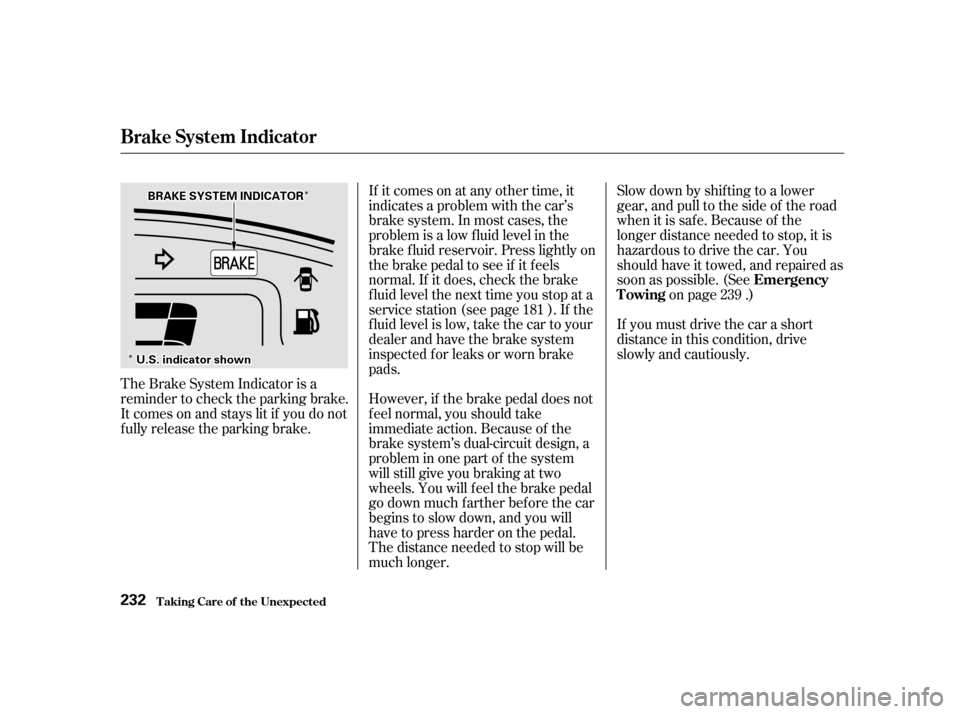
The Brake System Indicator is a
reminder to check the parking brake.
It comes on and stays lit if you do not
f ully release the parking brake. 181
239
Emergency
Towing
Brake System Indicator
T aking Care of t he Unexpect ed
232
BBRRAAKKEESSYYSSTTEEMMIINNDDIICCAATTOORR
UU..SS..iinnddiiccaattoorrsshhoowwnn