Page 190 of 269

�µ�µ �µ�µ
The belts should have the f ollowing
‘‘play’’ or def lection.
With Air Conditioning System
Without Air Conditioning System
If you see signs of wear or looseness,
have your dealer adjust or replace
the belts.
Check the tension of each belt by
pushingonitwithyourthumb
midway between the pulleys.
Check the condition of the drive belt.
Examine the edges of each belt for
cracks or fraying.
The dust and pollen f ilter removes
pollen and dust f rom the outside air
the heating and cooling system
brings into the interior. It should be
replaced according to the time and
distance recommendations in the
maintenance schedule.
This f ilter should be replaced every
30,000 miles (48,000 km) under
normal conditions. It should be
replaced every 15,000 miles (24,000
km) if you drive primarily in urban
areas that have high concentrations
of soot in the air f rom industry and
diesel-powered vehicles. Replace it
more of ten if air f low f rom the
climate control system becomes less
than usual. Have the dust and pollen
f ilter replaced by your Honda dealer.
Maint enance
Drive Belt
Dust and Pollen Filter
Dust and Pollen Filter, Drive Belt
191
CCOOMMPPRREESSSSOORRBBEELLTT 0.30 0.41 in (7.5 10.5 mm)
0.33 0.43 in (8.5 11.0 mm)
Page 191 of 269

We recommend that you visually
check your tires every day. If you
think a tire might be low, check it
immediately with a tire gauge.
To saf ely operate your car, your tires
must be the proper type and size, in
good condition with adequate tread,
and correctly inf lated. The f ollowing
pages give more detailed inf ormation
on how and when to check air
pressure, how to inspect your tires
for damage and wear, and what to do
when your tires need to be replaced.
Keeping the tires properly inf lated
provides the best combination of
handling, tread lif e and riding
comf ort. Underinf lated tires wear
unevenly, adversely af f ect handling
and f uel economy, and are more
likely to f ail f rom being overheated.
Overinf lated tires can make your car
ride more harshly, are more prone to
damage f rom road hazards, and wear
unevenly.
Use a gauge to measure the air
pressure at least once a month. Even
tires that are in good condition may
lose one to two psi (10 to 20 kPa, 0.1
to 0.2 kgf /cm ) per month.
Remember to check the spare tire at
thesametimeyoucheckallthe
other tires.Check the pressure in the tires when
they are cold. This means the car
has been parked f or at least three
hours. If you have to drive the car
bef ore checking the tire pressure,
the tires can still be considered
‘‘cold’’ if you drive less than 1 mile
(1.6 km).
If you check the pressure when the
tires are hot (the car has been driven
several miles), you will see readings
4 to 6 psi (30 to 40 kPa, 0.3 to 0.4
kgf /cm ) higher than the cold
reading. This is normal. Do not let
air out to match the specified cold
pressure. The tire will be
underinf lated.
Inf lation
Maint enance
Tires
192
Using tires that are excessively
worn or improperly inflated can
cause a crash in which you can
be seriously hurt or killed.
Follow all instructions in this
owner’s manual regarding tire
inflation and maintenance.
Page 193 of 269

Every time you check inf lation, you
should also examine the tires f or
damage, f oreign objects, and wear.
Youshouldlookfor:Bumps or bulges in the tread or
side of the tire. Replace the tire if
youfindeitherof theseconditions.
Cuts, splits, or cracks in the side
of the tire. Replace the tire if you
can see f abric or cord.
Excessive tread wear. In addition to proper inf lation,
correct wheel alignment helps to
decrease tire wear. If you f ind a tire
is worn unevenly, have your dealer
check the wheel alignment.
The tires were properly balanced by
the factory. They may need to be
rebalanced at some time bef ore they
are worn out. Have your dealer
check the tires if you f eel a consis-
tent vibration while driving. A tire
should always be rebalanced if it is
removed f rom the wheel f or repair.
Your car’s tires have wear indicators
molded into the tread. When the
tread wears down to that point, you
will see a 1/2 inch (12.7 mm) wide
band running across the tread. This
shows there is less than 1/16 inch
(1.6 mm) of tread lef t on the tire. A
tire that is this worn gives very little
traction on wet roads. You should
replace the tire if you can see the
tread wear indicator in three or more
places around the tire. Make sure the installer balances the
wheels when you have new tires
installed. This increases riding
comf ort and tire lif e. Your car’s
original tires were dynamic or ‘‘spin’’
balanced at the f actory. For best
results, have the installer perf orm a
dynamic balance.
Inspection
Maintenance
Maint enance
Tires
194
TTRREEAADDWWEEAARRIINNDDIICCAATTOORRSS
IINNDDIICCAATTOORRLLOOCCAATTIIOONNMMAARRKKSS
Page 195 of 269

�´
It is best to replace all f our tires at
thesametime.If thatisnotpossible
or necessary, then replace the two
f ront tires or the two rear tires as a
pair. Replacing just one tire can
seriously af f ect your car’s handling.
If you ever need to replace a wheel,
make sure the wheel’s specif ications
match those of the original wheel
that came on your car. Replacement
wheels are available at your Honda
dealer. Wheels:
Tires:
See page f or inf ormation about
DOT Tire Quality Grading.
Tires that are marked ‘‘M S’’ or
‘‘All Season’’ on the sidewall have an
all-weather tread design. They
should be suitable f or most winter
driving conditions. Tires without
these markings are designed f or
optimum traction in dry conditions.
They may not provide adequate
perf ormance in winter driving.
For the best perf ormance in snowy
or icy conditions, you should install
snow tires or tire chains. They may
be required by local laws under
certain conditions.
236
Tires
Maint enance Wheels and Tires Winter Driving
196 14x51/2JJ
P165/65R14 78S
Installing improper tires on your
car can affect handling and
stability. This can cause a crash
in which you can be seriously
hurt or killed.
Always use the size and type of
tires recommended in this
owner’s manual.
Page 208 of 269

As you dry the car, inspect it f or
chips and scratches that could allow
corrosion to start. Repair them with
touch-up paint (see page ).When you have washed and rinsed
the whole exterior, dry it with a
chamois or sof t towel. Letting it
air-dry will cause dulling and water
spots.
Check the body f or road tar, tree
sap, etc. Remove these stains with
tar remover or turpentine. Rinse it
of f immediately so it does not
harm the f inish. Remember to re-
wax these areas, even if the rest of
the car does not need waxing.
Wash the car using the water and
detergent solution and a sof t-
bristle brush, sponge, or sof t cloth.
Start at the top and work your way
down. Rinse f requently.
Fill a bucket with cool water. Mix
in a mild detergent, such as
dishwashing liquid or a product
made especially f or car washing.
Rinse the car thoroughly with cool
water to remove loose dirt.
Only use the solvents and cleaners
recommendedinthisOwner’s
Manual.
Wash your car in a shady area, not in
direct sunlight. If the car is parked in
the sun, move it into the shade and
let the exterior cool down bef ore you
start.
Frequent washing helps preserve
your car’s beauty. Dirt and grit can
scratch the paint, while tree sap and
bird droppings can permanently ruin
the f inish.
210
Washing
Exterior Care
Appearance Care
209
Chemical solvents and strong cleaners
can damage the paint, metal, and
plastic on your car.
Although almost all exterior panels on
your Honda are made of hardened
aluminum, they may dent more easily
than steel under some conditions.
Exercise care when leaning on or over
any part of the body.
Page 231 of 269
�Î�Î
�Î�ÎIf you must drive the car a short
distance in this condition, drive
slowly and cautiously.
Slow down by shif ting to a lower
gear, and pull to the side of the road
when it is saf e. Because of the
longer distance needed to stop, it is
hazardous to drive the car. You
should have it towed, and repaired as
soon as possible. (See
on page .)
However, if the brake pedal does not
f eel normal, you should take
immediate action. Because of the
brake system’s dual-circuit design, a
problem in one part of the system
will still give you braking at two
wheels. You will f eel the brake pedal
go down much f arther bef ore the car
begins to slow down, and you will
have to press harder on the pedal.
The distance needed to stop will be
much longer.
If it comes on at any other time, it
indicates a problem with the car’s
brake system. In most cases, the
problem is a low f luid level in the
brake f luid reservoir. Press lightly on
the brake pedal to see if it f eels
normal. If it does, check the brake
f luid level the next time you stop at a
service station (see page ). If the
fluid level is low, take the car to your
dealer and have the brake system
inspected f or leaks or worn brake
pads.
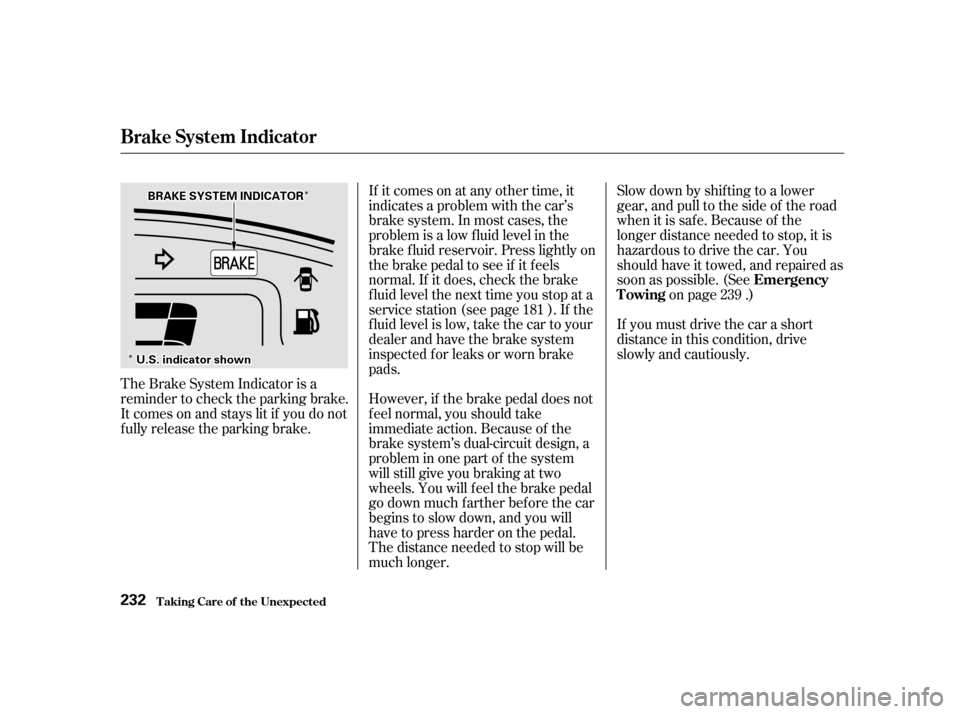
The Brake System Indicator is a
reminder to check the parking brake.
It comes on and stays lit if you do not
f ully release the parking brake. 181
239
Emergency
Towing
Brake System Indicator
T aking Care of t he Unexpect ed
232
BBRRAAKKEESSYYSSTTEEMMIINNDDIICCAATTOORR
UU..SS..iinnddiiccaattoorrsshhoowwnn
Page 235 of 269
�Î �Î
�µ �µ �µ
�Î
No. Amps. Circuits Protected Circuits Protected
No. Amps.
1 23456789
10 10 A
15 A
20 A
7.5 A
7.5 A
7.5 A 15 A
20 A
7.5 A 20 A SRS
Fuel Pump, SRS
Front Wiper
FI-ECU
Turn Light
Meter
IG Coil
Power Window, Passenger
Starter Signal
Power Window, Driver ACC Radio
ACC Socket
Not used
Not used
Small Light
Air Conditioning, R/C
Mirror
Daytime Running Light
Back Up Light
Interior Light
Radio
Daytime Running Light
Door Lock
Tailgate Lock
IMA
Not used
Rear Wiper
Back Light
111213141516 17 18192021222324252627
7.5 A
10 A
10 A
7.5 A
7.5 A
7.5 A
7.5 A 10 A
10 A
20 A
7.5 A
7.5 A
10 A
7.5 A
: Canadian model only
Fuses
T aking Care of t he Unexpect ed
236
INTERIOR FUSE BOX
Page 244 of 269
�µ�µ�µ
�µ �µ�µ�µ�µ�µ�µ�µ�µ�µ �µ �µ
�Î �Î
Specif ications
T echnical Inf ormation
245
Air Conditioning
Alignment
Tires
Lights Battery
Fuses HFC-134a (R-134a)
17.6 19.4 oz (500 550 g) SP-10
12 V 60/55 W (HB2) 0.00 in (0.0 mm)
0.12 in (3.0 mm)
0°1°
2°
P165/65R14 78S
T115/70D14 88M
Refrigerant type
Charge quantity
Lubricant type
Toe-in
CamberCaster Size
Pressure
Headlights (HI/LO)
Front turn signal
Front parking light
Side marker light
Rear turn signal lights
Stop/Taillights
Back-up lights
Trunk light
License plate lights
Interior light 12 V 21 W
12 V 5 W
12 V
12 V
21/5 W
21 W
12 V 18 W
12 V
12 V 5W5W
12 V
12 V
5W
3.4 W
12V 27Ah/5HR
Capacity
Interior
Under-hood 30 Ah/5 HR
12 V
See page 235 or the fuse label
attached to the inside of the fuse
box door under the dashboard.
See page 236 or the fuse box
cover. FrontRear
FrontRear
Front
Front/Rear
Spare
FrontRear
Spare
38 psi (260 kPa)
35 psi (240 kPa)
60 psi (420 kPa)
MTCVT
U.S. model

