Page 112 of 323
The outside air intakes f or the
heating and cooling system are at
the base of the windshield. Keep
these clear of leaves and other
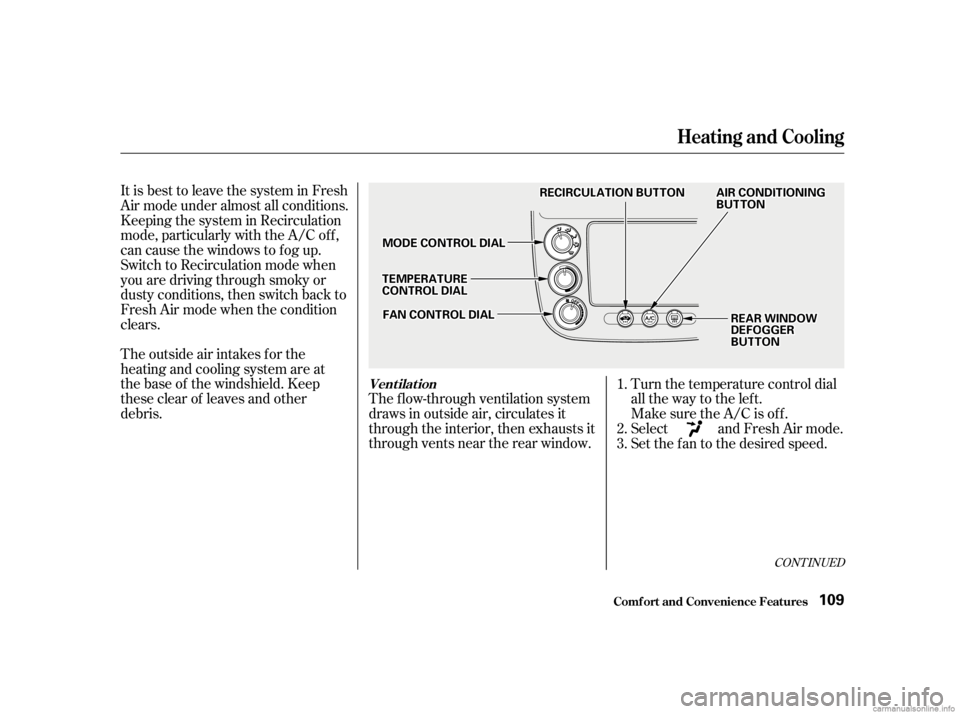
debris.The f low-through ventilation system
draws in outside air, circulates it
through the interior, then exhausts it
through vents near the rear window.
It is best to leave the system in Fresh
Air mode under almost all conditions.
Keeping the system in Recirculation
mode, particularly with the A/C of f ,
can cause the windows to fog up.
Switch to Recirculation mode when
you are driving through smoky or
dusty conditions, then switch back to
Fresh Air mode when the condition
clears.
Turn the temperature control dial
all the way to the lef t.
Make sure the A/C is of f .
Select and Fresh Air mode.
Set the f an to the desired speed.
1.
2.
3.
CONT INUED
Heating and Cooling
Comf ort and Convenience Feat ures
Vent ilat ion
109
A A
I
IRR C
COON NDDI
ITT I
IOON NIINNG G
B
BU UT TT
TO
ON N
M
M O
ODDE
E C
COON NTTR
RO OL L D
DI
IAA L
L
T
T E
EM
M P
PE
ER
RA A T
TU
UR REE
C
CO ON NTTR
RO OL L D
DI
IAA L
L
F
FA A N
N C
COON NTTR
RO OL L D
DI
IAA L
L R
RE
EC
CI IRRC CUUL LAA T
TI
IOON N B
BUUT TT
TO
ON N
R
REEA
A R
R W
WI INND DO
OW W
D
D E
EF
FOOG GGGEER
R
B
BU UT TT
TO
ON N
Page 301 of 323

�Î�ÎIn Canada, Honda vehicles comply
with the Canadian Motor Vehicle
Saf ety Standards (CMVSS) f or
Emissions valid at the time they are
manuf actured. The United States Clean Air Act
sets standards f or automobile
emissions. It also requires that
automobile manufacturers explain to
owners how their emissions controls
workandwhattodotomaintain
them. This section summarizes how
the emissions controls work.
Scheduled maintenance is on page .
The burning of gasoline in your car’s
engine produces several byproducts.
Some of these are carbon monoxide
(CO), oxides of nitrogen (NOx) and
hydrocarbons (HC). Gasoline
evaporating from the tank also
produces hydrocarbons. Controlling
the production of NOx, CO, and HC
is important to the environment.
Under certain conditions of sunlight
and climate, NOx and HC react to
f orm photochemical ‘‘smog.’’ Carbon
monoxide does not contribute to
smog creation, but it is a poisonous
gas.
Your car has a Positive Crankcase
Ventilation System. This keeps
gasses that build up in the engine’s
crankcase from going into the
atmosphere. The Positive Crankcase
Ventilation valve routes them fromthe crankcase back to the intake
manif old. They are then drawn into
the engine and burned.
As gasoline evaporates in the f uel
tank, an evaporative emissions
control canister f illed with charcoal
adsorbs the vapor. It is stored in this
canister while the engine is of f . Af ter
the engine is started and warmed up,
the vapor is drawn into the engine
and burned during driving.
The Onboard Ref ueling Vapor
Recovery (ORVR) system captures
the f uel vapors during ref ueling. The
vapors are adsorbed in a canister
f illed with activated carbon. While
driving, the f uel vapors are drawn
into the engine and burned of f .
194
The Clean Air Act
Crankcase Emissions Control
System Evaporative Emissions Control
System
Onboard Ref ueling Vapor
Recovery
T echnical Inf ormation
Emissions Cont rols
298
Page 302 of 323

The three way catalytic converter is
in the exhaust system. Through
chemical reactions, it converts HC,
CO, and NOx in the engine’s exhaust
to carbon dioxide (CO ), dinitrogen
(N ), and water vapor. This system constantly adjusts the
ignition timing, reducing the amount
of HC, CO and NOx produced.
The exhaust emissions controls
include three systems: PGM-FI,
Ignition Timing Control and Three
Way Catalytic Converter. These
three systems work together to
control the engine’s combustion and
minimize the amount of HC, CO, and
NOx that comes out the tailpipe. The
exhaust emissions control systems
are separate from the crankcase and
evaporative emissions control
systems.
The PGM-FI System uses sequential
multiport f uel injection.
It has three subsystems: Air Intake,
Engine Control, and Fuel Control.
The Engine Control Module (ECM)
or the Powertrain Control Module
(PCM) uses various sensors to
determine how much air is going
into the engine. It then controls how
much f uel to inject under all operat-
ing conditions.
The emissions control systems are
covered by warranties separate from
the rest of your car. Read your
warranty manual for more inf orma-
tion. The emissions control systems are
designed and certif ied to work to-
gether in reducing emissions to
levels that comply with the Clean Air
Act. To make sure the emissions
remain low, you should use only new
Genuine Honda replacement parts or
their equivalent f or repairs. Using
lower quality parts may increase the
emissions f rom your car.
2
2
Replacement Parts
Exhaust Emissions ControlsPGM-FI Syst em
Three Way Catalytic Converter
Ignit ion T iming Cont rol Syst em
Emissions Cont rols
T echnical Inf ormation299