Page 93 of 319
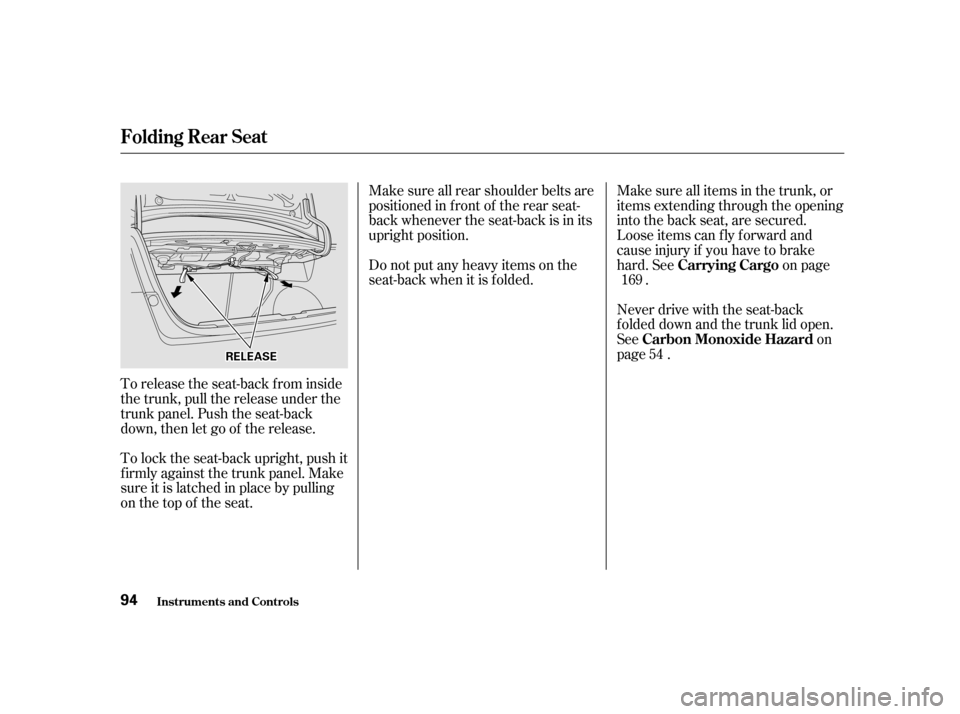
To release the seat-back from inside
the trunk, pull the release under the
trunk panel. Push the seat-back
down, then let go of the release.
To lock the seat-back upright, push it
f irmly against the trunk panel. Make
sure it is latched in place by pulling
on the top of the seat.Make sure all rear shoulder belts are
positioned in f ront of the rear seat-
back whenever the seat-back is in its
upright position.
Do not put any heavy items on the
seat-back when it is folded.
Make sure all items in the trunk, or
items extending through the opening
into the back seat, are secured.
Looseitemscanflyforwardand
cause injury if you have to brake
hard. See on page
.
Never drive with the seat-back
f olded down and the trunk lid open.
See on
page . 169
54
Folding Rear Seat
Inst rument s and Cont rols Carrying Cargo
Carbon Monoxide Hazard
94
RREELLEEAASSEE
Page 162 of 319
If you can open the hood without
lifting the hood latch handle, or the
hood latch handle moves stif f ly or
does not spring back as bef ore, the
mechanism should be cleaned and
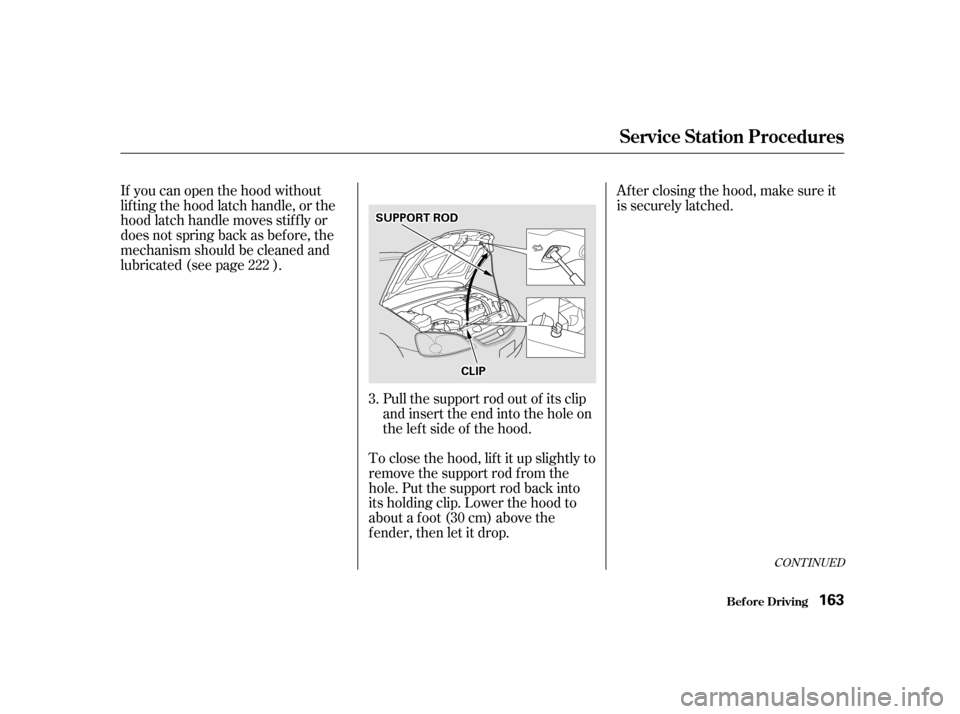
lubricated (see page ).Pull the support rod out of its clip
and insert the end into the hole on
theleftsideof thehood.Afterclosingthehood,makesureit
is securely latched.
To close the hood, lif t it up slightly to
remove the support rod f rom the
hole. Put the support rod back into
its holding clip. Lower the hood to
about a f oot (30 cm) above the
fender,thenletitdrop.
3.
222
CONT INUED
Service Station Procedures
Bef ore Driving
163
SSUUPPPPOORRTTRROODD
CCLLIIPP
Page 169 of 319

Store or secure all items that could
be thrown around and hurt
someone during a crash.
Besureitemsplacedonthefloor
behind the f ront seats cannot roll
under the seats and interf ere with
the driver’s ability to operate the
pedals, or with the proper
operation of the seats.
Keep the glove box closed while
driving. If the lid is open, a
passenger could injure their knees
during a crash or sudden stop.
This f igure includes the total weight
of all occupants, cargo, and
accessories.
To f igure out how much cargo you
can carry:
Add up the weight of all occupants.
The f inal number is the total weight
of cargo you can carry.
The maximum load for your car is
850 lbs (395 kg).
Subtract the total f rom 850 lbs
(395 kg). Do not put any items on top of the
trunk panel. They can block your
viewandbethrownaroundthecar
during a crash.
Carrying Items in the Passenger
Compartment
Load Limit
Carrying Cargo
Bef ore Driving
170 Overloading or improper
loading can affect handling and
stability and cause a crash in
which you can be hurt or killed.
Follow all load limits and other
loading guidelines in thismanual.
Page 173 of 319

Make sure all windows, mirrors,
and outside lights are clean and
unobstructed. Remove f rost, snow,
or ice.
Check that the hood and trunk are
f ully closed.Make sure the doors are securely
closed and locked.
Check that any items you may be
carrying with you inside are stored
properly or f astened down
securely.
Visually check the tires. If a tire
looks low, use a gauge to check its
pressure. Check the adjustment of the seat
(see page ).
Check the adjustment of the
inside and outside mirrors (see
page ).
Check the adjustment of the
steering wheel (see page ).Turn the ignition switch ON (II).
Check the indicator lights in the
instrument panel.
Start the engine (see page ).
Check the gauges and indicator
lights in the instrument panel (see
page ).
Fasten your seat belt. Check that
your passengers have f astened
their seat belts (see page ).
Youshoulddothefollowingchecks
and adjustments every day bef ore
you drive your car. 1. 2. 3. 4.
9.
10.
8.
7.
6.
5.
11.
12.
98 90
75 16
175
59
Preparing to Drive
Driving
174
Page 204 of 319
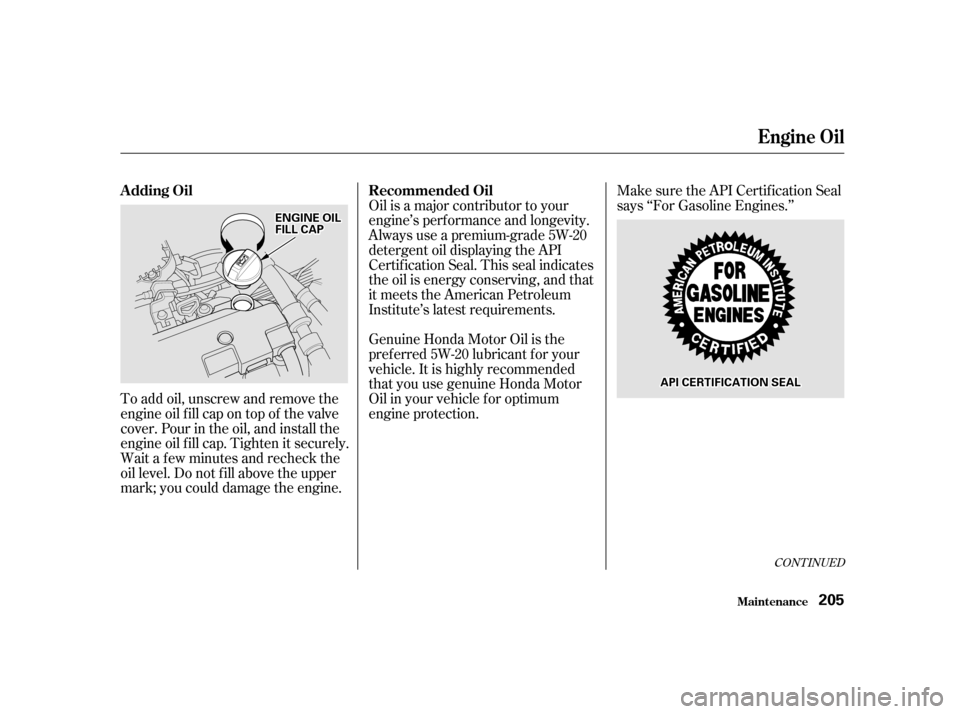
To add oil, unscrew and remove the
engine oil f ill cap on top of the valve
cover. Pour in the oil, and install the
engine oil f ill cap. Tighten it securely.
Wait a f ew minutes and recheck the
oil level. Do not f ill above the upper
mark; you could damage the engine.Oil is a major contributor to your
engine’s perf ormance and longevity.
Always use a premium-grade 5W-20
detergent oil displaying the API
Certif ication Seal. This seal indicates
the oil is energy conserving, and that
it meets the American Petroleum
Institute’s latest requirements.
Make sure the API Certif ication Seal
says ‘‘For Gasoline Engines.’’
Genuine Honda Motor Oil is the
pref erred 5W-20 lubricant f or your
vehicle. It is highly recommended
that you use genuine Honda Motor
Oil in your vehicle f or optimum
engine protection.
CONT INUED
Recommended Oil
A dding Oil
Engine Oil
Maint enance 205
EENNGGIINNEEOOIILLFFIILLLLCCAAPP
AAPPIICCEERRTTIIFFIICCAATTIIOONNSSEEAALL
Page 211 of 319
�µ
�´ �´ �µ
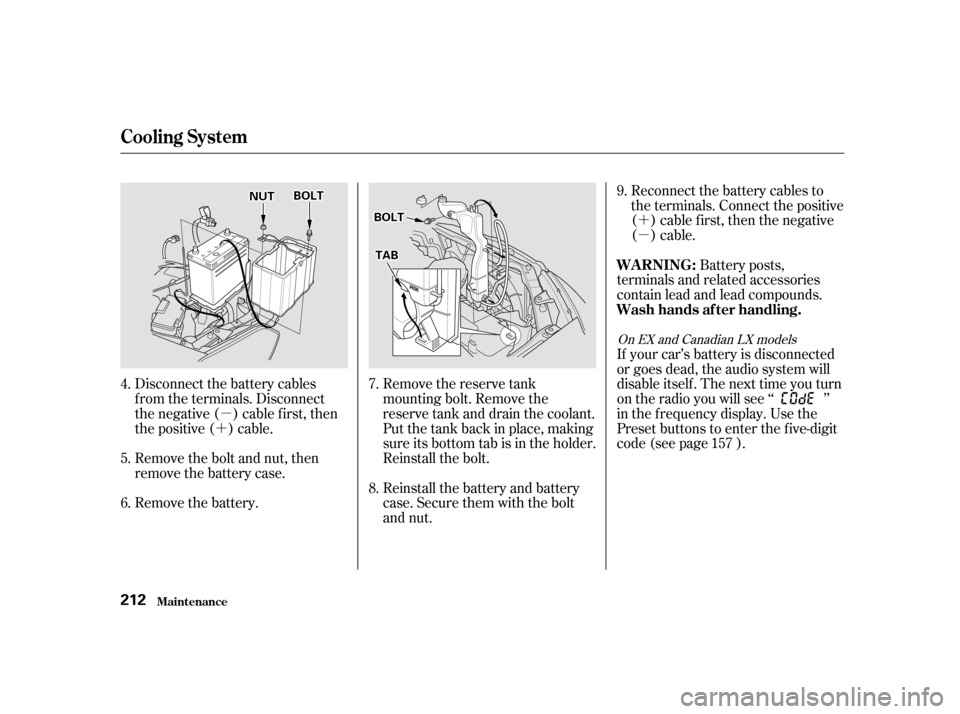
Disconnect the battery cables
f rom the terminals. Disconnect
the negative ( ) cable first, then
the positive ( ) cable.
Remove the bolt and nut, then
remove the battery case. Remove the reserve tank
mounting bolt. Remove the
reserve tank and drain the coolant.
Put the tank back in place, making
sure its bottom tab is in the holder.
Reinstall the bolt.
Reinstall the battery and battery
case. Secure them with the bolt
and nut.Reconnect the battery cables to
the terminals. Connect the positive
( ) cable f irst, then the negative
()cable.
Battery posts,
terminals and related accessories
contain lead and lead compounds.
Remove the battery. If your car’s battery is disconnected
or goes dead, the audio system will
disableitself.Thenexttimeyouturn
on the radio you will see ‘‘ ’’
in the f requency display. Use the
Preset buttons to enter the five-digit
code (see page ).
4. 6. 7.
5. 8.9.
157
On EX and Canadian LX models
Cooling Syst em
Maint enance WARNING:
Wash hands af ter handling.
212
NNUUTTBBOOLLTT
BBOOLLTT
TTAABB
Page 212 of 319
Tightening torque:
When the coolant stops draining,
tightenthedrainpluginthe
bottom of the radiator. Apply non-
hardening sealant to the drain bolt
threads, put a new washer on the
drain bolt, and reinstall the drain
bolt in the engine block. Tighten it
securely.
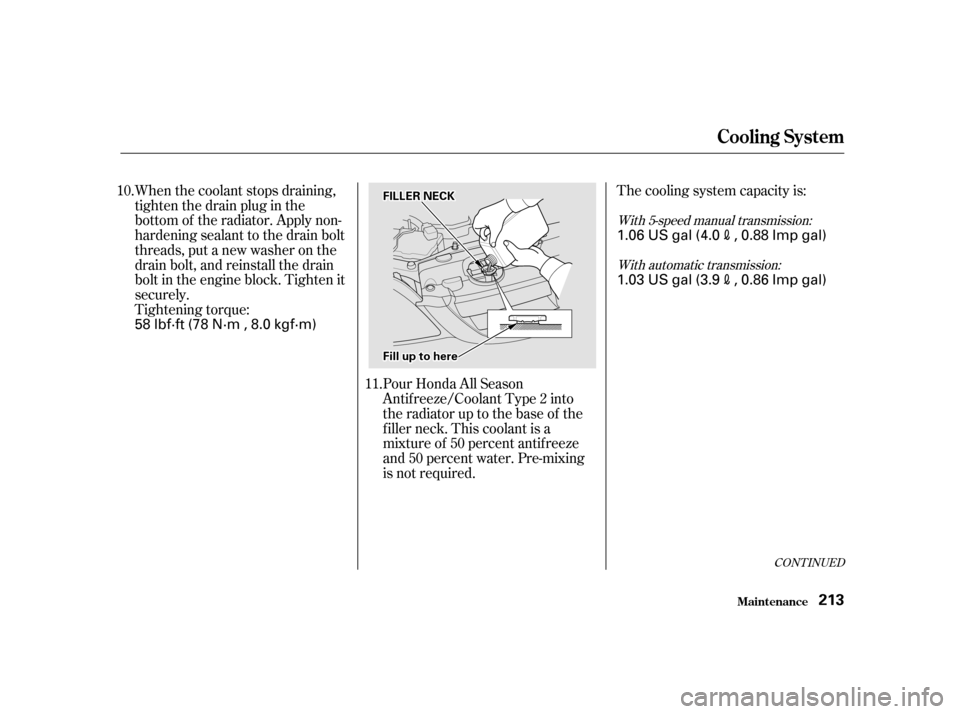
Pour Honda All Season
Antif reeze/Coolant Type 2 into
the radiator up to the base of the
f iller neck. This coolant is a
mixture of 50 percent antif reeze
and 50 percent water. Pre-mixing
is not required.The cooling system capacity is:
10.
11.
CONT INUED
With 5-speed manual transmission:With automatic transmission:
Cooling Syst em
Maint enance 213
FFIILLLLEERRNNEECCKK
FFiilllluuppttoohheerree
58 lbf·ft (78 N·m , 8.0 kgf·m) 1.06 US gal (4.0
, 0.88 Imp gal)
1.03 US gal (3.9
, 0.86 Imp gal)
Page 215 of 319
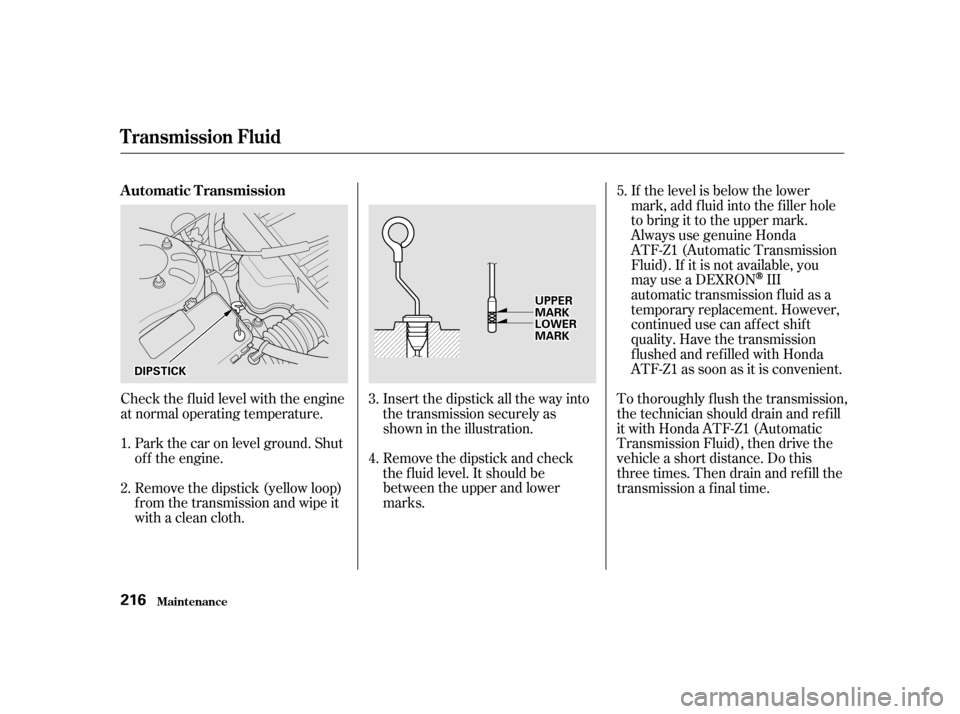
Insert the dipstick all the way into
the transmission securely as
shown in the illustration.
Remove the dipstick and check
the f luid level. It should be
between the upper and lower
marks.
Check the f luid level with the engine
at normal operating temperature.
Remove the dipstick (yellow loop)
f rom the transmission and wipe it
with a clean cloth.
Park the car on level ground. Shut
of f the engine. If the level is below the lower
mark, add f luid into the f iller hole
to bring it to the upper mark.
Always use genuine Honda
ATF-Z1 (Automatic Transmission
Fluid). If it is not available, you
may use a DEXRON
III
automatic transmission fluid as a
temporary replacement. However,
continued use can af f ect shif t
quality. Have the transmission
f lushed and ref illed with Honda
ATF-Z1 as soon as it is convenient.
To thoroughly f lush the transmission,
the technician should drain and ref ill
it with Honda ATF-Z1 (Automatic
Transmission Fluid), then drive the
vehicle a short distance. Do this
three times. Then drain and ref ill the
transmission a f inal time.
3. 4. 5.
1. 2.
Automatic Transmission
T ransmission Fluid
Maint enance
216
DDIIPPSSTTIICCKK
UUPPPPEERRMMAARRKKLLOOWWEERRMMAARRKK