Page 191 of 325

�µMake sure the moonroof and the
windows are closed.
Make sure the parking brake is f ully
released bef ore driving away.
Driving with the parking brake
partially set can overheat or damage
the rear brakes. Turn of f the lights.
Place any packages, valuables, etc.,
in the trunk or take them with you.
Lockthedoorswiththekeyorthe
remote transmitter.
Never park over dry leaves, tall
grass, or other f lammable
materials. The three way catalytic
converter gets very hot, and could
cause these materials to catch on
fire.
Always use the parking brake when
you park your car. The indicator on
the instrument panel shows that the
parking brake is not f ully released; it
does not indicate that the parking
brakeisfirmlyset.Makesurethe
parking brake is set f irmly or your
car may roll if it is parked on an
incline.
If your car has an automatic
transmission, set the parking brake
bef ore you put the transmission in
Park.Thiskeepsthecarfrom
moving and putting pressure on the
parking mechanism in the
transmission making it easier to
move the shift lever out of Park
when you want to drive away. If the car is f acing uphill, turn the
f ront wheels away f rom the curb. If
you have a manual transmission, put
it in f irst gear.
If the car is f acing downhill, turn the
f ront wheels toward the curb. If you
have a manual transmission, put it in
reverse gear.
Parking T ips
Driving
Parking
188
Page 193 of 325
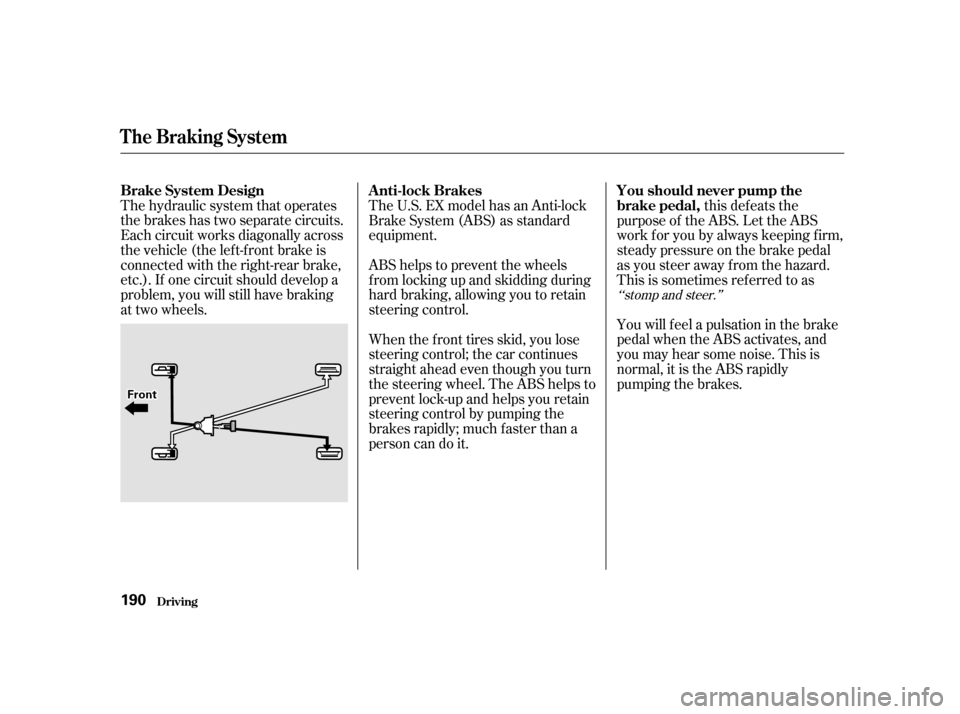
The hydraulic system that operates
the brakes has two separate circuits.
Each circuit works diagonally across
the vehicle (the lef t-f ront brake is
connected with the right-rear brake,
etc.). If one circuit should develop a
problem, you will still have braking
at two wheels.this defeats the
purpose of the ABS. Let the ABS
work f or you by always keeping f irm,
steady pressure on the brake pedal
as you steer away from the hazard.
This is sometimes ref erred to as
You will f eel a pulsation in the brake
pedal when the ABS activates, and
you may hear some noise. This is
normal, it is the ABS rapidly
pumping the brakes.
The U.S. EX model has an Anti-lock
Brake System (ABS) as standard
equipment.
ABS helps to prevent the wheels
f rom locking up and skidding during
hard braking, allowing you to retain
steering control.
When the f ront tires skid, you lose
steering control; the car continues
straightaheadeventhoughyouturn
the steering wheel. The ABS helps to
prevent lock-up and helps you retain
steering control by pumping the
brakes rapidly; much f aster than a
person can do it.
‘‘stomp and steer.’’
Brake System Design
A nti-lock BrakesYou should never pump the
brake pedal,
The Braking System
Driving190
F Fr roo n
nt
t
Page 194 of 325

on loose or
uneven surfaces, such as gravel or
snow, than a vehicle without anti-
lock. Slow down and allow a greater
distance between vehicles under
those conditions.
it
only helps with steering control
during braking. You should always
maintain a saf e f ollowing distance
f rom other vehicles.
such as trying to take a
corner too f ast or making a sudden
lane change. Always drive at a safe,
prudent speed f or the road and
weather conditions.
Always steer moderately
when you are braking hard. Severe
or sharp steering wheel movement
can still cause your car to veer into
oncoming traffic or off the road.
Activation varies with the amount of
traction your tires have. On dry
pavement, you will need to press on
thebrakepedalveryhardbeforeyou
activate the ABS. However, you may
feel the ABS activate immediately if
you are trying to stop on snow or ice.
CONT INUED
A vehicle with A BS may require a
longer distance to stop
A BS does not reduce the time or
distance it takes to stop the car,
A BS will not prevent a skid that
results f rom changing direction
abruptly,
A BS cannot prevent a loss of
stability.Import ant Saf et y Reminders
The Braking System
Driving191
Page 195 of 325
�Î
�Î�Î
�Î
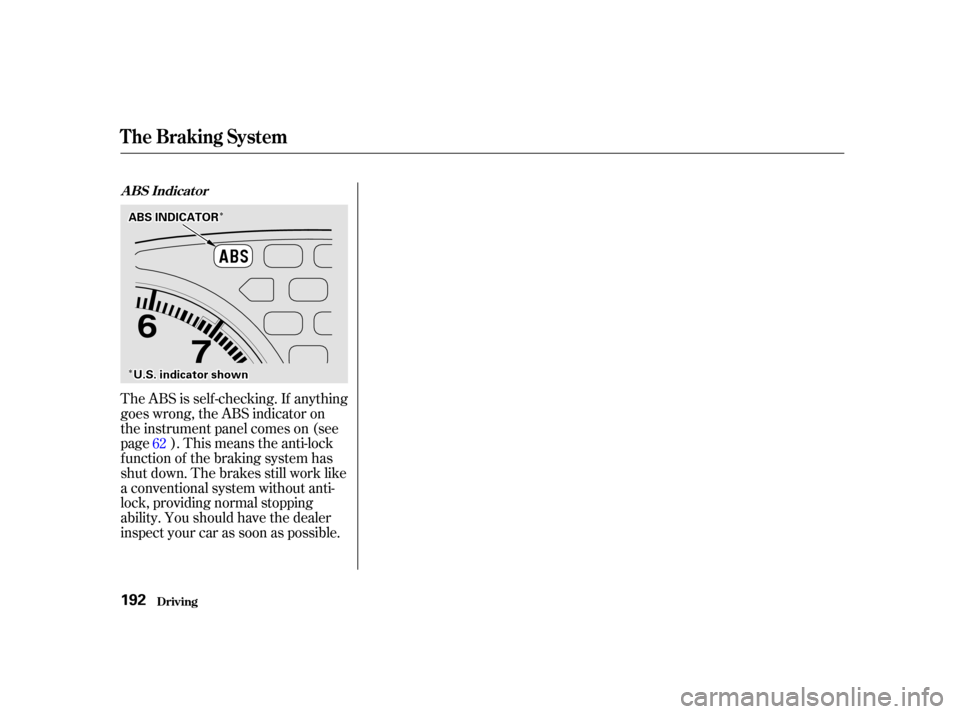
The ABS is self -checking. If anything
goes wrong, the ABS indicator on
the instrument panel comes on (see
page ). This means the anti-lock
f unction of the braking system has
shut down. The brakes still work like
a conventional system without anti-
lock, providing normal stopping
ability. You should have the dealer
inspect your car as soon as possible.
62
A BS Indicat or
The Braking System
Driving192
U U.
.SS. .i
inn d
di
icca at too r
r s
shh o
ow
wn n
A
A
B
BSS I
INND DI
ICCA A T
TO
OR R
Page 197 of 325
�µCheck your tires
f requently f or wear and proper
pressure. Both are important in
preventing ‘‘hydroplaning’’ (loss of
traction on a wet surface). In the
winter, mount snow tires on all f our
wheels f or the best handling.
Watch road conditions caref ully,
they can change f rom moment to
moment. Wet leaves can be as slip-
pery as ice. ‘‘Clear’’ roads can have
patches of ice. Driving conditions
can be very hazardous when the
outside temperature is near f reezing.
The road surf ace can become
covered with areas of water puddles
mixed with areas of ice, so your
traction can change without warning.
Be caref ul when downshif ting. If
traction is low, you can lock up the
drive wheels f or a moment and cause
askid. Be very cautious when passing, or
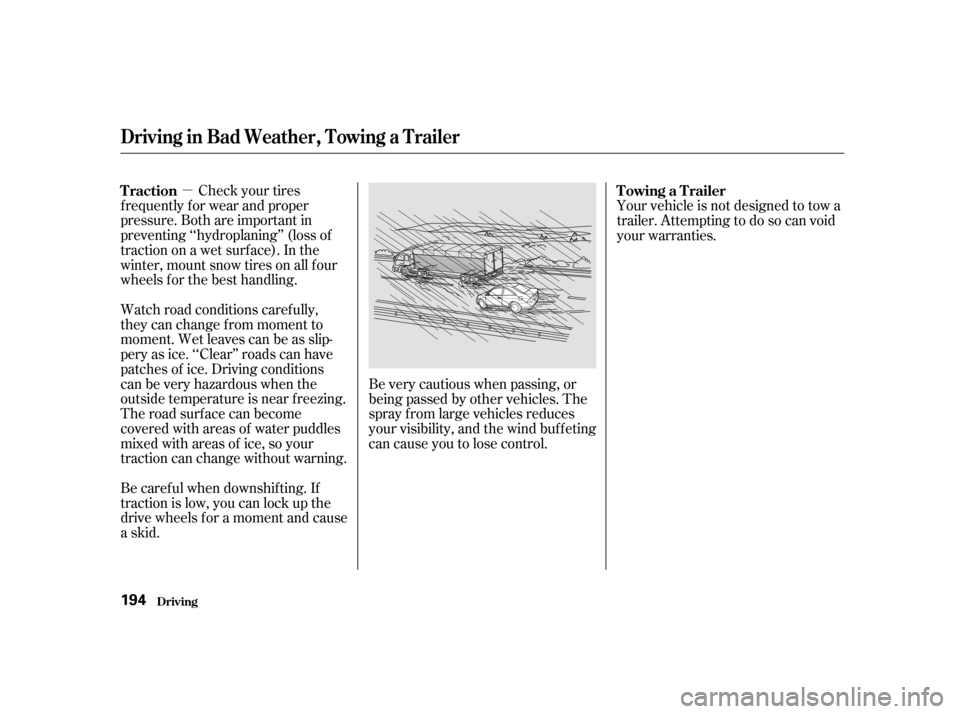
beingpassedbyothervehicles.The
spray f rom large vehicles reduces
your visibility, and the wind buf f eting
can cause you to lose control.Your vehicle is not designed to tow a
trailer. Attempting to do so can void
your warranties. Towing a Trailer
Traction
Driving in Bad Weather, Towing a Trailer
Driving194
Page 205 of 325

�µ
�Î
�Î
�Î
�Ì
�Ì�Ì�Î
�Ì�Î �Î
Maint enance202
Service at the indicated distance or time whichever comes first.
miles x 1,000
km x 1,000
months Replace every 5,000 miles (8,000 km) or 6 months
At 120,000 miles (192,000 km) or 120 months,
then every 60,000 miles (96,000 km) or 60 months Every 110,000 miles (176,000 km) or 84 months
Inspect every 110,000 miles (176,000 km), otherwise adjust only if noisy Every 110,000 miles (176,000 km)
Every 15,000 miles (24,000 km) in dusty conditions,
otherwise use normal schedule
Service the following items at the recommended intervals
Replace engine oil
Rotate tires (Check tire inflation and condition at least once per month)
Replace engine oil filter
Inspect front and rear brakes
Lubricate all door hinges, locks and latches, include the hood
Visually inspect the following items:Tie rod ends, steering gear box and boots, Suspension components
Driveshaft boots
Check engine oil and coolant
Visually inspect the following items: Brake hoses and lines (including ABS)
All fluid levels and condition of fluidsExhaust system, Fuel lines and connections
Lights and controls, Vehicle underbody
Check parking brake adjustment
Inspect and adjust drive belts
Replace air conditioning filter
Replace transmission fluid
Replace air cleaner element
Replace spark plugs
Inspect valve clearance Replace timing belt , and inspect water pump
Inspect idle speed
Replace engine coolant
Replace brake fluid 20
32
10
16 30
4840
6450
80 70
112 80
128 90
144 100
160110
176120
192
60
96
Check oil and coolant at each fuel stop
See information on maintenance and emissions warranty, last column, page . Refer to page for replacement information under special driving conditions.
Refer to page for replacement information under special driving conditions.
Replace at 60,000 miles (96,000 km) or 36 months, then every 40,000 miles (64,000 km) or 24 months Every 36 months (independent of mileage)24
4872
12 3660
MT
AT
CVT
1:
2:
3: : 235
237
199
1
2 3
Maintenance Schedule for Severe Conditions
Page 206 of 325

�µ�µ
�Ø
�Ø
�Ø
�Ø
�Ø
�Ø
�Ø
�Ø
�Ø
�Ø
�Ø
�Ø
�Ø
�Ø
�Ø
�Ø
�Ø
�Ø
�Ø
�Ø
�Ø
�Ì
�Ì
�Î
CONT INUED
Maint enance203
U.S. Owners
Canadian Owners A
B
C
D
E
F
Service at the indicated distance or time, whichever comes first.
Refer to page to determine which schedule to use.Use the Maintenance Schedule for Severe Conditions.
Replace engine oil.
Inspect front and rear brakes.
Rotate tires (follow pattern on page241).
Lubricate all hinges, locks, and latches include the
hood.
Inspect tie rod ends, steering gear box and boots.
Inspect suspension components.
Inspect driveshaft boots.
Replace air cleaner element.
Check parking brake adjustment.
Inspect brake hoses and lines (including ABS).
Check all fluid levels, condition of fluids, and check
for leaks. Inspect exhaust system.
Inspect fuel lines and connections.
Check all lights.
Inspect the underbody.
Inspect and adjust drive belts.
Replace air conditioning filter .
Replace brake fluid every 3 years independent of
milage.
Do items in A.
Do items in A, B.
DoitemsinA,C,F.
DoitemsinA,B,D.
Do items in A.
DoitemsinA,B,C,E.
Do items in A.
DoitemsinA,B,D.
DoitemsinA,B,D,E.
DoitemsinA,C,F.
Do items in A, B.
Do items in A.
Replace transmission fluid (CVT).
Replace transmission fluid (MT, AT).
DoitemsinA,B,C,D,E,F.
Do items in A.
Do items in A, B.
Do items in A, C.
DoitemsinA,B,D.
Do items in A. Replace transmission fluid (AT).
DoitemsinA,B,C,E,F.
5,000 mil/8,000 km/6 mos
10,000 mil/16,000 km
15,000 mil/24,000 km
20,000 mil/32,000 km/1 yr
25,000 mil/40,000 km/1½ yrs
30,000 mil/48,000 km
35,000 mil/56,000 km
40,000 mil/64,000 km
2yrs
45,000 mil/72,000 km/2½ yrs
50,000 mil/80,000 km
55,000 mil/88,000 km
At 60,000 mil/96,000 km
or 36 months,
thereafter every 40,000 mil/
64,000 km or 24 months
60,000 mil/96,000 km/3 yrs
65,000 mil/104,000 km/3½ yrs
70,000 mil/112,000 km
75,000 mil/120,000 km
80,000 mil/128,000 km/4 yrs
85,000 mil/136,000 km/4½ yrs
90,000 mil/144,000 km 198
1
Maintenance Schedule for Severe Conditions (listed by distance/time)
Page 217 of 325
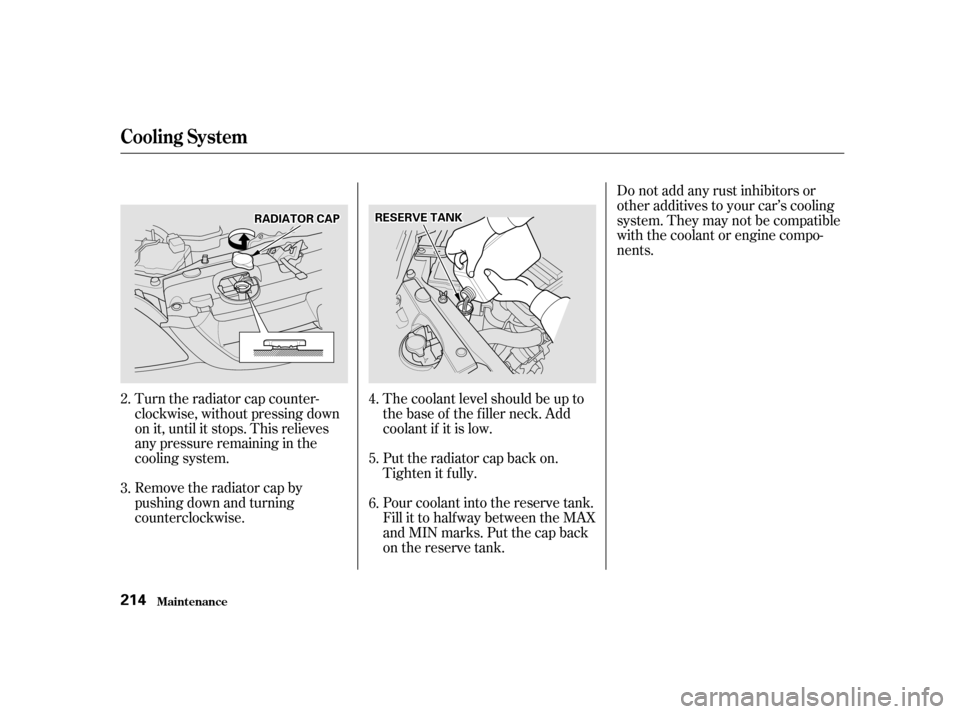
Remove the radiator cap by
pushing down and turning
counterclockwise. Turn the radiator cap counter-
clockwise, without pressing down
on it, until it stops. This relieves
any pressure remaining in the
cooling system.Pour coolant into the reserve tank.
Fill it to half way between the MAX
and MIN marks. Put the cap back
on the reserve tank. Put the radiator cap back on.
Tighten it f ully. The coolant level should be up to
the base of the f iller neck. Add
coolant if it is low.Do not add any rust inhibitors or
other additives to your car’s cooling
system. They may not be compatible
with the coolant or engine compo-
nents.
2.
3. 4.
5.
6.
Cooling Syst em
Maint enance214
R RA
A D
DI
IAA T
TO
OR R C
CAA P
P R
RE
ES
SE ER
RV V E
E T
TA
A N
NK K